Introduction
A commercial aquaponics system is not a tank with plants added to it. It is an operating system in which fish, plants, bacteria, water treatment equipment and day-to-day management must work together. That distinction matters when a farm owner, greenhouse developer, school or food-service project asks for a quotation. A low unit price can look attractive while leaving out filtration, aeration, backup planning, commissioning support or the site work needed to make the equipment usable.
This guide is written for B2B buyers who need to turn an early idea into a comparable supplier brief. It does not promise a universal production figure or return on investment: those depend on climate, crops, fish species, energy price, labour, market access and local regulations. Instead, it explains the decisions that should be made before an RFQ and the questions that make a commercial quotation more reliable.
Aquaponics combines recirculating aquaculture with plant production. In practice, the system is managed as an ecosystem of fish, plants and microorganisms, not as two independent pieces of equipment. FAO describes this operating balance clearly. That is why a good purchasing process begins with production and operating requirements—not a catalogue tank size.
Start With the Business Case, Not the Equipment List
Define the production model
Write down what the project must produce and who will buy it. A commercial leafy-green operation has a different design basis from a training greenhouse, a restaurant demonstration system or a mixed-crop community project. Start with these inputs:
- Target crops, planting rhythm and desired harvest calendar.
- Fish species, juvenile supply, harvest method and local aquaculture rules.
- Available footprint, greenhouse dimensions and future expansion area.
- Climate range, water source, electricity reliability and drainage.
- Operator capability: one experienced technician, a farm team, or students under supervision.
- Sales channel, food-safety requirements and budget range.
This is also where buyers should decide whether the project is commercial production, education and research, demonstration, or a phased pilot. A pilot can be designed to teach the team and validate demand; it should not be presented as proof that a much larger production facility will have the same economics.
Use a design brief instead of asking for “a price”
An RFQ that only says “please quote a 5-ton aquaponics system” creates unhelpful comparisons. Water volume alone does not define crop area, filtration duty, temperature control, packing capacity or commissioning scope. Ask every supplier to respond to the same project brief and to state assumptions. This is the simplest way to compare scope rather than headlines.
Mid-article CTA — Get a Project Specification Review
Send YAFAN your site dimensions, target crops, fish species, country and preferred start date. We can return a preliminary equipment scope and a list of information needed before quoting. Contact our project team for a specification review.
Understand the Core Process Equipment
Fish tanks and hydraulic layout
Tanks need more than a stated volume. Buyers should ask about material, food-contact suitability where relevant, drain geometry, access for harvesting and cleaning, pipe connections, overflow paths and safe isolation for maintenance. The hydraulic layout should show where water moves during normal operation and what happens if a pump stops or a line is blocked.
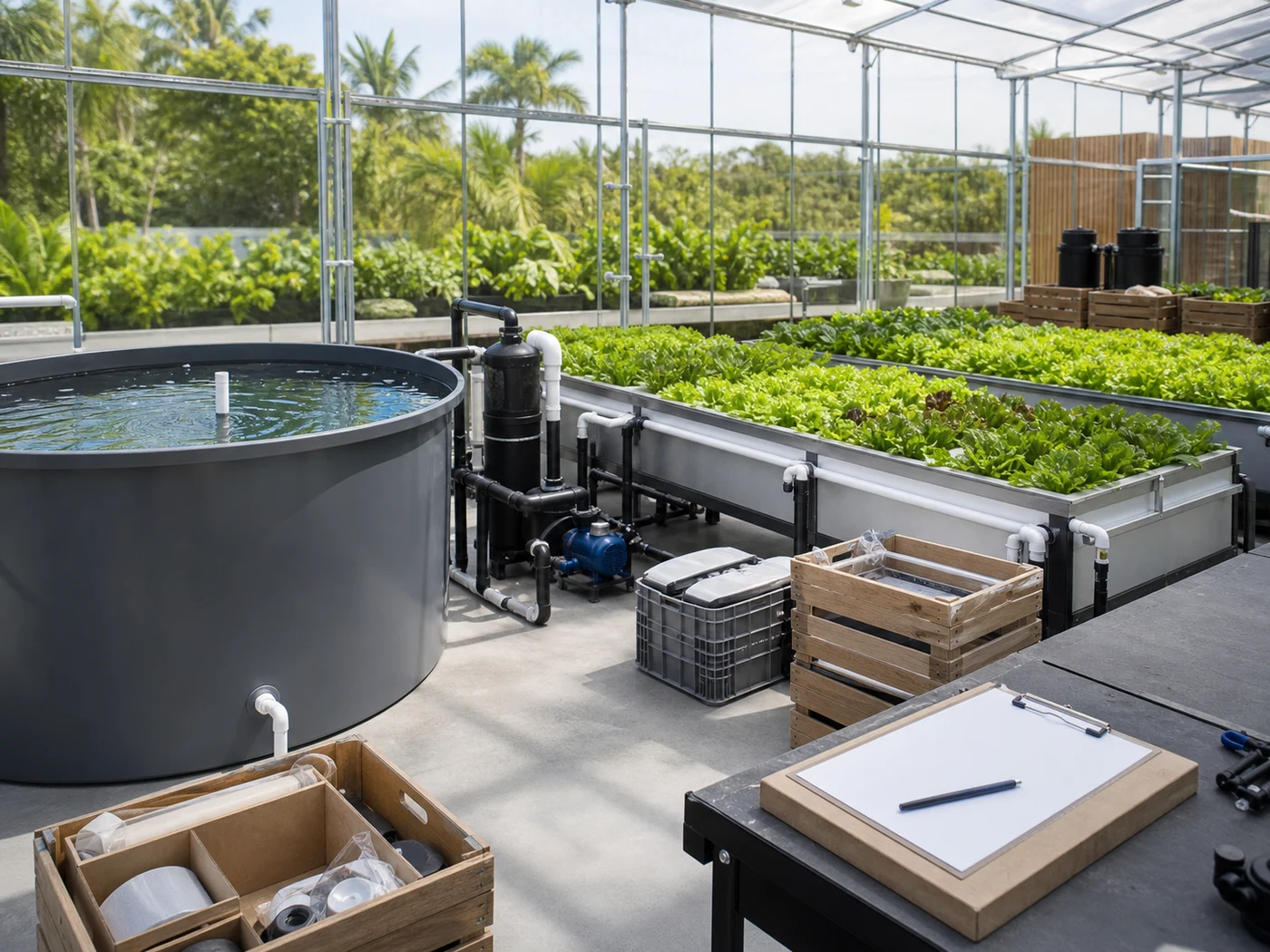
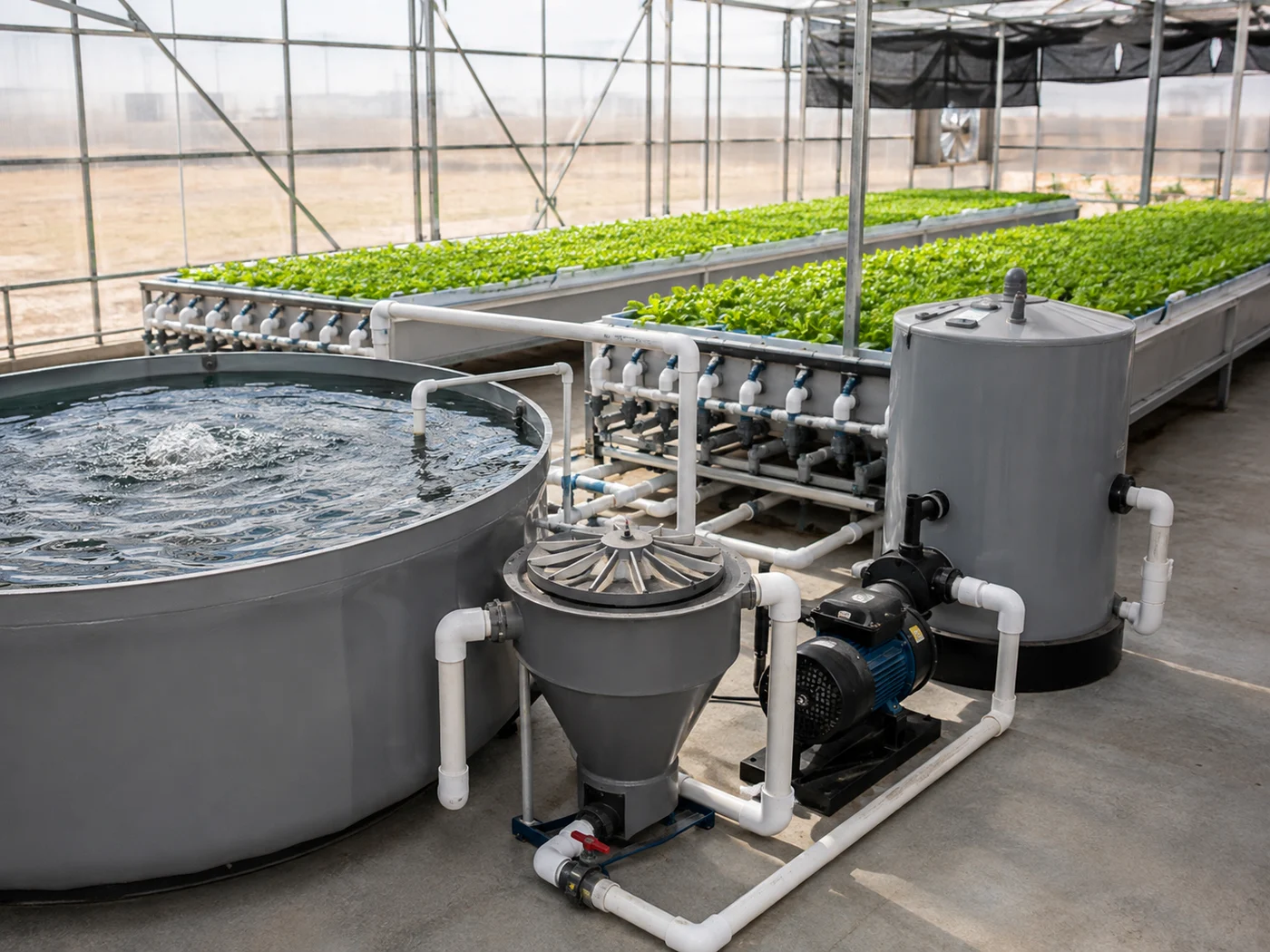
For commercial projects, request a process flow diagram. It should identify fish tanks, solids removal, biofiltration, sump, pumps, aeration, grow zones, make-up water, drains and emergency overflow. A diagram does not replace detailed engineering, but it reveals whether the supplier has considered the full water loop.
Solids removal and biofiltration
Fish waste contains solids and dissolved nutrients. Solids management protects downstream pumps, channels and plant roots; biofiltration provides surface area for nitrifying bacteria that convert ammonia through the nitrogen cycle. The choice may include settling or radial-flow equipment, screens, mineralization or sludge handling, moving-bed media, fixed media and separate biofilters. The appropriate combination depends on feed rate, fish biomass, grow method and operating practice.
Do not accept “filter included” as a complete specification. Ask for the expected duty, media type or capacity, cleaning routine, access points, valves and what is excluded. University extension guidance likewise emphasizes monitoring ammonia, nitrite, nitrate, pH, temperature and dissolved oxygen; system sizing and water quality management are linked rather than separate decisions. See Oklahoma State University’s maintenance guidance.
Aeration, circulation and backup
Oxygen and circulation are operationally critical. A commercial quotation should identify pump quantity, duty point, head assumptions, air blower or pump capacity, distribution manifolds, isolation valves and spare-parts strategy. It should also distinguish standard operating equipment from resilience measures such as standby pumps, alarm points, backup power interface or emergency aeration.
The right redundancy level is a project decision. It should reflect stock value, local grid reliability, response time and the operator’s monitoring plan. A supplier should be able to explain the consequence of a single component failure instead of simply adding a premium option without context.
Grow system selection: media beds, DWC, NFT or a hybrid
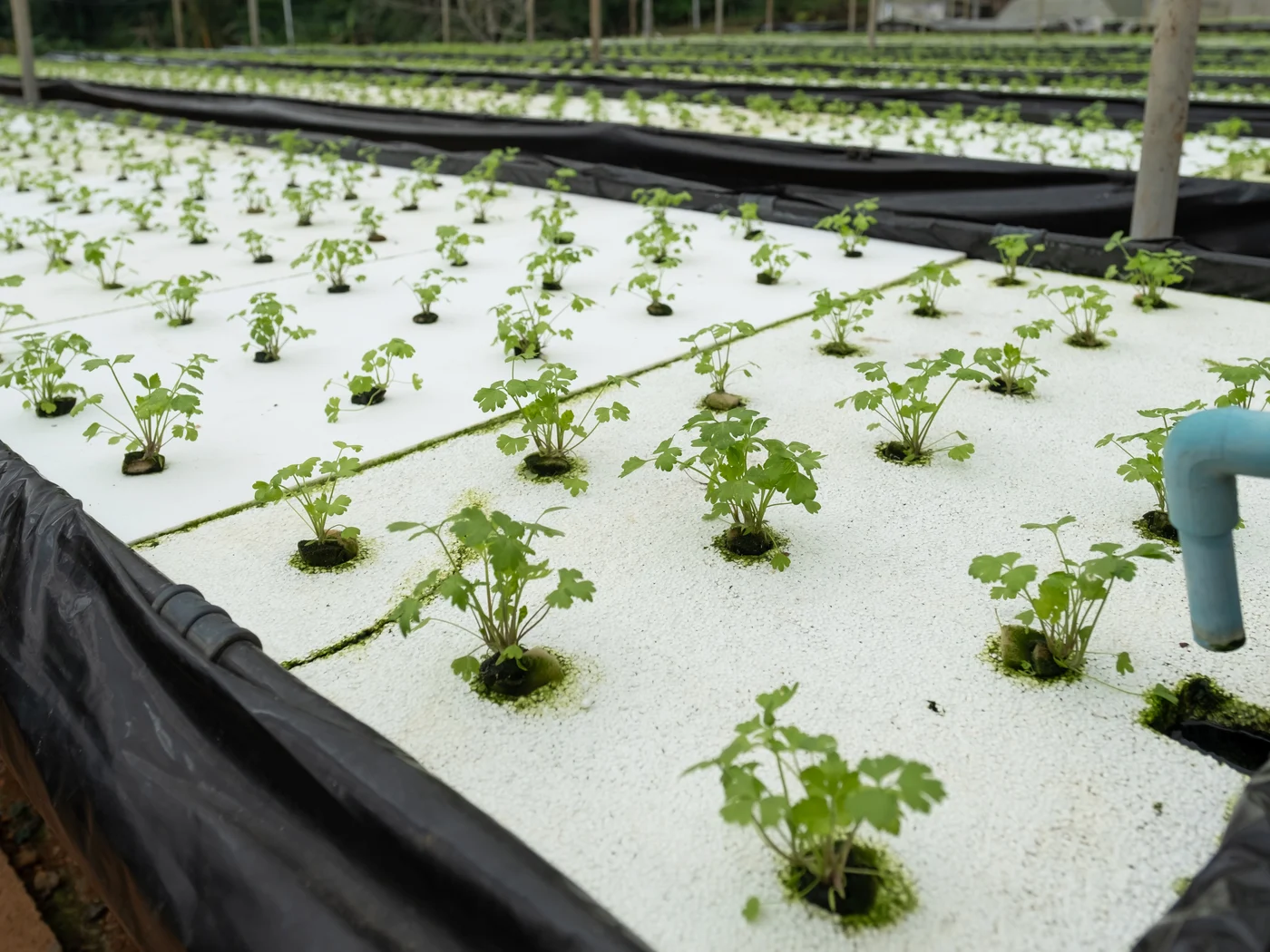
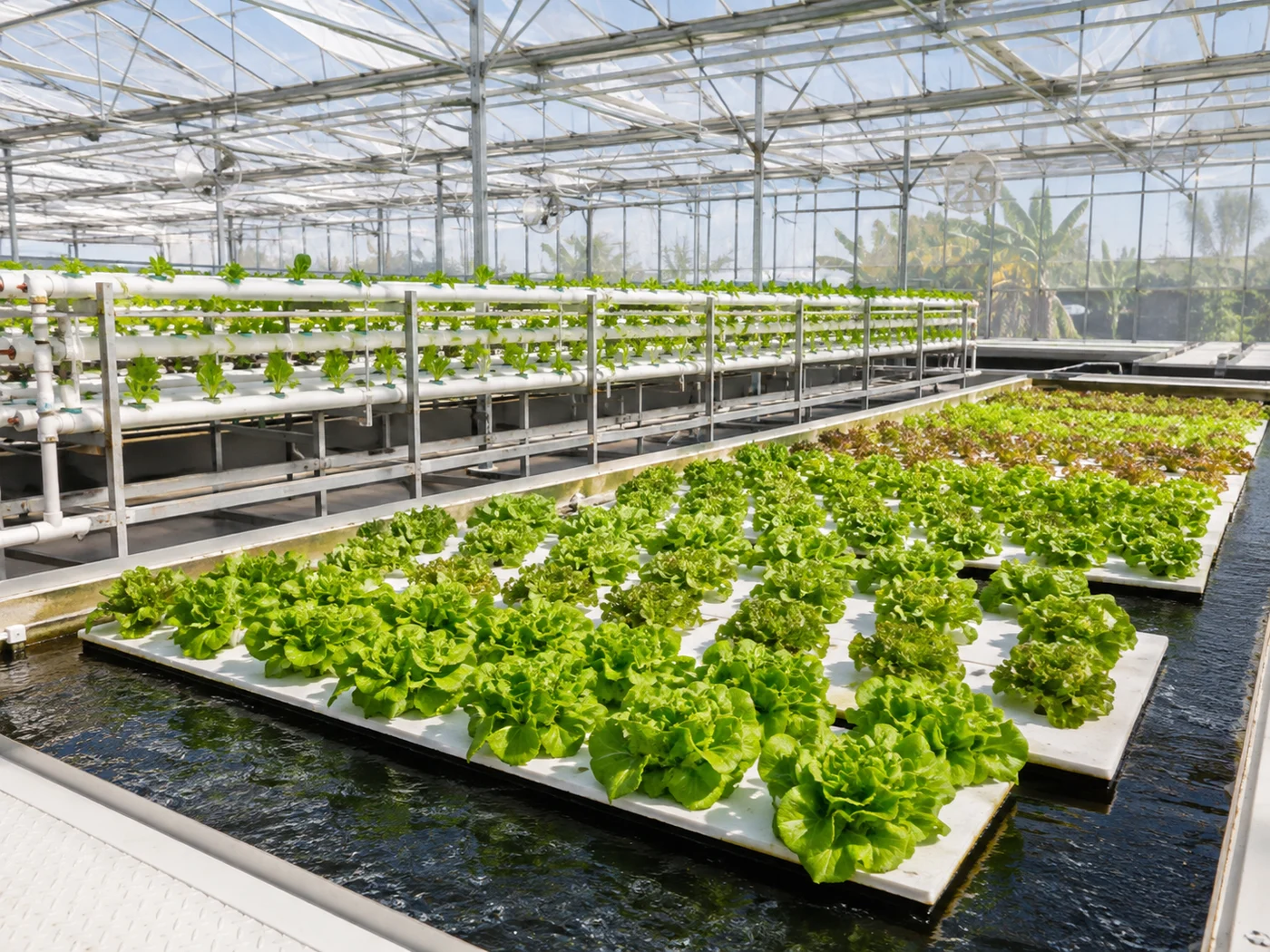
There is no single “best” grow method. Media beds are often valued for versatility and educational visibility. Deep-water culture (DWC) suits many leafy-green workflows when hydraulic and solids management are well controlled. Nutrient film technique (NFT) can be useful for some crops but needs careful pretreatment and cleaning because fine solids and roots can restrict channels. Commercial growers may combine methods when crop mix and operating capability justify it.
Ask the supplier to explain the proposed method against your crop plan, not just show a familiar layout. If fruiting crops are planned, clarify support structures, micronutrient management and the additional operational attention required. Avoid claims that fish feed alone will automatically satisfy every crop nutrient demand in every season.
Specify the Site Interface Before Factory Production
Utilities and civil works
Many equipment delays occur because a project has not defined what belongs to the site and what belongs to the equipment supplier. Before production, document:
- Incoming power voltage, phase, frequency and available load.
- Water quality, pressure, storage and treatment needs.
- Floor levelness, structural capacity, drainage routes and sump position.
- Greenhouse ventilation, heating, cooling, shading and lighting boundaries.
- Door widths, unloading access, forklift availability and internal transport route.
- Local permits, food-safety process and waste-water handling responsibility.
The U.S. EPA’s aquaponics business-plan guide lists the familiar core loop—fish tank, solids settling, biofilter, hydroponic growing area and recirculation—and notes that commercial operations are commonly built in controlled environments or suitable outdoor climates. Its planning guide is useful background. The specific site design must still be checked locally by the buyer and relevant professionals.
Installation preparation is a deliverable
An export supplier should provide more than cartons and a packing list. Before shipment, request a foundation or layout drawing, connection schedule, packing list, installation sequence, tool list and a named question-and-answer process. For a complex project, agree on whether remote commissioning, site supervision or local installer coordination is included.
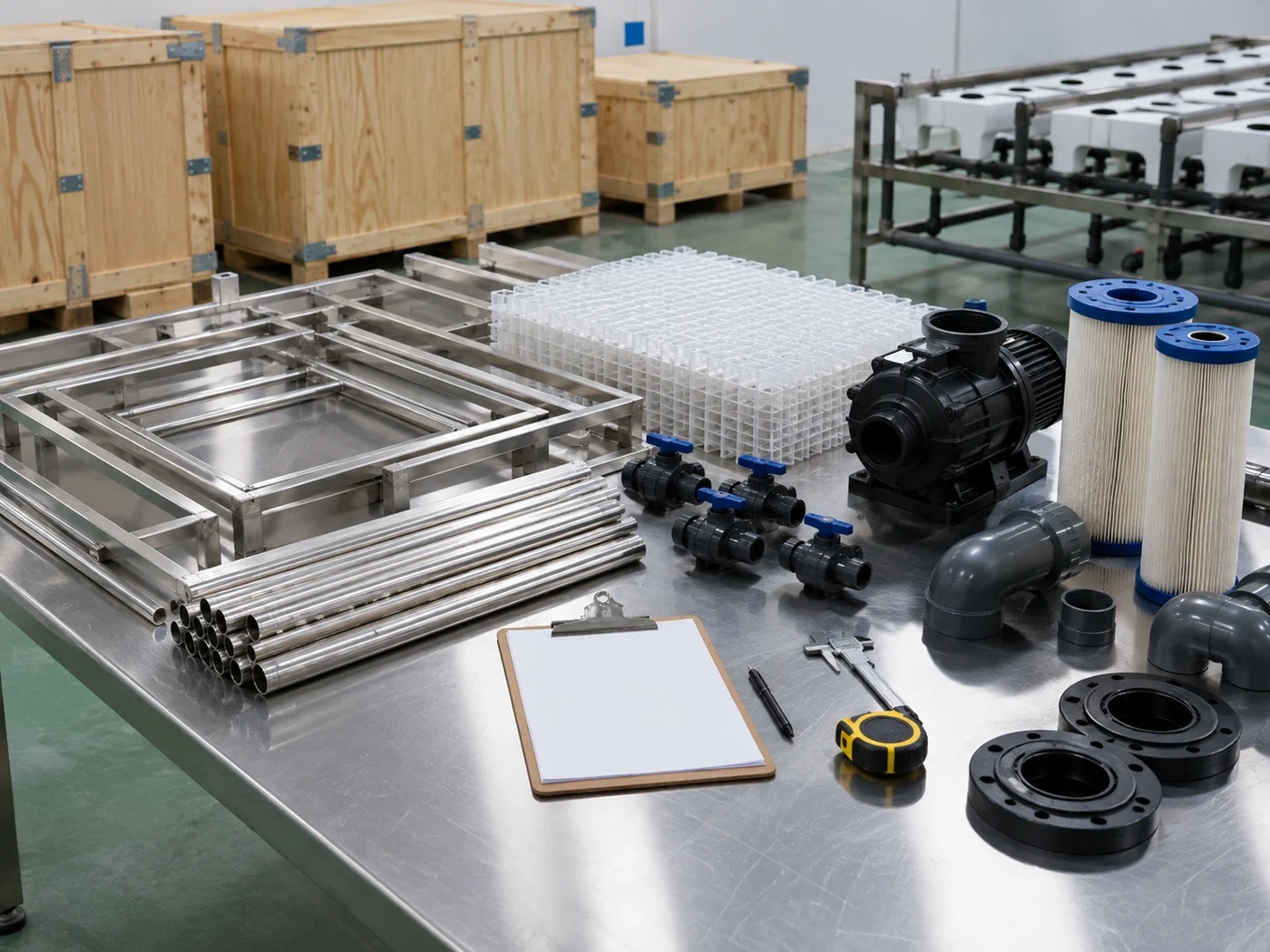
This is where a practical factory workflow builds trust. Factory testing can confirm that assembled components fit, valves operate and electrical panels are labelled before disassembly. Shipment inspection can verify counted packages, visible condition, labels and documents before containers close. These steps reduce avoidable omissions, but they do not replace final on-site leak testing, electrical checks and operator training.
How to Compare Suppliers Fairly
Ask for scope clarity
Compare quotations line by line. At minimum, separate equipment, controls, piping, consumables, greenhouse structure, shipping, insurance, installation, commissioning, training, spare parts and exclusions. A credible supplier should list specifications, quantities, materials, lead time, warranty conditions and payment milestones.
Review evidence, not only marketing images
Useful proof can include photos or video of actual factory assembly, equipment labels, test records, drawings, packing inspections, manuals and reference projects that the supplier is authorized to disclose. Ask what a photograph shows, when it was taken and whether the configuration is comparable to your project. Be wary of generic claims such as “maintenance-free,” guaranteed yield or a fixed ROI without operating assumptions.
Build a pre-shipment acceptance checklist
Before final payment or container loading, agree what will be checked. A practical checklist may cover tank and frame quantities, pump and aeration model numbers, control-panel labelling, pipe/fitting package count, visible damage, accessories, manuals, packing marks and export documents. Record discrepancies in writing and agree the resolution path.
Build an RFQ That Produces Comparable Answers
Many B2B inquiries become slow because the buyer and suppliers are each filling in different missing assumptions. A structured RFQ protects both sides. It lets the supplier state exactly what was designed and lets the buyer see when one quote includes a service that another quote excludes.
Project information to include
Start with commercial intent: country and delivery city, project type, desired opening date, whether a greenhouse already exists, and whether the request is for equipment only or design-and-support scope. Then list the available indoor or greenhouse area, clear height, floor type, doors, truck access and any site photos. State the crops you expect to grow, the fish species being considered, the expected operating season and whether the project will start as a pilot.
Next, add utility information: source-water report if available, incoming voltage/phase/frequency, estimated power availability, drainage approach and local climate range. If this information is not available, say so rather than guessing. A good supplier can identify it as a project assumption and recommend the next verification step.
Equipment and service questions
Ask each supplier to answer the same questions:
1. What water process is proposed, and can you provide a labelled flow diagram?
2. Which tanks, filters, pumps, aeration equipment, controls, pipes, valves and grow structures are included?
3. What material, quantity and model information is available for key equipment?
4. Which grow method and crop plan assumptions support the proposal?
5. What utility connections, greenhouse works and civil works are the buyer’s responsibility?
6. What packing, factory inspection, shipping documents and warranty terms are included?
7. What installation, remote support, commissioning and training are included or excluded?
8. Which consumables and spares should be ordered with the first shipment?
This structure is particularly useful for cross-border procurement. It gives the buyer something concrete to discuss with a freight forwarder, local electrician, greenhouse contractor and finance team. It also prevents an RFQ from turning into a collection of uncomparable PDF catalogues.
Evaluate total project readiness, not just unit price
Factory equipment price is only one part of a project. A lower-priced proposal may still be sensible, but buyers should understand its boundaries. Compare freight terms, destination handling, import duties, local construction, electrical work, water treatment, climate systems, installation labour, travel, training, operational spares and time to commissioning. Do not convert a supplier’s preliminary quotation into a fixed business-case number until these project interfaces have been checked.
For internal approval, present three columns: included equipment, buyer-provided site work, and open decisions. This simple format makes hidden risk visible and helps purchasing teams seek the right approvals before production begins.
Common Buyer Questions
How large should a commercial aquaponics system be?
Start with production targets, site constraints and operator capacity. The correct size follows from fish, plants, water treatment and utilities being balanced; it is not selected from water volume alone.
Can a system be expanded later?
Often yes, if expansion is planned early. Reserve floor area, manifolds, electrical capacity, drainage and space for added filtration. Ask the supplier which parts are expansion-ready and which must be replaced.
What operating data should be monitored?
The monitoring plan depends on design and species, but commonly covers water temperature, dissolved oxygen, pH and nitrogen compounds. Set frequency, responsible person, alarm thresholds and corrective actions before stocking fish.
Does a turnkey system include a greenhouse and installation?
Not necessarily. “Turnkey” is not a technical standard. Ask for a written inclusion and exclusion list and confirm local civil, electrical, greenhouse and commissioning responsibilities.
What should be tested before shipment?
Confirm fitted assemblies where possible, component models and quantities, electrical labelling, accessory packages, documents and packing condition. Final commissioning must still happen after installation at the destination site.
Conclusion
The best commercial aquaponics purchase is not the one with the shortest equipment list. It is the one that translates a real crop, fish, site and operating model into a clear scope that can be installed, tested and managed. Treat the early RFQ as an engineering conversation: define the production goal, request a water-process diagram, separate supplier scope from site scope, and inspect what will actually ship.
Final CTA — Request a Commercial Aquaponics Quote
YAFAN can prepare a preliminary commercial aquaponics configuration after reviewing your application, site, country, crops and estimated project timeline. Contact our team to discuss a quotation or product information.
FAQ
What information should I send to an aquaponics system supplier?
Send your location, available dimensions, target crops and fish, greenhouse status, power and water information, approximate budget, delivery destination and required timeline. Photos or a simple site plan help identify installation constraints early.
What is the difference between equipment supply and a full project package?
Equipment supply normally covers the listed manufactured components. A full project package may additionally include design coordination, greenhouse interfaces, shipping support, installation supervision, commissioning and training. Verify each item in writing.
Why are aeration and backup planning important?
Fish and biofilters depend on oxygen and circulation. The project should decide what happens during a power or equipment failure and who responds. The right solution varies by stock density, local grid conditions and monitoring arrangements.
Can YAFAN quote components only?
Yes. Buyers can request systems, selected components or consumables. Include existing tank volumes, pipe sizes, power standard and the problem to be solved so compatibility can be reviewed.