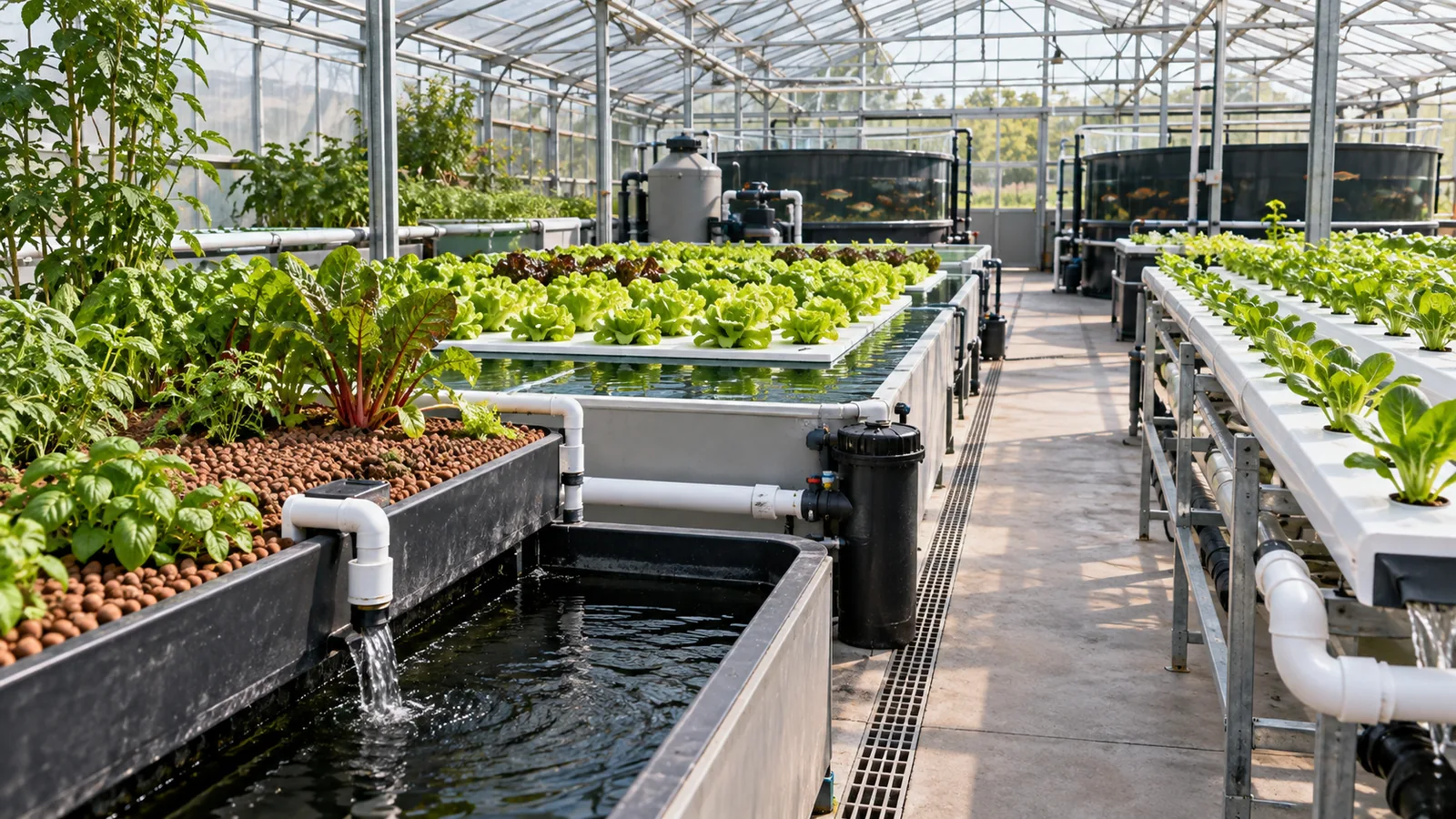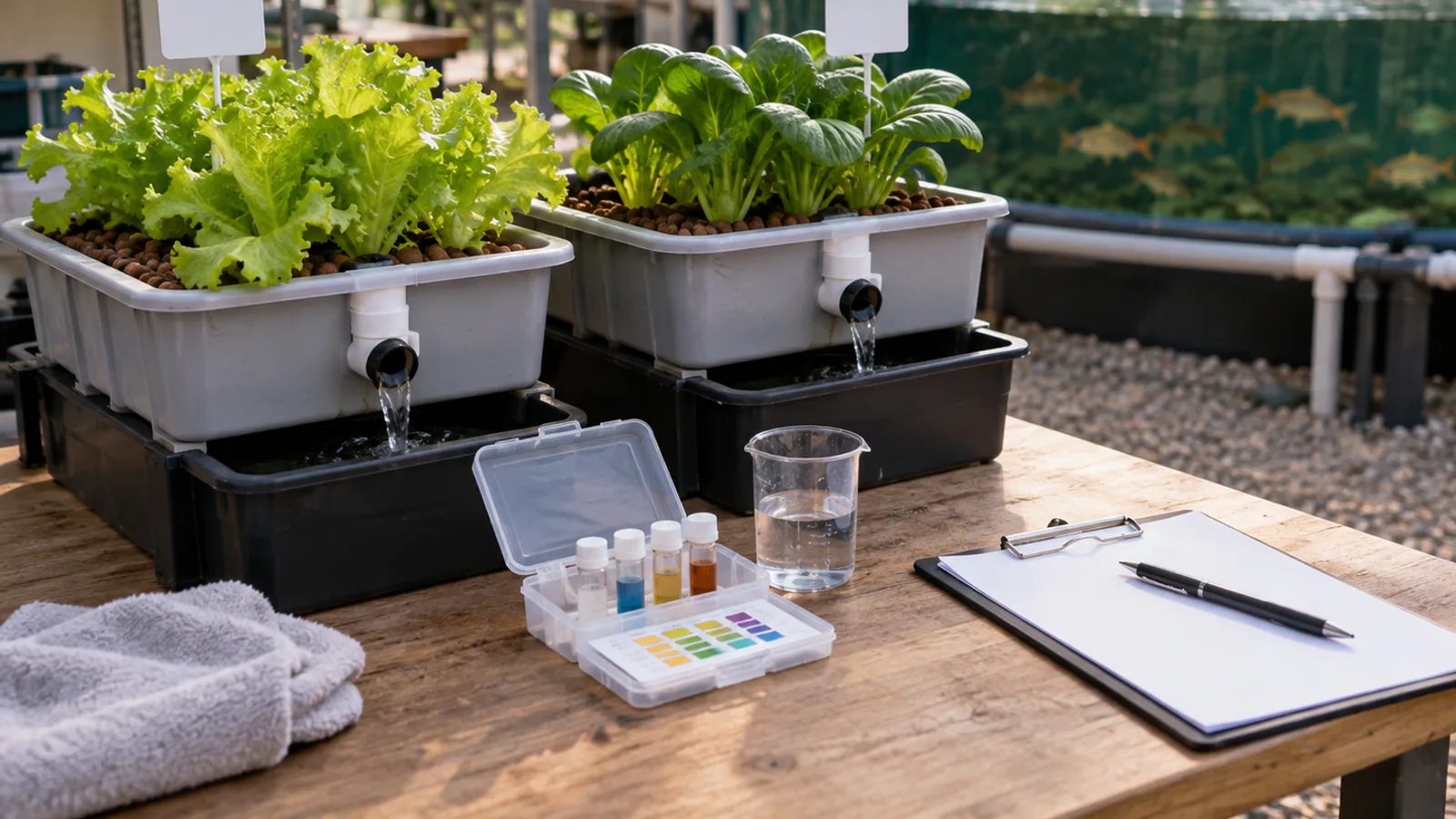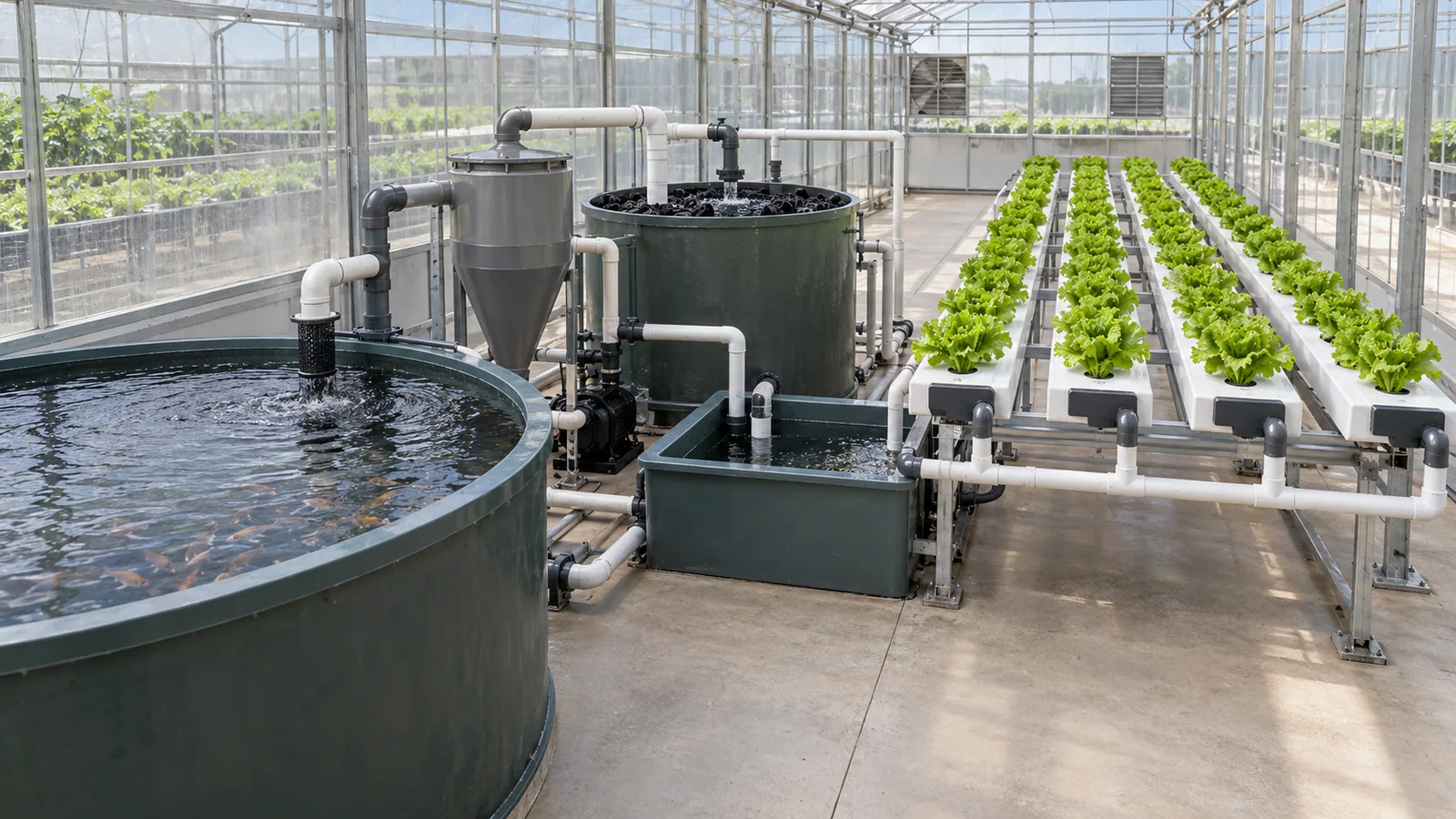
A nutrient film technique aquaponics system continuously sends a shallow stream of filtered, nutrient-containing water through slightly sloped growing channels. Plant roots touch the moving water while much of the root mass remains exposed to humid air. The water then drains by gravity to a sump or fish-side treatment loop and is recirculated by a pump.
That simple description can make NFT look like little more than a fish tank connected to rows of pipe. In practice, successful NFT aquaponics depends on several coordinated processes. Solids must be removed before water enters the channels, ammonia must be converted through biological filtration, flow must remain even across every channel, and roots must not be allowed to block the return path.
For those reasons, NFT is especially useful for leafy greens, herbs and compact crops, but it is less forgiving than a media bed when pumps stop or filtration is undersized. This guide explains the complete flow path, design priorities and purchasing questions needed to evaluate an NFT aquaponics system realistically.
The Short Answer: How NFT Aquaponics Works
A typical NFT aquaponics system follows this sequence:
1. Fish consume feed and release dissolved ammonia and solid waste.
2. Water leaves the fish tank and passes through mechanical solids removal.
3. A biofilter provides surface area for nitrifying microorganisms.
4. The biofilter converts ammonia first to nitrite and then to nitrate.
5. A pump distributes clarified water to the high end of each growing channel.
6. A shallow film flows past the lower portion of the plant roots.
7. Roots absorb water and dissolved nutrients.
8. Water drains from the lower end and returns to the sump or fish tank.
The word “film” is important. An NFT channel should not normally run full. The shallow stream keeps the lower roots wet while leaving air space around the rest of the root mass.
Virginia Cooperative Extension describes NFT as an active recirculating method in which a thin nutrient solution flows through channels and then returns by gravity to the reservoir. See its NFT system design publication.
NFT Aquaponics Versus Hydroponic NFT
The growing channels may look similar, but the water source and treatment requirements are different.
In conventional hydroponics, the grower prepares a mineral nutrient solution and adjusts its concentration directly. In aquaponics, most nitrogen enters through fish feed. Fish metabolism and organic decomposition produce ammonia, bacteria process the ammonia, and plants absorb the resulting nitrate and other available nutrients.
Aquaponic water also carries suspended solids, uneaten feed, fecal material and microbial particles. Hydroponic NFT channels therefore cannot simply be attached to a fish tank without an appropriate treatment system.
A practical NFT aquaponics installation generally requires:
- A fish tank sized for the planned fish biomass
- Mechanical solids separation
- Biological filtration
- A sump or pump chamber
- A distribution manifold
- Flow-balancing valves
- Slightly sloped growing channels
- Accessible return plumbing
- Fish-tank aeration
- Backup provisions for critical pumps or aeration
Buyers comparing NFT with other formats should first understand the different types of aquaponics systems. NFT is not automatically better than media beds or deep-water culture. It is suited to a different production model.
The Complete Water Path
1. Fish and feed create the nutrient load
Fish feed is the primary controlled nutrient input. Fish retain part of the feed for growth and release the remainder as dissolved and solid waste.
Daily feed rate, fish size, biomass, species, temperature and feed composition all affect the load placed on the treatment system. An NFT design therefore should not be sized only by counting planting holes.
A proposal that specifies channel length but does not address daily feed input, fish biomass or biofilter capacity is incomplete. Plant production, fish production and water treatment must be considered together.
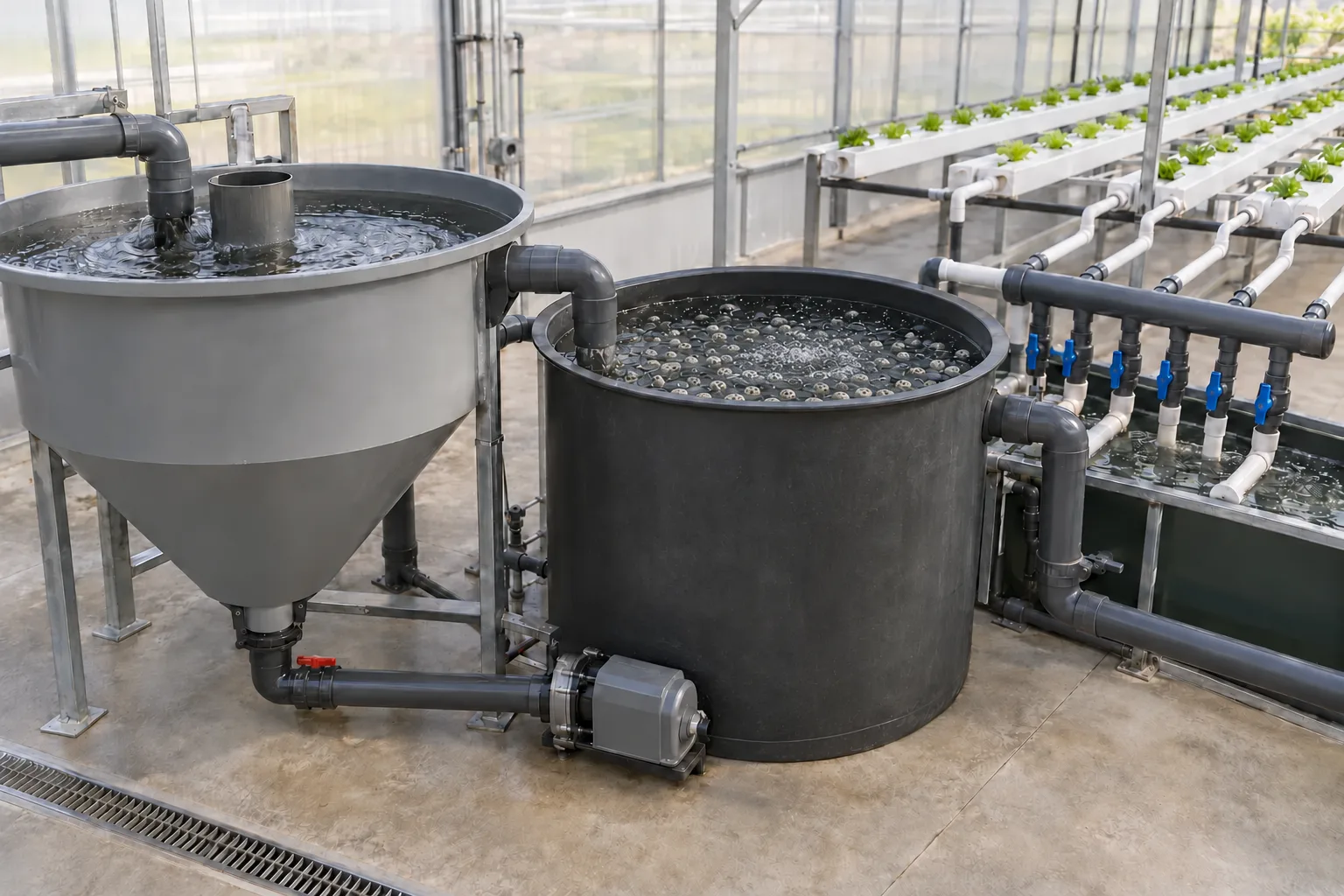
2. Mechanical filtration removes solids
Before fish water enters the NFT channels, most settleable solids should be removed.
Possible equipment includes radial-flow settlers, swirl separators, screen filters, drum filters, clarifiers and secondary fine-solids filters. The appropriate equipment depends on system flow, fish load, particle size and available maintenance labor.
Sending untreated water directly into long NFT channels creates predictable problems. Solids settle behind root mats, microorganisms consume oxygen while decomposing the material, channel flow becomes uneven and anaerobic areas can develop.
A screen is helpful only when its opening size, hydraulic capacity and cleaning method match the application. Our guide to screen filtration in aquaponics explains why mesh alone should not be treated as a complete filtration system.
3. Biofiltration converts ammonia
NFT channels provide some wetted surface for biofilm, but they should not automatically be assumed to provide all the biological filtration required by the fish.
Compared with media beds and raft troughs, NFT channels contain relatively little water and offer less dependable surface area. Dense roots and accumulated organic matter can reduce oxygen and obstruct useful colonization surfaces.
Oklahoma State University notes that dense roots and organic matter can block flow and form low-oxygen zones in NFT channels, making separate biofiltration necessary in many installations. See its technical publication on integrating fish and plant culture.
The biofilter should be sized from the expected feed load and ammonia production—not from fish-tank volume alone. It also needs adequate oxygen, alkalinity, pH and continuous circulation.
Factory testing can confirm water flow, leakage, pump operation and equipment assembly. It cannot instantly prove biological capacity. That capacity develops and is validated during cycling and gradual commissioning.
4. The pump supplies the manifold
The water pump lifts treated water to a distribution manifold, which divides it between the NFT channels.
Water naturally follows the path of least resistance. Without balancing valves or calibrated outlets, the first channels may receive too much water while distant channels receive too little.
Pump selection should be based on required flow at the actual total dynamic head. This includes vertical lift, pipe friction, elbows, fittings, valve losses, filter resistance and manifold pressure. The design should also include a reasonable allowance for gradual fouling.
The flow printed on a pump label normally represents operation under limited or zero head. It should not be treated as the delivered flow after the pump is connected to a real system.
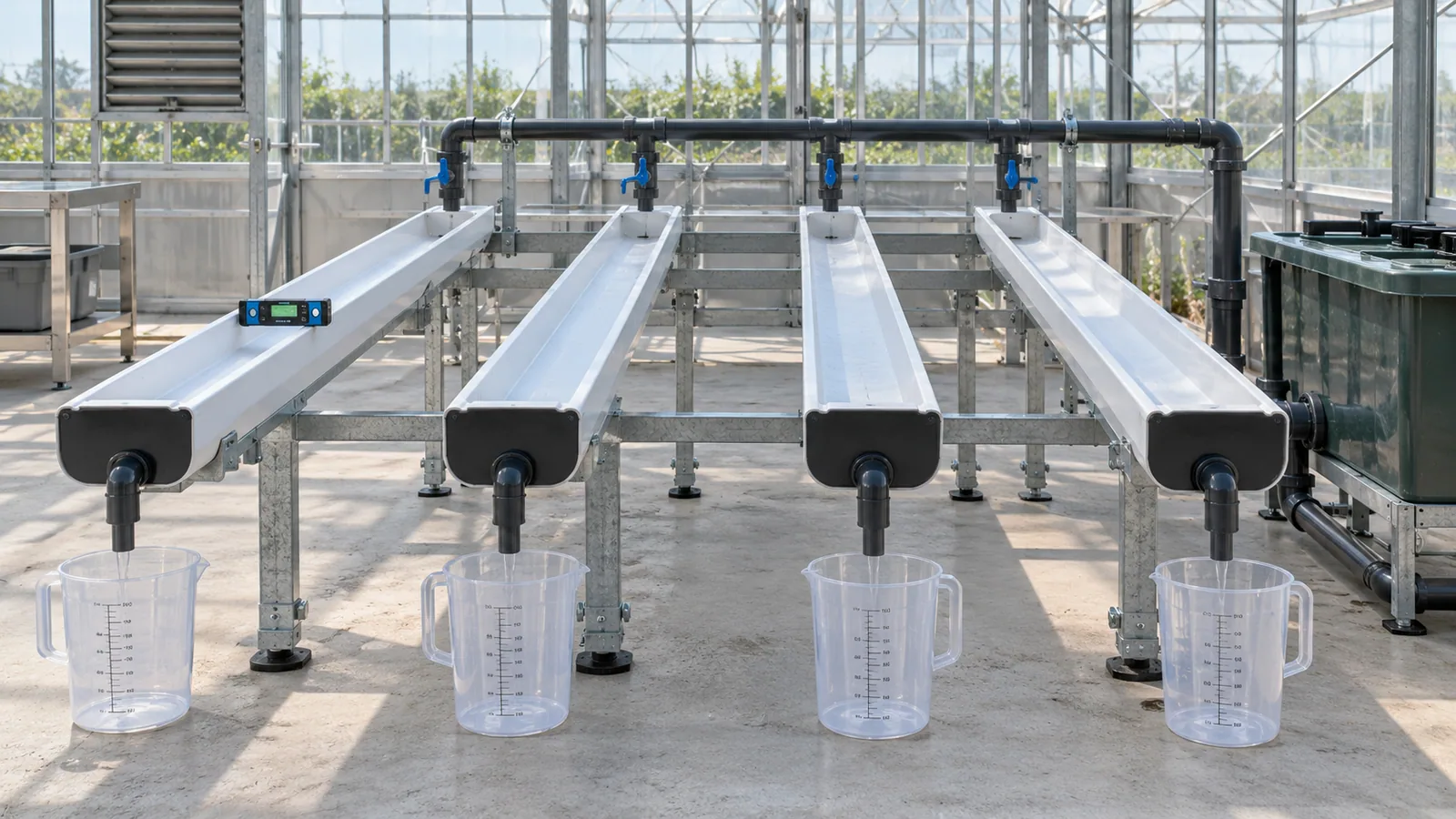
For small installations, channel flow can be checked with a measuring container and timer. Commercial systems benefit from flow meters or repeatable manifold measurements.
5. Water passes through the plant roots
Seedlings are placed in net pots or collars installed along the channel cover. As the roots develop, they extend into the moving water.
The lower roots remain wet while the upper root zone receives oxygen from the humid air inside the channel. This combination of water, nutrients and root-zone oxygen is one of the main advantages of NFT.
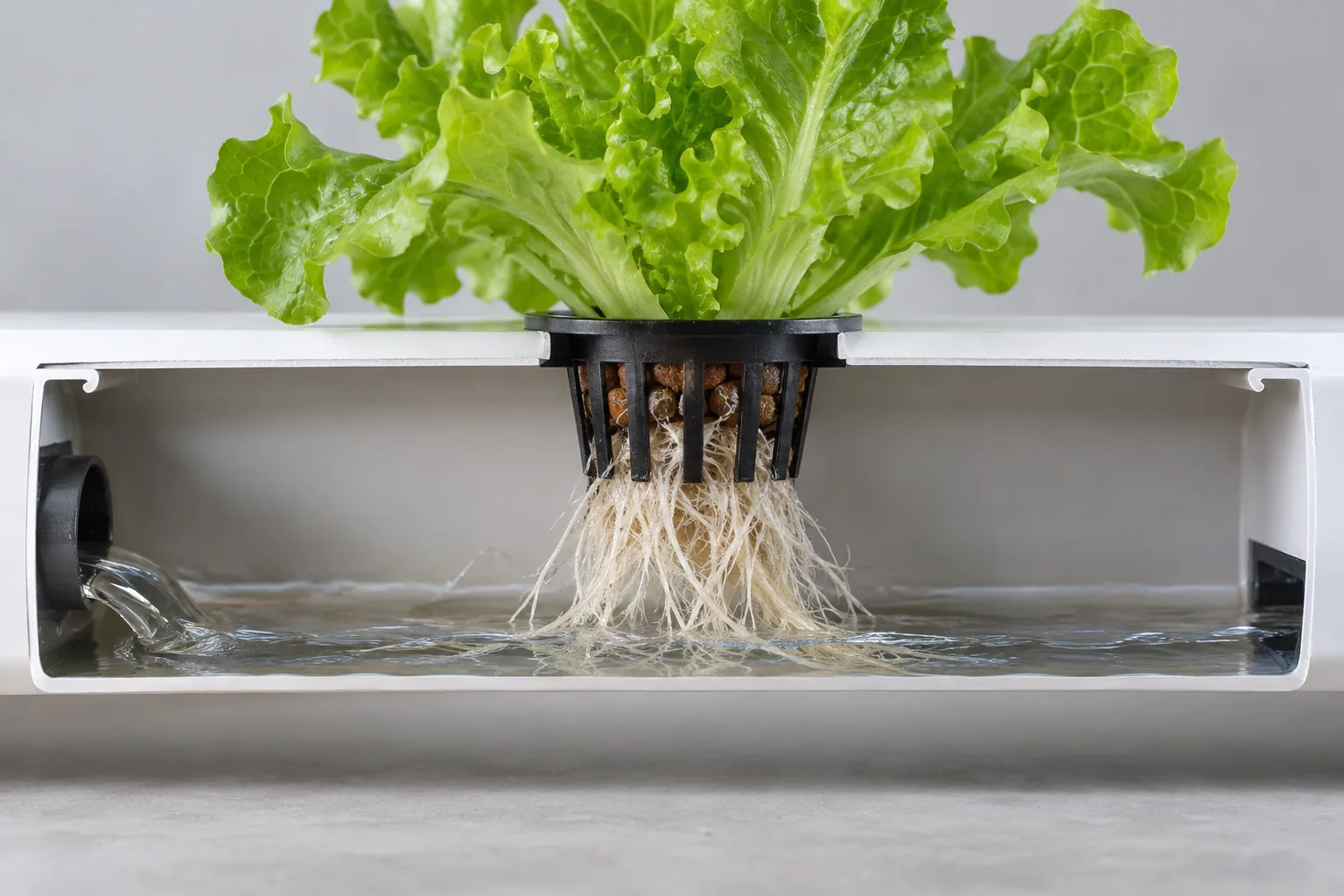
The channel must have a consistent, gentle slope. Too little slope encourages ponding. Too much slope may cause water to follow a narrow path without contacting the roots evenly. Uneven support frames can produce alternating deep and dry areas even when inlet flow is correct.
There is no single channel slope or flow rate that fits every installation. Final settings depend on channel profile, width, length, crop spacing, root density, plant maturity, inlet arrangement and return capacity. Supplier data and an actual commissioning test are more useful than copying one universal figure from an unrelated system.
6. Water returns by gravity
At the low end, water enters a return header or collection gutter and flows back to the sump or fish tank.
The return line must carry normal flow with a safe margin. It should also remain accessible for inspection, flushing and root removal.
Falling return water may add some oxygen, but splash should not be treated as the only aeration source for a meaningful fish biomass. Air delivery should be sized separately.
Which Crops Work Best?
NFT is most commonly used for light, fast-growing crops with manageable root systems. Suitable candidates include lettuce, basil, mint, pak choi, compact Asian greens, young kale, selected culinary herbs and nursery-stage plants.
Large fruiting crops such as tomatoes and cucumbers can be grown, but they require stronger supports and greater root management. Their root systems may fill narrow channels and restrict water movement.
The crop decision also affects nutrient management. Aquaponics does not guarantee that every mineral will always be present at the ideal concentration. Depending on the feed, water source and crop, iron, potassium or calcium may require fish-safe supplementation.
A hydroponic nutrient recipe should never be copied directly into an aquaponics system without checking its effect on fish and biological filtration.
Critical NFT Design Decisions
Channel shape and access
Purpose-designed flat-bottomed NFT channels generally produce a more predictable shallow stream than improvised round pipes.
Channels should be food-safe, opaque, resistant to expected temperature and UV exposure, smooth enough to clean, accessible at both ends and strong enough to remain straight under operating conditions.
Long channels magnify small errors in slope and support. Modular lengths are often easier to ship, install, level and maintain.
Solids-removal strategy
The supplier should specify what the separator removes, the flow rate at which it operates and how captured waste leaves the system.
A filter that works hydraulically but requires difficult daily cleaning may not fit the available labor. Isolation valves and bypass lines make maintenance easier without shutting down the entire facility.
Pump redundancy
NFT roots have little stored water around them. During hot, dry weather, a circulation failure can damage plants faster than it would in a deep raft trough.
Commercial systems may require a standby pump, high- or low-water alarms, remote alerts, backup power or emergency irrigation. For a small home installation, keeping a compatible spare pump and clearly labeled fittings may be sufficient.
Sump volume
The sump must maintain adequate pump submergence throughout operation. It also needs enough freeboard to receive drain-down water when pumps stop.
Marking minimum and maximum water levels provides a simple daily inspection reference and helps prevent dry running.
Cleaning access
Root removal and channel flushing should be planned before installation. Useful features include removable end caps, accessible unions, isolation valves, removable covers, flush points and adequate space around the low end of every channel.
Advantages of NFT Aquaponics
When correctly matched to the crop and treatment system, NFT can provide:
- High planting density
- Organized production rows
- Low water volume in the plant section
- Efficient greenhouse floor use
- Convenient planting and harvesting height
- Modular channel expansion
- Good upper-root oxygen exposure
- Clean crop presentation
- Easier crop scheduling
NFT can be attractive for buyers planning repeatable leafy-green production rather than a mixed backyard garden.
Limitations and Risks
NFT remains an active system with several important risks:
- Pump failures can dry roots quickly
- Small inlets can clog
- Roots can block drains
- Poorly leveled supports create uneven flow
- Inadequate filtration creates deposits
- Warm water carries less dissolved oxygen
- Crop choice is more restricted
- Biofiltration may be underestimated
- Long channels can be difficult to flush
- Power interruptions affect fish and plants simultaneously
These risks do not make NFT unreliable. They explain why the complete hydraulic and treatment design is more important than the appearance of the channels.
Installation and Commissioning
Before shipment, review channel dimensions, frame drawings, pump duty, filter capacity, pipe sizes, electrical requirements, supplied fittings, spare parts and packing methods.
Shipment inspection should check for cracked channels, distorted frames, damaged pump housings, missing seals and incorrect quantities before assembly begins.
During installation, level the supporting structure before setting the final slope. Run clean water through every channel and check leakage, standing water, overflow risk, unequal inlet flow, return-line capacity, sump level and emergency drain-down behavior.
Flow should be measured rather than judged only by appearance.
After hydraulic commissioning, dechlorinate the system and begin biological cycling. Do not immediately stock the full planned fish biomass. Verify ammonia and nitrite conversion, introduce fish gradually and compare actual feeding with the biofilter design.
Questions to Ask an NFT Supplier
1. What operating flow is recommended for each channel?
2. At what total dynamic head was the pump selected?
3. Which solids-removal components are included?
4. For what maximum daily feed load was the biofilter sized?
5. What crop spacing is assumed?
6. How long are the individual channels?
7. How can manifolds and channels be flushed?
8. What happens during a power failure?
9. Are spare pumps, valves, seals and fittings available?
10. Which components receive factory testing?
11. What installation preparation is required?
12. Which performance variables must be confirmed during commissioning?
Mid-article CTA — Send Your Requirements
Planning an NFT layout for a greenhouse, school or commercial leafy-green project? **Send Your Requirements** with the available footprint, target crop, fish-tank volume, expected biomass, power supply and local climate.
FAQ
Does NFT aquaponics require a separate biofilter?
Often, yes. NFT channels provide limited and variable colonization area. A separate biofilter offers more predictable nitrification capacity and can be sized for the expected feed load.
Should NFT water run continuously?
Continuous circulation is the normal and safer approach. Because the channels store little water, interrupting flow can expose roots to rapid drying.
Can round PVC pipe be used?
It can be used in some small systems, but round pipe concentrates water at the bottom and can be more difficult to inspect. Purpose-designed NFT channels normally provide more predictable flow.
How deep should the water be?
NFT uses a shallow film rather than a full channel. The correct depth depends on the profile, slope, flow and root development.
Can tomatoes grow in NFT aquaponics?
Yes, but they require strong supports, larger root capacity and careful flow management. Leafy greens are usually a more forgiving choice.
What happens if the pump stops?
Water stops reaching the roots, and fish-side circulation or treatment may also deteriorate. Response time depends on temperature, humidity, channel design and biomass.
Conclusion
An NFT aquaponics system works by moving clarified and biologically treated fish water as a shallow stream through slightly sloped plant channels. Lower roots receive water and dissolved nutrients, upper roots receive oxygen, and the water returns for recirculation.
Reliable operation depends on much more than the channels. The system needs properly sized fish production, solids separation, biofiltration, balanced distribution, accurate supports, accessible drainage and failure preparation.
When those elements are matched to a leafy-green production plan, NFT can provide a compact and organized growing method. When they are omitted, narrow channels can magnify clogs, uneven flow and pump failures.
Final CTA — Get an NFT Aquaponics Quote
Need an NFT aquaponics system configured for your crop, location and production target? **Get a Quote** by sending your growing area, preferred channel layout, fish-tank volume, target crop, electrical supply and destination.