
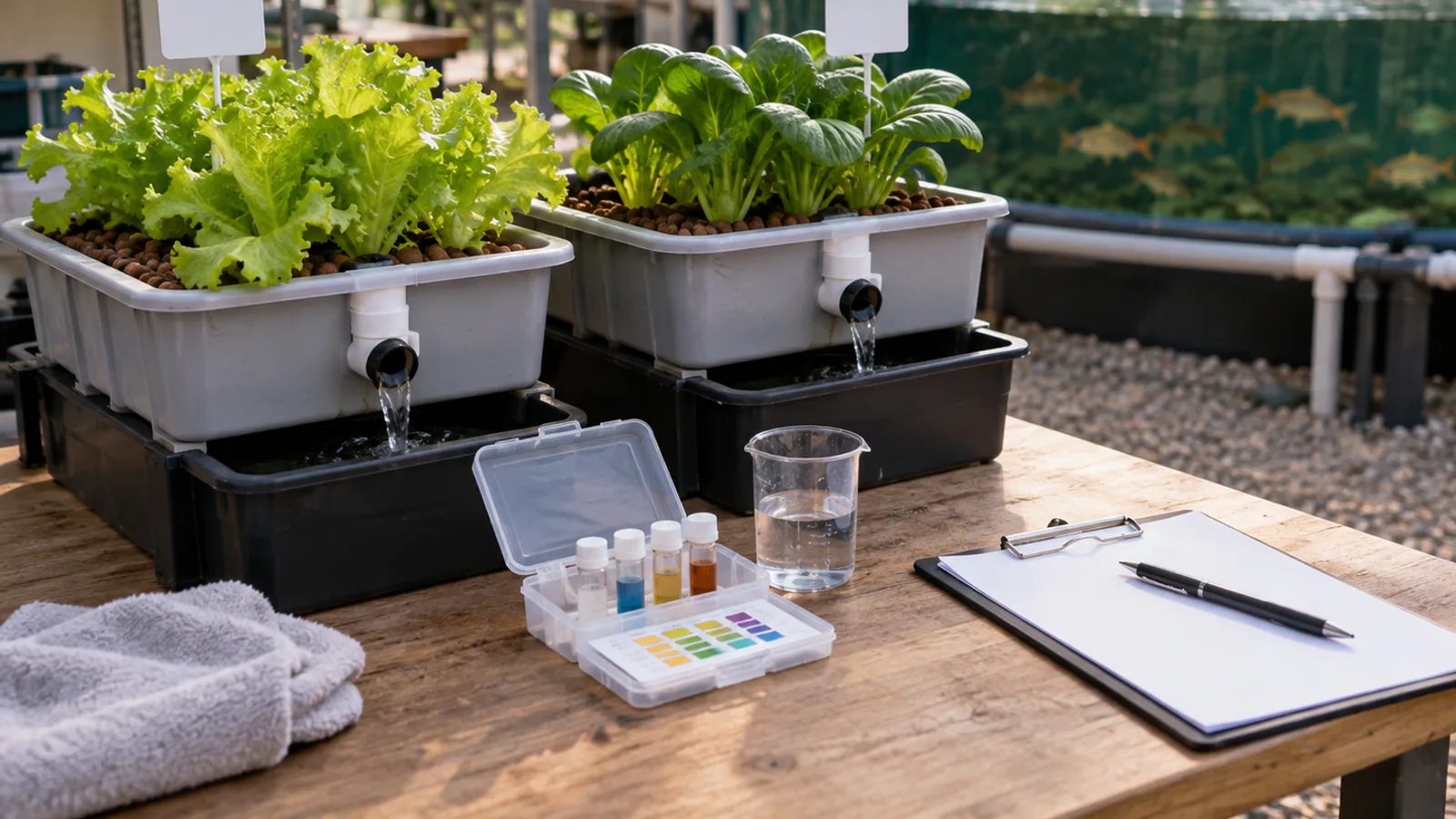
Yes. A screen filter can be used in an aquaponics system to capture suspended or settleable solids before they reach sensitive downstream equipment. It can protect pumps, channels, raft beds and biofilters from uneaten feed and fish waste. But it is not a universal substitute for biofiltration, aeration, solids settling or routine maintenance. The best choice depends on fish biomass, feed rate, particle size, flow, growing method, cleaning capacity and the operator’s daily routine.
In a well-designed system, a screen filter is one part of a solids-management sequence. Water usually leaves the fish tank, passes through a solids-removal stage, continues to a biofilter or biologically active grow zone, reaches plants and returns through the designed loop. The screen must be located, sized and serviced so captured material is removed before it decomposes and creates another water-quality burden.
Clemson’s aquaponics system-layout guide distinguishes passive and active approaches to mechanical filtration, which is a useful starting point when deciding how a filter will fit the site hydraulics. Read Clemson’s system-layout guide. SRAC Publication No. 453 explains screen filtration, including drum-screen configurations, backwashing and suspended-solids removal in recirculating aquaculture systems. See the University of Kentucky-hosted SRAC Publication No. 453.
The short answer
Use a screen filter when the system needs mechanical capture of solids and the team can clean it reliably. It is particularly relevant where fine passages or exposed roots are vulnerable to clogging, such as NFT channels, small emitters, some vertical systems and deep-water rafts. It may be less central in a well-managed media-bed system where the media itself provides some solids capture, but that does not eliminate the need to manage accumulated waste.
Before selecting one, define:
- expected fish biomass and daily feed input;
- required flow at the actual installed head and pipe length;
- selected growing method and tolerance for suspended solids;
- screen opening/mesh, flow rating and cleaning mechanism;
- bypass, overflow and isolation-valve arrangement;
- waste collection, drain route and cleaning frequency; and
- spare parts, power requirements and operator availability.
For a broader view of the water loop, read How Does an Aquaponics System Work?. This article answers the narrower component question: whether a screen is appropriate, where it belongs and what it cannot do.
What a screen filter does—and does not do
It physically captures solids
A screen filter separates particles from flowing water using a mesh or screen surface. Captured feed fragments, feces and plant debris can then be removed from the main loop instead of travelling to pumps, pipes or crop areas. That reduces clogging pressure and can make downstream water-treatment equipment easier to manage.
It does not replace biofiltration
Screen filtration is mechanical. It does not provide a reliable replacement for the protected, oxygenated surface area where nitrifying microorganisms convert ammonia to nitrite and nitrate. A design still needs sufficient biological capacity, aeration and stable flow. If the screen is doing its job well, the biofilter may receive fewer solids; it still must process dissolved nitrogen compounds.
It does not remove every water-quality problem
Very fine and dissolved solids may pass through a screen. A screen will not correct insufficient oxygen, unsuitable pH, excessive feed, immature biofiltration, warm water or poor fish health. It is one defence, not a diagnostic shortcut. Water testing and observation remain necessary, especially after feeding changes or equipment cleaning.
Where should a screen filter be placed?
Usually early in the water-treatment path
For many layouts, placing mechanical solids removal after the fish tank and before the main biofilter protects downstream components. The exact order can vary with a radial-flow separator, settling tank, mineralization process, pump arrangement and hydraulic design. The key is that water reaches the screen at a controlled flow, captured waste can be removed safely, and a blockage does not starve fish or biofilter of circulation.
Consider gravity flow versus pumped flow
Some filters work in gravity-fed configurations; others are designed for pumped pressure or a particular head loss. Do not select from a catalogue flow figure alone. Measure or calculate the installed pipe run, elevation, elbows, valves and expected fouling condition. A unit that works when clean but restricts flow too quickly in daily operation can create risk.
Add isolation, bypass and overflow intentionally
Operators need a safe way to inspect and clean a filter without draining an unintended section or stopping essential aeration. A process-flow drawing should show valves, normal flow direction, a controlled bypass where appropriate, drains and overflow paths. A bypass must not become an unmanaged shortcut that sends dirty water into sensitive crop channels; write an operating procedure for when it is used and who authorizes it.
Choosing the right screen filter
Start with feed, not only tank volume
Tank volume is useful context, but daily feed input and fish growth drive solids production. Two tanks of the same size can have very different filter duty. Document present and expected feed rate, species, fish size, biomass, harvest schedule and seasonal temperature. Then select a filter with a realistic cleaning duty—not just maximum new-equipment flow.
Match screen opening to the protected equipment
Finer screens can protect small passages better, but they may foul more rapidly. Coarser screens have lower cleaning pressure but pass more material downstream. The appropriate opening depends on particle characteristics and the next component: a delicate NFT channel may require better solids control than a wide media bed. Ask the supplier to explain the selection in relation to the actual crop method, expected feed loading and cleaning interval.
Compare manual and automatic cleaning honestly
Manual filters can be practical where staff are present daily and the system scale is modest. Automatic or self-cleaning equipment can reduce routine labor in some applications, but it adds controls, water use, service needs and sometimes power dependence. Neither option eliminates inspection. Choose the arrangement the operating team can maintain, source parts for and safely clean.
Check access and waste handling before ordering
The best filter is not useful if staff cannot remove the screen, reach the drain or safely carry waste to the designated handling point. During installation preparation, confirm floor drainage, service clearance, splash control, lighting, hose access and the route for collected solids. These ordinary details determine whether a cleaning schedule is followed after the first busy harvest week.
Screen filter design examples by grow method
Deep-water culture (DWC)
Rafts and long troughs benefit from good solids control because settled material can collect in low-flow areas and affect root-zone conditions. A screen filter may be combined with settling and biofiltration, depending on the design. Ensure that the return path and trough hydraulics do not create stagnant zones merely because the inlet water appears clear.
Nutrient film technique (NFT)
Narrow channels and roots are comparatively sensitive to solids. Mechanical filtration deserves early attention, along with inlet protection, channel slope, access for inspection and routine root management. Do not expect a screen alone to solve an undersized channel or irregular flow.
Media beds
Media can intercept some solids and provide biological surface area. That can simplify small layouts, but accumulated solids still need a cleaning and flood/drain management routine. Screen filtration may be added when fish load, feed rate or downstream equipment makes separate mechanical treatment worthwhile.
Vertical towers
Towers can make productive use of height, but their distribution lines, emitters and root zones may be sensitive to particles. A screen filter can help protect those passages, provided the system also maintains adequate flow, aeration and access for cleaning. See What Are the Different Types of Aquaponics Systems? for the broader growing-method comparison.
> CTA — Need help matching filtration to your growing method? Send your fish species, daily feed estimate, crop method, site plan and target capacity. We can help prepare a clear discussion of tanks, mechanical filtration, biofiltration, pumps and installation requirements. Ask for Product Catalog.
Maintenance: the filter only works when waste leaves the loop
Create a routine based on observations
Inspect filter condition, water level/head loss, flow, odor, pump sound and fish behaviour at a frequency appropriate to the feed load and system. Feed increases, warm weather, fish growth, storms and plant debris can change filter duty. A fixed weekly schedule may be insufficient during a high-load period; cleaning every few hours without a cause analysis can indicate an undersized or poorly configured system.
Clean without damaging the system
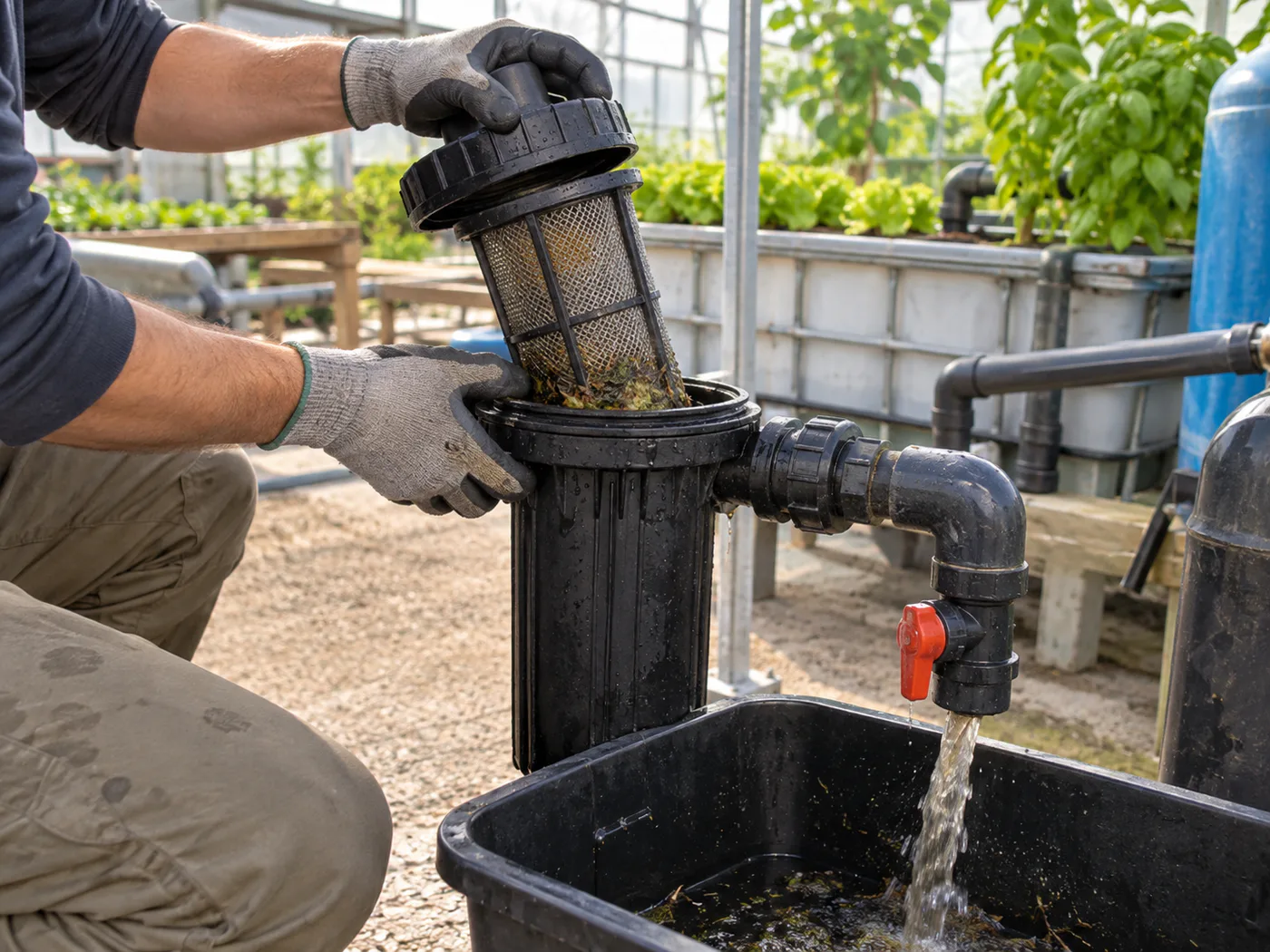
Follow the supplied operating procedure. Isolate the correct valves, protect pump operation, collect waste, inspect seals and return the filter to normal flow. Do not indiscriminately disinfect biofilter media or strip all biological surfaces while solving a mechanical-cleaning issue. Record the date, observed condition, action taken and any water-quality response.
Treat blocked flow as a fish-welfare event
Loss of circulation can affect oxygen supply and biological treatment quickly. If flow falls unexpectedly, restore safe aeration, observe fish, check the filter and pump, and test water according to the farm’s emergency procedure. Do not respond only by opening a bypass and forgetting it; identify why the screen fouled and correct the cause.
Factory testing, shipment inspection and site commissioning
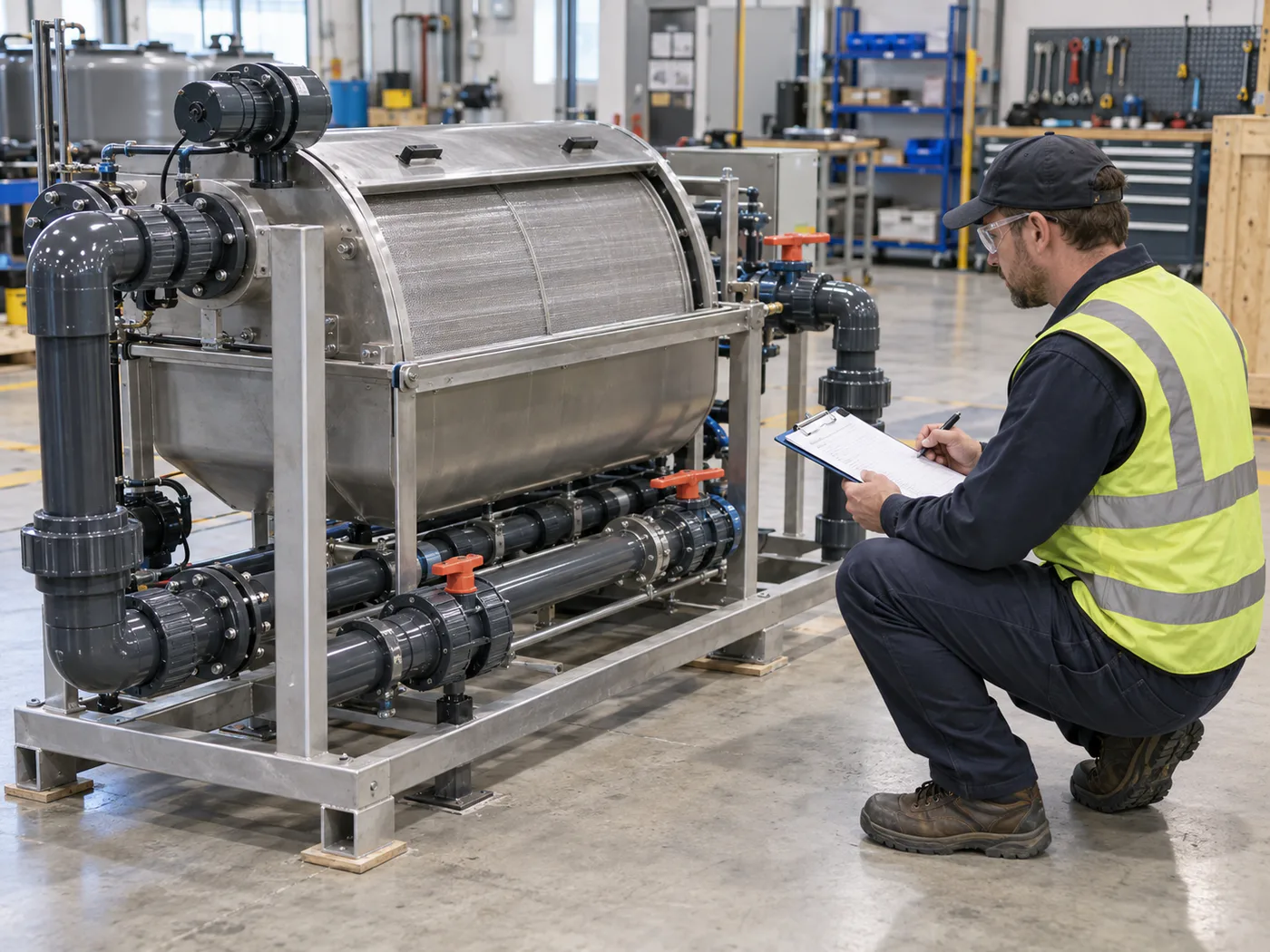
For a supplied aquaponics project, require a visible equipment list and process-flow drawing before shipment. During factory testing, check screen-filter model, connections, valves, screen access, drains, pump direction, available service clearance and any automatic-cleaning controls. Photograph the assembly and list spare screens, seals, manuals and fittings.
During shipment inspection, confirm that the filter body, screen elements, valves, unions, drain fittings and tools named in the agreement are present. At site installation, level the equipment where required, support pipework, route waste safely, test leaks, confirm flow through the treatment path and practice the cleaning routine before fish are stocked heavily. This is the difference between a component that looks complete in a catalogue and one that remains serviceable in operation.
FAQ
Do I need a screen filter for every aquaponics system?
No. The need depends on fish loading, feed rate, crop method, existing solids management and the operator’s maintenance capacity. It is a useful option, not a universal requirement.
Can a screen filter replace a biofilter?
No. A screen filter captures physical particles. A biofilter supports nitrifying microorganisms that manage dissolved nitrogen compounds. Most fish-and-plant systems need both functions, whether they occur in separate components or a carefully designed combination.
What mesh size should I choose?
There is no one correct mesh size. It must be selected against particle load, flow, downstream equipment and cleaning capability. Ask for a supplier recommendation tied to your feed rate and growing method, then validate it during commissioning.
How often should I clean the screen?
As often as required to maintain designed flow and water quality. Establish a normal routine after observing the system under its real feed and fish load; increase checks during changes rather than relying on a universal calendar interval.
Conclusion
A screen filter can be an effective aquaponics component when it is used for its actual job: mechanical solids capture. It should be selected from feed load, flow and protected equipment; installed with service access and controlled drainage; and cleaned as a documented operating task. It complements—not replaces—biofiltration, aeration, water testing and careful fish management.
CTA — Ready to review an aquaponics filtration scope? Contact Us with your project drawing, fish plan, growing method and location. We will help make the filter, pump and grow-zone scope clear before installation preparation begins.

