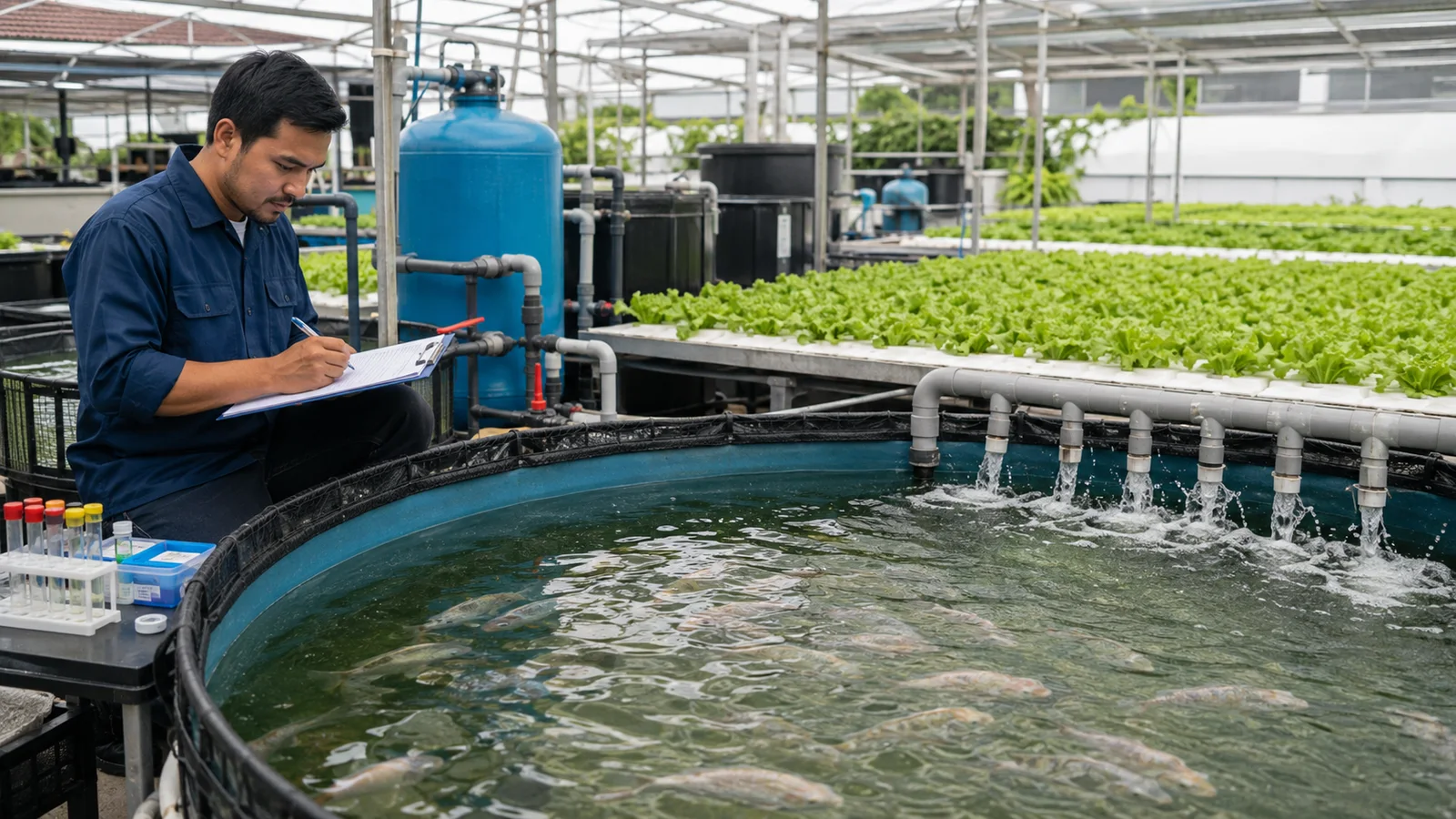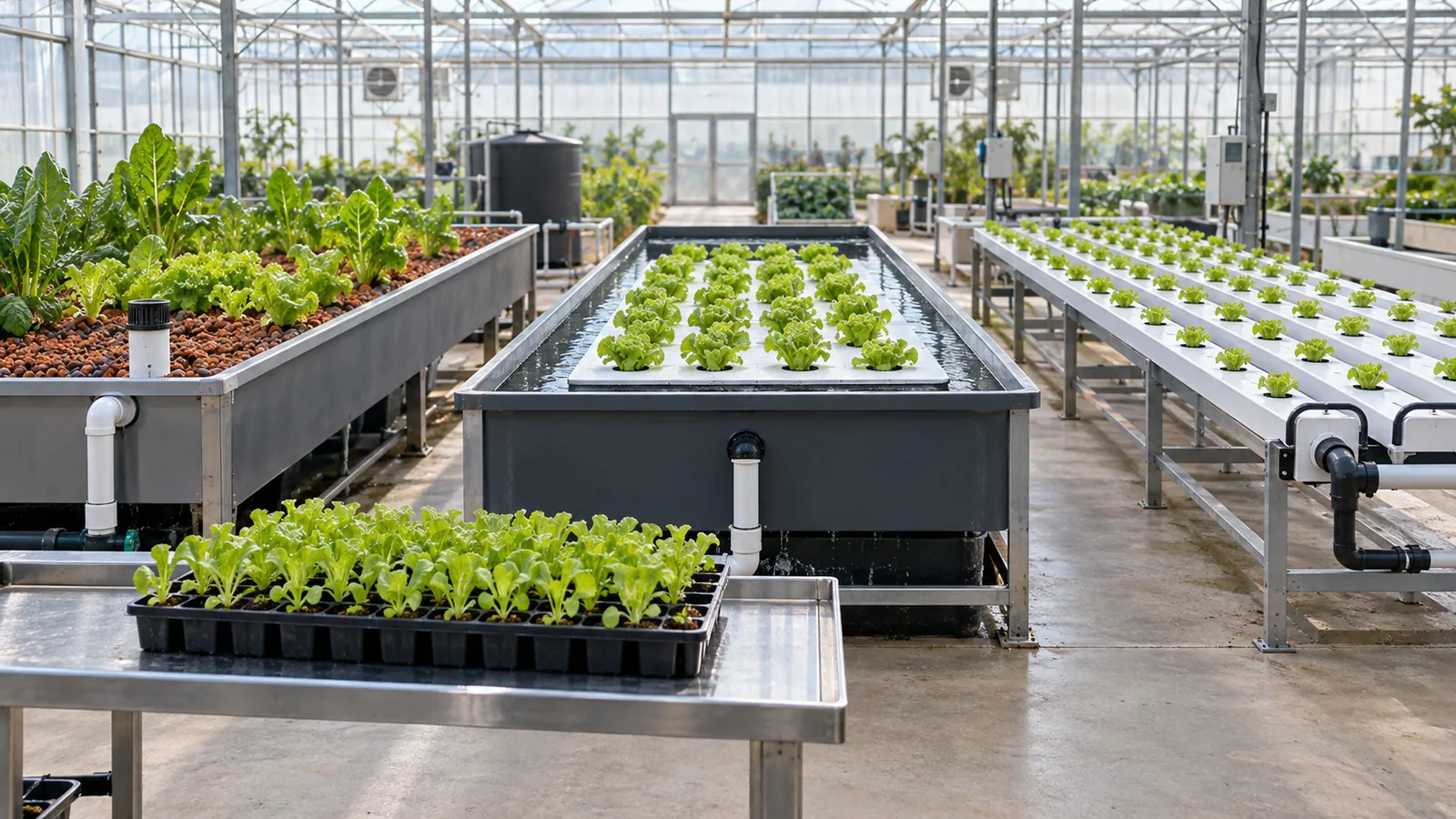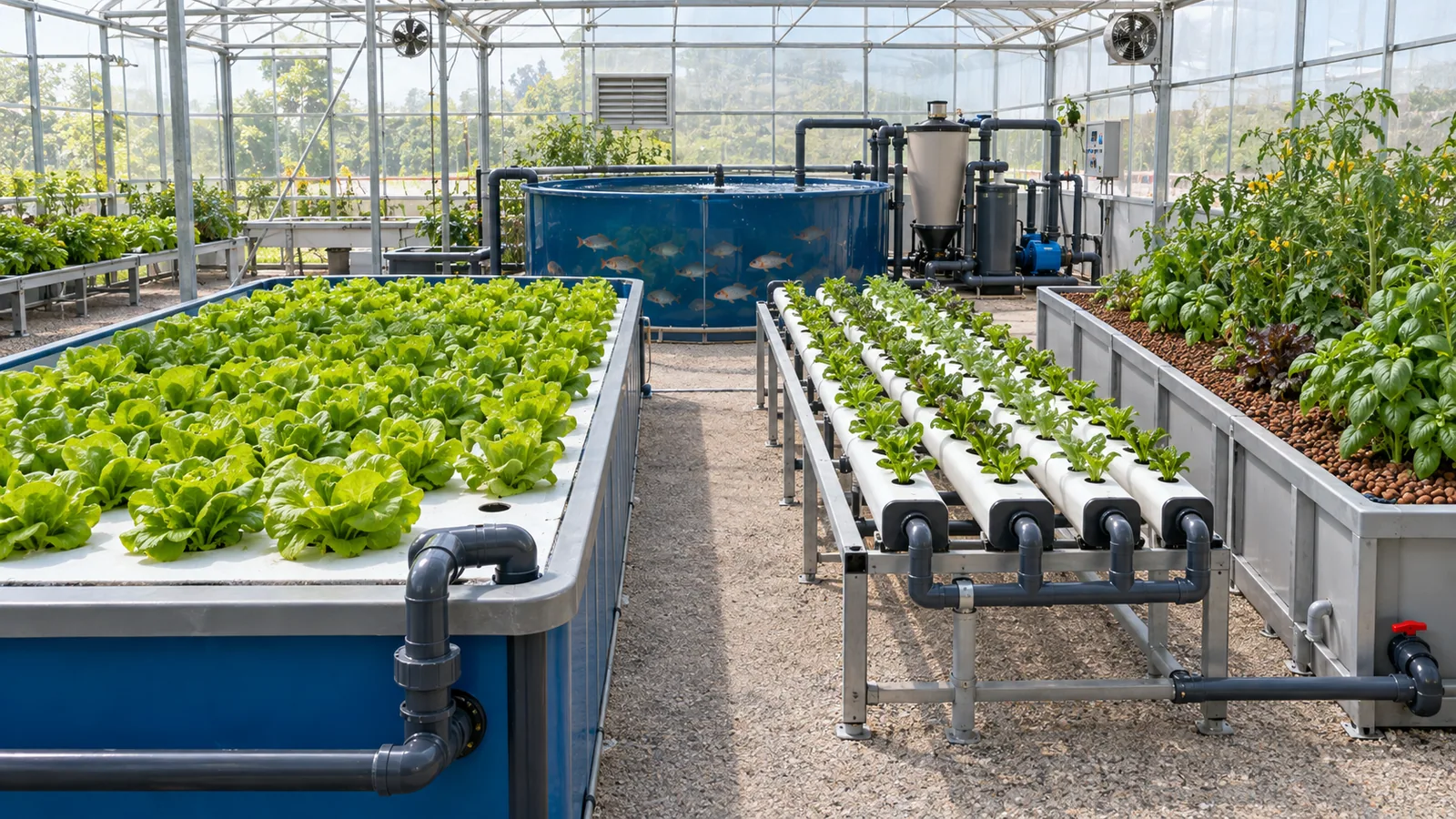
An aquaponics system can support only the number of plants allowed by both its physical growing space and its available nutrient supply. Count the installed planting positions first, then check whether daily fish feed, fish biomass, filtration, water flow, oxygen, light and crop stage can support those positions at the intended yield.
A raft with 100 holes has space for 100 plants, but that does not prove the system can grow 100 mature plants well. Young seedlings consume little; mature lettuce or basil consumes more; tomatoes and cucumbers require more root space, structural support and a different nutrient plan. Fish feeding also changes with biomass, temperature and growth stage.
For that reason, there is no universal “one fish supports two plants” rule. A credible capacity plan uses plant spacing to calculate physical capacity and a system-specific feed-rate relationship to estimate nutrient-supported growing area. The lower of those two capacities is the practical starting limit.
The Short Answer
Use this sequence:
1. Measure the usable plant-production area.
2. Select the crop and mature spacing.
3. Calculate the number of physical planting sites.
4. Record average daily fish feed at each production stage.
5. Select a validated feed-rate-to-growing-area range for the actual system type.
6. Compare nutrient-supported area with installed area.
7. Apply reductions for startup, seasonal growth, harvest gaps and operating uncertainty.
8. Expand only after water tests, plant performance and fish welfare remain stable.
Two basic calculations help:
Physical plant capacity = usable growing area ÷ area required per plant
Nutrient-supported growing area = average daily feed input ÷ selected feed-rate ratio
Neither calculation is a standalone guarantee. They are planning tools that must be checked against crop response and system records.
Define What “Support” Means
A plant can remain alive without reaching commercial size or quality. Before calculating capacity, define the result:
- Seedlings held temporarily
- Full-size lettuce harvested weekly
- Culinary herbs cut repeatedly
- Fruiting crops grown through a long cycle
- Mixed demonstration crops
- Nursery plants transferred elsewhere
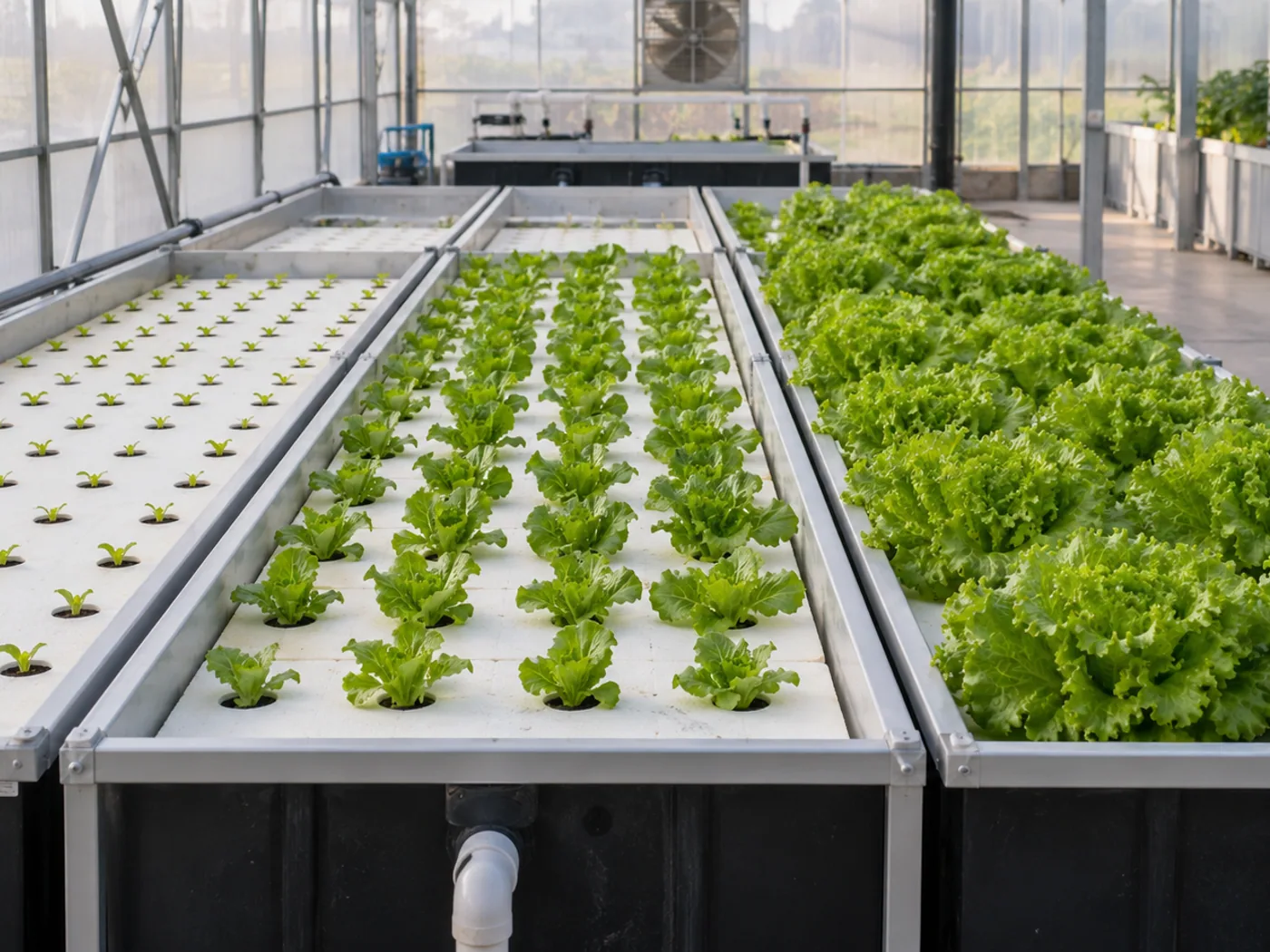
The same grow bed may physically hold many young plants but far fewer mature fruiting plants. Commercial planning should use the number of marketable plants at the chosen harvest specification, not the maximum number of net pots that can be installed.
Step 1: Calculate Physical Planting Capacity
Raft or deep-water culture
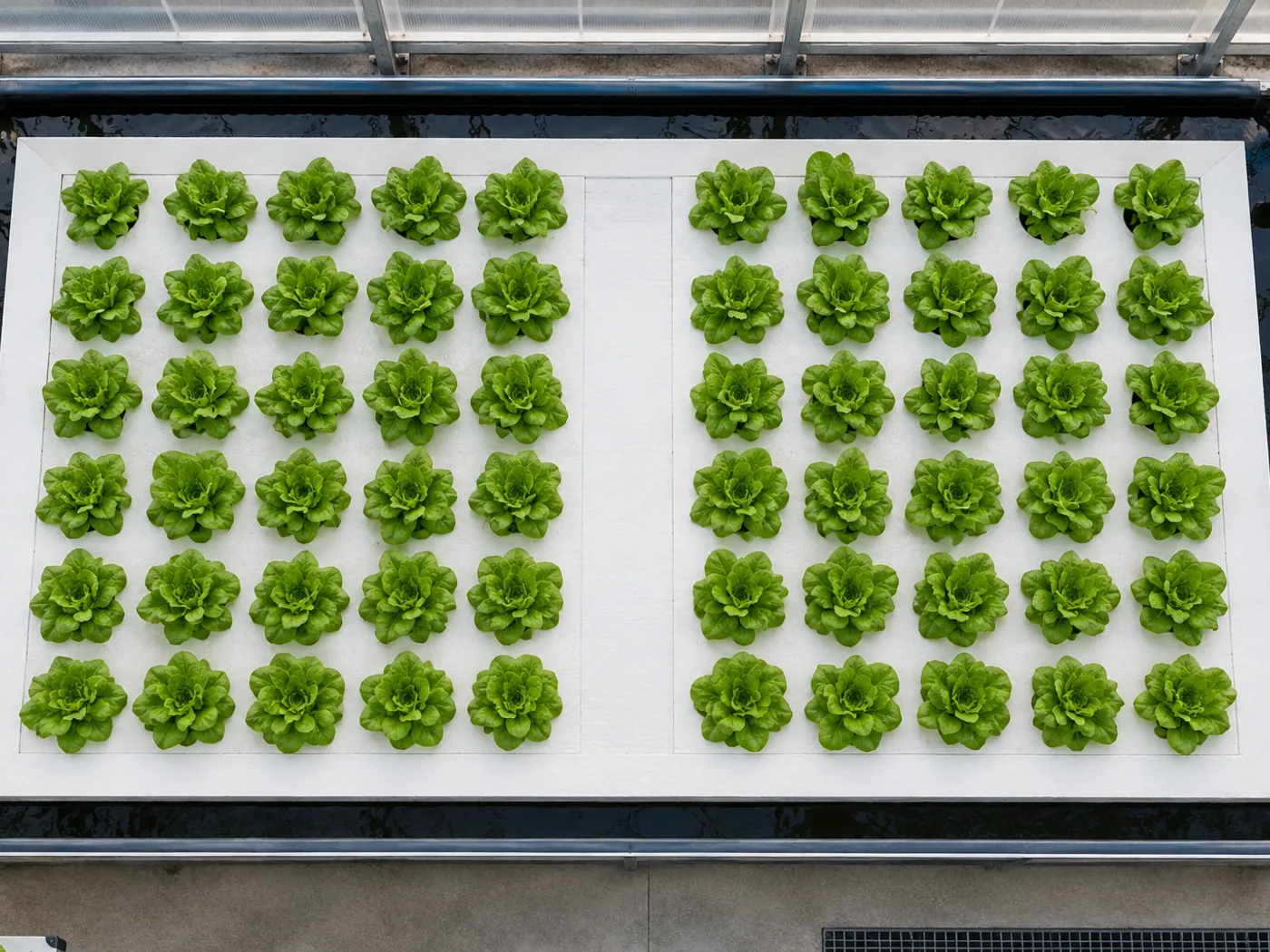
For DWC, usable area is the raft area that can be planted while maintaining edges, access and hydraulic movement. Calculate the number of holes from row spacing and in-row spacing.
Approximate planning ranges may include:
| Crop form | Preliminary center spacing | Approximate physical positions per m² |
|---|---|---|
| Small leafy greens | 15–20 cm | 25–44 |
| Full-head lettuce and similar greens | 20–30 cm | 11–25 |
| Culinary herbs | 20–30 cm | 11–25 |
| Larger fruiting crops | 45–75 cm | 2–5 |
These are layout ranges, not production guarantees. Verify cultivar width, airflow, light distribution, disease pressure, support structure and harvest method. A dense planting plan that blocks inspection or airflow is not useful capacity.
Nutrient film technique
Count the holes in each channel, then subtract positions reserved near inlets, outlets, supports or service breaks. Channel capacity is constrained by root volume as well as shoot spacing. A crop that looks compact above the channel may create a dense root mat that restricts flow.
NFT capacity must also respect maximum channel length, slope, inlet distribution and return capacity. Adding more holes cannot correct uneven flow or inadequate filtration.
Media beds
Use the planted surface area and mature canopy spacing, but also consider root competition, structural support and access to standpipes or siphon guards. A mixed media bed rarely follows one uniform grid.
Reserve maintenance zones around drains and distribution points. Large crops may need trellising independent of the bed. If roots block access, the theoretical plant count creates recurring maintenance problems.
Vertical towers
Count installed planting pockets, then confirm light reaches every level. A tower with many pockets can have lower usable capacity when lower plants are shaded, airflow is poor or flow is uneven.
Include aisle width, safe working height, cleaning access and the ability to remove a tower without disturbing the whole loop.
Step 2: Calculate Nutrient-Supported Area
Aquaponics nutrients are driven largely by fish feed. Fish retain part of the feed, while waste and microbial processes make part of its nutrient content available to plants. Daily feed input is therefore more useful than fish headcount for estimating plant-side capacity.
Southern Regional Aquaculture Center guidance describes a 60–100 grams of fish feed per square metre of raft growing area per day reference range developed for a specific commercial raft approach. It also explains that the optimum relationship changes with hydroponic method, water volume, solids removal, source water, crop and production schedule. Review the fish-feed-to-plant-area design guidance.
Do not copy that range blindly into a home media bed, NFT system, tower or new biofilter. It is a design reference with defined assumptions, not a universal instruction to feed fish more.
An illustrative calculation
Assume a mature raft system receives an average of 120 grams of feed per day. If its validated design basis uses 60 grams per square metre per day:
120 g/day ÷ 60 g/m²/day = 2 m² of nutrient-supported raft area
If the raft layout provides 25 full-head lettuce positions per square metre, the physical layout has approximately 50 positions.
That does not promise 50 marketable heads. The result still depends on feed composition, fish response, source water, solids treatment, mineral availability, lighting, temperature, plant health and harvest schedule. If average feed falls to 60 grams per day during a cool period, the same nutrient relationship would support only about 1 m², even though all 50 holes remain physically present.
Physical Capacity and Nutrient Capacity Must Agree
Use a simple capacity table:
| Capacity check | Result |
|---|---|
| Installed plant positions | 50 |
| Positions after maintenance/access allowance | 46 |
| Positions supported by planned active area | 40 |
| Startup safety factor | 70% |
| Initial planted positions | 28 |
The lowest justified figure sets the first operating plan. As the biofilter matures and records confirm stable performance, planting can increase in stages.
Do not respond to weak crop growth by adding fish or feed automatically. Diagnose light, temperature, pH, root oxygen, individual nutrients, disease and water flow first. Overfeeding to force plant production can raise ammonia, solids and oxygen demand.
Step 3: Adjust for Crop Type
Leafy greens
Lettuce, pak choi and similar greens are common because they have relatively short cycles and manageable support needs. Capacity still depends on harvest size. Baby greens and full heads should not share the same plant-count assumption.
Herbs
Basil, mint and other herbs may be harvested repeatedly. Repeated cutting changes canopy size and nutrient demand over time. Some herbs also spread aggressively or form large roots.
Fruiting crops
Tomatoes, cucumbers, peppers and eggplants require more support, longer production cycles and careful management of potassium, calcium, iron and other nutrients. Counting one tomato plant as equivalent to one lettuce plant is misleading.
Fruiting plants may physically fit in a media bed or Dutch bucket but exceed the nutrient balance used for a leafy-green design. Treat them as a separate crop zone with documented trellising, pruning, pollination and supplement procedures.
Mixed cropping
Mixed systems are useful for education and household production but harder to model. Create crop groups by spacing, growth stage and nutrient demand. Review the groups weekly instead of reporting one undifferentiated plant total.
Step 4: Account for Plant Age and Crop Scheduling
Seedlings do not use nutrients at the same rate as mature plants. If every plant is transplanted and harvested together, nutrient demand rises and falls as a batch. Fish feeding may remain relatively steady, creating nutrient accumulation after harvest and potential shortage near peak crop growth.
Staggered planting places different crop ages in the system at the same time. This can smooth nutrient uptake and provide a more consistent harvest. It also makes nursery planning and replacement seedlings part of the capacity calculation.
The commercial-crop guidance from the Southern Regional Aquaculture Center emphasizes that greenhouse crop density, plant health and space use affect output and that crop choice must suit the growing subsystem. See SRAC Publication 5009 on greenhouse crops and cropping systems.
Track:
- Germination date
- Transplant date
- Active position
- Crop and cultivar
- Expected harvest date
- Actual harvest date
- Marketable weight or grade
- Rejected or lost plants
A system with 100 installed sites but only 75 consistently marketable harvests should be planned around the verified result, not the hole count.
Step 5: Check the Fish and Feed Plan
Fish count alone is a weak plant-capacity measure. Fish grow, feeding changes and species have different feed and temperature requirements. Record biomass and daily feed for each tank.
Our guide to fish stocking capacity in aquaponics explains why biomass, feed, oxygen, filters and plant area must be planned together.
Key questions include:
- What is the average and peak daily feed?
- How does feed change by season?
- What happens during fish harvest or replacement?
- Is feed composition consistent?
- How much feed is actually consumed?
- What solids are removed before mineralization?
- Can aeration and biofiltration support the peak load?
Do not keep feeding fish solely to maintain plant nutrients when temperature, appetite or fish health indicates that feed should be reduced.
Step 6: Check Non-Nitrogen Limits
Nitrate does not prove that plants have every required nutrient. Aquaponics crops may need managed iron, potassium or calcium supplementation depending on feed, source water, pH and crop.
Plant capacity may also be limited by:
- Light intensity and uniformity
- Water temperature
- Air temperature and humidity
- Root-zone dissolved oxygen
- Carbon dioxide and ventilation
- pH
- Flow distribution
- Pest and disease pressure
- Sodium or other source-water accumulation
- Operator time
If one constraint limits growth, adding more planting positions divides the same limited resource among more plants.
Mid-Article CTA — Send Your Capacity Requirements
Planning grow beds, rafts, NFT channels or towers for a new project? **Send Your Requirements** with the available area, crop list, target harvest, fish plan, climate and preferred growing method. We can help organize the information needed for a system-capacity discussion.
Step 7: Apply a Startup and Reliability Margin
A new system should not begin at theoretical maximum capacity. The biofilter, operators, crop nursery and maintenance routines all need time to stabilize.
A staged approach might use:
- 50–70% of planned plant positions during initial biological commissioning
- Increased planting after stable ammonia and nitrite performance
- Further expansion after one or more complete crop cycles
- Full planned capacity only after feed, crop and water records agree
These percentages are project-management examples, not biological standards. The appropriate margin depends on system risk, operator experience and the consequences of failure.
Maintain reserve space for:
- Replanting after loss
- Trial crops
- Access to drains and channels
- Isolation of a problem zone
- Seasonal reductions
- Maintenance and cleaning
Step 8: Verify Capacity With Operating Data
Create a weekly dashboard containing:
- Active plant positions
- Empty positions
- Crop stages
- Marketable harvest
- Fish biomass estimate
- Daily feed
- Water temperature
- pH
- Ammonia, nitrite and nitrate
- Relevant nutrient tests
- Pump and aeration status
- Root and leaf observations
- Filter-cleaning activity
Capacity should be revised when equipment, crop, feed, climate or staffing changes. A system that supported one crop mix may not support a new crop at the same density.
Common Capacity-Planning Mistakes
Counting holes instead of usable positions
Some holes are shaded, inaccessible or too close to walls and supports. Count only positions that can be planted, observed and harvested safely.
Using one fish-to-plant rule
One small fish and one harvest-size fish do not produce the same waste or consume the same feed. Use biomass and feed records.
Ignoring harvest gaps
When a full crop is removed, nutrient uptake drops immediately. A staggered plan reduces the size of that change.
Treating all plants as equal
A lettuce seedling, mature basil plant and fruiting tomato have different space, support and nutrient requirements.
Increasing feed to fix nutrient deficiency
A single nutrient deficiency may require a verified supplement or pH correction—not more total fish waste. Diagnose before acting.
Forgetting roots and maintenance access
Dense roots can block NFT channels and collect solids. Media beds and rafts also need accessible drains, aeration and cleaning routes.
Designing from peak theoretical yield
Factory or supplier claims should state crop, density, cycle length, climate, light, feed and operating assumptions. Do not convert theoretical planting positions directly into annual sales.
Product Selection and Supplier Questions
When requesting a proposal, provide:
- Usable floor and greenhouse area
- Desired growing method
- Crop and cultivar
- Plant spacing
- Weekly or monthly harvest target
- Fish species and biomass schedule
- Expected daily feed
- Water source and analysis
- Climate and lighting plan
- Local electrical supply
- Operator staffing
- Expansion plan
Ask the supplier for:
- Number of usable planting positions
- Channel, raft or bed dimensions
- Flow per zone
- Filtration and biofilter design basis
- Aeration scope
- Crop-support and trellis exclusions
- Utility schedule
- Cleaning and access requirements
- Spare parts
- Installation and commissioning checklist
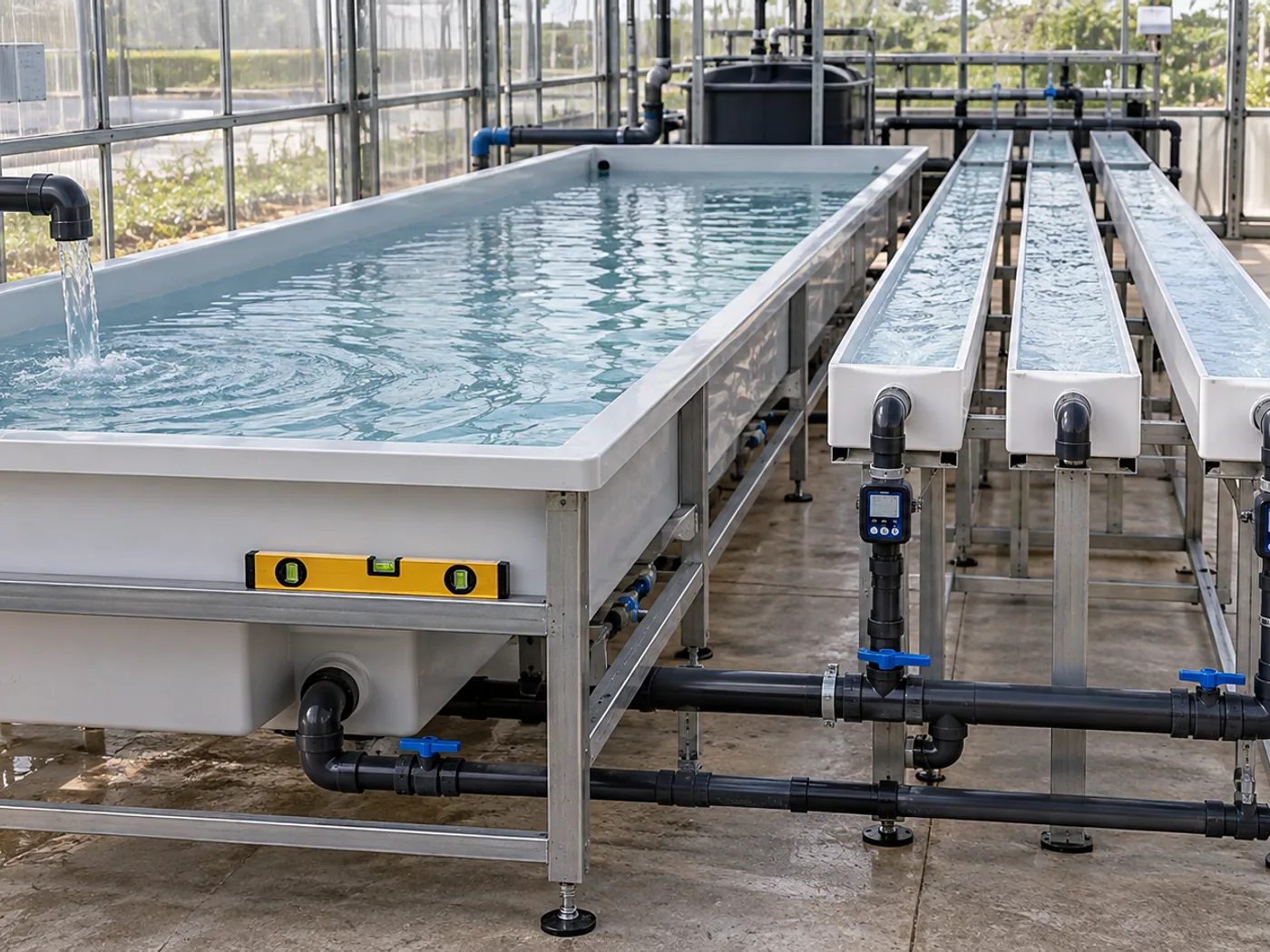
During factory testing, verify dry equipment dimensions, connection sizes, supports, pumps, valves and representative water distribution. Export shipment should contain dry, empty tanks and grow modules—never fish, operating water or growing crops. At the site, installation preparation should confirm levels, drainage, electrical protection, water treatment and nursery readiness before plants are added.
Our plant transplanting guide explains how to place seedlings without bringing excessive soil, residues or pests into the recirculating loop.
FAQ
How many plants can one fish support?
There is no responsible universal number. Fish size, daily feed, system type, crop and water treatment matter more than one fish headcount.
How many lettuce plants fit in one square metre?
Depending on cultivar and harvest size, a preliminary layout may contain about 11–25 full-head lettuce positions per square metre. Verify spacing, airflow, light and local production experience.
Can I fill every planting hole immediately?
Not in every system. Begin below planned capacity during commissioning and add plants in stages as nutrient supply, water quality and operating routines stabilize.
Do more plants make the water safer for fish?
Plants remove some dissolved nutrients, but they cannot compensate instantly for overfeeding, inadequate biofiltration, low oxygen or poor solids removal.
What happens if there are too many plants?
Plants may compete for light, space and available nutrients. Deficiencies, slow growth, uneven size, root congestion and unstable nutrient patterns can occur.
What happens if there are too few plants?
Dissolved nutrients may accumulate, especially when feed remains high, although water exchange, source water, solids removal and microbial processes also affect concentration. Diagnose the whole system.
Does NFT support more plants than a media bed?
NFT can install many compact leafy-green positions in a small footprint, but filtration, root congestion, flow distribution and power-outage response can limit practical capacity.
Should plant capacity be based on nitrate level?
Nitrate is useful but incomplete. It does not describe every essential nutrient, light, root oxygen, disease, crop stage or future feed change.
Conclusion
Aquaponics plant capacity is the lower of two limits: the number of usable planting positions and the area supported by the system’s real nutrient and operating capacity. Calculate physical sites from mature crop spacing, then compare them with daily feed, crop demand, system type, filtration, light, oxygen and production schedule.
Start below the theoretical maximum, stagger crops where practical and use operating records to expand. A design that supports consistent marketable harvests is more valuable than one that simply contains the greatest number of holes.
Final CTA — Ask for a System Capacity Review
Need a grow-module plan matched to your crops and production target? Ask for a Product Catalog and send your available area, crop list, weekly harvest goal, fish plan and delivery location.