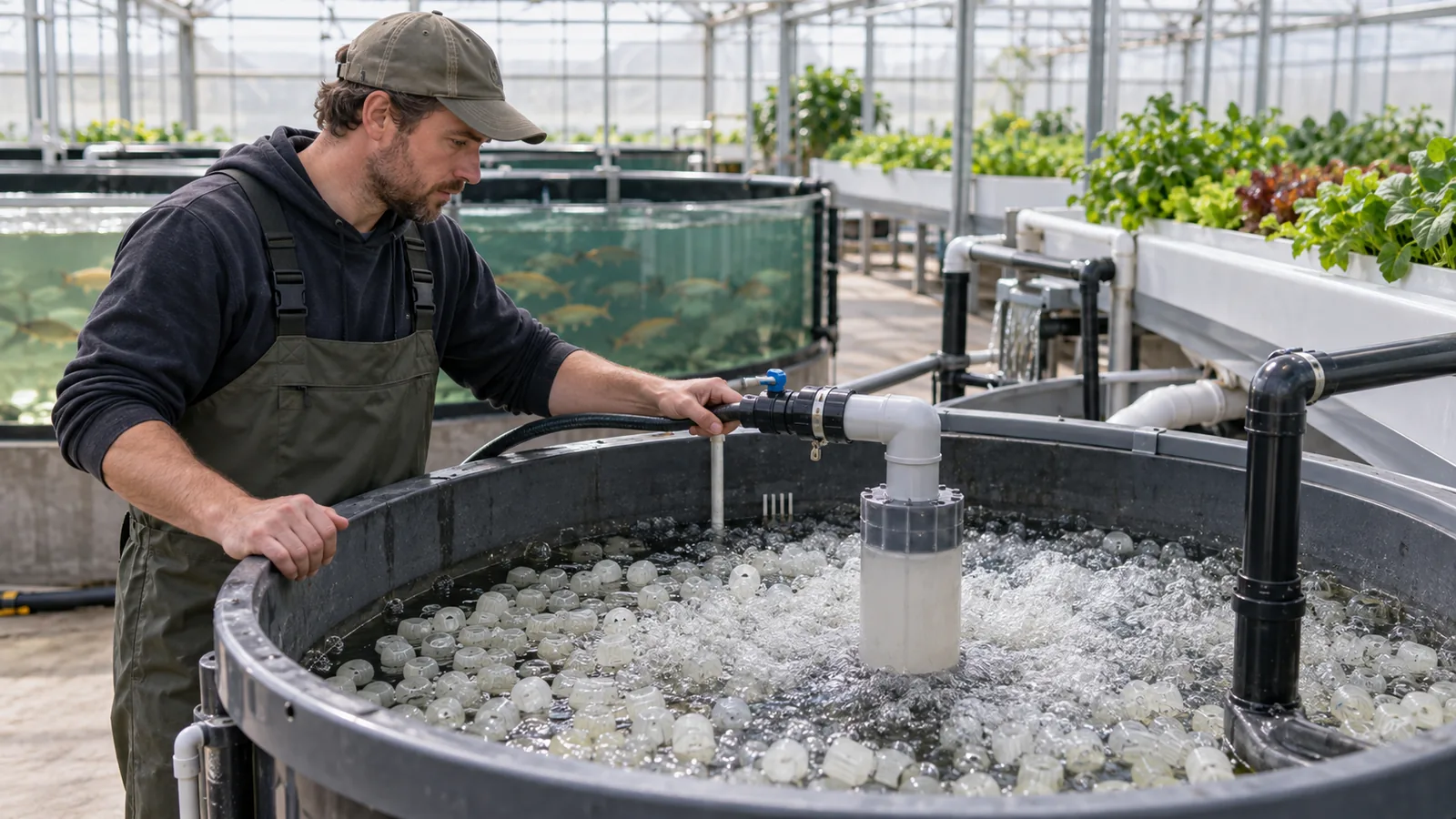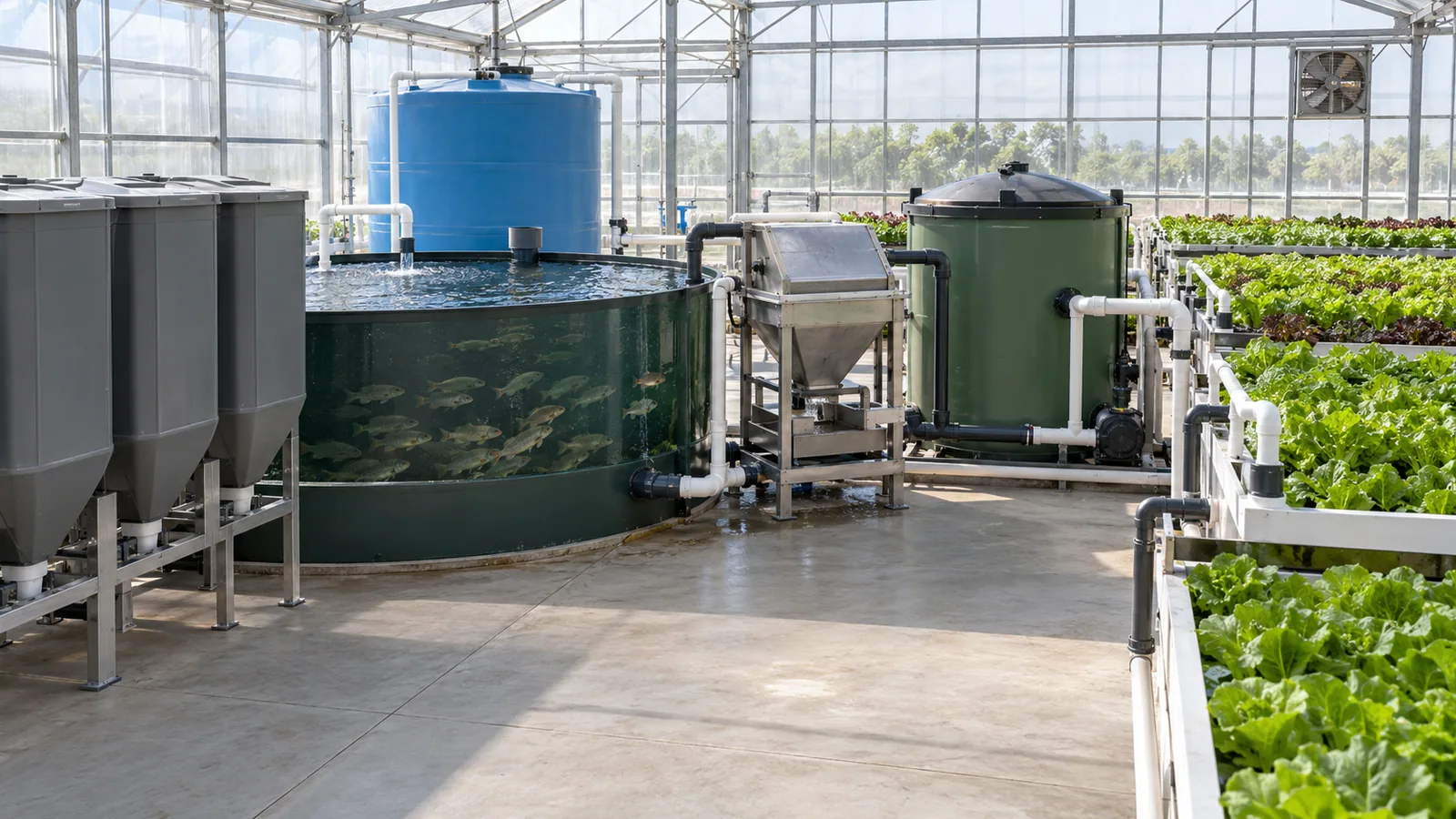
Minerals enter an aquaponics system through more pathways than fish waste alone. Fish feed is usually the main deliberate nutrient input in a coupled system, but source water can add calcium, magnesium, bicarbonate and other dissolved ions. Solid fish waste and uneaten feed can release nutrients as microorganisms break them down. pH-adjustment materials may add calcium or potassium, and targeted supplements may add iron or other elements when testing and crop observations support the decision. Equipment, grow media and contamination can also introduce unwanted substances.
Knowing where minerals come from helps operators diagnose plant symptoms without guessing. A yellow leaf does not prove the water contains too little of a particular element. The element may be present but unavailable because of pH, precipitation, root damage or low oxygen. Conversely, clear water and a normal electrical-conductivity reading do not prove that every essential nutrient is balanced.
This article maps the major mineral inputs, explains how nutrients move between solids and dissolved water, and shows what buyers and operators should document before adding products.
The short answer
Most aquaponic minerals originate from six sources:
1. fish feed and its ingredients;
2. the source or make-up water;
3. dissolved and solid waste produced after fish digest feed;
4. microbial mineralization of captured organic solids;
5. pH and alkalinity-control materials; and
6. deliberate nutrient supplements.
Smaller contributions may come from propagation media, grow-bed aggregate, dust, corrosion, cleaning residues or other unintended inputs. Once inside the system, an element may remain dissolved, bind to solids, precipitate, enter fish or plant tissue, accumulate in sludge or leave through harvest, cleaning and water discharge.
A chapter on nutrient cycling in aquaponics identifies fish feed and water inputs as the principal nutrient origins and explains why nutrient availability depends on biological and chemical transformations rather than input alone. Review the aquaponics nutrient-cycling chapter.
What does “mineral” mean in this context?
Growers often use *mineral* as a general term for inorganic nutrients needed by plants. These include macronutrients such as nitrogen, phosphorus, potassium, calcium, magnesium and sulfur, as well as micronutrients such as iron, manganese, boron, zinc, copper and molybdenum. Fish also require a suitable dietary mineral profile, but plant-water analysis and fish nutrition are not the same task.
An element can exist in several chemical forms. Plants absorb nutrient ions through roots, but not every form present in feed or sludge is immediately soluble or available. Phosphorus may bind or precipitate. Iron can become poorly available as pH and oxidation conditions change. Nitrogen moves through ammonia, nitrite, nitrate, organic matter and biomass. The total amount in the system may therefore differ from the dissolved amount that roots can access at a particular moment.
Avoid using “minerals” as a substitute for one EC or total dissolved solids value. EC reflects the combined conductivity of dissolved ions; it does not identify each element. A system can show a stable EC while potassium or iron is inadequate relative to crop demand.
1. Fish feed is the main planned nutrient input
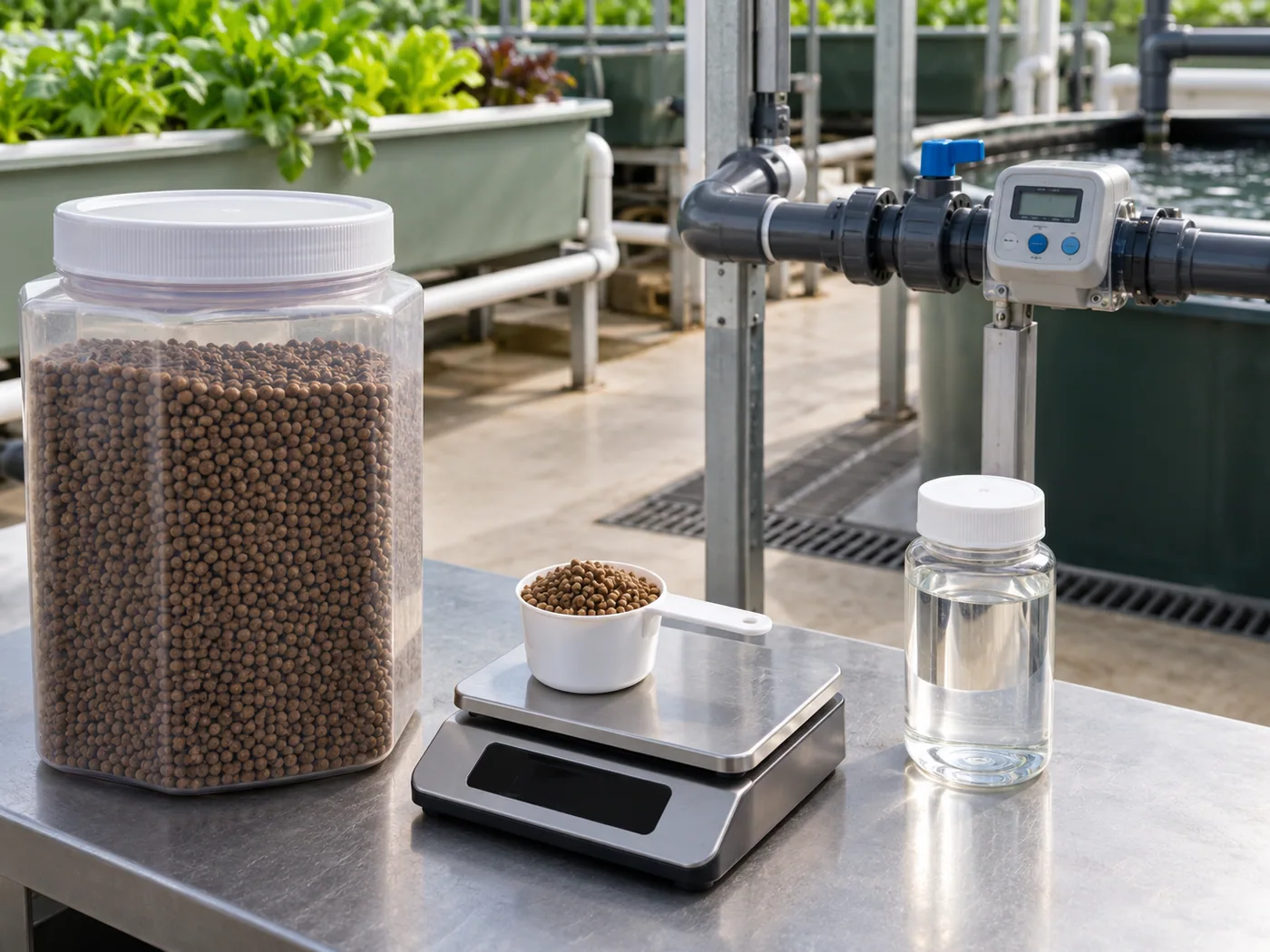
In many coupled aquaponics systems, most new nutrients enter in feed. Feed contains protein, fat, carbohydrate, vitamins, minerals, binders and moisture formulated for the fish species and life stage. Fish retain part of those inputs for growth. The remainder appears in feces, urine, gill excretion, uneaten pellets and dissolved compounds.
This does not mean that all nutrients in a feed label become plant fertilizer. Digestibility, fish growth, feed conversion, particle capture and system design change where nutrients go. Some are retained in harvested fish. Some become dissolved and circulate. Some remain in solids that are removed during cleaning. Some may be lost through gas exchange or discharge.
Feed selection is therefore both a fish-health decision and a nutrient-input decision. Do not choose feed primarily to correct plant deficiency. The first obligation is a complete, appropriate fish diet from a reliable supplier. If plants need a nutrient that feed does not provide in the required available form, address it through system management and a controlled supplement plan rather than distorting fish feeding.
Record feed brand, formulation, batch, pellet size, daily quantity and fish biomass. A change in feed can alter waste production and nutrient patterns even if the number of fish stays the same.
2. Source water can add useful or excessive minerals
Every initial fill and top-up adds whatever is dissolved in the source water. Groundwater may contain calcium, magnesium, bicarbonate, sodium, chloride, iron or other constituents. Rainwater is often lower in alkalinity but can collect roof dust and other contaminants. Municipal water may contain treatment chemicals that require appropriate conditioning before it reaches fish or biofilters.
Source-water minerals can support buffering or plant nutrition, but they can also create problems. High alkalinity may keep pH above the range where some nutrients remain readily available. Excess sodium or chloride may accumulate as water evaporates and plants transpire. Iron in raw water may oxidize and precipitate rather than remain available to crops. Seasonal changes or switching wells can alter the system without any change in feed.
Test the source water separately from recirculating system water. At minimum, the project should understand pH, alkalinity, hardness, salinity or EC, and any locally relevant treatment or contaminants. For a commercial installation, use a qualified laboratory and local water specialist to define the required panel. Keep the original report and record each source used.
3. Fish metabolism changes feed into dissolved and solid waste
Fish release ammonia primarily through the gills and generate fecal solids. Uneaten feed adds another organic load. Nitrifying microorganisms convert ammonia to nitrite and then nitrate under suitable oxygen, pH, temperature and surface-area conditions. That process makes nitrogen less acutely toxic than ammonia and produces a form widely used by plants, but it does not create every required mineral.
Solid particles contain nutrients that have not yet been released into the water. If particles accumulate on plant roots or in low-flow zones, decomposition can consume oxygen and harm the system. If they are removed too aggressively and discarded immediately, potentially recoverable nutrients leave the production loop. The correct solids strategy depends on fish load, growing method, food-safety plan, labor and the ability to manage mineralization safely.
Our guide to the role of bacteria in aquaponics explains why nitrification and broader organic-matter breakdown should not be treated as the same process.
4. Mineralization releases nutrients from captured solids
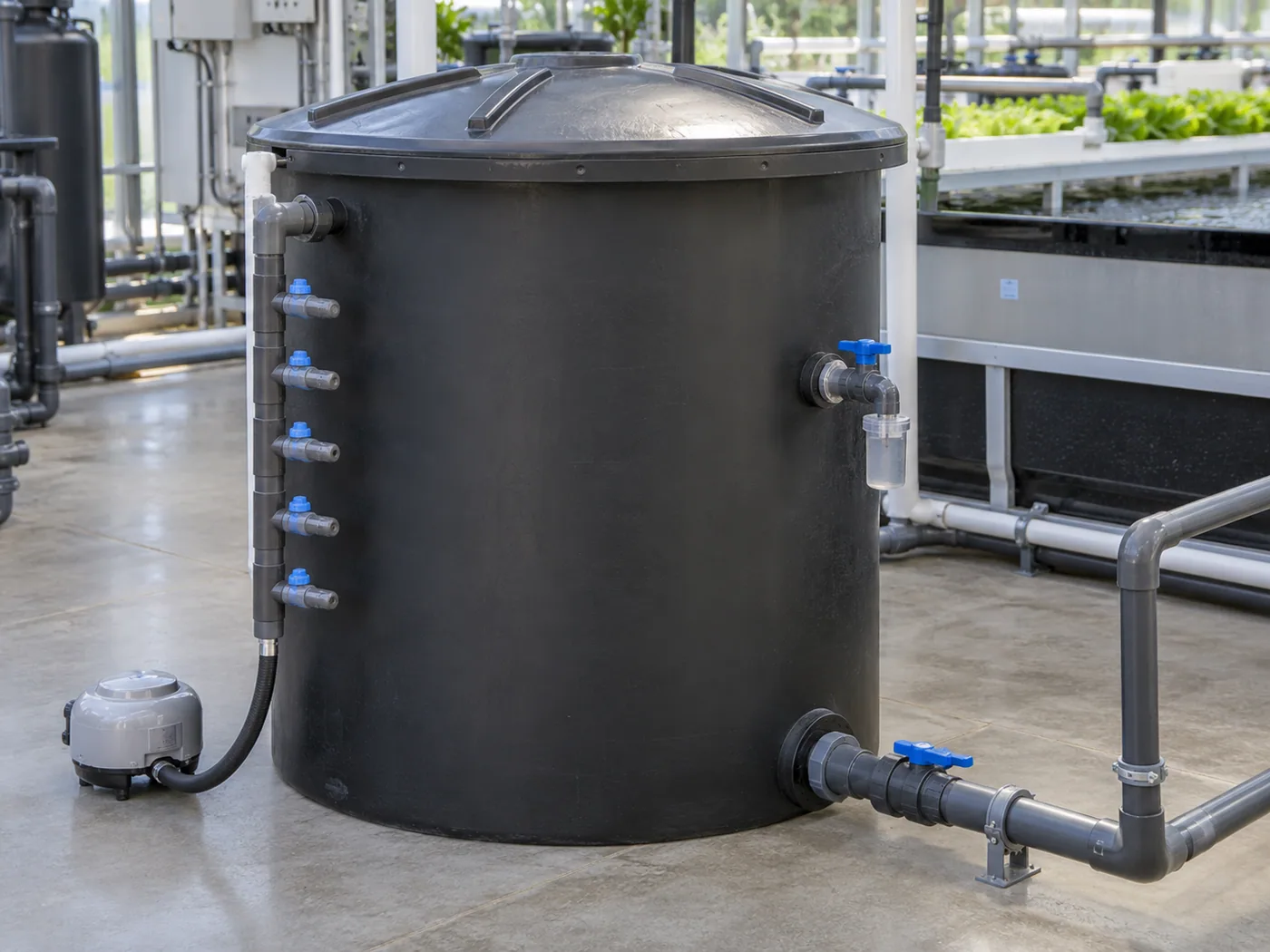
Mineralization is the microbial breakdown of organic matter into simpler dissolved forms. It may happen gradually in media beds, sludge zones or a dedicated, managed vessel. A dedicated mineralization stage can give the operator more control over aeration, mixing, retention and solids separation before liquid is returned or used elsewhere.
Mineralization is not simply storing sludge until it disappears. Uncontrolled solids can become anaerobic, produce odors, consume oxygen and release compounds at rates the plant and fish loops cannot safely accept. The process needs an operating purpose, a retention and removal plan, and measurements appropriate to the site.
The University of Vermont Sea Grant aquaponics brochure describes how bacteria in a mineralizer consume fine particles and release minerals that plants can absorb, while distinguishing this process from nitrification in the biofilter. See the UVM aquaponics system brochure.
For procurement, define whether a mineralization tank is included, what solids feed it, how it is aerated or mixed, how supernatant is handled, where settled material goes and how operators clean it. A tank without procedures is storage, not a validated nutrient-recovery process.
5. pH and alkalinity materials can add minerals
Nitrification consumes alkalinity, so many systems need controlled buffering over time. Depending on the approved operating plan, calcium- or potassium-based materials may be used to support pH and alkalinity while contributing those plant nutrients. The amount added must be governed by measured water chemistry and product identity, not by a desire to fertilize quickly.
Different compounds behave differently. A product labeled “potassium” may be a hydroxide, carbonate, bicarbonate, sulfate or another form with its own pH, alkalinity and safety implications. The label concentration, purity, contaminants and destination-market rules matter. Never add an unidentified powder to fish water.
Separate the question “Does the system need alkalinity?” from “Does the crop need potassium or calcium?” One input may influence both, but a safe pH correction may not provide the crop ratio desired, and a nutrient supplement may alter pH or salinity. Document the primary purpose of each addition.
6. Targeted supplements fill demonstrated gaps
Aquaponics may require carefully selected supplements, commonly discussed for iron, potassium or calcium depending on crop, feed, source water and operating conditions. A supplement should have a clear chemical identity, guaranteed analysis, application instructions, storage conditions and supplier documentation. Confirm whether it is suitable for a recirculating fish-and-food-crop system and compliant with local rules.
Symptoms alone are insufficient. Interveinal chlorosis, tip burn, weak stems, poor flowering and marginal scorch can have multiple causes. Check root health, oxygen, pH, temperature, light, pests and water movement before concluding that an element is low. When measurement is warranted, define whether the question concerns dissolved water, total recoverable material or plant tissue.
Our guide to ordering aquaponics supplements and additives provides a procurement checklist for product identity, documentation and shipping.
7. Media and equipment may release minerals—intentionally or not
Some grow-bed rocks can dissolve carbonate minerals and raise alkalinity and pH. Metal components may corrode. Concrete that has not been evaluated or conditioned can influence water chemistry. Galvanized surfaces, unsuitable recycled plastics, sealants, coatings and dust may introduce substances that are not part of the nutrient plan.
Use food-contact and aquatic compatibility requirements appropriate to the project. Approve a representative sample of aggregate and check its source, grading, fines and chemical behavior before purchasing a full shipment. A quick household test may flag obvious carbonate reaction, but it does not replace a documented material specification or water analysis where risk is significant.
“Natural” does not mean inert. A mineral released by media can be beneficial, neutral or harmful depending on its identity, rate and the system’s existing chemistry.
8. Unintended inputs also count
Dust, fertilizer from a nearby crop zone, overspray, dirty tools, contaminated top-up hoses, pest-control residues and cleaning chemicals can all enter an open system. The same is true of nursery media carried on transplant roots. These inputs are often intermittent, making them difficult to diagnose from a single sample.
Create physical separation between chemical storage, nursery runoff, floor drainage and fish water. Label measuring tools and do not use the same scoop for feed, lime and cleaning products. Record unusual events such as construction dust, a new source-water tank, roof runoff or a spilled product. Traceability is a practical control, not paperwork for its own sake.
What happens after minerals enter?
Dissolution and circulation
Some compounds dissolve and move with the recirculating water. Distribution depends on mixing, flow and the point of addition. Adding a concentrated product to a low-flow fish tank can create a damaging local exposure even if the calculated whole-system concentration appears modest.
Biological uptake
Plants absorb ions according to species, growth stage, light, temperature, root health and concentration. Fish and microorganisms also retain elements in biomass. Harvest removes those nutrients from the loop.
Precipitation and adsorption
Elements can form insoluble compounds or bind to surfaces and organic matter. A nutrient can therefore be present in total analysis but low in the dissolved fraction available to roots. pH is a major influence, but it is not the only one.
Accumulation and removal
Water loss through evaporation removes water but leaves most dissolved salts behind. Repeated additions can cause accumulation. Conversely, filter cleaning, sludge removal, crop harvest and water discharge remove material. A useful nutrient balance accounts for inputs and outputs over time.
Build a mineral-source map
Create a simple table for every routine input:
| Input | Information to record | Possible mineral contribution | Main control |
|---|---|---|---|
| Fish feed | Brand, batch, daily mass, guaranteed analysis | Many macro- and micronutrients | Feed log and fish performance |
| Source water | Laboratory report, volume added, season | Calcium, magnesium, alkalinity, sodium and others | Separate source-water testing |
| Captured solids | Origin, mass or volume, retention | Organic-bound nutrients | Solids and mineralization procedure |
| pH material | Exact compound, concentration, dose | Calcium, potassium or carbonate species | pH/alkalinity log and controlled dosing |
| Supplement | Guaranteed analysis, form, lot, dose | Targeted element(s) | Approval and measurement plan |
| Media/equipment | Material specification, batch, condition | Carbonates, metals or contaminants | Sample approval and inspection |
The table will not calculate every nutrient concentration, but it helps operators identify what changed before a symptom or test result appeared.
Measurement and diagnosis
Routine aquaponics testing often prioritizes temperature, pH, dissolved oxygen, ammonia, nitrite, nitrate and alkalinity. A broader nutrient panel may be useful when crop symptoms persist, a commercial crop specification requires it, source water changes or supplementation decisions carry significant cost and risk.
Choose the analytical question first. A filtered water sample can represent dissolved nutrients; an unfiltered or digested sample may include material associated with particles. Plant tissue analysis reflects what accumulated in sampled tissue under defined conditions. These results are related but not interchangeable.
Use the laboratory’s containers, preservation instructions, holding times and chain-of-custody requirements. Sample from repeatable locations after normal mixing, not immediately beside a supplement addition. Record feed, top-up water, pH corrections, filter cleaning and crop stage around the sample date.
Coupled and decoupled systems handle minerals differently
In a coupled loop, fish, filters and plants share recirculating water, so a crop-side addition can return to fish. Product selection and dosing must protect the most sensitive component. A decoupled design may allow separate crop-water adjustment, but it also introduces more tanks, controls, records and transfer decisions. Separation is not permission to ignore water chemistry.
Define where each input is allowed and who approves it. Use dedicated dosing equipment and prevent backflow. If mineralized liquid moves from a fish-solids process to the plant loop, specify quality checks and volumes rather than transferring by appearance.
Factory testing, shipment inspection and customer requirements
Factory testing can confirm pumps, mixers, sensors and dosing controls operate as specified with clean test water. It cannot prove the future mineral profile of a biological system because that profile depends on local feed, fish, source water, crops and management.
During shipment inspection, verify the mineralization vessel, aeration components, sampling valves, compatible tubing, storage containers, meter accessories and spare parts against the approved list. Tanks and pipes should ship dry and clean, without fish, nutrient solution or plants. Chemical products require separate documentation, packaging and transport review; do not place unidentified supplements inside system tanks.
Installation preparation should identify the local laboratory, source-water report, approved fish feed, planned crops, allowed pH materials, supplement approval process and responsible operator. Customer requirements should state whether the supplier is providing only equipment, a commissioning checklist, water-testing guidance or ongoing agronomic support.
Mid-article CTA — Map Your System Inputs
Send Your Requirements with your water source, fish species, feed information, crops, grow method and current treatment plan. We can help organize the equipment and sampling questions for a clearer project discussion.
Common mistakes
- Assuming fish waste provides every crop nutrient in the required ratio.
- Treating EC as a complete mineral analysis.
- Adding a supplement based only on leaf color.
- Ignoring source-water changes and top-up volume.
- Letting captured solids become uncontrolled anaerobic sludge.
- Using pH-adjustment chemicals without recording their nutrient contribution.
- Approving aggregate or metal parts without checking water compatibility.
- Sampling immediately beside a dosing point.
- Comparing filtered and unfiltered laboratory results as if they were identical.
- Claiming factory testing proves future biological nutrient balance.
FAQ
Do all aquaponic minerals come from fish waste?
No. Feed is often the main planned input, but source water, pH-control materials, supplements, media and unintended contamination can also add elements. Fish waste is one stage in the path from feed to dissolved and solid nutrients.
Does mineralization happen automatically?
Organic matter breaks down naturally, but useful, controlled mineralization requires oxygen, mixing or retention appropriate to the process, solids management and a plan for the remaining residue. Unmanaged sludge can reduce oxygen and create water-quality problems.
Can EC tell me which minerals are present?
No. EC measures overall ionic conductivity. It cannot separate potassium from calcium, sodium, nitrate or other ions. Specific elements require suitable analytical methods.
Why can plants show deficiency when a mineral is present?
The element may be in an unavailable form, precipitated, bound to solids or poorly absorbed because of pH, root damage, low oxygen, temperature or competing ions. Tissue demand and crop stage also matter.
Do pH buffers add nutrients?
Some do. Calcium- or potassium-based compounds can contribute those elements while changing pH or alkalinity. Record the exact compound and amount rather than treating all buffers as equivalent.
Should solids always be returned after mineralization?
Not automatically. The decision depends on process control, oxygen, pathogen and food-safety considerations, water quality, residue handling and the design of the fish and plant loops. Follow the approved site procedure.
Conclusion
Minerals enter aquaponics through feed, water, waste transformation, buffering materials, supplements and construction or growing materials. The important management question is not only what entered, but in what chemical form, where it moved, what became available to plants and what accumulated or left the system.
Build a source map, keep feed and water records, manage solids deliberately and use targeted testing when the decision requires it. This approach is more trustworthy than treating every crop symptom as a request for fertilizer. It also gives buyers a clearer basis for specifying mineralization equipment, sampling points, dosing controls and operating support.
Final CTA — Ask for a Mineral-Input Checklist
Contact YAFAN with your system layout, source-water analysis, feed plan, crops and intended supplements. We can help prepare an equipment inquiry and commissioning checklist that separates supplier scope from site water and crop-management responsibilities.