
Introduction
Buying an “aquaponics supplement” online can look simple: a product image, a large bag, a promise of greener leaves. In a working aquaponics system, however, an addition reaches a shared water loop that affects plants, fish, nitrifying bacteria, filters and sometimes food-production records. That is why a product suitable for conventional hydroponics, ornamental ponds or soil crops is not automatically suitable for an aquaponics system.
The safest procurement approach is evidence-first. Identify the actual problem, verify it with system records or suitable testing, identify the product’s ingredients and intended use, confirm its compatibility with the whole system, and keep a traceable record of what arrived and what was used. This article is a purchasing and verification guide; it is not a universal dosing recipe or a substitute for fish-health, food-safety or local regulatory advice.
The short answer
Order a nutrient supplement or additive only when you can identify the manufacturer, complete product name, active ingredients, concentration, intended application, safety documentation, lot or batch information, storage conditions and supplier contact. Prefer a product supported for aquaponics or for the specific shared-water use proposed. Do not use an unclear “all-purpose” additive, a repackaged product without a label, or an online recommendation as proof that a product is safe for your fish, plants and market.
First identify what you are trying to correct
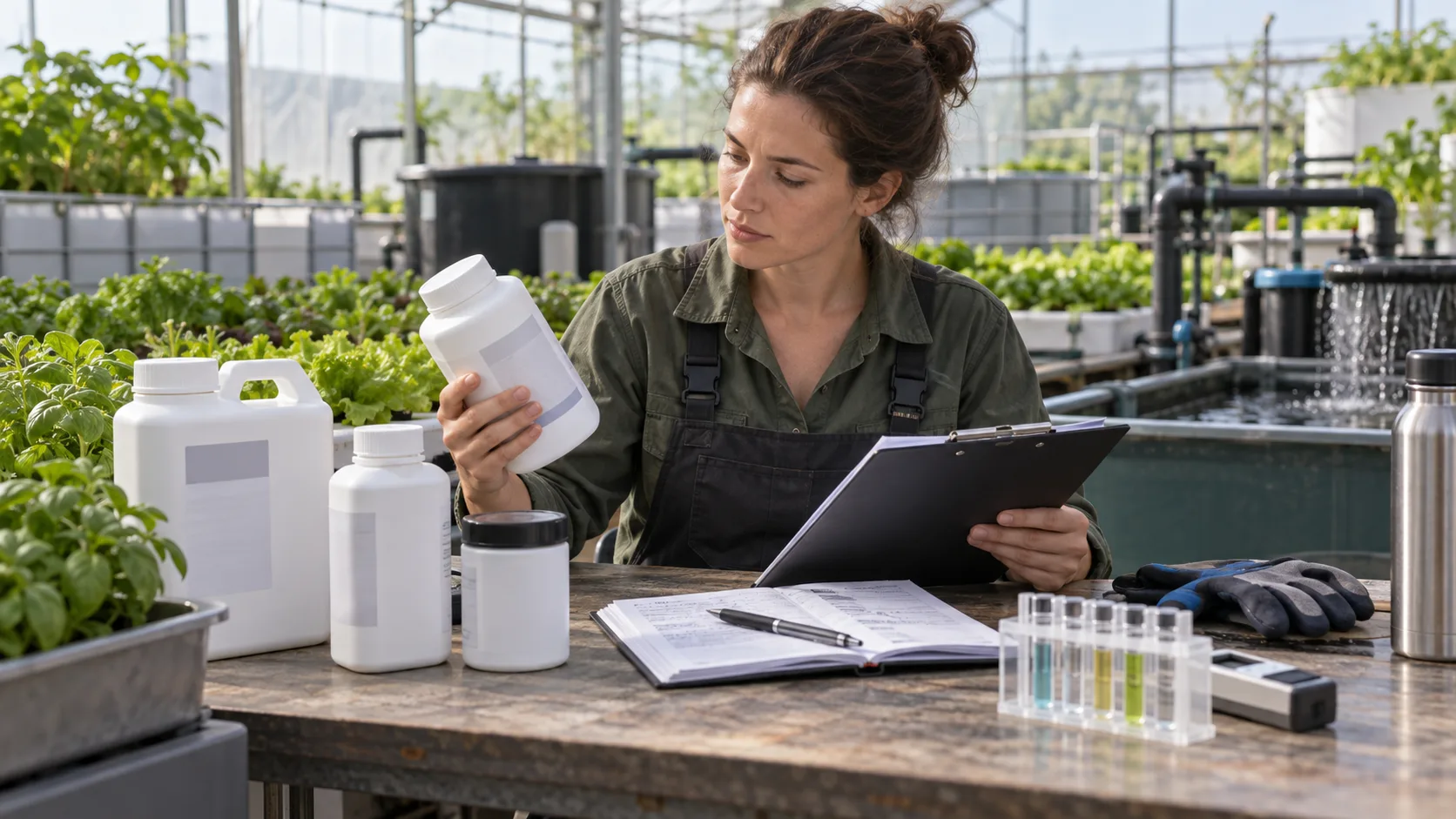
Yellow leaves, slow growth, brown edges and poor flowering can have many causes. Light, crop age, root health, water temperature, pH, dissolved oxygen, feed input, pest pressure, source water, salinity and flow distribution may all be involved. Buying a supplement before identifying the cause can introduce an unnecessary compound while missing the actual problem.
Begin with a dated observation: crop, variety, planting date, location, visible symptoms, water temperature, pH, ammonia, nitrite, nitrate, feed rate, recent water additions, weather or room conditions and any maintenance or product application. Compare one affected zone with a healthy zone when possible. A plant issue at the end of one channel may indicate flow or root restriction, not a nutrient shortage.
Some systems do need targeted supplementation. New Mexico State University notes that fish feed supplies many plant nutrients but that calcium, potassium and iron can be limiting in aquaponics; it also stresses the importance of balancing conditions for fish, bacteria and plants. Read its water-quality parameters guide as a technical reference, then adapt decisions to the particular site rather than copying a number from a forum.
Classify the product before adding it to a cart
Online listings often combine very different products under the word “additive.” Separate them before comparison.
Nutrient supplements and pH-related materials
These may supply a mineral nutrient, change pH or alkalinity, or do both. Their suitability depends on chemical form, concentration, water conditions and how the product is used. A supplier should provide the exact analysis—not only a claim such as “plant booster.” A product used to correct pH can change nutrient availability and may add ions that accumulate over time.
Water conditioners and source-water treatments
These are intended to address a known source-water issue or preparation step. Their compatibility cannot be assumed from a hydroponic label. Request the intended-use statement and do not introduce a conditioner to a live fish system simply because it is popular in an aquarium or garden setting.
Biological, microbial and enzyme products
Claims for bacteria blends, mineralizers, sludge treatments or “beneficial microbes” need careful reading. Ask what organism or ingredient is actually present, whether the product is meant for aquaculture, whether it has a shelf-life or temperature requirement, and what evidence supports its stated use. A named product category is not a substitute for correcting a clogged filter, low aeration or poor solids management.
Pest, cleaning and sanitation products
Do not treat these as nutrient additives. A cleaning chemical, pesticide, algaecide, fragrance or surface treatment can create direct risks if it reaches fish water. Keep product decisions separated and follow local labels and professional advice for any pest or sanitation situation. Our safe pest-control guide explains why crop protection must keep aquatic exposure in view.
Build a supplier-document checklist
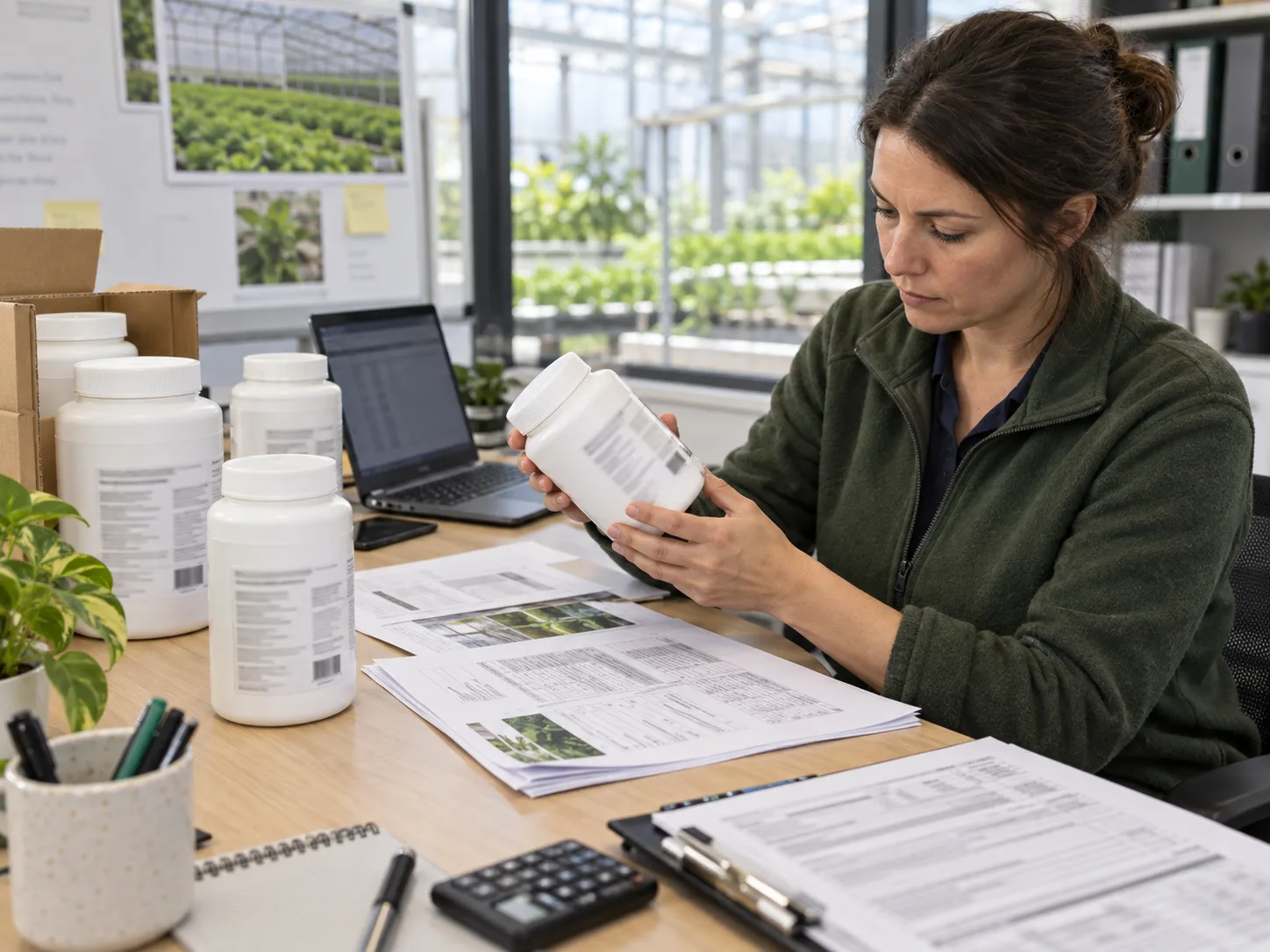
Before checkout, obtain or save the documents that connect an online listing to a traceable product. A reputable seller should be able to provide most of the following without improvisation:
1. Manufacturer and complete trade name.
2. Product analysis, ingredient statement or guaranteed composition.
3. Label directions and intended application.
4. Safety Data Sheet where relevant.
5. Lot or batch identification and expiry or manufacture date.
6. Storage temperature, sunlight and moisture requirements.
7. Package weight, seal type and transport restrictions.
8. Contact for technical questions and product complaint process.
9. Statement of aquaponics, aquaculture, hydroponics or other intended compatibility—if the manufacturer makes one.
10. Country-of-origin and import documentation where required.
If a marketplace listing contains only a photo of a generic pouch, a product benefit and reviews, pause. Ask for the original label and technical documentation. Do not accept a cropped screenshot as the only evidence of composition. In commercial purchasing, save a PDF or dated web copy in the procurement file because web listings can change after an order is placed.
Verify ingredient identity and system compatibility
Read the chemical form, not just the nutrient name
“Iron,” “calcium” or “potassium” is incomplete information. The carrier, chelate or related compound can influence solubility, pH interaction, storage, availability and fish exposure. Ask the manufacturer which exact form is supplied, the concentration, any other constituents and the water-condition range for the product’s stated use. Never assume two containers with the same headline nutrient have the same behaviour.
For example, the University of Florida’s technical note on micronutrients explains why nutrient trends can differ between systems and why testing and interpretation matter. Its aquaponics micronutrient guidance is particularly useful because it warns that a symptom or single reading does not justify indiscriminate additions.
Check the whole shared loop
Before a product enters the system, ask four questions:
- Is it appropriate for the selected fish and life stage?
- Can it affect nitrifying bacteria, biofilter media, solids equipment, pipework or sensors?
- Is it consistent with crop-use, harvest and certification requirements at this site?
- What happens if an operator uses the wrong amount or applies it twice?
The answer may require the manufacturer, an aquaculture professional, an Extension adviser or the local authority—especially for food production. A credible supplier will acknowledge the boundary of its product information instead of claiming compatibility with every fish, crop and water condition.
If the project uses organic language or makes market claims, do not infer compliance from a natural-sounding ingredient. See our organic aquaponics fish guide for the difference between system practice, documentation and a lawful certification or label claim.
Compare listings on total procurement risk
The cheapest bag can become expensive if it cannot be traced, is delayed by transport, arrives heat-damaged or cannot be identified later. Compare suppliers with a simple table: delivered price, concentration, net contents, label clarity, batch information, expiry, shipping method, handling restrictions, return route, technical contact, evidence of original manufacture and delivery lead time.
Check whether the order is shipped directly by the manufacturer, an authorised distributor or an unknown marketplace seller. This does not mean marketplaces are automatically unacceptable, but it changes the verification work. Request a current photograph of the actual labelled unit when the product is high-value, controlled, imported or important to a commercial crop schedule.
For repeat orders, retain the approved product specification and compare every new listing with it. A seller may change the pack size, formula, manufacturer or fulfilment source without changing a familiar product title. A purchase order should identify the product by full name, analysis and pack size—not by a vague phrase such as “iron additive.”
Handle delivery, storage and receiving correctly
Before dispatch
Ask the seller to confirm that the ordered batch is within its stated shelf-life and will be packed to remain dry, sealed and protected from extreme heat or freezing where those conditions matter. For cross-border orders, clarify customs classification, import restrictions, documentation, duties and whether the product can be transported by the intended carrier. Do this before placing an urgent order, not when a crop symptom has already become severe.
Avoid adding untested new products as an emergency response to a delivery delay. A temporary shortage should trigger a documented technical review, not an impulse substitution from a local shelf.
Shipment inspection
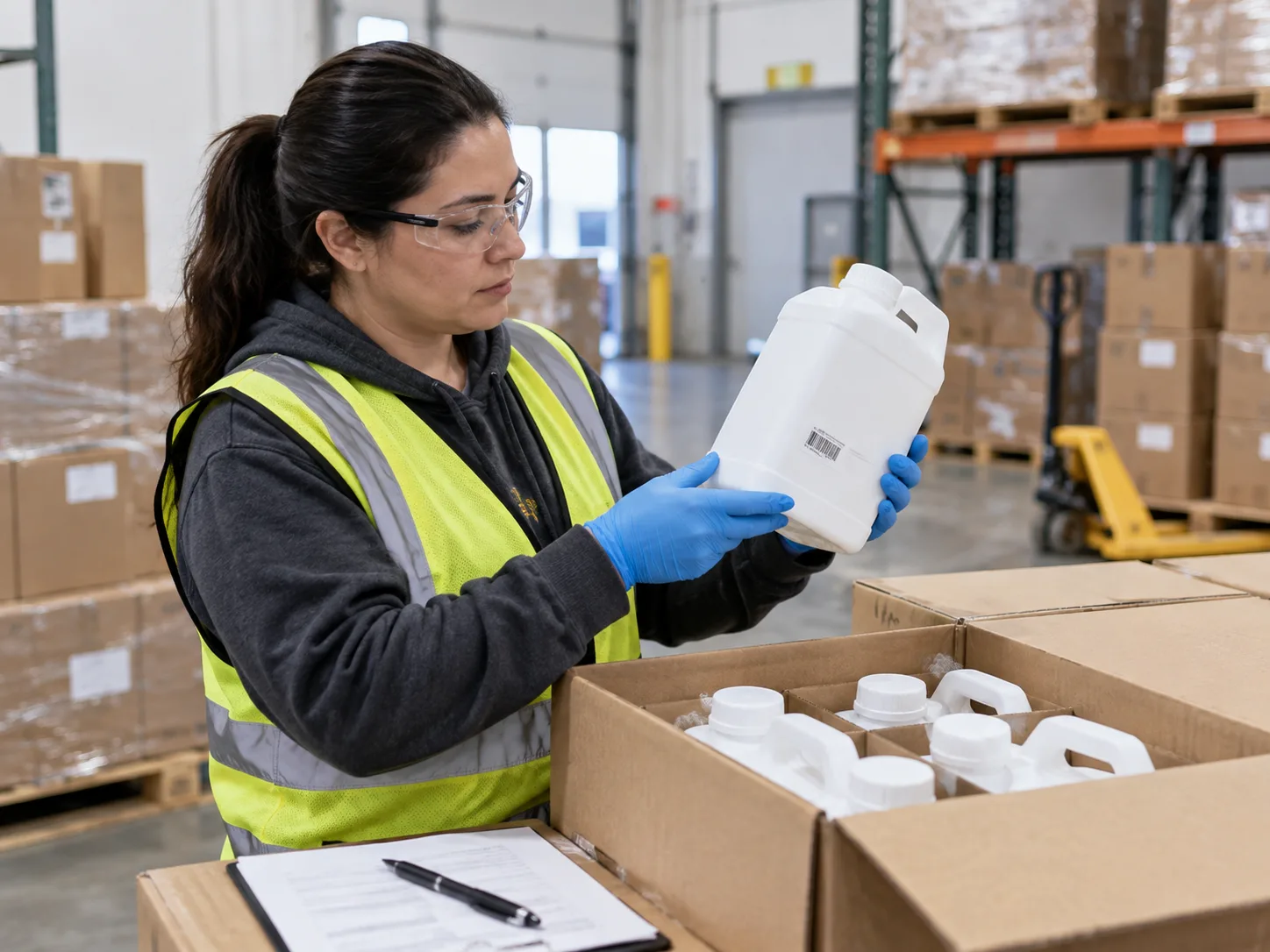
At receiving, inspect the outer carton, inner seal, label, lot number, expiry date and quantity before accepting the shipment into stock. Photograph leaks, punctures, unclear labels, moisture exposure or mismatched containers immediately. Keep damaged or questionable containers isolated; do not decant them into an unlabelled bottle just to save space.
For a system-equipment shipment, nutrient products should be packed separately from tanks, pumps, pipework and electrical controls. Container-loaded aquaponics equipment should remain dry and empty; it should not be shown as a live, planted system in a freight photograph. This separation simplifies both shipment inspection and safe storage.
Storage and inventory
Store containers according to their label, away from feed, food-contact items, sunlight, moisture, children and unauthorised access. Keep the label readable. Use a first-expiry-first-out routine and record receipt date, lot, storage location and responsible person. A small controlled inventory is safer than several unidentified half-used containers.
Add only through a documented operating decision
This is not a dosing guide. The correct product, amount, mixing method, timing and re-test interval depend on the identified need, tank volume, water chemistry, fish species, crop, product formulation and local technical advice. Never pour an unfamiliar concentrate directly beside fish or into a stagnant section. Use the product label and qualified advice to define safe handling and application.
Before any authorised addition, record the reason, evidence, product name, lot, amount, location, responsible person, time, expected observation and follow-up test. If a product needs pre-dissolving or controlled application, use dedicated clean equipment and label it. Recheck the relevant measurements and observe fish and plants according to the site plan. If an unexpected response occurs, stop repeating the addition and seek qualified help.
Keep application tools separate from food-handling tools and from ordinary cleaning equipment. A labelled measuring container, scale or mixing vessel supports repeatable records and prevents a concentrate from being mistaken for a harmless household material. Once a product container is empty, retain the label or a digital copy with the lot record before disposing of the packaging according to local instructions. These basic controls matter most when several workers share the same greenhouse or when the project has a formal traceability requirement.
This discipline helps distinguish a genuine product effect from a coincidental change in feed, weather, pH, planting density or maintenance. It is also valuable when customer requirements demand traceability or when a team changes shift.
Mid-article CTA
Need a procurement-ready additives checklist? Send your crop, fish species, water source, existing product labels and destination country. Send Your Requirements before you place an order.
Avoid these online purchasing mistakes
Buying from symptom photos alone
Leaf appearance can be a useful clue but not a complete diagnosis. Check water quality, roots, flow, pH, crop history and recent management before selecting a product.
Treating “hydroponic” as proof of fish safety
Hydroponic nutrient formulations are built for a different operating context. A shared fish-and-plant loop needs a separate compatibility review.
Choosing a product without a batch or label
Without a traceable label, it is difficult to confirm what entered the system, manage a recall, reorder accurately or investigate a problem.
Ordering more than can be stored safely
Large packs may lower unit price but create expiry, moisture, handling and inventory risks. Buy a sensible quantity based on verified use and storage capacity.
Using a supplement to hide a design problem
An imbalanced feed-to-plant relationship, poor solids removal, unsuitable water source, blocked channel or inadequate light will not be solved reliably by repeated additions. Correct the operating cause before building a dependency on a bottle or powder.
FAQ
Are all hydroponic nutrients safe for aquaponics?
No. A product must be evaluated for the shared fish, plant and bacterial system. A hydroponic use statement alone does not establish fish safety or compatibility.
What should I request from an online seller?
Request the original label, ingredient or analysis statement, Safety Data Sheet where relevant, lot information, expiry, storage instructions and a technical contact. Save the documents with the order record.
Can I buy a large quantity to save on shipping?
Only if it can be stored safely within shelf-life and the project has a verified need. Large inventory is not a saving if it becomes untraceable, degraded or unusable.
Should I use a product immediately after delivery?
Not automatically. First verify the received product, lot, condition and documented need. Follow the product instructions and site operating plan; seek qualified advice where fish welfare, food production or uncertain compatibility is involved.
Conclusion
Responsible online procurement begins long before a container is opened. Diagnose the need, verify the exact product, document compatibility, inspect the shipment and retain a clear application record. This protects fish, plants, operators and the credibility of the finished crop. It also creates a cleaner conversation with suppliers: they can respond to a product name, batch, water record and observed need rather than a vague request for a miracle additive.
Final CTA
Ask for an Aquaponics Additives Procurement Checklist. Contact Us with your system type, fish and crop plan, country, source-water information and the product you are considering. We will help you define the records and supplier questions needed for a safer order.

