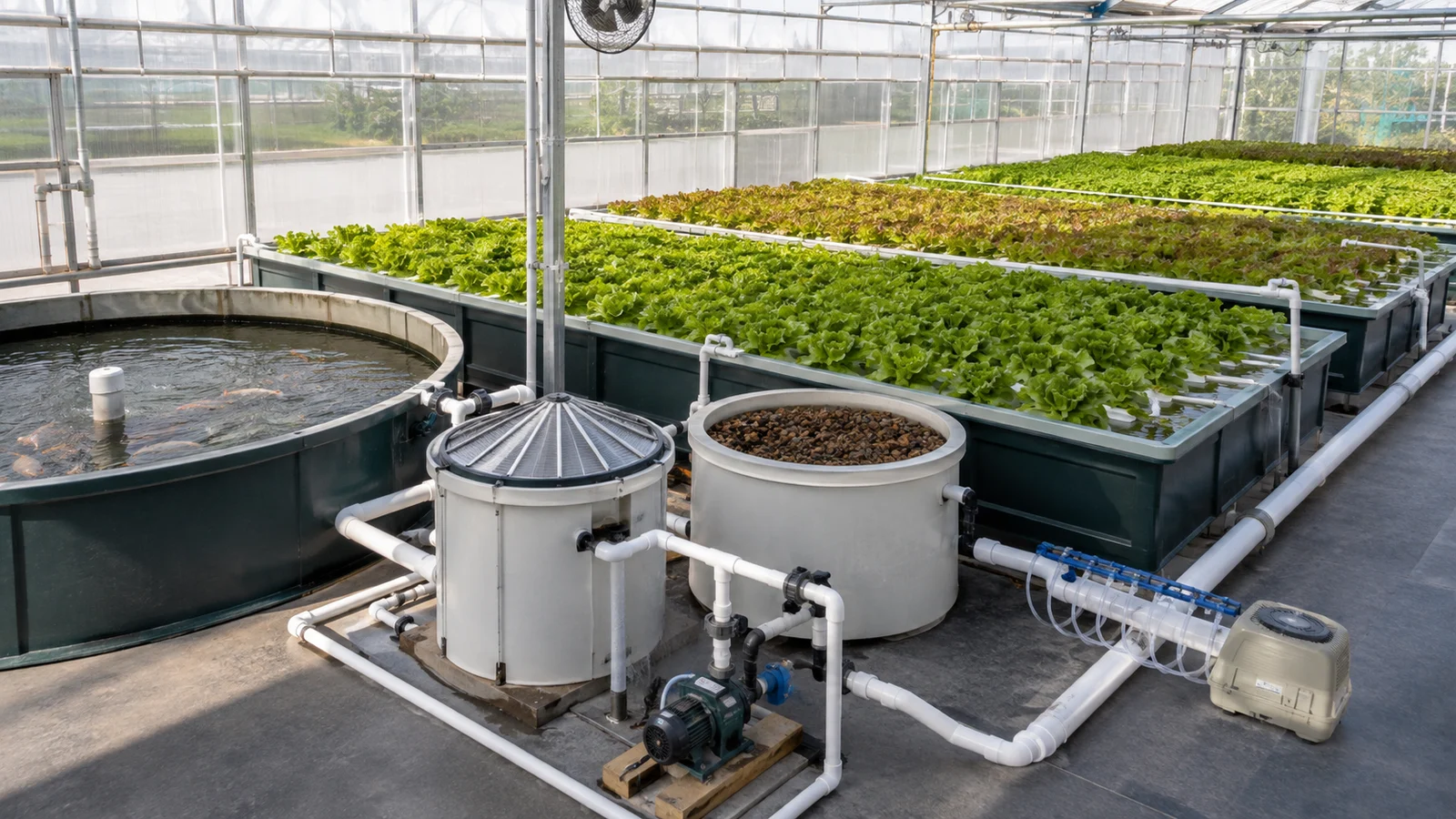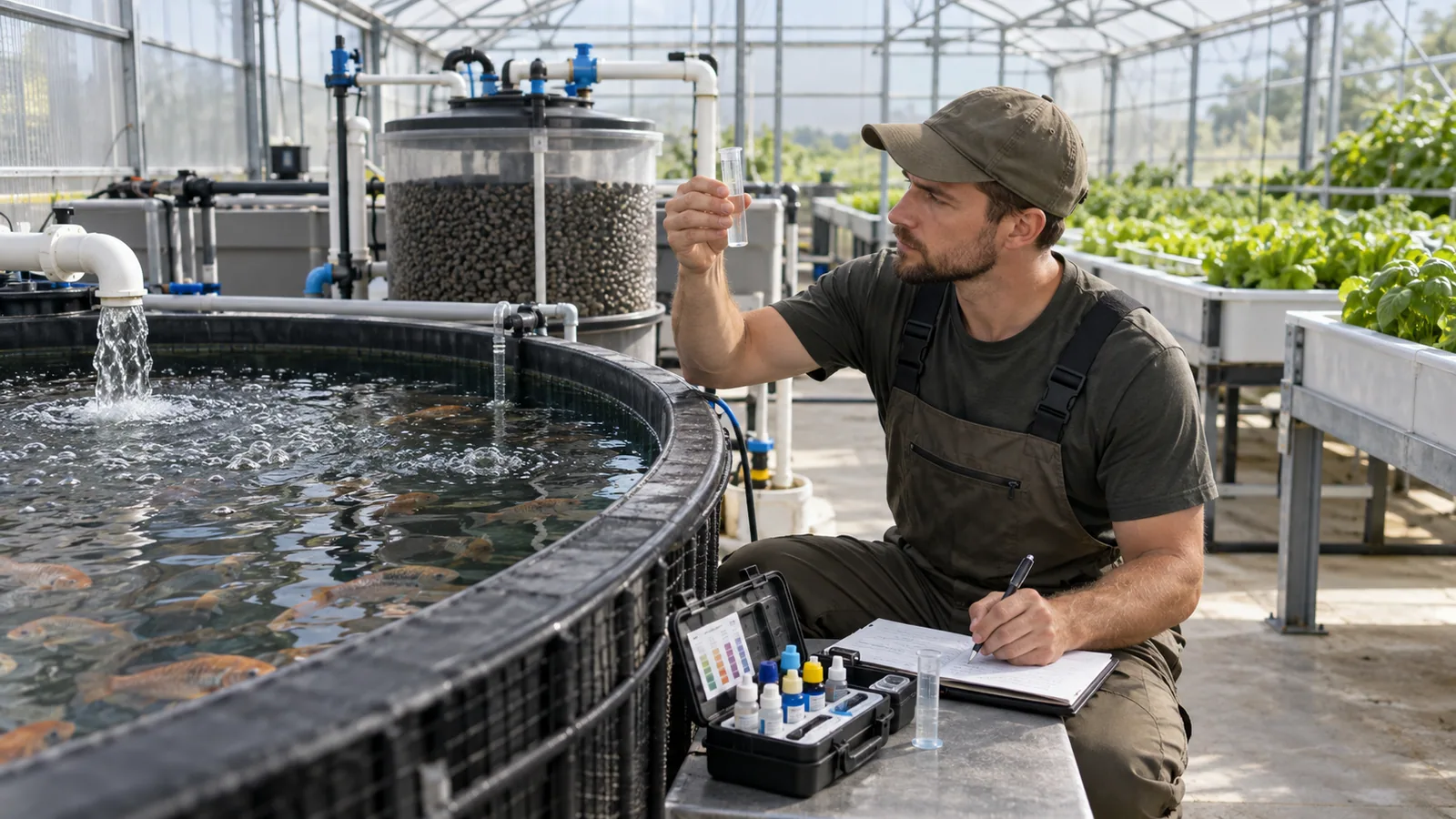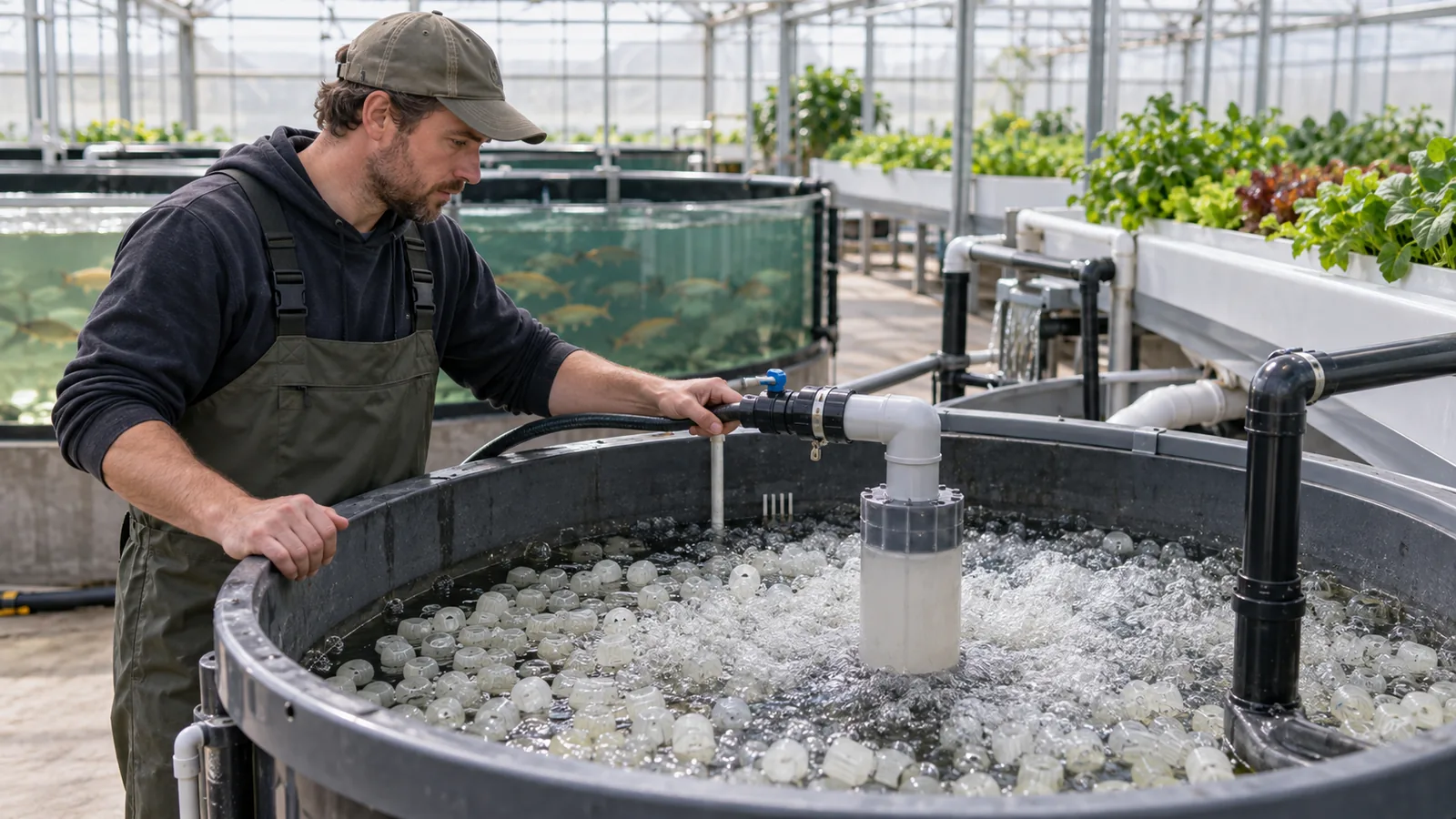
Bacteria are the biological workforce that makes recirculating aquaponics possible. Fish release waste, feed creates dissolved nitrogen compounds, and plants cannot safely use every form of nitrogen that appears first. Beneficial microorganisms living on wet, oxygenated surfaces convert those compounds into forms that are less harmful to fish and more useful to plants.
That description is simple, but the practical implication matters: bacteria are not an optional additive. They are part of the treatment process. A pump, solids filter, aeration device, grow bed, and biofilter all need to be designed and operated so that a stable microbial community can live on them. For the full water-and-nutrient loop, see our guide to how an aquaponics system works.
The short answer
In an aquaponics system, nitrifying bacteria primarily convert toxic ammonia from fish waste into nitrite and then nitrate. Nitrate is generally the nitrogen form plants can use most readily. The bacteria grow as biofilms on media and other submerged surfaces; they need oxygenated water, a usable surface area, and reasonably steady operating conditions.
Research on recirculating aquaculture and aquaponics shows that microbial communities establish in biofilters and other system compartments, rather than simply floating in the water. A practical system therefore needs biological filtration designed as a living process, not just a tank filled with media. This peer-reviewed review of aquaponic microbial ecology and Ohio State University South Centers' aquaponics overview are useful starting references for operators planning that process.
The nitrogen conversion sequence: why bacteria matter to fish and plants
The most important bacterial role is nitrification. It links fish production and plant production through a sequence of conversions:
1. Fish metabolize feed and release ammonia through their gills and waste.
2. One group of nitrifying microorganisms oxidizes ammonia to nitrite.
3. Another group converts nitrite to nitrate.
4. Plant roots take up some nitrate and other dissolved nutrients while the system recirculates.
Ammonia and nitrite can become dangerous for fish when they accumulate. Nitrate is not a license to ignore water quality, but it is usually the more plant-useful end product of the nitrification pathway. The exact speed and stability of the process vary with feed rate, stocking density, water temperature, dissolved oxygen, pH, alkalinity, filter capacity, and the age of the biofilter.
For an operator, the key lesson is that water can look clear while biological filtration is under pressure. Water tests, fish behavior, feed changes, temperature shifts, and pump performance provide a more reliable picture than appearance alone.
Where do beneficial bacteria live?
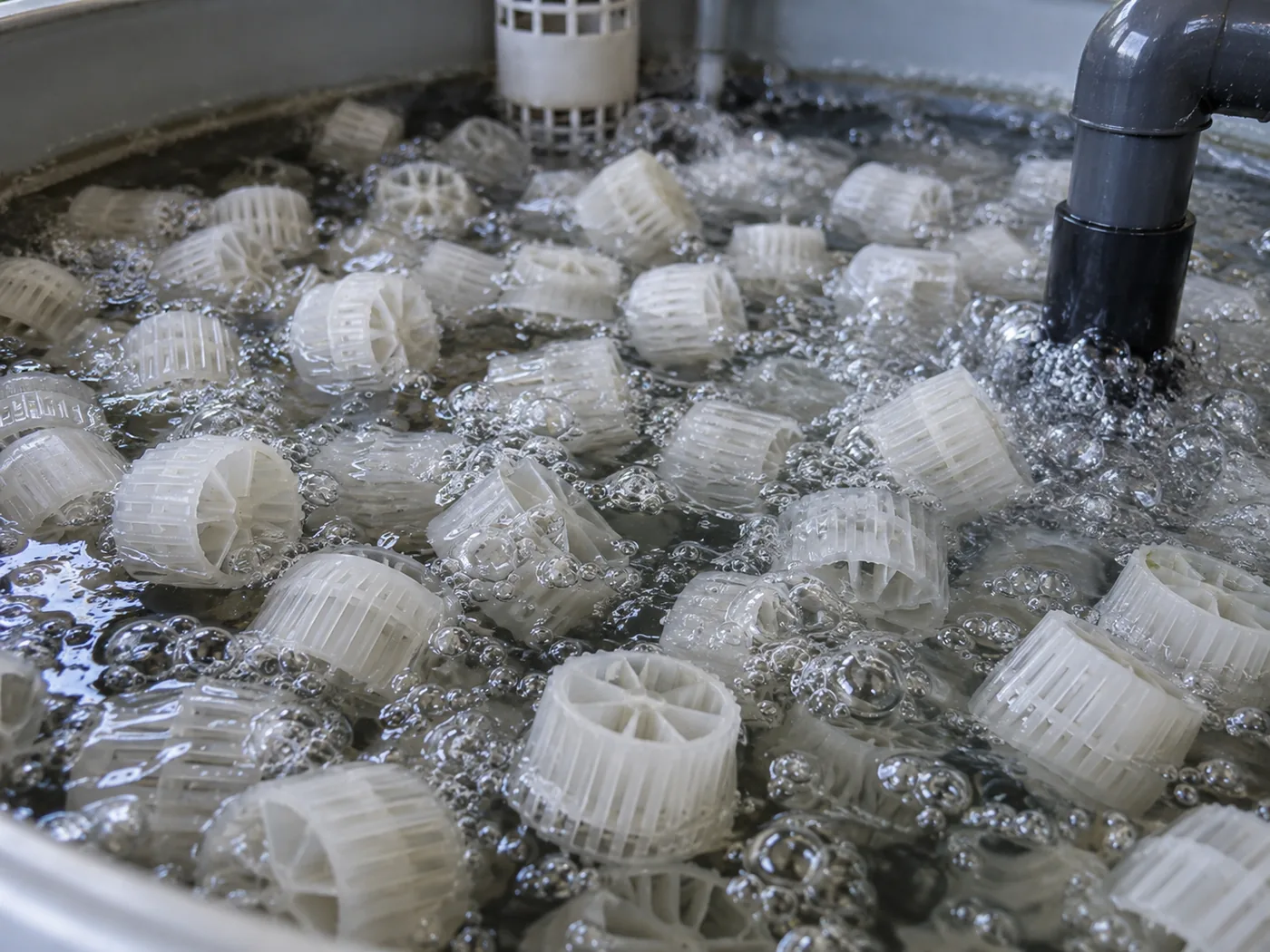
Nitrifying bacteria attach to surfaces and form thin biofilms. They do not need a branded product to exist, but they do need suitable habitat. In a well-planned system, that habitat may include:
- dedicated biofilter media with high protected surface area;
- expanded clay, gravel, or other media in a media-bed system;
- the walls and plumbing of tanks, sumps, and channels;
- roots and wet structural surfaces, to a limited and variable extent; and
- moving-bed or fixed-bed biological filter chambers.
Not all surface area performs equally. A surface that is frequently clogged with solids, exposed to poor flow, or short of oxygen will not support the same biological activity as clean, well-aerated media with steady circulation. This is why mechanical solids removal and biological filtration should be considered together. Removing excess solids before they decompose can help keep the biofilter environment more stable.
Four operating roles bacteria perform
1. They reduce toxic nitrogen pressure
The immediate operational role is fish protection. As feed enters the system, ammonia production rises. A mature biofilter helps process that load before ammonia and nitrite reach harmful levels. If the bacterial community is immature or disrupted, fish are often the first part of the system to show stress.
2. They create a plant-available nitrogen pathway
Plants need nitrogen, but the form and timing matter. Nitrification turns a fish-waste problem into nitrate that can contribute to crop nutrition. It does not guarantee that every crop nutrient requirement is met: calcium, potassium, iron, and other elements may still require monitoring or carefully managed supplementation, depending on the crop and source water.
3. They make feed rate a biological design question
Adding more fish or feeding more heavily is not only a production decision. It increases the nitrogen load the biofilter must handle. A system should be sized with a realistic margin for expected feed input, seasonal temperature changes, and the recovery time needed after maintenance or a power interruption.
4. They provide an early-warning lens for system health
A sudden rise in ammonia or nitrite can indicate more than one issue: a new system that is still cycling, an overloaded biofilter, low dissolved oxygen, a pump or aeration failure, aggressive cleaning, chemical exposure, or a sharp change in feeding. The test result is a warning that the biological process may no longer match the load.
What do bacteria need to work reliably?
Beneficial bacteria are resilient when their basic conditions are protected, but they do not respond well to abrupt changes. During installation preparation and commissioning, the following conditions deserve attention.
Oxygenated, circulating water
Nitrification uses oxygen. Aeration is therefore not only for fish; it also supports the biofilter. Confirm that water movement reaches the biological media and that backup planning accounts for the most critical pumps and air equipment.
Enough usable surface area
Biofilter capacity is not determined by tank volume alone. It depends on the media, protected surface area, hydraulic loading, oxygen supply, solids management, and operating temperature. Suppliers should be able to explain the basis for their filter recommendation and the expected feeding or biomass assumptions behind it.
A stable chemical environment
pH, temperature, alkalinity, and source-water chemistry influence both fish, plants, and microorganisms. The aim is not to chase a single universal number; it is to keep changes gradual and monitor the system response. If pH management is the immediate problem, consult our troubleshooting guide on how to lower pH in an aquaponics system before making large adjustments.
Reasonable solids control
Uneaten feed and accumulated solids consume oxygen as they decompose. A good solids-removal routine protects the water path leading into the biofilter. It should be matched to the system type and crop plan rather than copied from a different installation without review.
Why cycling is really a bacterial start-up process
Cycling is the period in which a new system establishes enough nitrifying capacity to handle a planned nitrogen load. It is not simply a number of days on a calendar, and a bottle of bacteria cannot replace testing and observation. A system can be mechanically complete at shipment inspection yet still need biological commissioning after installation, when water, fish, feed, temperature, and local operating conditions are present.
During cycling, operators commonly track ammonia, nitrite, nitrate, pH, and temperature while increasing load carefully. The result is a record of how the biofilter responds, not merely a pass/fail label. Our guide to cycling an aquaponics system explains a cautious start-up sequence in more detail.
How to protect the bacterial colony during normal operation
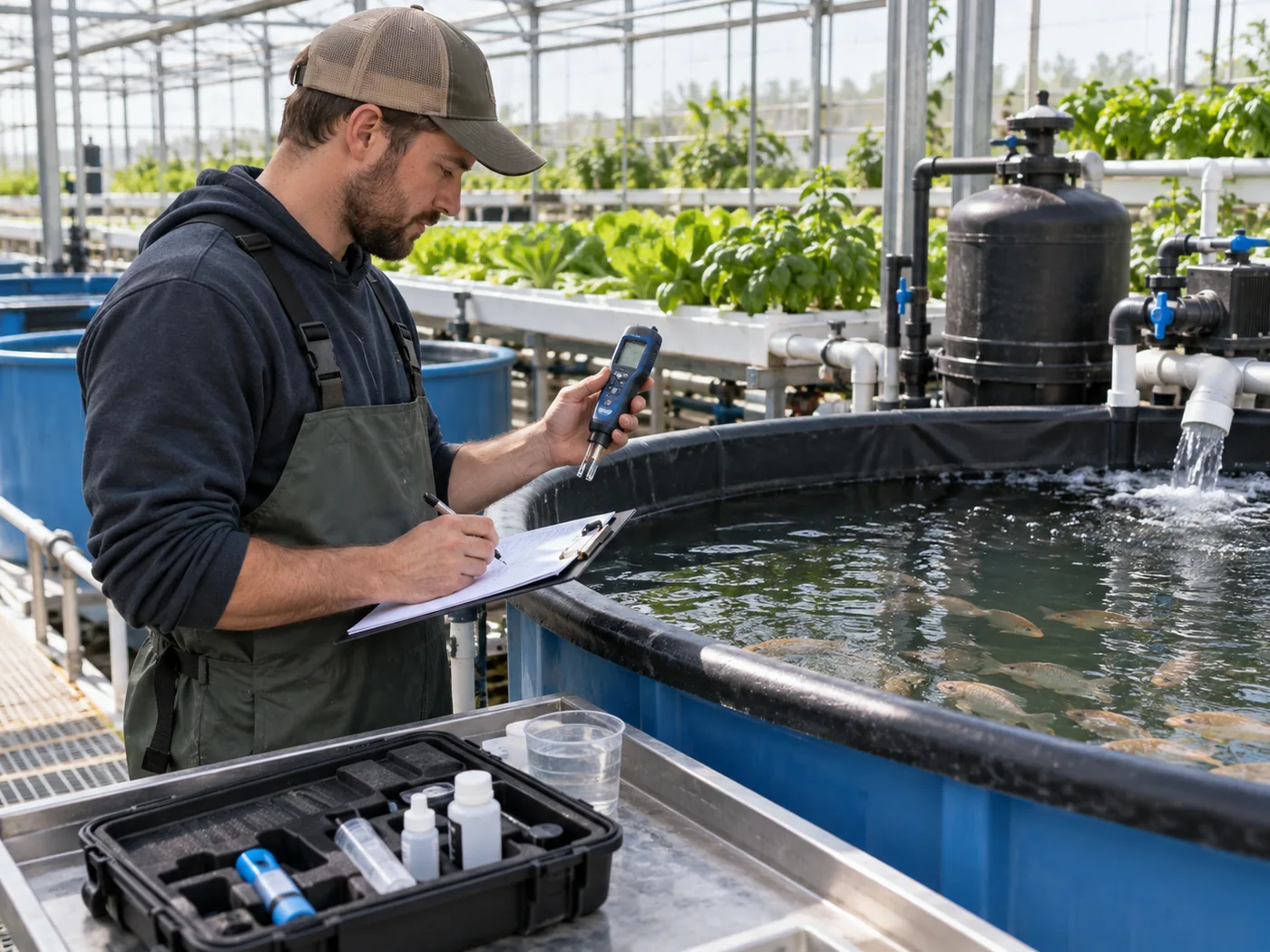
The best maintenance approach is deliberate and incremental. In established systems, avoid treating every reading as a reason for a large correction. Instead, use a repeatable inspection routine.
Check the causes before correcting the symptoms
When ammonia or nitrite rises, review recent feeding, fish behavior, water temperature, aeration, pump flow, solids removal, and any cleaning or treatment events. A measurement tells you that something changed; the operating record helps identify what.
Clean filters without sterilizing the biofilter
Mechanical filters require cleaning, but biological media should not be aggressively stripped or exposed to unsuitable disinfectants during routine maintenance. When maintenance is necessary, work in sections where possible and preserve stable filter areas. The exact method should follow the equipment supplier's instructions and the site water-management plan.
Introduce changes gradually
Increase feeding, fish biomass, or plant production in steps that the established biofilter can absorb. The same caution applies to changing source water, adding treatments, adjusting pH, or replacing media. Sudden changes are more likely to create a mismatch between nitrogen production and processing capacity.
Prepare for power and oxygen interruptions
Short interruptions can become serious when fish density is high, weather is warm, or the system has limited oxygen reserve. A practical commissioning checklist should cover alarm options, backup power or air, response responsibilities, and a way to verify flow after an outage.
Do bacteria work differently in each aquaponics system type?
The biology is the same in principle, but the habitat and maintenance demands change with the system layout.
- In media-bed systems, the bed media may provide substantial biological surface area, while also trapping solids. Media selection, flow pattern, and cleaning discipline matter.
- In deep-water culture (DWC) raft systems, a dedicated solids-removal and biofiltration train is typically more important because plant rafts do not replace all required treatment capacity.
- In nutrient film technique (NFT) systems, fine channels are sensitive to solids and uneven flow, so filtration upstream of the crop channels needs careful attention.
- In hybrid systems, each component should have a defined role: solids capture, biological conversion, aeration, and crop production.
For the broader layout comparison, read what the different types of aquaponics systems are. The right arrangement is determined by crop choice, water volume, available footprint, desired labor level, local climate, and the level of operational control the customer can maintain.
Factory testing, delivery, and site commissioning: set realistic expectations
For a commercial or project-scale purchase, bacterial performance should be discussed honestly. A factory can inspect tank fabrication, pipe fittings, pump operation, aeration equipment, filter assembly, control components, and packing condition before shipment. It cannot fully establish the final site biofilter in the same way it can pressure-check plumbing.
At delivery, verify that biological media, filter housings, valves, air equipment, and test provisions match the approved equipment list. During installation preparation, plan water-source testing, drainage, electrical protection, start-up staffing, and a monitoring schedule. After the system is filled and operating, cycling and biofilter maturation need site-specific records.
This distinction is useful for procurement teams: ask a supplier to separate what can be factory tested from what must be validated during on-site commissioning. Clear scope reduces unrealistic promises and helps operators prepare the people and test equipment needed for a stable start.
A practical monitoring routine around the biofilter
A routine should be simple enough to be completed consistently. During normal operation, record feed offered, fish behavior, water temperature, pump and air performance, and the scheduled water-quality results. After a change in feed rate, fish biomass, weather, water source, cleaning practice, or equipment condition, increase observation until the system has shown a stable response.
For a project team, the most useful record is a trend sheet rather than a collection of isolated test values. It allows the operator to compare a rising ammonia or nitrite result with recent events: Was a filter cleaned? Did flow slow? Was the system topped up? Did staff increase feeding? Were fish delivered? This history lets a technical adviser or supplier help identify a likely operational mismatch without pretending that a single number explains every cause.
Commissioning documents should also name the person responsible for testing, the escalation contact, the test equipment to be kept on site, and the response limits agreed for the project. These modest procedures turn beneficial bacteria from an invisible assumption into a managed part of the production system.
Common misconceptions about aquaponics bacteria
“Clear water means the biofilter is working.”
Clear water can still contain ammonia or nitrite. Use test data and operating observations, not clarity alone.
“Any bacteria product instantly cycles a system.”
Commercial inoculants may be considered within a documented start-up plan, but they do not eliminate the need for stable water conditions, time, testing, and controlled loading.
“More media always means more safety.”
Media must receive appropriate water flow and oxygen and be protected from excessive solids. Capacity comes from the whole filtration design, not a single component count.
“Plants remove every fish-waste risk.”
Plants contribute to nutrient uptake, but they do not replace nitrification, aeration, solids control, or water-quality monitoring.
FAQ
Are bacteria good or bad in aquaponics?
Both beneficial and unwanted microorganisms can exist in a recirculating system. The bacteria discussed here are beneficial nitrifiers that support ammonia and nitrite conversion. Good sanitation, feed management, and water-quality routines help favor a stable production environment.
Do I need to add bacteria to a new aquaponics system?
The system needs to establish nitrifying microorganisms before carrying its planned fish and feed load. An inoculant may be part of a start-up protocol, but it is not a substitute for cycling, testing, and gradual loading.
How do I know whether my bacteria are working?
Use a water-testing routine and interpret ammonia, nitrite, nitrate, pH, temperature, and operating records together. Trends after feeding, weather changes, maintenance, or outages are usually more useful than one isolated reading.
Can high or low pH harm beneficial bacteria?
Large or abrupt pH changes can affect biological activity. Make corrections gradually, based on reliable tests and a clear understanding of the likely cause.
Can I wash biofilter media with tap water?
The safest method depends on the local water chemistry and equipment plan. Avoid routine practices that may expose biological media to unsuitable disinfectants or remove too much established biofilm at once. Follow the system supplier's maintenance guidance and assess the consequences before cleaning.
Conclusion
Bacteria are the quiet treatment system behind productive aquaponics. They help protect fish from ammonia and nitrite, create nitrate for plants, and make the relationship between feeding, filtration, and crop production workable. Their value is best protected through sound design, steady aeration and flow, practical solids management, gradual changes, and routine testing.
If you are specifying an aquaponics project, send us your crop plan, fish plan, site water information, target capacity, and available footprint. Our team can help you review the filtration and commissioning considerations before equipment selection. Send your requirements to discuss a system configuration.