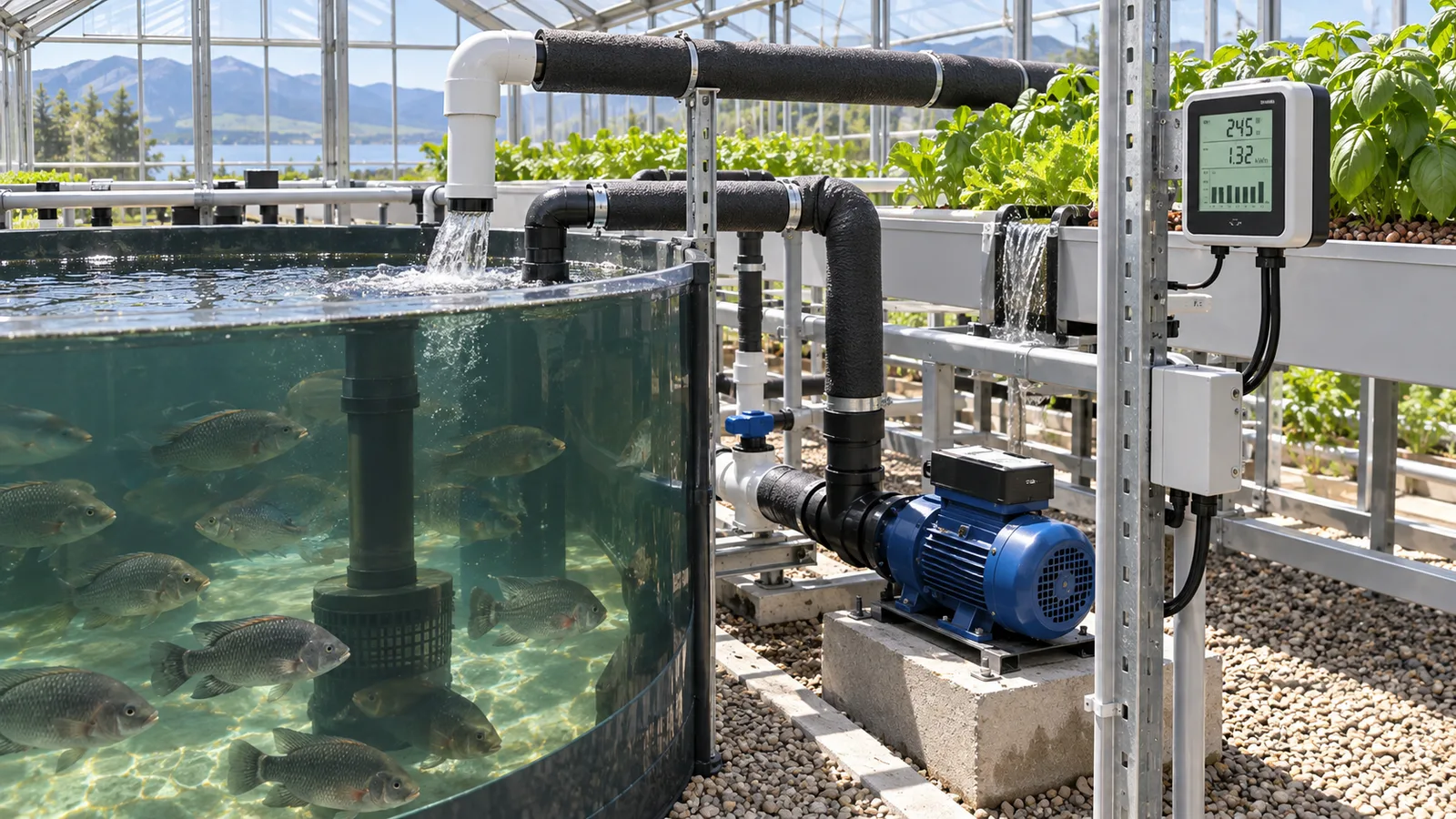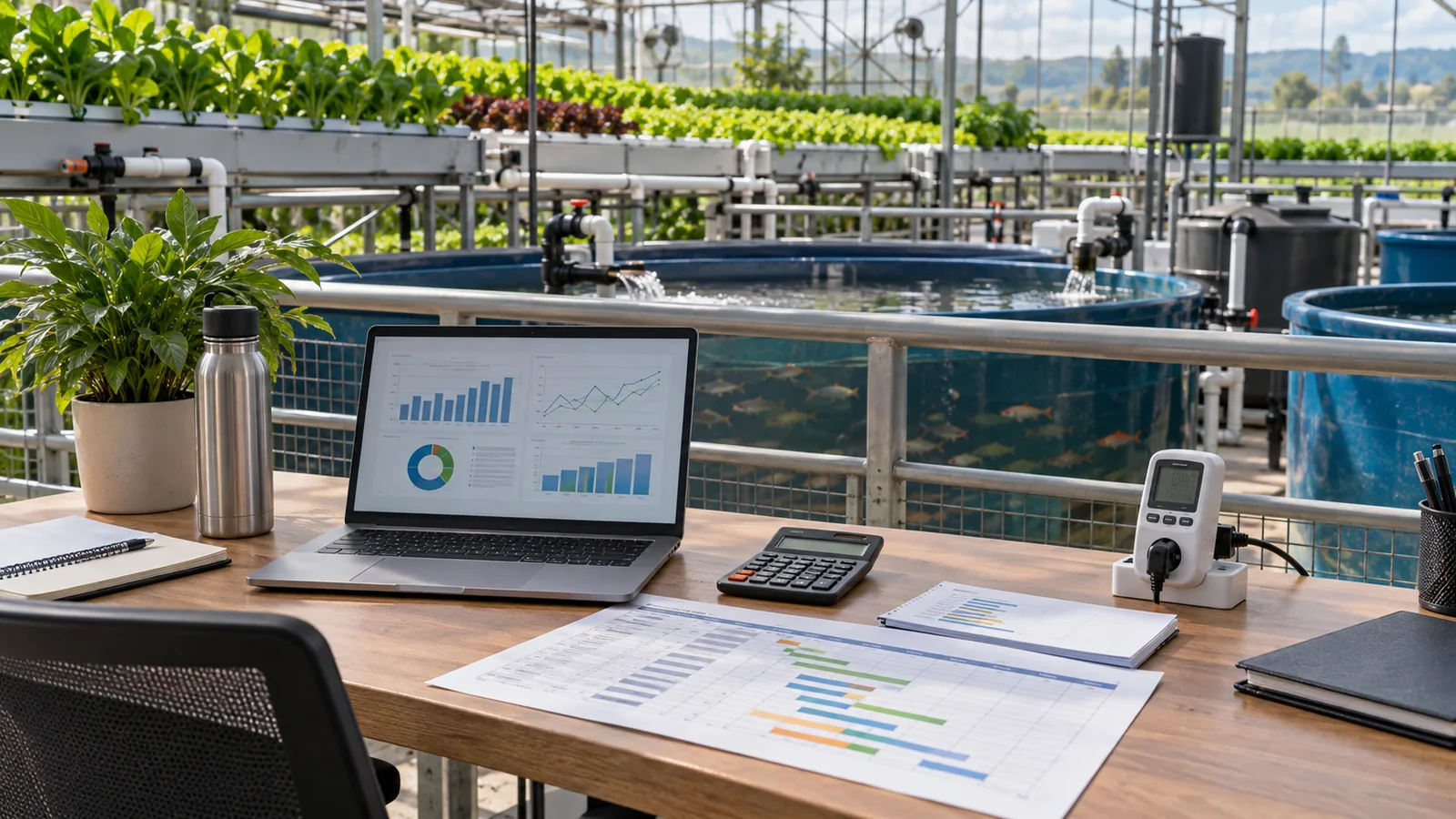
The cost to run an aquaponics system depends on equipment power, climate control, lighting, fish feed, seedlings, water treatment, test supplies, replacement parts and labor. There is no credible universal monthly figure. A small outdoor media-bed system in a mild climate may need only modest pumping, aeration and consumables, while an indoor system with grow lights, water heating, ventilation and paid labor can cost many times more to operate.
The most reliable estimate starts with an equipment and operating schedule—not tank volume alone. Record the rated and measured power of each device, its daily run time, local electricity price, monthly feed use, crop schedule and maintenance workload. Then calculate a low, expected and high-cost scenario for each season.
This guide focuses on recurring operating expenditure, or OPEX. Purchase price, freight, installation and commissioning are capital or project costs and are covered separately in our aquaponics system cost and pricing guide.
The Short Answer
Build the monthly operating budget from nine categories:
1. Water circulation and aeration electricity
2. Heating, cooling, ventilation and dehumidification
3. Grow-light electricity and lamp replacement
4. Fish feed and replacement stock
5. Seeds, seedlings, plugs and crop supplies
6. Water, source-water treatment and supplements
7. Testing, cleaning and consumables
8. Maintenance, spare parts and equipment replacement reserves
9. Labor, waste handling, insurance and site overhead
For electricity, use:
Monthly energy (kWh) = equipment watts × operating hours per day × 30 ÷ 1,000
Monthly electricity cost = monthly kWh × local price per kWh
Use measured power where possible. A nameplate describes rated conditions; actual draw and duty cycle can differ. Heating and cooling are especially sensitive to weather, insulation, setpoint and equipment control.
Operating Cost Is Different From Purchase Cost
A quotation tells you what equipment is supplied and what it costs to purchase. It does not automatically show what the system will consume or how much operator time it will require.
A lower purchase price can create higher operating costs when it leads to:
- An oversized pump throttled by a valve
- Long, narrow or poorly routed pipework
- An uninsulated fish tank in a cold climate
- A greenhouse with uncontrolled heat gain
- Inaccessible filters that require excessive cleaning time
- Grow lights selected without an efficient crop-lighting plan
- No installed metering to verify real consumption
- Parts that are difficult to source locally
The procurement decision should compare total cost of ownership: purchase, installation, expected operation, planned maintenance, downtime exposure and replacement life.
Start With a Load and Activity Inventory
Create one operating-cost line for every device, material and recurring task. Do not use one percentage of the equipment price as a substitute for a real operating plan.
Continuous life-support loads
Water pumps, air pumps, blowers, controllers and some monitoring equipment may operate continuously. Their individual wattage may look small, but 24-hour operation turns a modest load into a significant annual total.
List each pump separately. Record:
- Rated wattage
- Measured wattage at the installed duty point
- Hours per day
- Normal and backup operating mode
- Expected service interval
- Replacement cost and estimated life
If two pumps alternate duty, calculate their actual schedule. If a backup pump is normally off, place it in the replacement-capital reserve rather than continuous electricity.
Intermittent and seasonal loads
Feeders, filter-cleaning pumps, UV equipment, heaters, chillers, fans, dehumidifiers and grow lights may run by schedule or control signal. Use a realistic duty cycle for each season.
A 1,000-watt heater does not necessarily consume 1 kWh every hour, but assuming an arbitrary low duty cycle can also understate winter expense. Measure actual runtime during representative cold periods and model unusually cold conditions separately.
How to Calculate Electricity Cost
Consider this illustrative equipment schedule:
| Equipment | Rated or measured power | Run time | Monthly energy |
|---|---|---|---|
| Water pump | 80 W | 24 h/day | 57.6 kWh |
| Air pump | 40 W | 24 h/day | 28.8 kWh |
| Controls and sensors | 12 W | 24 h/day | 8.64 kWh |
| Grow lights | 600 W | 14 h/day | 252 kWh |
| Ventilation fan | 150 W | 8 h/day | 36 kWh |
This example totals 383.04 kWh before heating, cooling or dehumidification. Multiply that total by the local electricity tariff. If the utility uses time-of-use rates, demand charges or seasonal pricing, calculate each rate period separately rather than applying one average.
The example is not a recommended equipment package. Pump size must follow required flow and total dynamic head; aeration must follow oxygen demand; lighting must follow crop, fixture efficiency, mounting and photoperiod. The purpose of the table is to show how a transparent estimate works.
Verify energy use after installation
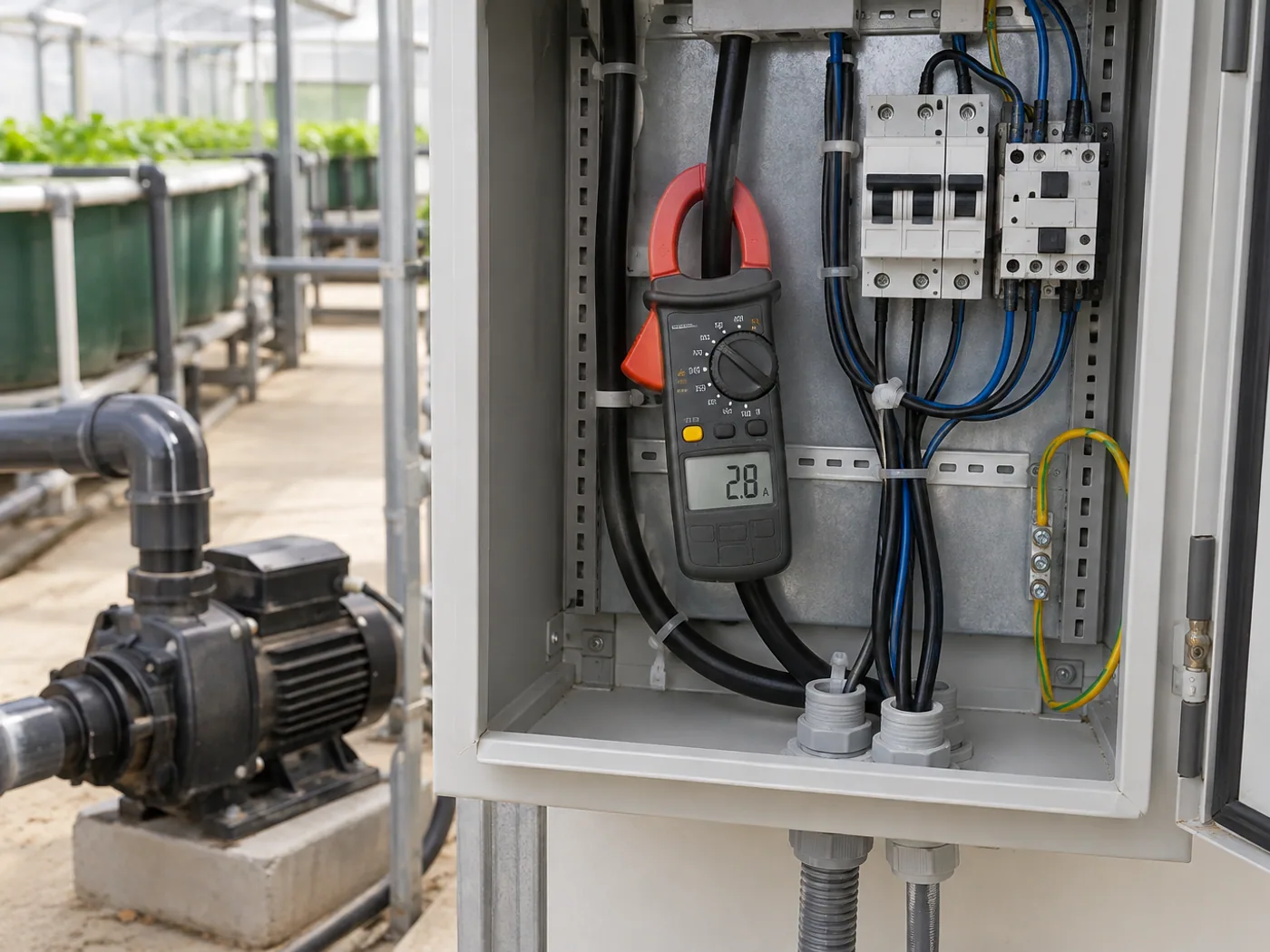
Install submetering or use a suitable energy meter where electrical rules permit. Record at least one representative week in each major season. Compare actual kWh with the budget and explain the difference.
If a pump draws more power than expected, investigate head loss, blockage, valve position, impeller condition and whether the operating point matches the pump curve. Do not reduce essential circulation or aeration merely to reach a budget.
The Major Recurring Cost Categories
Electricity for pumping and aeration
Circulation transports solids and treated water between fish, filters and plants. Aeration supports fish, biofilters and submerged roots. These are life-support functions.
Cost reduction should begin with system layout: shorter pipe runs, adequate pipe diameter, low static lift, gravity return, clean inlets and pumps selected near an efficient operating point. Our guide to energy-efficient aquaponics system design explains why hydraulic resistance should be reduced before buying a larger pump.
Do not place essential air delivery on an aggressive timer simply because electricity is expensive. The correct schedule must be supported by measured dissolved oxygen and a risk assessment at maximum biomass, feed and water temperature.
Heating and cooling
Temperature control can dominate the energy budget. The load depends on:
- Fish and crop temperature requirements
- Water volume and exposed surface
- Tank and pipe insulation
- Greenhouse or room envelope
- Outdoor temperature and solar gain
- Ventilation and evaporation
- Heat generated by lights and equipment
- Desired operating season
Match fish species and crops to the climate where practical. Insulate tanks and hot-water lines before increasing heater capacity. Use covers only where they do not compromise gas exchange, access or safety.
For commercial projects, request a heat-loss or cooling-load calculation rather than a heater price based on tank volume alone.
Grow lighting, ventilation and humidity control
Indoor crop production adds a separate energy system. Lighting cost is affected by fixture power, photoperiod, dimming schedule and the number of active growing zones. Ventilation and dehumidification may be needed to manage the water vapor released by open water and plant transpiration.
Turning off environmental equipment can reduce short-term cost while increasing condensation, disease pressure or crop loss. Model the crop room as a whole rather than treating each device independently.
Fish feed and fish stock
Feed is both a production input and the principal planned nutrient input. Monthly cost depends on fish biomass, species, life stage, feed formulation, feed conversion, mortality and market availability.
Record feed by date and tank. Do not calculate from the number of fish alone. As fish grow, daily ration and waste production change. Include freight, storage losses and minimum order quantities for imported or specialist feed.
Fingerlings, juveniles or ornamental stock may be purchased by batch. Convert the annual production schedule into a monthly reserve, including transport, acclimation and a realistic mortality allowance without normalizing preventable losses.
Seeds, seedlings and crop consumables
Include seed, propagation plugs, net pots, nursery trays, labels, trellis material, clips and crop-support supplies. Account for germination rate and transplant loss instead of assuming every seed becomes a harvested plant.
For repeated production, a higher-quality propagation process can reduce wasted grow-space weeks. Compare seedling cost with the cost of an empty channel or raft position.
Water and source-water treatment
Aquaponics recirculates water, but it still loses water through evaporation, transpiration, filter cleaning, harvest activities, leaks and intentional discharge. Measure make-up water rather than advertising a theoretical saving as an operating figure.
If source water contains chlorine, chloramine, unsuitable alkalinity, salinity or other constraints, include storage, treatment, testing and waste-stream costs. Reverse osmosis or blending can add water rejection, pumping and mineral-management expense.
Supplements and pH management
Fish feed may not provide every plant nutrient in the required form and amount. Iron, potassium or calcium may require controlled supplementation based on testing and system design. Include approved products, dosing equipment where used and verification tests.
Do not create a fixed monthly supplement allowance without considering crop, source water, pH, feed and mineralization. Unnecessary dosing wastes money and can harm fish or disrupt nutrient balance.
Testing and sanitation supplies
Budget for calibration standards, reagents, test kits, sample containers, replacement probes, cleaning tools and approved sanitation materials. Low-cost instruments can become expensive if results are unreliable and decisions must be repeated.
Set a calibration and replacement schedule. Commercial operations may also need laboratory analysis, food-safety verification or water testing required by buyers or local authorities.
Maintenance and replacement parts
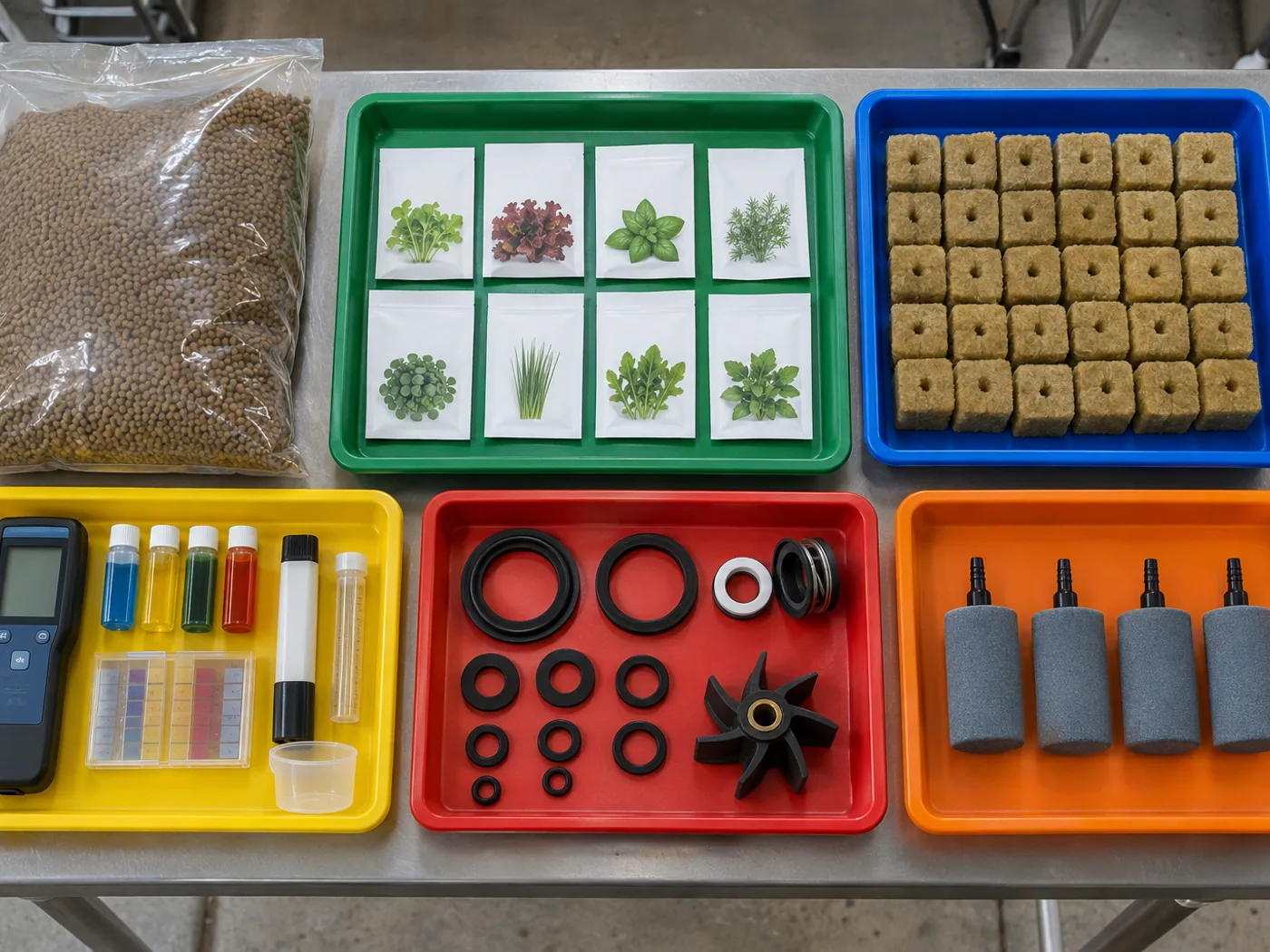
Recurring maintenance includes pump cleaning, diffuser replacement, filter screens, seals, bearings, UV lamps where applicable, valves, unions, sensors and electrical components.
Create a planned spare-parts kit based on failure consequence and lead time. A spare inexpensive air pump may prevent animal loss; a specialized imported controller may require a larger inventory decision.
Labor and management time
Labor can be the largest operating category even when the owner does not take a cash wage. Count daily observation, feeding, planting, harvesting, filter cleaning, water testing, packing, sales, recordkeeping and emergency response.
A peer-reviewed small-scale study found that the relative importance of energy, feed and labor varied by design and local prices; it also emphasized that unpaid family labor still has an opportunity cost. See the economic sustainability analysis of small-scale aquaponics.
A separate techno-economic study of a mid-size tilapia-and-lettuce system reported labor as the largest annual operating-cost contribution in its modeled case. The exact figure is not transferable to another country or system, but the result is a useful warning against budgeting only electricity and feed. Review the techno-economic aquaponics analysis.
Mid-Article CTA — Request an Operating-Requirements Schedule
Comparing system configurations before purchase? **Send Your Requirements** with the planned tank volume, growing area, equipment list, local voltage, electricity tariff, climate and staffing model. We can help organize the utility and maintenance questions for a supplier discussion.
Build a Monthly Cost Worksheet
Use columns for:
- Cost category
- Unit
- Quantity per month
- Unit price
- Expected monthly cost
- Low and high scenario
- Source of assumption
- Date last verified
- Responsible person
For electricity, attach equipment power and operating hours. For feed, attach biomass and feeding assumptions. For labor, list tasks and time. For maintenance, identify the service interval and replacement price.
Separate cash expense from reserves
Some months have no pump purchase, but pumps eventually fail. Divide planned replacement cost by expected service months to create a maintenance reserve. Keep that reserve separate from cash spent so decision-makers can see both.
Separate fixed and variable costs
Rent, insurance, core staffing and basic circulation may continue regardless of output. Feed, seedlings, packaging and harvest labor change with production. This distinction helps evaluate the cost of running below planned capacity.
Model seasonality
Prepare at least four monthly cases:
1. Mild-season normal operation
2. Peak heating month
3. Peak cooling or dehumidification month
4. Reduced-production or maintenance month
An annual average can hide a winter cash-flow problem.
Compare Cost per Useful Output
Monthly cost alone does not show efficiency. Track:
- Cost per kilogram of marketable fish
- Cost per marketable plant or kilogram of crop
- Electricity per kilogram of combined output
- Feed per kilogram of fish growth
- Labor hours per production unit
- Percentage of crop positions harvested at specification
Do not divide cost by theoretical capacity. Use actual marketable output and include losses. If the system also provides education, research or community services, record those outputs separately rather than forcing them into a food-yield claim.
Where Cost Reduction Is Safe—and Where It Is Not
Usually worthwhile
- Reducing unnecessary hydraulic head
- Cleaning clogged pump inlets and diffusers
- Insulating tanks and pipes
- Zoning lights so empty areas are not illuminated
- Improving seedling success
- Standardizing accessible fittings
- Installing useful meters and alarms
- Planning local replacement parts
- Staggering crops and fish cohorts
Requires engineering or operating evidence
- Reducing water turnover
- Cycling the main pump off overnight
- Reducing aeration
- Raising or lowering temperature setpoints
- Removing backup equipment
- Extending filter-cleaning intervals
- Replacing specified feed with a cheaper formulation
Aquaponics supports living animals and crops. A cost-saving change is not successful if it increases mortality, unstable water quality, crop rejection or emergency labor.
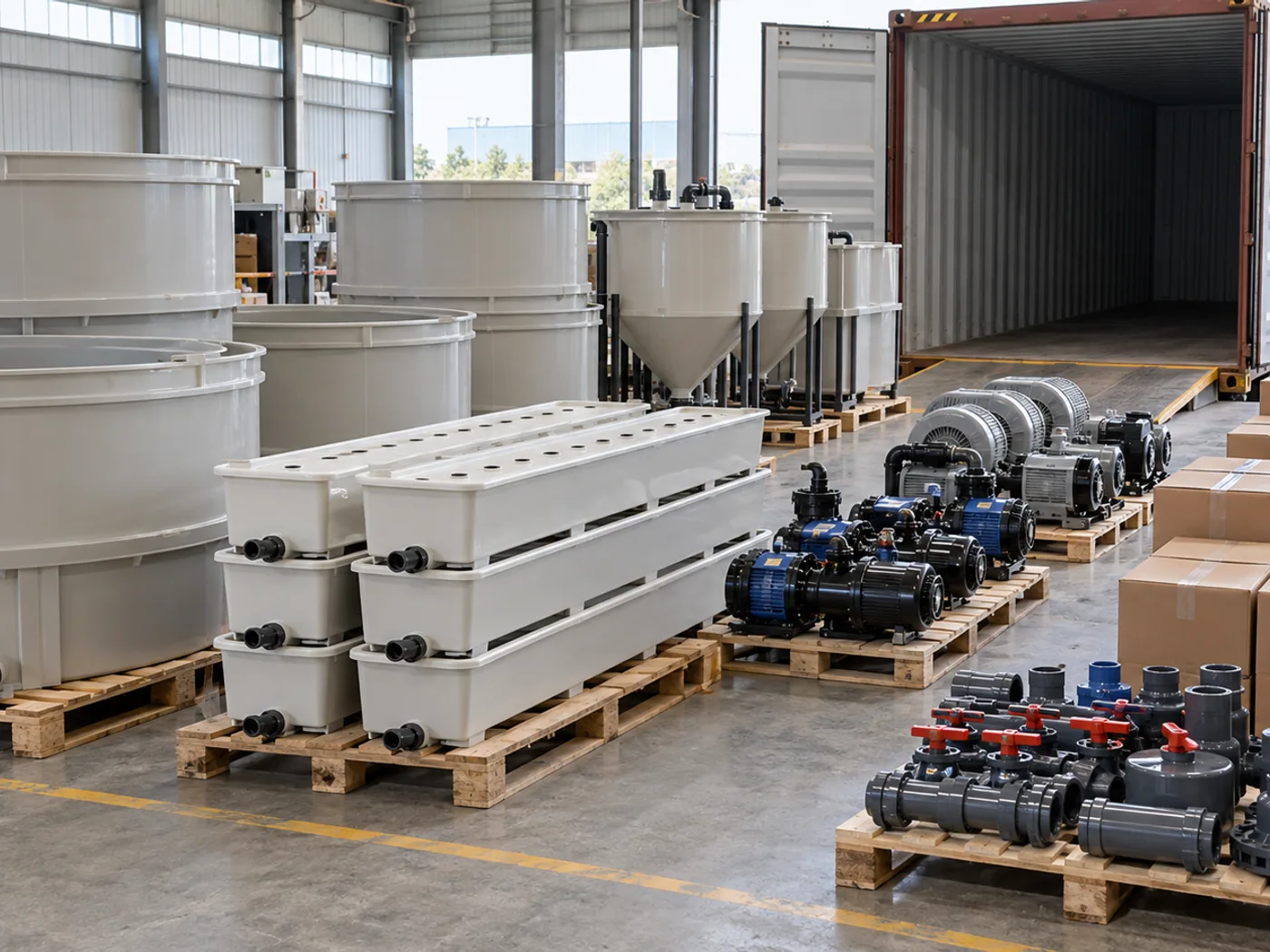
Procurement, Factory Testing and Handover
Ask suppliers to provide:
- Equipment model and rated power
- Expected operating point and duty schedule
- Utility requirements
- Consumable and replacement-part list
- Recommended service intervals
- Alarm and backup scope
- Warranty exclusions
- Installation and commissioning responsibilities
- Operator training scope
Factory testing can verify pump rotation, representative flow, air distribution, controller functions and leakage before shipment. It cannot reproduce the buyer’s climate, utility price, biomass or crop schedule. Shipment inspection should confirm models, quantities, spare parts and manuals. Export tanks and grow modules should be dry and empty—without fish, water or plants.
During installation preparation, meter the major loads where practical and create a baseline operating log before full stocking. Compare the first 30, 90 and 180 days with the budget.
FAQ
What is the biggest aquaponics running cost?
It depends on the project. Labor can dominate commercial systems; heating, cooling or grow lighting can dominate controlled environments; feed and continuous electricity may be most visible in smaller systems.
How much electricity does an aquaponics system use?
Add the measured watts of each device multiplied by its operating hours. Separate continuous pumps and blowers from scheduled lights and seasonal climate equipment.
Is an outdoor aquaponics system cheaper to run?
It may avoid grow lights and building climate control, but weather protection, seasonal production, water temperature and backup requirements still matter. Lower electricity does not guarantee lower total cost.
Can I turn the pump off at night to save money?
Only if the system is specifically designed and validated for intermittent flow. Fish, biofilters, roots and solids transport may depend on continuous circulation. Never change a life-support schedule based only on a power calculation.
Does aquaponics save water costs?
It can reduce water use compared with some production methods, but cost depends on local water price, evaporation, crop transpiration, filter cleaning, source-water treatment and discharge.
Should labor be counted if I operate the system myself?
Yes. Unpaid time still has an opportunity cost and is essential when comparing designs or evaluating commercial viability.
Are maintenance costs the same every month?
No. Use a monthly reserve for predictable replacement and keep contingency for unexpected failures. Record actual spending separately.
Conclusion
The cost to run an aquaponics system is not a fixed amount per gallon. It is the sum of continuous life-support energy, seasonal climate and lighting loads, feed, crop inputs, water, testing, maintenance, replacements and labor.
Build the estimate from an equipment schedule and operating plan. Use local tariffs and supplier prices, measure actual consumption after commissioning, and compare cost against marketable output rather than theoretical capacity. Most importantly, do not reduce essential circulation, aeration or monitoring simply to make the budget appear smaller.
Final CTA — Get a Project-Specific Quote
Need an aquaponics proposal with clear utility requirements and maintenance scope? Get a Quote and send your site location, available area, fish and crop plan, local power details and preferred system size.