
Introduction
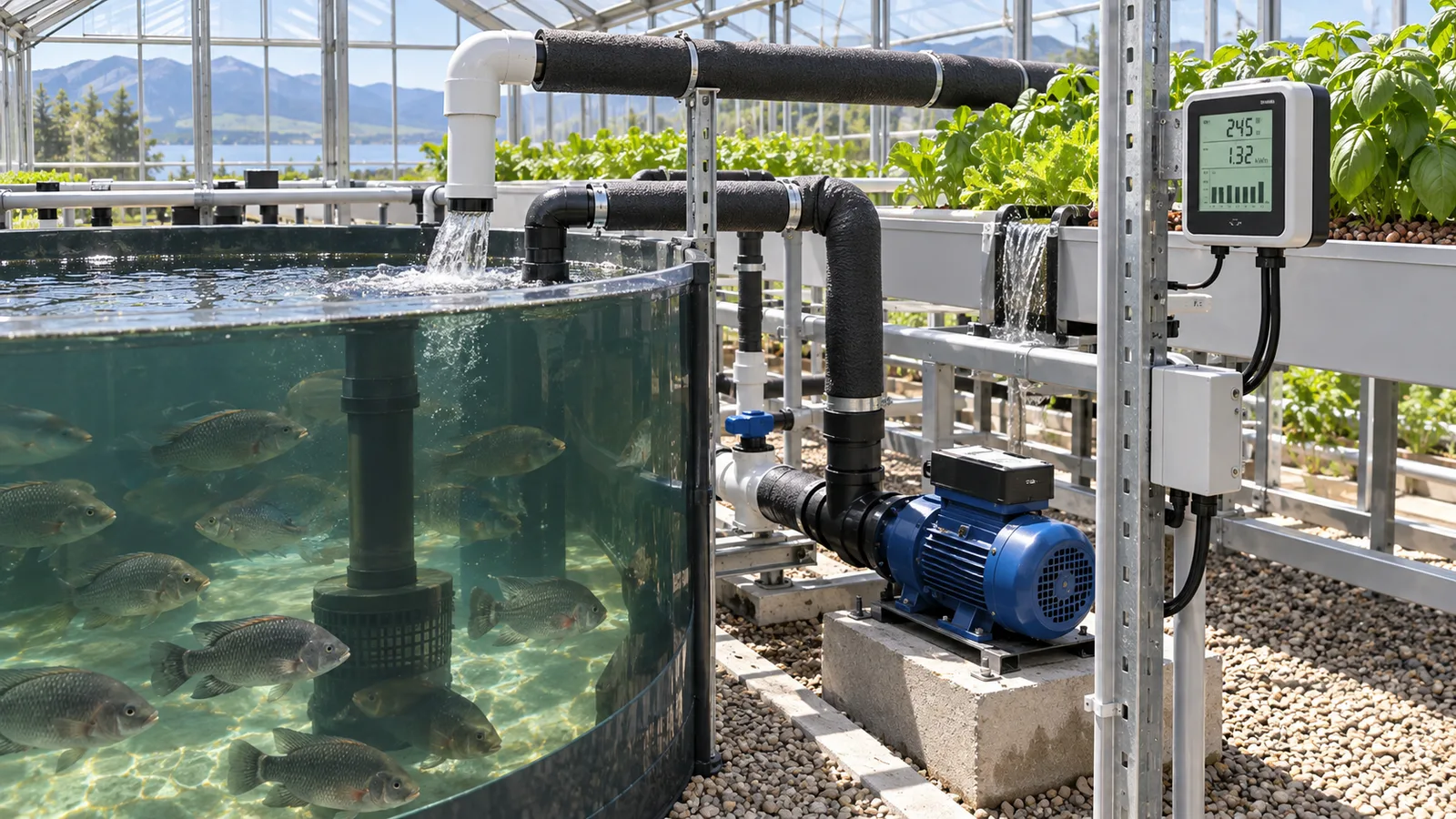
An energy-efficient aquaponics design is not a system that simply uses a smaller pump. It is a design that reduces unnecessary lift, heat loss, lighting time and avoidable run hours while preserving the circulation, aeration, temperature and monitoring needed for fish, plants and bacteria. Energy is a system-level operating issue: tank location changes heating load; pipe routing changes pump demand; crop format changes lighting and water movement; and controls determine whether equipment runs only when it is needed.
The best design therefore begins with an energy map before equipment is purchased. List the loads—water pumps, air blowers, heaters/chillers, grow lights, fans, dosing/control equipment—and identify what keeps fish alive versus what can be scheduled or optimized. Never reduce critical life-support capacity merely to lower a power reading.
The short answer
For most home and small commercial systems, the strongest energy-saving design combines a low-head water path, gravity return where practical, correctly sized high-efficiency pumps, protected/insulated fish water, efficient lighting with a crop schedule, accessible filters and simple monitoring. The system should be designed so that routine cleaning restores performance; a clogged screen, constricted pipe or fouled impeller can turn a good design into an inefficient one.
An industry review of small-scale aquaponics notes that power demand varies with system size, filtration, growing technique and temperature control, and identifies pumps, lighting and environmental equipment as important design decisions. Read the review.
Start with an energy map
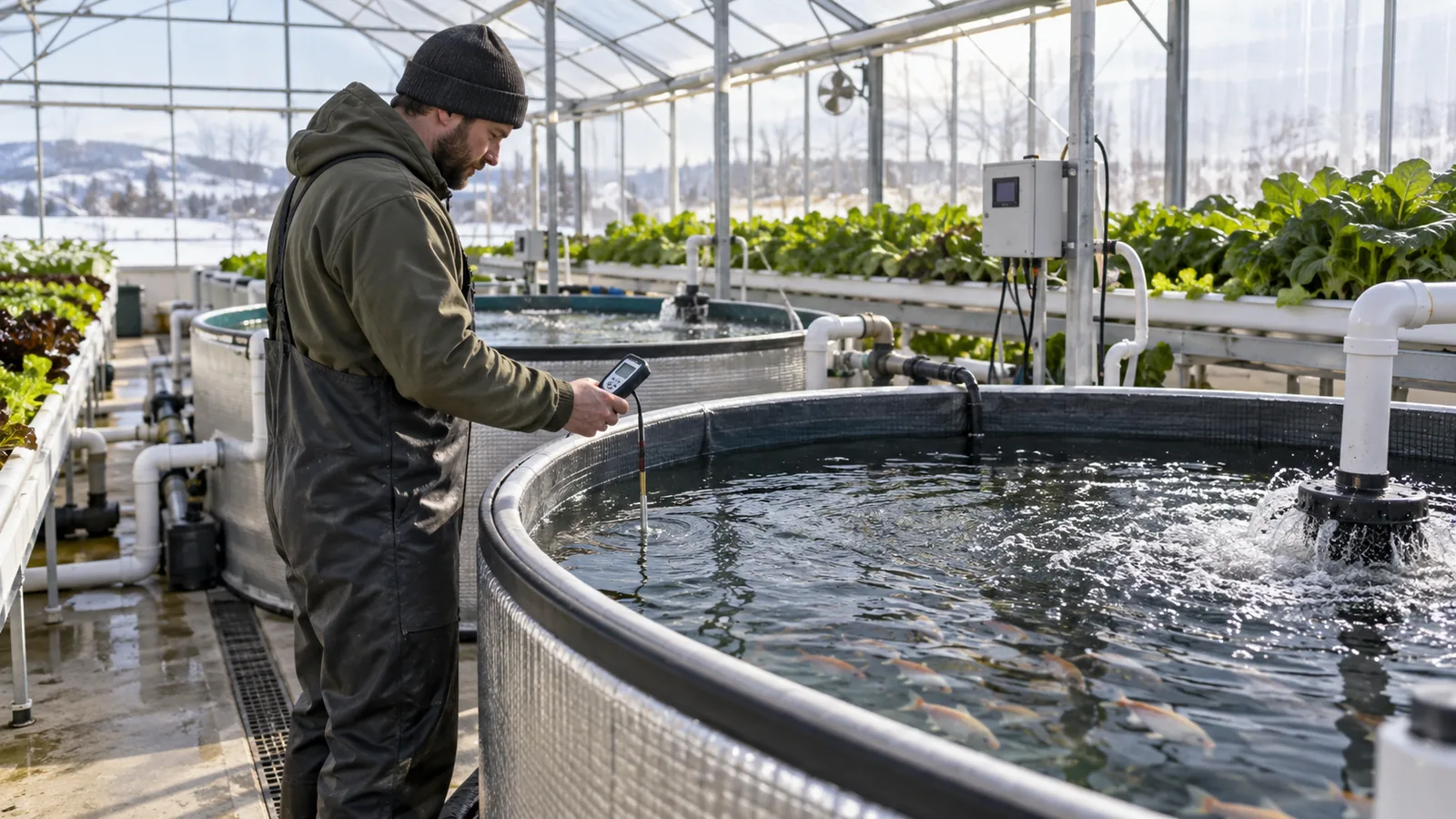
Before selecting a kit or supplier, create a table with each load, watts, normal operating hours, seasonal variation, criticality, control method and backup plan. Measure real consumption after commissioning with an appropriate meter; nameplate wattage alone does not show cycling behavior or heater duty.
This record turns vague claims into decisions. It can show that a pump runs against unnecessary head, a heater is compensating for uninsulated tank walls, or lights are operating when the crop area is empty. It also supports realistic supplier discussions during installation preparation and factory testing.
Use gravity and low head before adding pump power
Every vertical lift, sharp bend, restrictive fitting and undersized pipe adds resistance. Arrange the water path so filtered water can return by gravity where the site allows, and place tanks/grow modules at elevations that reduce required pump head without compromising safe access. Use sweeping routing and isolation unions to make maintenance practical.
A bigger pump may conceal poor layout temporarily, but it can increase electricity, heat and turbulence. Select a pump from its performance curve at the actual total dynamic head, not its maximum advertised flow. Verify flow after installation, with clean filters and normal operating water level.
Separate water circulation from aeration decisions
Water movement and aeration both support the system but do not always need to be delivered by the same equipment. A properly selected air blower, diffusers and distribution manifold may provide essential oxygenation efficiently, while a water pump is selected for the actual circulation duty. Maintain backup aeration for fish welfare; it is resilience equipment, not optional energy waste.
Check diffuser cleanliness, airline leaks and filter fouling routinely. A simple maintenance log often identifies lost efficiency earlier than a monthly utility bill. For daily and weekly checks, use our aquaponics maintenance routine.
Reduce heating and cooling demand
Heating, cooling and dehumidification can dominate energy use in an indoor or cold-climate project. Begin with site choices: place tanks away from drafts and direct solar overheating, insulate exposed tank surfaces where suitable, cover water appropriately while retaining gas exchange and minimize unplanned heat loss from pipe runs. Then select temperature equipment and controls appropriate to the chosen fish species and crop plan.
Do not solve a climate mismatch with a larger heater alone. A controlled-environment review notes that insulation, heat storage and environmental screens can be part of energy-efficiency strategy, while the right combination depends on climate and operating conditions. Review the research overview.
For water-temperature decisions, see how to heat aquaponics water safely. Energy efficiency must not produce rapid or unsafe temperature changes.
Match lighting to crop and canopy
Indoor lighting deserves a crop plan, not a fixed all-day schedule. Use fixtures suited to a wet growing environment, provide safe clearances and set the photoperiod for crop needs. Keep lights close enough to use their output effectively but far enough to control heat and permit access. Empty channels and unused plant sites should not receive the same schedule as a fully planted canopy.
Use timers and record crop response, fixture heat, room temperature and electricity use. Avoid universal claims about LED savings; fixture efficacy, layout, canopy, hours and ventilation determine the outcome on a particular site.
Design for cleaning, not only for first-day efficiency
Energy use grows when water paths become dirty. Include valves, unions, drains, access panels and service clearance so filters, screens and pump inlets can be cleaned quickly. Put gauges or observation points where a change in water level or flow is visible. This is a design feature, not merely a maintenance preference.
When reviewing a supplier proposal, request a process-flow drawing, equipment schedule, pump duty point, electrical-load list, access requirements and commissioning checklist. Our commercial aquaponics buyer’s guide provides a structured RFQ approach.
Controls that save energy without hiding problems
Basic timers, thermostats, water-level alarms and temperature records can prevent needless run time and alert the operator to a fault. Automation should support inspection, not replace it. For example, a timer may control lights, but a blocked filter still needs a human response; a temperature alarm warns of a change but does not diagnose heat loss.
Specify fail-safe behavior: what happens after a power interruption, sensor failure or controller reset? Critical aeration and circulation must have a resilient plan. Include manual override, labeled circuits and a tested emergency procedure in the handover documents.
Size equipment for the operating duty, not the catalogue headline
Energy-efficient design starts with a duty point: the actual flow, pressure and operating hours the system needs. Catalogue maximums are useful only as limits. A water pump should be selected around the expected total dynamic head after accounting for vertical lift, pipe diameter, bends, valves, filters and changes in water level. A pump that performs efficiently at its chosen duty may be less expensive to operate and easier to control than an oversized model throttled by a valve.
Apply the same thinking to aeration, heating, fans and lighting. An air blower is selected for the diffuser network and water depth, not simply by its largest listed airflow. A heater is selected after reducing avoidable heat loss and defining the acceptable temperature range for the chosen fish. Fans are selected for the room’s heat and humidity load, not only for their advertised speed. Each decision should have a stated requirement and a way to verify performance after installation.
During factory testing, suppliers can confirm component operation, leaks, control logic and basic flow direction. Site commissioning must then confirm the real installation: elevation, ambient temperature, local electrical supply, insulation, drainage and operator access. A factory result is evidence, but it is not a substitute for commissioning at the final site.
Use zones to prevent one condition from controlling everything
A single large loop can be simple, but it can force all crops and equipment into one schedule. Where the project is large enough to justify it, separate practical zones: fish water, filtration, a leafy-green production section, a nursery or a climate-sensitive area. Zoning can allow lighting and environmental control to follow actual crop occupancy rather than operating at full output across empty space.
This does not mean adding complexity without a maintenance plan. Every extra valve, pump, sensor or control zone needs labels, safe isolation and an operator who understands the water path. The objective is to remove wasteful operation while retaining a system that can be inspected and repaired. A modest, well-documented zone is usually better than a highly automated layout with no local support.
Schedule non-critical loads carefully
Some loads are continuous life support; others can be scheduled. Fish aeration and essential circulation may require continuous operation according to the system design. Lighting can follow a crop-specific photoperiod. Some ventilation and dehumidification can be controlled by measured conditions. Cleaning tasks can be planned for times when crop handling and site access are safest.
The distinction must be documented in the operating manual. Never use a timer to reduce critical circulation without a verified design basis and a response plan. If an energy-saving schedule causes water level instability, low oxygen or uneven plant wetting, it is not an efficiency improvement.
Measure before and after each change
One of the most useful acceptance documents is an energy baseline. After commissioning, record individual electricity use for pumps, aeration, lights and temperature equipment over representative days. Note weather, water temperature, crop occupancy and production stage. This gives future comparisons context: an increase in electricity may be justified by colder weather or a fuller canopy, while an unexplained increase may reveal fouling or a control problem.
When a change is tested—such as insulating a pipe run, replacing a pump, adjusting lighting height or revising a timer—record one change at a time. Compare the energy meter with flow, water quality, crop response and fish observations. Reducing kWh is not a successful outcome if it lowers survival, growth or product quality. The best projects use energy records as an operating tool, not as a marketing claim.
Procurement questions that protect long-term efficiency
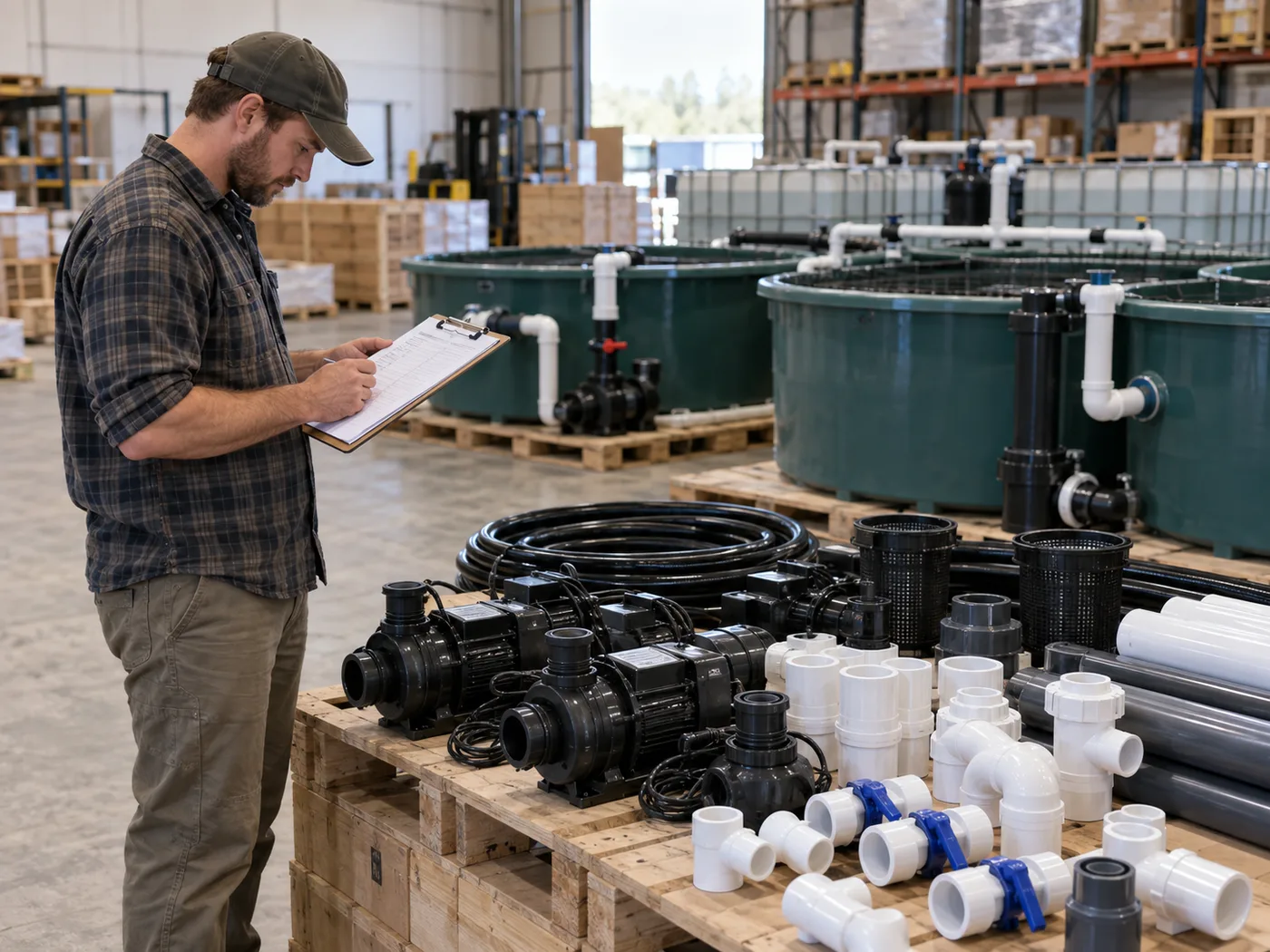
Before placing an order, request an equipment schedule that identifies model, electrical requirement, expected duty, control method, maintenance access and spare-parts route. Ask whether major components are locally serviceable and how the supplier handles shipment inspection, damage claims and replacement parts. For a commercial delivery, request a wiring diagram, process-flow drawing, packing list and commissioning checklist.
At shipment inspection, check insulation, support brackets, pump ports, cable protection, sensor locations and documentation. At installation, keep pipework supported, prevent unnecessary heat bridges where practical, provide drain paths and make meters readable. These details are not decorative; they determine whether the designed efficiency survives contact with daily operation.
Energy resilience is part of efficiency
An efficient system that cannot tolerate a power interruption is not operationally efficient. Plan for alarms, backup aeration, manual bypass options where appropriate and a clear escalation procedure. The backup may use energy rarely, but it protects the biological and financial investment when the primary supply fails. Test it during commissioning rather than assuming it will work.
For each alarm, define the response: who receives it, what they check first, what action is safe, and when supplier support is needed. A stable system with measured consumption and a credible emergency plan is more valuable to a buyer than an unsupported promise of the “lowest energy use.”
An energy-efficiency acceptance checklist
- Verify actual pump flow at installed head and normal filter condition.
- Inspect gravity return, water levels and drainage during a water-only test.
- Record blower, pump, lighting and temperature-control loads separately.
- Confirm insulation, condensation control and safe electrical routing.
- Check filter and impeller access during factory testing or commissioning.
- Test alarms, power-recovery behavior and backup aeration.
- Compare readings after the first crop cycle, then correct the physical cause of waste.
Review efficiency by season and occupancy
An energy plan should be reviewed when outdoor temperature, crop occupancy or fish biomass changes. A well-insulated system may need little heating in one season and substantially more in another; a partly empty grow area may need a different lighting and ventilation schedule than a full canopy. Record these conditions alongside electricity readings so the team does not mistake a legitimate seasonal change for equipment failure.
At the same time, keep the design limits visible. A lower lighting schedule cannot compensate for inadequate crop planning, and reduced pump run time cannot compensate for a poorly routed water path. Review the physical cause first: fouled filters, obstructed pipework, leaking airlines, uninsulated surfaces, an unused zone or a control setting that no longer matches the operating schedule. Correcting the cause protects both energy use and biological stability.
Specify a practical handover package
For a supplied system, request a handover package with the final process-flow drawing, equipment schedule, electrical-load list, controller settings, recommended service intervals, spare-parts list and emergency contacts. Ask the commissioning team to explain how meters are read and which values should be recorded. This provides an operational baseline that can be used by a new owner, a maintenance contractor or a future project manager without relying on memory. Energy performance is sustained through this documentation, not through equipment selection alone.
FAQ
Does a smaller pump always save energy?
No. A pump must meet the actual flow and head requirement. An undersized pump can reduce filtration or distribution performance, while an oversized pump wastes power and can create operating problems. Select from documented duty, then measure performance after installation.
Is solar power automatically the best option?
Not automatically. Solar generation, battery storage, grid reliability, load timing, local rules and life-support backup must be assessed together. First reduce avoidable demand through layout and equipment selection.
What consumes the most energy in aquaponics?
It varies by climate and design. In indoor or cold locations, heating/cooling and lighting can be substantial; elsewhere continuous pumping and aeration may be prominent. Measure individual loads rather than assuming.
Conclusion
Energy-efficient aquaponics starts with a water path and climate strategy that do not create unnecessary work for pumps and heaters. Measure loads, retain life-support resilience, design access for cleaning, and use controls that make faults visible. The result is an operating system, not an unsupported efficiency claim.
CTA — Need an energy-aware aquaponics equipment layout? Contact Us with your location, available space, crop plan and target water volume.

