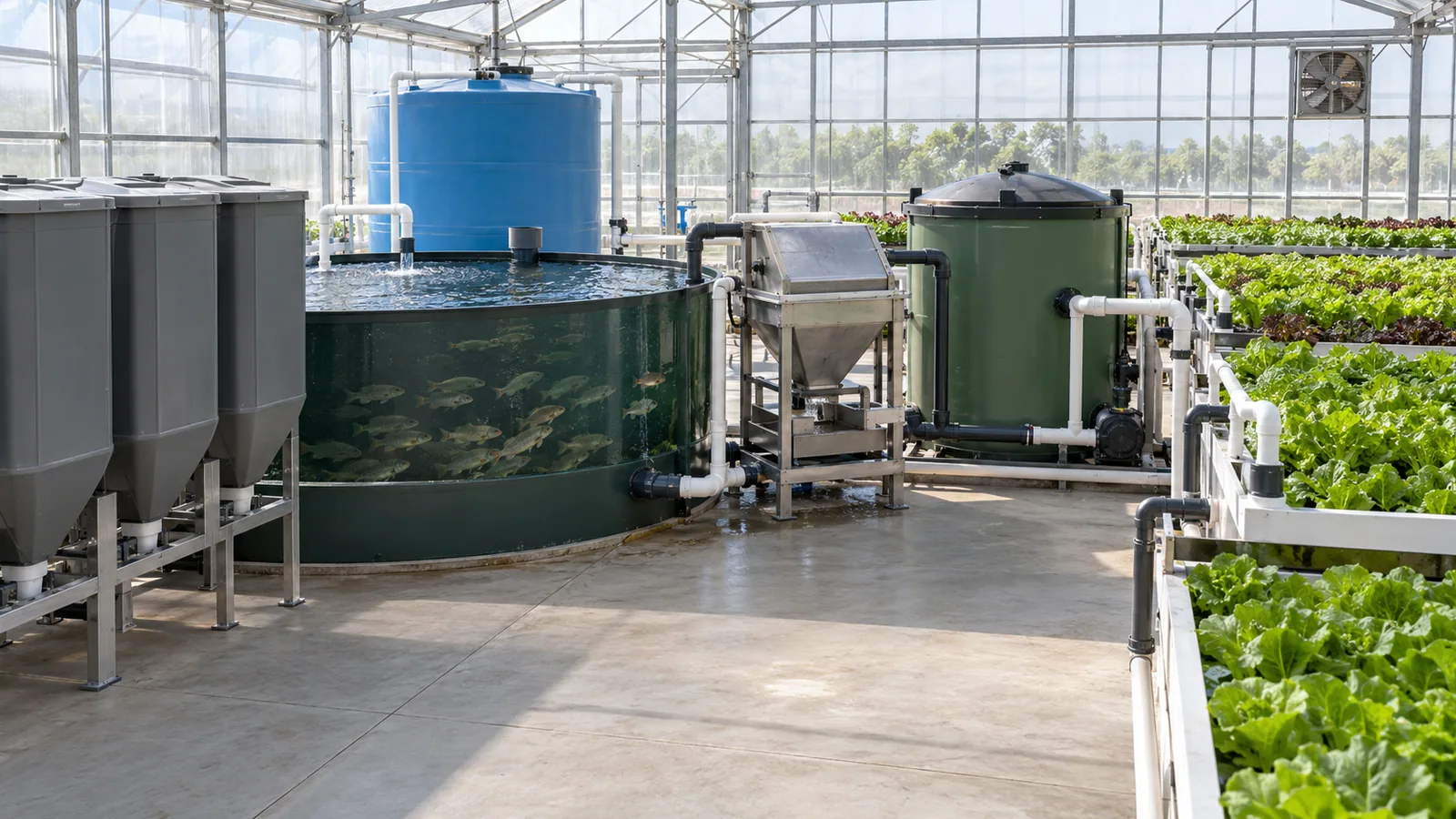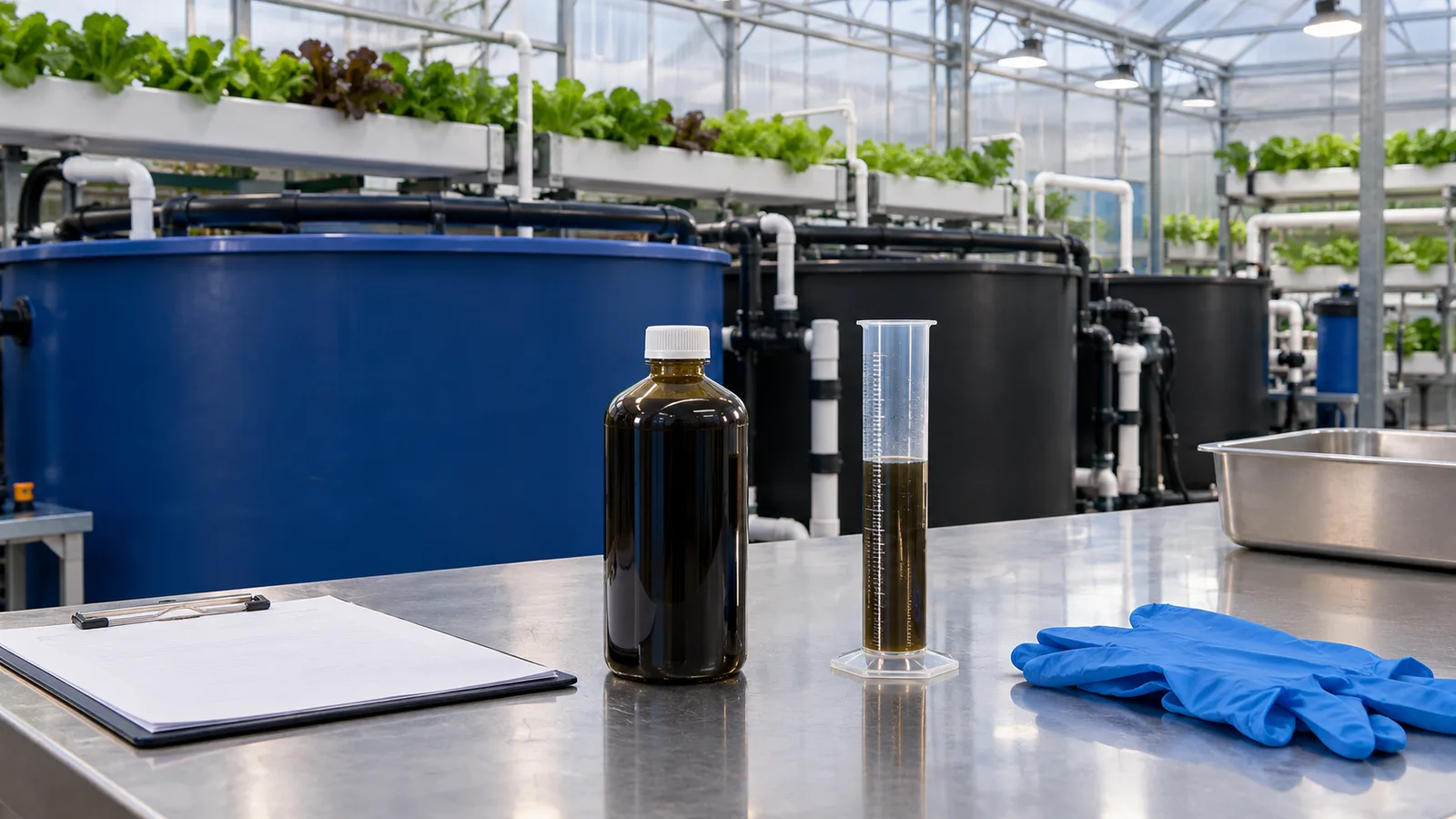
There is no universal amount of liquid seaweed that is safe or useful in every aquaponic system. Products sold as liquid seaweed differ in seaweed species, extraction method, concentration, carrier, preservatives, added minerals and intended application. A rate printed for soil, hydroponics or foliar use is not automatically approved for water shared by fish, nitrifying bacteria and edible crops.
The correct decision may be to use no seaweed product at all. Fish feed, source water, mineralized solids and measured supplements already provide nutrients to an aquaponic loop. Liquid seaweed is generally treated as a biostimulant or supplementary input, not a complete fertilizer and not a substitute for diagnosing a mineral deficiency.
Before calculating millilitres, obtain the full product label and composition, confirm that the manufacturer supports the proposed aquaponic use, measure the actual treated water volume, review fish and crop compatibility, and decide whether the product belongs in the shared loop, an isolated plant loop or a controlled foliar program. Then use the labelled rate for that exact product as an upper decision boundary—not a rate borrowed from another brand.
The Short Answer
Use this calculation only when the exact product is documented as suitable for the intended application:
Product volume (mL) = approved product rate (mL/L) × actual treated water volume (L)
If a label gives a range, do not automatically select the highest number. Determine whether the rate refers to a foliar spray, root drench, hydroponic reservoir or field irrigation. These are different applications. A hydroponic label rate still does not prove fish safety in a coupled aquaponic loop.
For example, a hypothetical product label specifies 0.5 mL/L for a recirculating root-zone application, and the manufacturer confirms that this use is compatible with the project. A measured 800-L isolated plant loop would require:
0.5 mL/L × 800 L = 400 mL of product
That calculation is mathematically correct only for the stated product, rate and volume. It is not a general recommendation for adding 0.5 mL/L to aquaponics. If the product has no aquaponic or aquatic-organism compatibility information, do not use a hydroponic calculation to fill the evidence gap.
What Liquid Seaweed Actually Is
“Liquid seaweed” describes a broad product category. Commercial extracts may be made from kelp or other marine algae and processed by mechanical, alkaline, enzymatic or fermentation methods. The resulting product may contain organic compounds associated with biostimulant effects, small quantities of minerals, carbohydrates and other constituents. Some products are blended with fish hydrolysate, humic substances, nitrogen, potassium, micronutrients, surfactants or preservatives.
Those differences matter. Two brown liquids in similar bottles may have very different dry-matter content, sodium concentration, pH, electrical conductivity and biological oxygen demand. A dosage copied from a different brand can therefore deliver a different chemical and organic load.
A controlled hydroponic lettuce study on Eucheuma cottonii seaweed extract evaluated defined replacement proportions of one extract and commercial nutrient solution, reporting that some partial substitution treatments maintained several measured growth outcomes. Those ratios describe that extract and experiment; they are not aquaponic dosing instructions because the study did not expose fish and an aquaponic biofilter to the treatment.
Do Aquaponic Plants Need Liquid Seaweed?
Plants need essential mineral elements in available forms. They do not have a defined requirement for a branded seaweed extract. A biostimulant may influence growth or stress response under some conditions, but it cannot replace missing nitrogen, phosphorus, potassium, calcium, magnesium, iron or other essential elements unless its guaranteed analysis supplies enough of that element.
Start with the system’s nutrient pathways. Fish feed is usually the main planned nutrient input. Minerals also enter through source water, pH buffers and deliberate supplements. Captured solids may release nutrients as they mineralize. The guide on how minerals enter an aquaponics system explains why an operator should map these inputs before adding another product.
Ask four questions:
1. What plant problem or operational objective is being addressed?
2. Is that objective supported by water, tissue, crop or environmental data?
3. What does the exact seaweed product add besides the advertised biostimulant fraction?
4. Can the response be measured against an untreated comparison?
If the answer is simply “plants look weak,” inspect light, temperature, pH, dissolved oxygen, root condition, flow, pests and individual nutrients first. Seaweed extract should not become a catch-all response to every symptom.
Why Published Hydroponic Rates Cannot Be Copied Directly
Hydroponic research is useful for understanding possible crop responses, but coupled aquaponics adds fish, feed, nitrification and organic solids to the same water. A product that is acceptable for roots may contain constituents that have not been evaluated for the resident fish species or microbial community.
Research results also vary by formulation. A study comparing several biostimulants in indoor hydroponic lettuce found that product responses were not uniformly positive; one seaweed-derived product produced slight negative growth effects under the tested conditions. The original HortTechnology biostimulant comparison supports a cautious product-specific approach rather than assuming that all seaweed extracts behave alike.
Published rates should therefore be read as experimental treatments attached to a particular product, crop, water chemistry and application method. They can help a qualified grower design a trial, but they do not replace the product label or aquatic-safety documentation.
Review the Product Before Calculating Any Dose
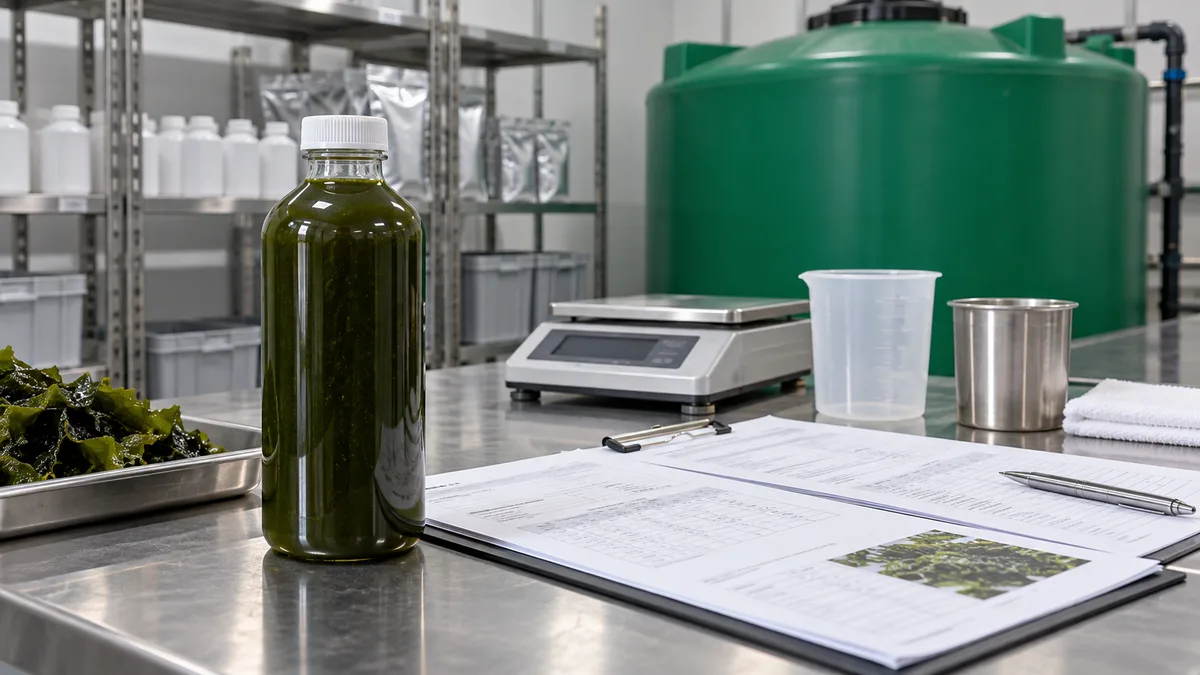
*A useful purchasing decision starts with composition, application directions and batch traceability.*
Confirm identity and composition
Request the complete label, technical data sheet and Safety Data Sheet where applicable. Record:
- Manufacturer and product name
- Seaweed species or source material when disclosed
- Extraction or processing method when available
- Guaranteed nutrient analysis
- Dry matter or concentration
- Sodium, chloride and potassium information where available
- pH and density
- Preservatives, surfactants and added fertilizers
- Intended crops and application methods
- Lot number and expiry or storage guidance
Avoid products whose ingredients are described only as a proprietary organic blend with no meaningful analysis. “Natural,” “organic,” “kelp” and “food safe” do not establish compatibility with fish or nitrifying bacteria.
Distinguish root-zone and foliar directions
A foliar rate normally describes the dilution placed in a spray tank, not the concentration that should circulate continuously through an aquaponic system. A root drench may assume drainage into soil rather than indefinite recirculation. A hydroponic reservoir direction is more relevant to soilless roots, but still requires a separate fish-safety decision.
Check certification and destination requirements
Commercial growers should confirm input rules for the destination market, crop-certification scheme and buyer. If produce is marketed with an organic or residue-related claim, obtain written guidance from the responsible certifier rather than relying on a retailer’s product description.
Decide Where the Product Should Be Applied
Shared coupled loop
This is the highest-exposure option because fish, biofilter and plants receive the addition. Use it only when product documentation and competent project review support the application. Account for the entire connected water volume and the fact that repeated doses can accumulate constituents that plants do not remove quickly.
Decoupled plant loop
A separate plant loop gives the operator more control over crop inputs and prevents automatic exposure of fish. It still requires food-crop suitability, nutrient accounting and discharge planning. Confirm that return plumbing cannot accidentally carry concentrate into the fish loop.
Foliar application
Foliar application can limit the amount entering the water, but overspray and runoff remain concerns. Follow the exact crop label, worker-protection requirements, pre-harvest interval where applicable and food-safety procedure. Shield open tanks and channels, control drift, and never improvise a spray concentration from a reservoir recipe.
Small isolated trial
For a permitted product with uncertain crop benefit, use a separate, representative plant group rather than the entire production system. Keep the comparison scientifically useful: same cultivar, age, light, temperature and irrigation, with an untreated control. Do not include fish in an informal product trial.
Measure the Actual Treated Water Volume
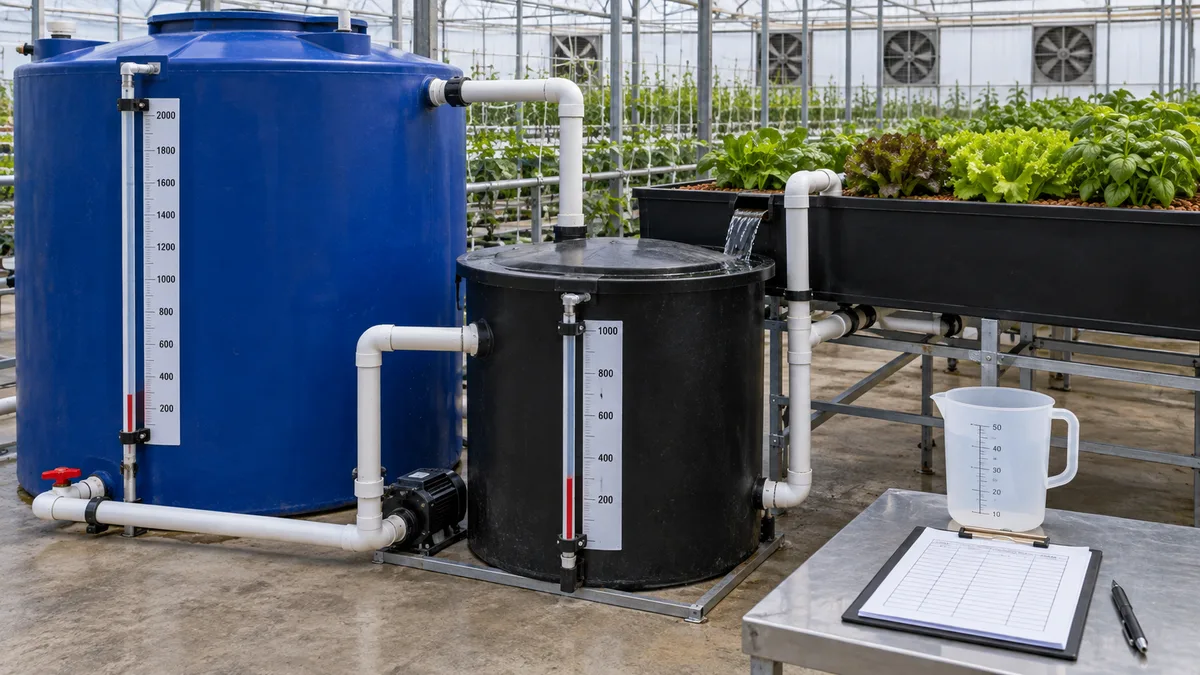
*Dose calculations must use the actual water volume connected to the selected application zone.*
Nominal tank capacity is not system volume. Include water in the sump, filters, pipes, DWC troughs and the void space of flooded media beds. Exclude isolated vessels and unused tank capacity.
| Component | How to estimate operating water volume |
|---|---|
| Fish tank | Normal measured water depth × internal plan area, or verified tank chart |
| Sump | Normal operating level, not brim capacity |
| DWC trough | Internal length × width × water depth |
| Media bed | Flooded bulk volume × measured media void fraction |
| Filters | Normal filled volume from supplier data or measurement |
| Pipework | Internal cross-sectional area × filled length |
Recalculate after expansion or seasonal shutdown. A 20 percent volume error creates a 20 percent dose error before product uncertainty is considered.
Convert Label Directions Correctly
Rate stated in mL/L
Product mL = rate mL/L × treated litres
Rate stated per gallon
Keep the same gallon definition used by the label. A US gallon is approximately 3.785 L, while an imperial gallon is approximately 4.546 L. Mixing the two creates a meaningful dosing error.
Dilution ratio
A direction such as 1:1,000 may mean one part product in 1,000 parts final solution, but label conventions differ. Confirm the manufacturer’s definition. Do not guess whether the product volume is included in the final total.
Rate stated by area
A foliar direction in mL per square metre or fluid ounces per 1,000 square feet cannot be converted to a reservoir concentration without application-volume information. Calculate spray mix from the labelled area rate and calibrated sprayer output.
Concentrated stock solution
If a dosing pump injects stock, separate the final-system rate from the stock concentration and injection ratio. Verify calibration by collecting and measuring pump output. Factory testing can confirm that a dosing pump operates; site commissioning must confirm its real delivery against installed pressure and controls.
Build a Controlled Introduction Procedure
Use a written procedure rather than pouring product directly into a tank:
1. Define the measured crop objective.
2. Approve the exact product and application route.
3. Record system volume and calculation.
4. Inspect the container seal, lot and storage condition.
5. Calibrate the measuring vessel or dosing pump.
6. Establish baseline pH, EC, dissolved oxygen, temperature, ammonia, nitrite and crop observations.
7. Apply only through the approved dilution and distribution method.
8. Prevent direct contact between concentrate and fish, roots, probes or biofilter media.
9. Observe water clarity, foam, odor, fish behavior and equipment.
10. Record the response and do not repeat automatically.
Organic products can increase microbial oxygen demand or foam depending on formulation and system conditions. Maintain aeration and investigate any unexpected dissolved-oxygen change. A darker water color can also interfere with visual inspection; it is not evidence that the product is working.
Mid-Article CTA — Review the Input Before It Enters the Loop
Considering a nutrient or biostimulant program for a new project? Send Your Requirements with the system volume, crops, fish species, water analysis and complete product label so the equipment and monitoring discussion starts with the right information.
Monitor a Defined Set of Indicators
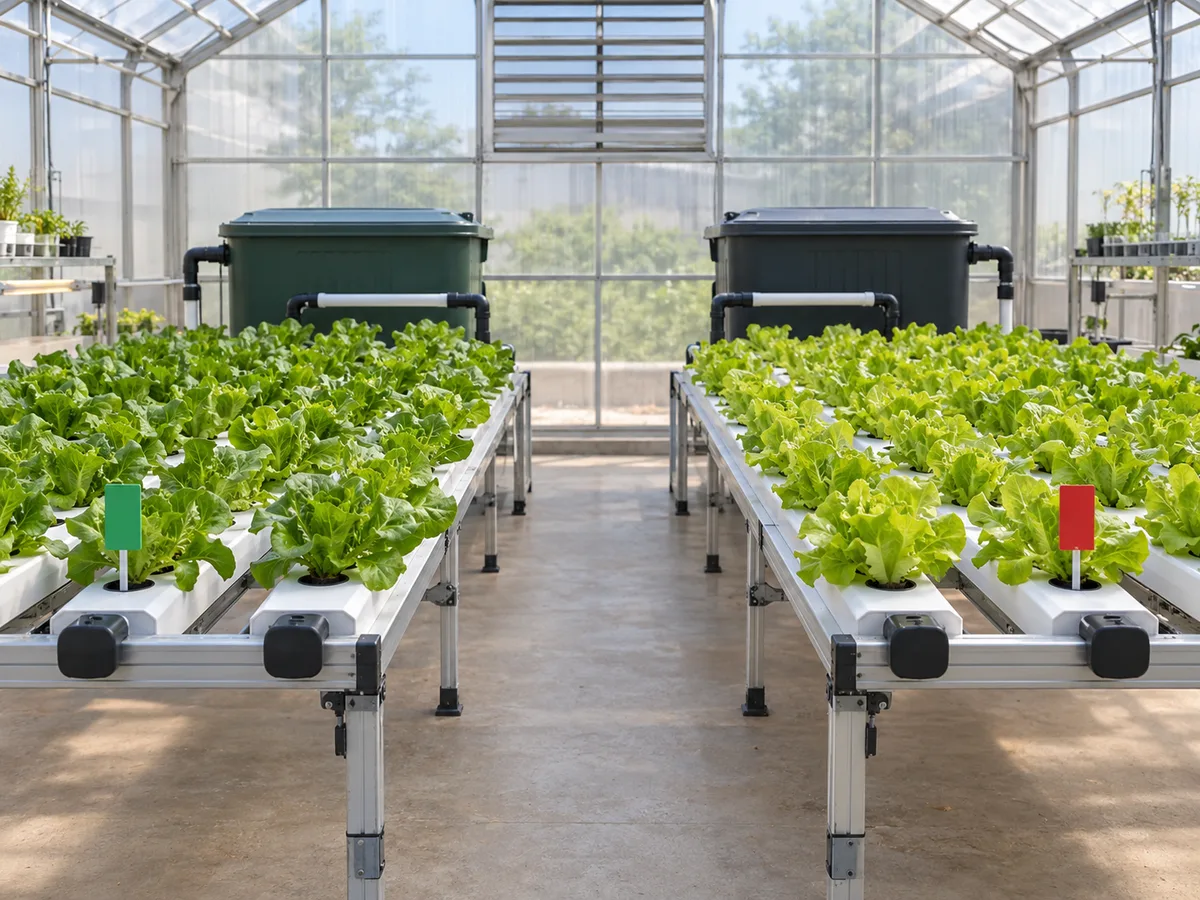
*A small isolated comparison reveals more than an undocumented whole-system dose.*
Record the baseline and follow-up window before application. Useful indicators include:
- New leaf growth and marketable weight
- Root color, odor and integrity
- Crop uniformity by zone
- Water pH and EC
- Dissolved oxygen and temperature
- Ammonia and nitrite
- Fish appetite, respiration and swimming behavior
- Foam, turbidity and filter loading
- Any change in pump, screen or channel fouling
Do not judge success from greener leaves alone. Light changes, crop age and nitrogen availability can alter color. Compare a treated plant group with a control and use repeated measurements. If the system response is adverse, stop the planned repeat, preserve records and obtain qualified advice rather than adding a second product to counteract the first.
Avoid Accumulation From Repeated Applications
In a recirculating system, water evaporates but many dissolved constituents remain. Top-up water and repeated supplements may raise sodium, chloride, potassium or EC over time. A weekly label schedule developed for soil or drain-to-waste production may therefore be unsuitable for a coupled loop.
Track total product added, water removed, top-up water and laboratory results. If a product contains measurable minerals, add them to the nutrient mass balance. If the composition is undisclosed, the operator cannot reliably predict accumulation; that is a procurement problem, not a reason to dose by habit.
The supplier checklist in how to order aquaponics nutrient supplements online can help buyers request composition, batch documents and shipping information before purchase.
Factory Testing, Shipment Inspection and Installation Preparation
For an equipment supplier, liquid seaweed is usually an operating input rather than a standard part of the aquaponics package. However, the system can be designed to manage inputs safely.
During factory testing, verify dosing-pump function, tank graduations, mixing, check valves, alarm logic and isolation between fish and plant loops. Do not factory-fill export equipment with a biological product. Shipping containers should carry dry, clean equipment unless the approved scope says otherwise.
During shipment inspection, confirm model numbers, wetted-material compatibility, spare tubing, calibration cylinders and instructions. A leaking or incorrectly oriented check valve can allow concentrate to siphon into the system.
Installation preparation should provide a labelled input station with secondary containment, dedicated measuring tools, safe storage and a written approval process. Customer requirements should specify whether the system will be coupled or decoupled, whether crop inputs require certification, and who is authorized to change dosing settings.
Common Mistakes
Copying another grower’s millilitres per gallon
Their product, concentration, crops, water and application route may differ. Copy the decision process, not the number.
Treating liquid seaweed as a complete nutrient solution
Most seaweed biostimulants do not supply a balanced crop formula. Verify the guaranteed analysis and diagnose individual nutrient gaps.
Assuming hydroponic-safe means fish-safe
Hydroponic labels address plants and equipment. Aquatic compatibility requires separate evidence.
Dosing the nominal fish-tank capacity
Calculate the actual connected volume or the isolated plant-loop volume, depending on where the product goes.
Adding more when no response is visible
Plant response may take time, and the product may not address the limiting factor. Reassess the diagnosis instead of stacking doses.
Using homemade seaweed tea in the shared loop
Uncontrolled fermentation, salinity, contamination and composition create additional risks. A homemade extract has no reliable guaranteed analysis or batch consistency.
FAQ
Is liquid seaweed safe for aquaponic fish?
Safety depends on the exact formulation, concentration, fish species and exposure. A product described as natural or hydroponic-compatible is not automatically verified for fish. Obtain manufacturer documentation and qualified guidance before shared-loop use.
Can I use the rate printed for hydroponics?
Only as product information for the plant side. It does not establish aquatic safety. In a coupled system, the fish and biofilter assessment must come first.
Is liquid seaweed a source of potassium?
Some products contain potassium, but amounts vary. Use the guaranteed analysis and a potassium-specific test strategy. Do not assume that seaweed extract will correct a measured potassium deficiency.
Will liquid seaweed increase ammonia?
The direct effect depends on its nitrogen and organic composition. Organic material can affect microbial activity and oxygen demand. Monitor ammonia, nitrite and dissolved oxygen when an approved input is introduced.
Is foliar application safer than adding it to the tank?
It can reduce fish exposure when properly controlled, but the product must be labelled for foliar use on the crop. Prevent drift and runoff into tanks, comply with worker and harvest requirements, and record the application.
How often should liquid seaweed be added?
Do not create a universal aquaponic schedule. Follow the exact approved product direction, monitor the defined objective and reassess before repeating. Recirculating systems require accumulation to be considered.
Can I use liquid seaweed during system cycling?
Adding an unnecessary organic or mineral input can complicate interpretation of ammonia, nitrite, oxygen and microbial changes. Establish the biofilter with a documented cycling procedure rather than using seaweed as an unverified shortcut.
Conclusion
The amount of liquid seaweed used in aquaponics must come from the exact product, approved application route and measured treated volume. Published hydroponic rates can illustrate research methods, but they do not prove safety for fish or justify copying a dose into a coupled system.
Define the crop objective, inspect the formulation, confirm aquatic compatibility, calculate from actual volume, introduce the product through a controlled procedure and evaluate it against a baseline. In many systems, correcting light, pH, roots, mineral balance or flow will be more important than adding a biostimulant. A disciplined decision protects fish and biofiltration while giving the grower evidence about whether the product creates any measurable value.
Final CTA — Plan a Traceable Input System
Need an aquaponics layout with controlled plant-input handling and clear monitoring points? Ask for a Product Catalog and send your project scale, crops, fish plan, water source, destination and customer requirements.