
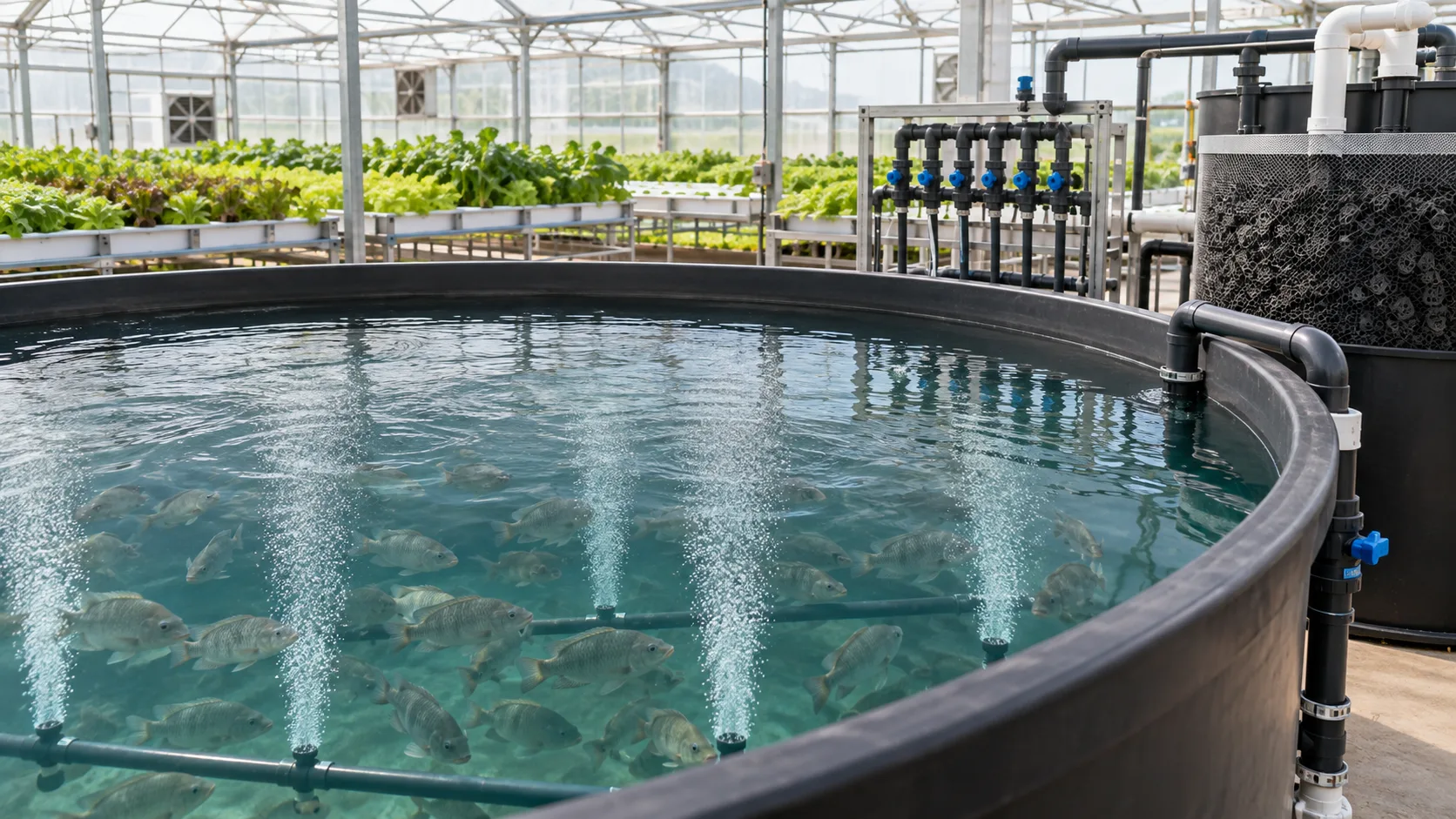
An effective aeration system maintains enough dissolved oxygen (DO) for fish, nitrifying bacteria and the changing oxygen demand created by feeding, temperature and solids. For most small and medium aquaponics systems, the practical starting point is a continuously operating air pump or regenerative blower feeding correctly placed fine-bubble diffusers, backed by a separate emergency air source and a response plan. The correct equipment cannot be chosen from fish-tank volume alone. It must be selected from the expected fish biomass, feed rate, water temperature, tank geometry, biofilter design, operating altitude and the time an operator needs to respond to a fault.
Aeration is often described casually as “adding bubbles.” That is incomplete. Bubbles move water, exchange gases and can help prevent dead zones, but a visibly vigorous tank is not proof that oxygen is adequate everywhere. A reliable system has a defined normal duty, an independently testable backup duty, accessible valves and check valves, a way to observe or measure performance, and clear action when power or air delivery fails.
Aeration, oxygenation and circulation are related—but different
Aeration transfers oxygen from ordinary air into water and helps release carbon dioxide. Oxygenation uses concentrated oxygen and requires a more specialised, controlled design. Circulation moves water; it can distribute oxygen but does not automatically add enough of it. A pump return that ripples the surface may be useful, yet it should not be treated as the only life-support method for a stocked fish tank.
The SRAC review of recirculating-system component options distinguishes atmospheric aeration from pure-oxygen transfer and explains why oxygen demand must include fish and bacterial activity. The SRAC management guide also notes that oxygen demand rises with loading and feeding, while both fish and biological treatment depend on adequate DO. These are useful design references, not universal set-points for every species or project.
Start with the oxygen-demand profile, not a catalogue photograph
Ask the supplier or system designer to document these assumptions before selecting an air system:
Fish, feed and temperature
Species, standing biomass, expected harvest size and feed schedule affect oxygen demand. Demand is rarely constant across the day. It can rise after feeding, during warm weather, when solids accumulate, or when a system is pushed beyond its intended stocking plan. Warm water generally holds less oxygen than cooler water, so a configuration that appears comfortable in a cool commissioning test can be inadequate during a hot period.
Biological treatment and solids handling
The biofilter needs oxygen too. A blocked solids filter, overloaded settling stage or neglected grow-bed return can consume oxygen and reduce usable flow. Do not increase fish loading simply because a larger air pump has been fitted; aeration does not replace solids removal, biofiltration, circulation or responsible feeding.
Tank shape and hydraulic pattern
Deep circular tanks, shallow rectangular tanks and multi-tank systems need different diffuser layouts. The objective is not the largest plume in the centre. It is even water movement without a stagnant corner, excessive fish stress, exposed diffuser line, or a return pattern that drives waste into an inaccessible area. In a factory testing review, ask for a short video that shows the tank at its operating water level, the airflow at each outlet and the position of isolation valves.
Common aeration options and where they fit
Diaphragm or linear air pumps
These are common in compact systems. They are quiet, accessible and suitable when the number of outlets, water depth and resistance in the distribution line are within their actual rated performance. Their limitations are often hidden by headline flow figures: output falls when air must travel through long pipework, several diffusers, deeper water or restrictive manifolds. Choose a model with serviceable diaphragms and a documented replacement route.
Regenerative blowers
For a larger fish room, multiple tanks or a long distribution manifold, a regenerative blower can provide more stable air volume. It needs deliberate installation: dry protected location, clean intake air, vibration control, safe electrical isolation, pressure relief where appropriate and a manifold that permits balancing. A blower should not be made the single point of failure merely because it can feed every tank. Critical zones need a tested backup route.
Fine-bubble diffusers, air stones and membrane discs
Fine-bubble devices can provide useful transfer area and are practical for many tanks. Selection should consider fouling, cleaning method, compatibility with the air source and whether the diffuser can be removed without catching fish or draining the tank. Cheap air stones can be reasonable for a small demonstration system, but a commercial buyer should request material specification, expected service interval, spare quantity and connector standard.
Air lifts and flow-stream aeration
Air lifts can combine water movement with gas exchange in compatible layouts. Packed columns, trickling sections and degassing stages may improve gas management in a designed recycle path. They are not interchangeable with tank diffusers. In particular, treating an elegant waterfall or splash return as the emergency oxygen system is risky unless actual performance and failure behaviour have been designed and tested.
Pure oxygen systems
Concentrated oxygen can be appropriate in intensive aquaculture designs, but it introduces different controls, supply logistics, pressure equipment, fire-safety considerations and risks of improper supersaturation. It should be engineered for the project and operated by trained personnel. It is not a casual upgrade for a lightly instrumented home or teaching system.
Choose capacity with margin—and state what the margin means
An RFQ should request a design duty and an emergency duty. “Oversized” is not a specification. Ask: at what fish biomass, temperature, feed input and water depth was the normal-air requirement estimated? What residual capacity remains if one diffuser line is isolated? Does the backup maintain life support for the full fish load or only buy time for a defined response window? What happens after a breaker trip, a failed check valve, a blocked diffuser or a power restoration?
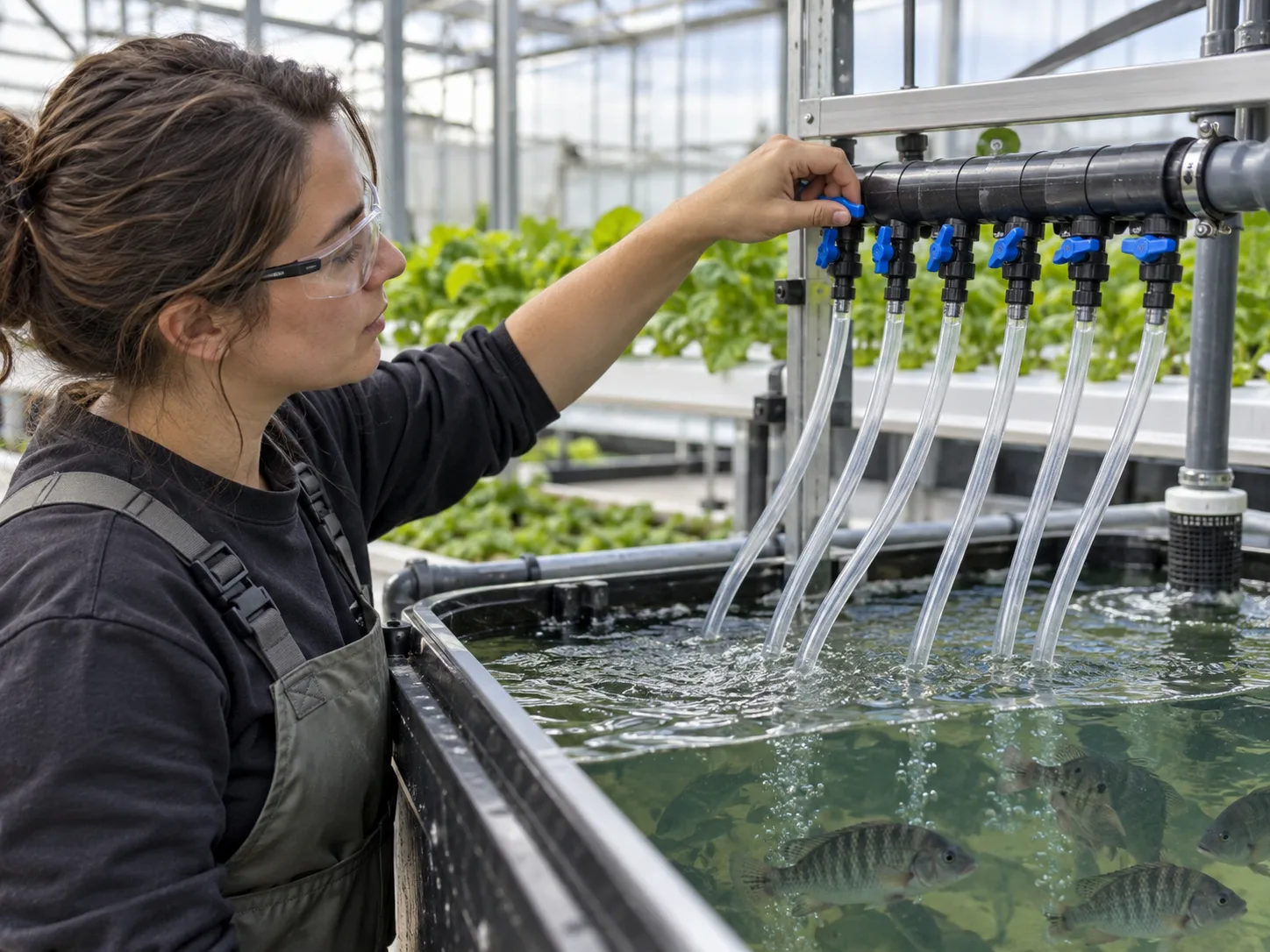
For a modular system, divide the air network into zones. Each zone should have labelled take-offs, non-return valves where needed, an accessible flow-control valve and a way to isolate one outlet without stopping the rest of the tank. Use a manifold that can be inspected, rather than concealing fittings behind permanent panels. A simple pressure gauge can reveal a broad change, but it does not replace a DO check or a physical inspection of the water pattern.
> Need an aeration layout matched to your tank count and site utilities? Send Your Requirements with fish species, tank dimensions, target biomass, climate, voltage and your required backup period.
Layout details that protect real performance
Place diffusers so their upward movement complements the tank’s solids-collection and return-water pattern. Keep air lines supported, protected from foot traffic and routed to avoid low points where condensate can accumulate. Use correct-size tubing and fittings; undersized distribution pipe can make a large blower perform like a much smaller unit. Install electrical equipment away from splash zones, with local isolation and protection selected by a qualified electrician under local requirements.
In shipment inspection, count each blower, pump, manifold, diffuser, valve, non-return valve and spare kit against the packing list. Before fish are introduced, carry out installation preparation: pressure or leakage checks as applicable, dry electrical checks, a filled-water airflow check, simulated loss of primary air and a record of which person receives the alarm. This is more useful than discovering a missing check valve during an emergency.
Monitoring: observe trends, not a single reassuring number
Portable DO measurement can be useful when it is maintained and calibrated according to the instrument instructions. Measure at a repeatable time and record temperature, feeding, air-equipment state and unusual weather. In a larger system, a maintained online sensor and alarm may add response time, but it still needs cleaning, calibration, defined alarm ownership and a local manual check. Our guide to app-based aquaponics monitoring and remote control explains why an alert is valuable only when the system can also be safely operated on site.
Watch fish behaviour as well as data. Surface gathering, unusually fast gill movement, crowding near an inlet, loss of appetite or a sudden change after feeding deserves immediate investigation. Those signs are not a diagnosis by themselves: temperature, carbon dioxide, water chemistry, disease, crowding and flow faults can overlap. Reduce risk first, verify the equipment and seek species-appropriate technical advice where needed.
Build a backup plan before stocking increases
The backup should be independent of the failure it protects against. A battery air pump, inverter system, generator or dedicated emergency oxygen arrangement can each have a role, but each must be sized, installed and test-run for the actual anticipated outage. Label the connection points and define who starts it, who checks it and when escalation occurs. Keep a written call list next to the equipment.
During handover, test the alarm, switch to backup air, confirm airflow in every critical tank and time the battery or generator run under realistic load. Rehearse it before the system is heavily stocked. Factory testing can confirm component operation; site commissioning is where the actual power supply, cable routing, tank layout and response team prove whether the plan works.
Maintenance and acceptance tests that buyers should not skip
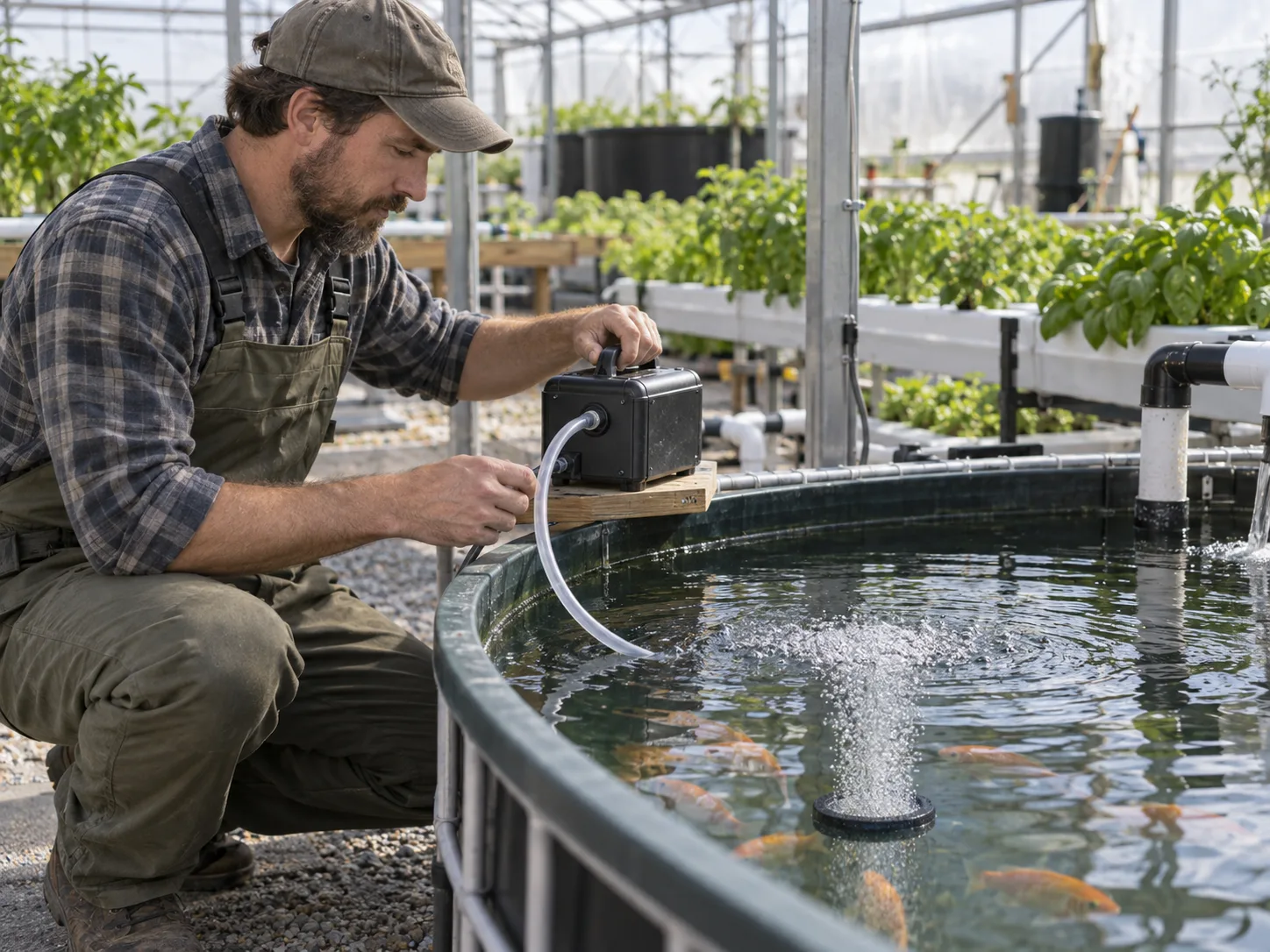
Air equipment is a wearing system. Intake filters collect dust, diaphragms fatigue, blower bearings and vibration mounts age, tubing can harden, and diffuser pores can foul. Put the inspection interval, cleaning method, approved spare part and expected replacement route in the operations manual. Do not clean a diffuser with an unverified chemical or return a component to the fish loop until it has been rinsed and checked according to the manufacturer’s instructions.
At acceptance, record the installed model and serial number, supply voltage, manifold arrangement, number of active outlets, normal pressure indication and location of each critical diffuser. Take photographs that show route and isolation points. Repeat the same inspection after the first weeks of operation, because settling pipe supports, changed fish behaviour and real feed input can reveal issues that a short commissioning run did not show.
Energy use should also be visible. The buyer should know which air device runs continuously, which equipment starts only under an alarm, and whether the power allowance includes line losses and ancillary controls. Selecting the quietest or lowest-wattage device without considering delivered air at the required pressure can create a false economy. Conversely, a correctly selected blower should not be throttled randomly to conceal an oversized or poorly balanced network.
For multi-tank installations, use a written inspection route. Begin at the air source, inspect the intake and vibration condition, read the local indication, trace each manifold branch, observe bubble pattern and fish behaviour, then check the backup ready state. A standard route prevents the least visible tank from becoming the least protected tank.
A practical buyer checklist
Before ordering, request:
- a stated design basis for fish biomass, feed, temperature and anticipated demand;
- normal and emergency air duties, including response-time assumptions;
- blower or pump curve, voltage/frequency and noise information;
- a labelled distribution drawing showing manifolds, zones, valves and check valves;
- diffuser material, quantity, depth and replacement/cleaning procedure;
- local electrical and backup-power responsibilities;
- factory-test evidence, packing list and spare-parts list; and
- installation, commissioning and operator-training scope.
These questions turn “included aeration” into an auditable scope. They also help compare quotations fairly when one supplier includes only a small pump and another includes distribution, backup interfaces, alarms and commissioning support.
FAQ
Is one air pump enough for an aquaponics fish tank?
It can be enough for a small, lightly stocked and correctly designed system, but it should not be assumed from tank volume alone. Evaluate the operating load, water temperature, diffuser depth, line losses and the consequence of failure. A separate backup route is prudent whenever fish welfare depends on continuous air delivery.
Are more bubbles always better?
No. Excess turbulence can stress fish, disturb solids movement or waste energy. The goal is adequate DO and well-distributed, manageable water movement—not the noisiest tank.
Should the biofilter receive air too?
The answer depends on the biological-treatment design. Nitrifying organisms require oxygen, but an arbitrary extra diffuser can disrupt a filter intended to work in another hydraulic pattern. Follow the design rationale and check oxygen conditions through the treatment train.
Can a water pump replace an air system?
Usually no. Pump circulation and a splash return may contribute to exchange, but they should be assessed separately from dedicated life-support aeration and emergency backup.
Conclusion
The most effective aquaponics fish-tank aeration system is a documented oxygen-management package, not a single air pump. Start with real demand, distribute air evenly, protect the electrical installation, monitor performance, retain service access and prove an independent backup before fish biomass rises. That discipline supports fish welfare, biofilter stability and a calmer operating routine.
Planning a new or expanded fish-tank system? Contact Us for a component schedule and aeration discussion based on your customer requirements, local utilities and intended operating conditions.

