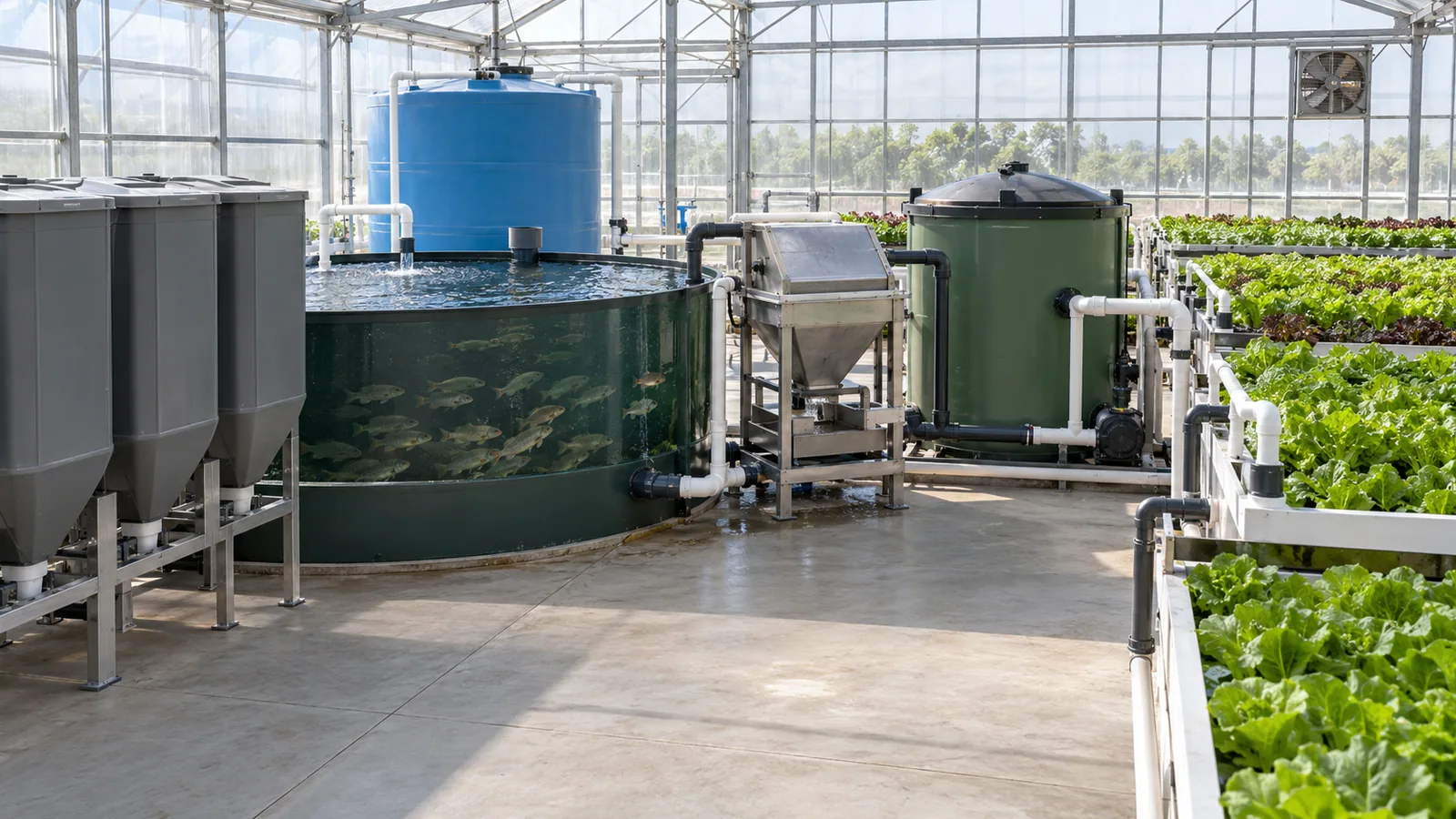
Iron is essential for plant chlorophyll formation, enzyme activity and new growth, yet it can be unavailable in aquaponics even when some iron is present in the system. Fish feed and solids may introduce iron, but oxidation, precipitation, pH and competing chemistry can leave too little soluble iron for crops. This is why growers often use a chelated iron product rather than an unverified iron salt.
Adding iron should still be a measured correction—not a routine handful added whenever leaves look pale. Similar symptoms can come from root damage, high pH, low temperature, poor oxygen, manganese deficiency, disease or insufficient light. The product’s iron percentage and chelating agent also change the required mass and its stability in the actual water.
A defensible process is to confirm the symptom pattern, review water and root conditions, test where practical, select a traceable chelated product for the operating pH, calculate from actual connected water volume, dissolve and distribute it through a controlled route, then record and reassess before repeating.
The Short Answer
Do not add raw iron metal, rusty objects or an unidentified garden product to the fish loop. Use a documented chelated-iron product that is suitable for the intended food-production and aquaculture context.
Once a qualified target has been selected, calculate the product mass as follows:
Product required (g) = desired Fe increase (mg/L) × treated water volume (L) ÷ [1,000 × product Fe fraction]
If a product contains 11 percent iron, its Fe fraction is 0.11. If measured iron is already present, the desired increase is the approved target minus the measured usable concentration—not the full target.
The target is not universal. Crop, growth stage, pH, chelate, existing iron, analytical method, fish species and system design all matter. Start from documented guidance, use a conservative staged correction and verify plant response and water conditions.
Confirm That Iron Is the Likely Problem
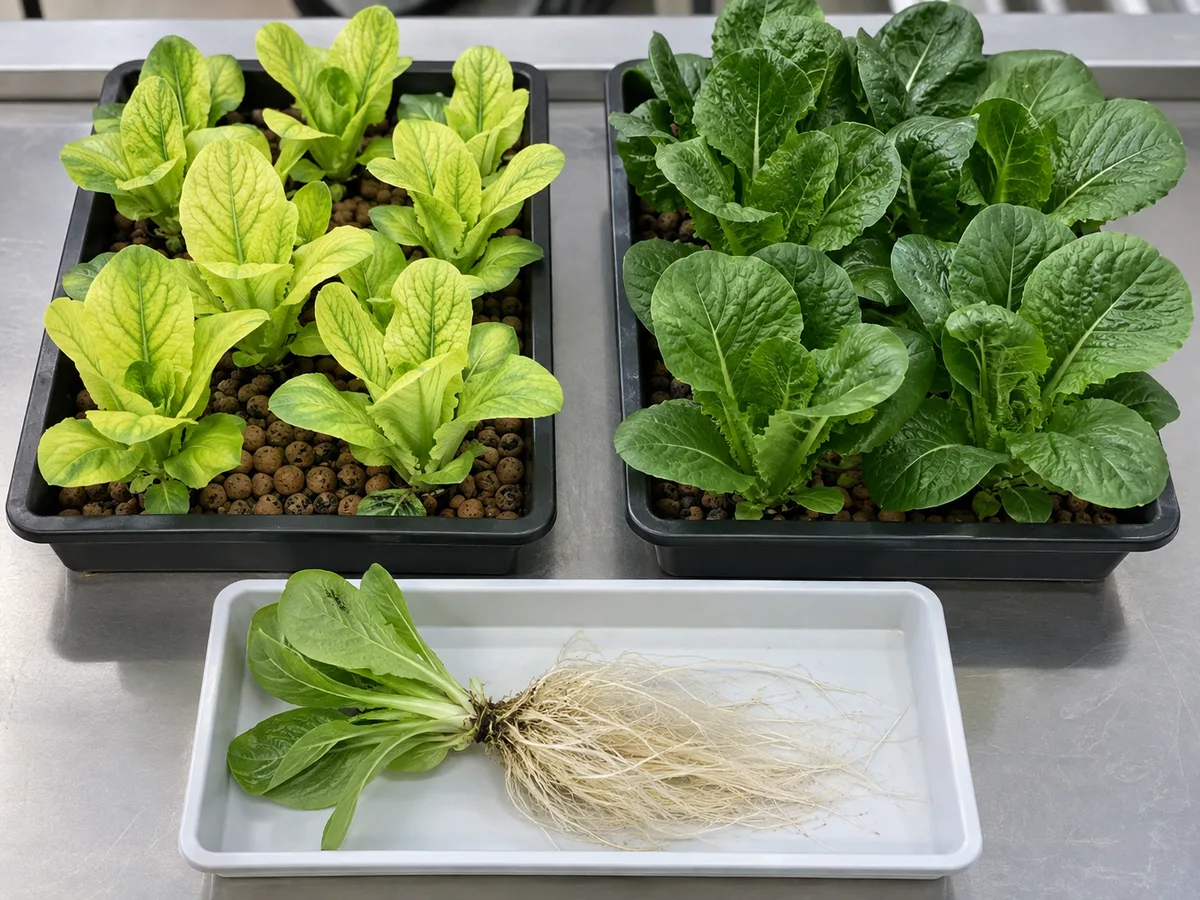
Iron is relatively immobile within plants. A typical deficiency pattern therefore appears first on newer leaves: tissue between the veins becomes pale while veins may remain greener. Severe deficiency can make young leaves almost yellow or white and slow new growth.
That pattern is useful but not conclusive. Before adding anything, check:
- Whether symptoms begin on new or old leaves
- Whether all crops and zones are affected
- Root color, odor and integrity
- Water and air temperature
- pH at the fish tank and plant inlet
- Dissolved oxygen and circulation
- Ammonia and nitrite stability
- Recent additions, water changes or filter cleaning
- Pest, disease and light patterns
- Product history and previous iron additions
Nitrogen or magnesium problems more often affect older leaves first, while root stress can produce mixed symptoms. A high pH can reduce iron availability even if the total iron number does not look extremely low. Correcting a hydraulic, oxygen or pH problem may be more important than adding more iron.
The broader guide to how minerals enter an aquaponics system explains why the amount introduced and the amount available to roots are not the same.
Understand Why Chelated Iron Is Used
In oxygenated water, unchelated iron can oxidize and form poorly soluble compounds. A chelate is an organic ligand that binds the iron ion and helps keep it in a form that can remain available longer under defined conditions.
The peer-reviewed review Iron supplementation and management in aquaponic systems emphasizes that iron-chelate bioavailability depends on the system environment and that supplementation requires management rather than a universal recipe. It compares common iron sources and discusses how pH influences chelate selection.
Chelation does not make every product automatically safe or effective. A buyer still needs:
- The exact chelating agent
- Guaranteed iron percentage
- Product purity and other ingredients
- Intended application and regulatory status
- Lot identification and expiry or storage guidance
- Solubility and mixing instructions
- Safety documentation
Avoid products blended with broad fertilizer packages unless every component has been reviewed for the fish, biofilter, crop and recirculating application.
Select the Chelate for the Operating pH
EDTA, DTPA and EDDHA are common names on iron fertilizer labels. They are not interchangeable.
Fe-EDTA
EDTA can keep iron available under more acidic conditions but becomes less reliable as pH rises. A system operating near neutral pH may lose more of the intended benefit than the label’s iron percentage suggests. Do not choose it merely because it is inexpensive.
Fe-DTPA
DTPA is commonly used where water is mildly acidic to around neutral. It generally offers better stability than EDTA as pH approaches the range frequently used in aquaponics. The exact suitability still depends on the product and actual water chemistry.
Fe-EDDHA
EDDHA is more stable at higher pH than EDTA or DTPA, but it can be more expensive and may give the water a red or pink appearance. Color change alone should not be interpreted as toxicity or proof of correct dosing; it must be considered with the product documentation and measured water quality.
The University of Florida IFAS guide on selecting chelated fertilizers by pH illustrates the major stability difference among EDTA, DTPA and EDDHA. That publication is written for plant production rather than a coupled fish system, so use its chelate chemistry as selection context—not as permission to copy a soil or foliar application rate into aquaponics.
Practical selection table
| Decision factor | Question to document |
|---|---|
| Operating pH | What is the measured range, not one spot reading? |
| Iron analysis | What percentage elemental Fe does the label guarantee? |
| Chelate identity | EDTA, DTPA, EDDHA or another specified ligand? |
| Other ingredients | Are there added nutrients, surfactants, dyes or carriers? |
| Intended use | Is recirculating food production addressed? |
| Traceability | Can the supplier provide batch and technical records? |
| Measurement | How will baseline and follow-up be verified? |
Measure the Actual Treated Water Volume
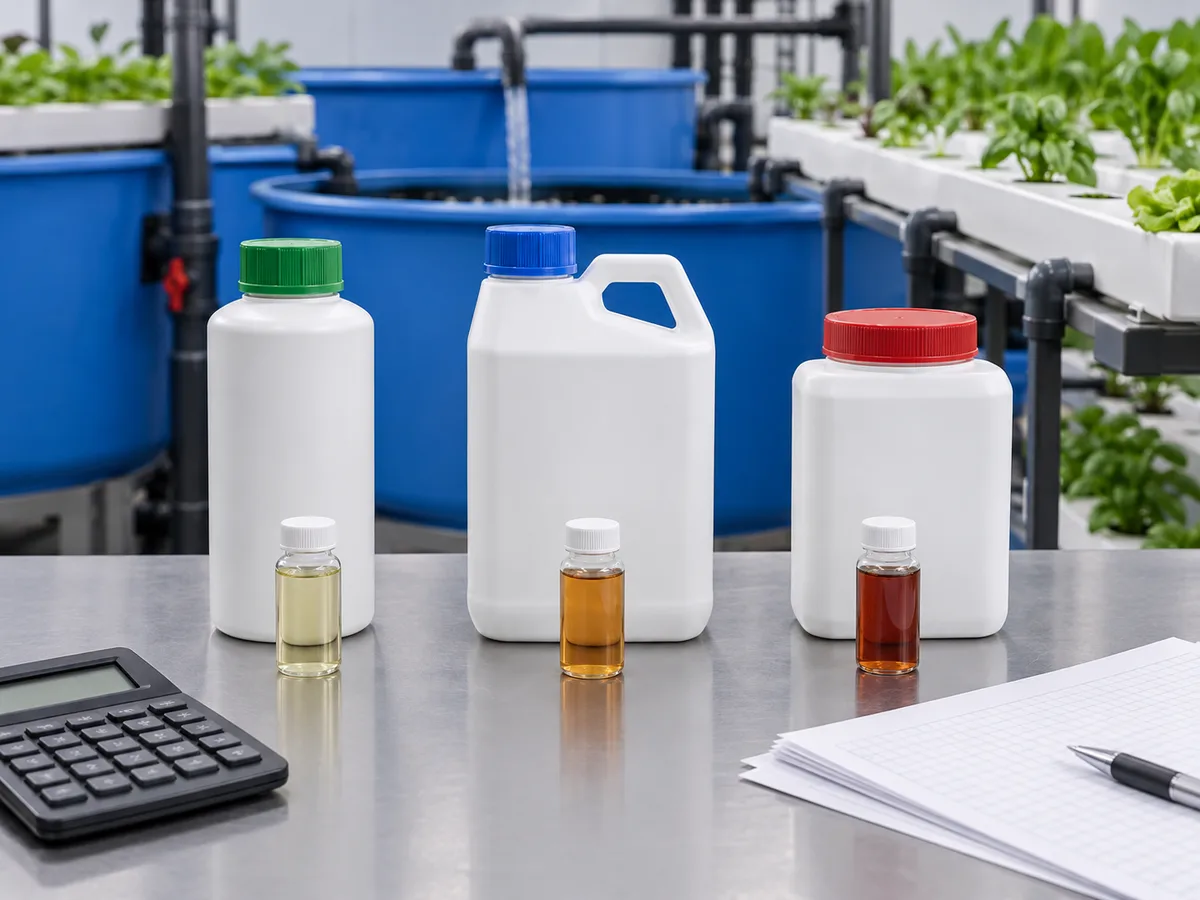
Do not calculate from fish-tank capacity alone. Include only water hydraulically connected during treatment:
- Fish tanks at operating level
- Sump at a defined point in the cycle
- Mechanical and biological filters
- Grow beds, raft troughs and channels
- Mineralization vessels connected to the loop
- Pipes and headers where material
Exclude isolated quarantine, rainwater or makeup-water tanks. Record the reference condition because a flood-and-drain system’s sump volume changes through the cycle.
If the media-bed water contribution is uncertain, use the project-specific procedure in the grow-media water-volume guide. Verify connected volume by controlled filling and level calibration rather than a nominal bed capacity.
Calculate the Iron Product Mass
Step 1: Define the desired increase
Suppose a qualified production plan calls for increasing available iron by 1.0 mg/L. If a valid laboratory method reports 0.3 mg/L relevant iron, the calculated gap is 0.7 mg/L. Confirm that the analytical result and target refer to comparable forms; “total iron” and immediately available dissolved iron may not be interchangeable.
Step 2: Confirm the guaranteed iron fraction
Examples:
- 6% Fe = 0.06
- 10% Fe = 0.10
- 11% Fe = 0.11
The percentage of the whole chelated product is not the same as the percentage of iron. Use the guaranteed elemental Fe value on the current lot documentation.
Step 3: Apply the formula
For a 2,000-L connected system, a desired 0.7 mg/L increase and an 11% Fe product:
0.7 × 2,000 ÷ (1,000 × 0.11) = approximately 12.7 g product
This result is the theoretical mass needed to add 1,400 mg of elemental iron. It does not guarantee that all iron will remain available or that the target is appropriate.
Step 4: Check the calculation independently
Record:
- Date and system ID
- Actual treated volume
- Baseline iron method and result
- Selected target and authority
- Desired increase
- Product name, chelate, lot and Fe percentage
- Calculated mass
- Actual mass added
- Application point and time
- Follow-up observations and result
Have a second person check unit conversions on commercial systems. Confusing milligrams, grams, litres, gallons or the percentage Fe value can create a large dosing error.
Prepare and Add the Product Safely
1. Review the current label, technical sheet and safety information.
2. Verify the scale with a check weight suitable for the expected mass.
3. Wear the protective equipment stated by the manufacturer.
4. Weigh the product in a dry, controlled area away from feed and harvest containers.
5. Dissolve it in an appropriate quantity of system-compatible water according to product instructions.
6. Add the solution slowly at a high-flow point where it will disperse before reaching fish or roots at a concentrated level.
7. Prevent undissolved material from entering pump intakes or settling on plant crowns.
8. Record the actual addition immediately.
Do not pour a concentrated solution directly onto fish, biofilter media or one plant row. Do not combine iron with pH chemicals in the same concentrate unless a documented procedure establishes compatibility. Strongly acidic or alkaline local conditions can destabilize nutrients and damage organisms.
For a new product, a controlled plant-zone or separate trial may be more informative than treating the entire commercial loop. Customer requirements for organic certification, food safety or local discharge rules should be reviewed before procurement.
Test, Observe and Reassess
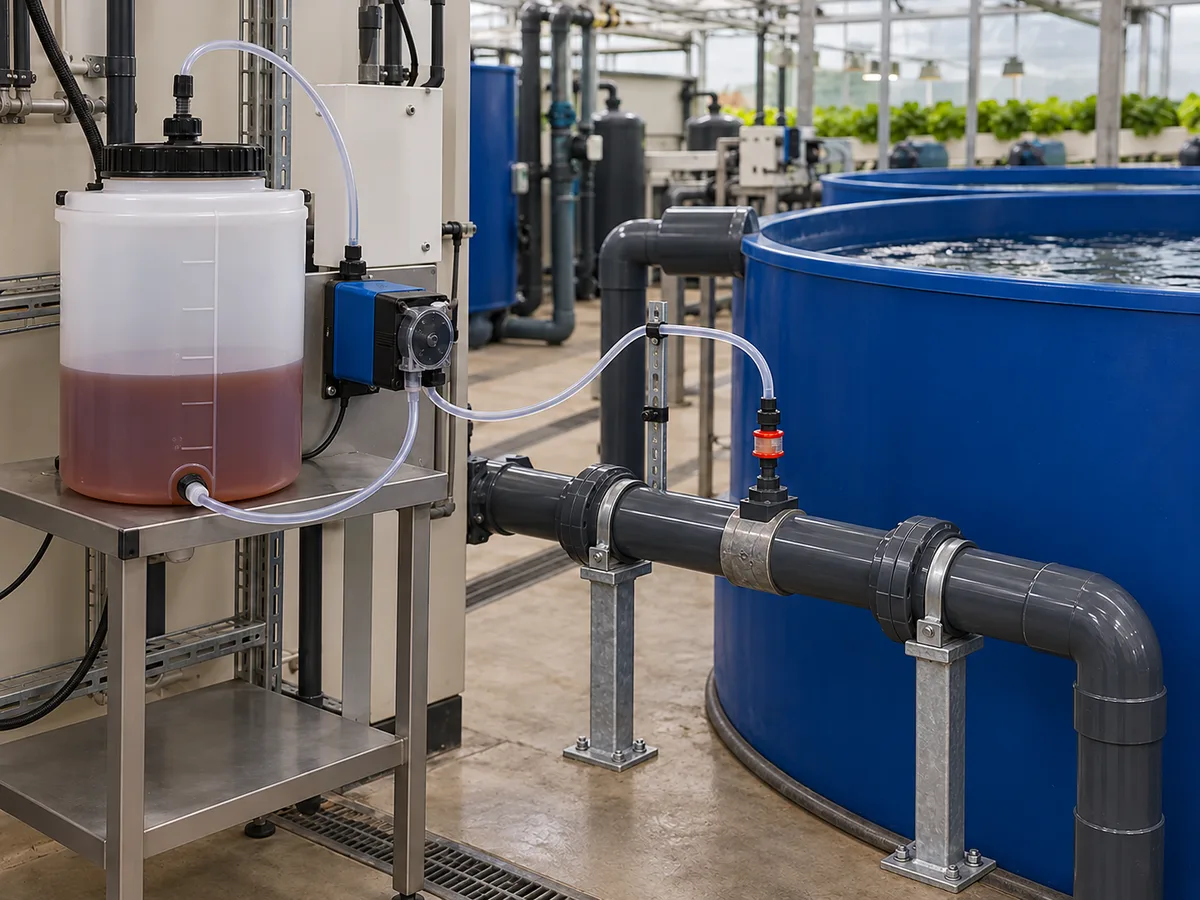
Iron management is a feedback process. After addition, track:
- New-leaf color and expansion
- Crop uniformity across zones
- Root condition
- Water pH and temperature
- Dissolved oxygen
- Ammonia and nitrite
- Fish appetite, respiration and behavior
- Water color and clarity
- Filter loading or unexpected precipitate
- Iron result using the same sampling method where practical
Old damaged leaves may not become fully green. Judge response primarily from healthy new growth over an appropriate crop-specific period. Avoid repeating a dose merely because an old leaf remains pale the next day.
Sampling location and timing matter. A sample collected immediately beside the addition point is not representative of a mixed system. Use a defined sampling point after adequate circulation and record the elapsed time.
Prevent Repeated Deficiency Instead of Chasing Symptoms
If iron deficiency returns regularly, review the process rather than increasing the dose automatically.
Review pH control
Iron availability may fall as pH increases. Determine why pH is high: source-water alkalinity, carbonate media, concrete exposure or an unsuitable buffering method. Correct the cause through an approved gradual plan; never force a rapid pH change in a live fish system.
Review solids and mineralization
Iron can enter with feed and remain in solid waste or precipitated forms. A mineralization strategy may affect recovery, but uncontrolled solids retention also consumes oxygen and creates maintenance problems. Do not retain sludge simply because it contains nutrients.
Review crop demand and system balance
Fast-growing plants, dense production and certain crops may exceed the iron supplied by feed. Compare crop area, harvest schedule and feed input with real operating data.
Review source water
Source water can contain iron, but it may oxidize and precipitate during aeration. A raw-water total-iron result does not prove that crops will receive a stable available supply.
Review purchasing controls
For repeat orders, match the approved chelate, Fe percentage and lot documentation. The article on ordering aquaponics nutrient supplements provides a broader supplier and shipment-inspection checklist.
Factory Testing, Shipment Inspection and Installation Preparation
Iron supplementation is an operating process, but equipment design can make it safer.
During factory testing, confirm that mixing tanks, dosing ports and sampling points are accessible and clearly separated from fish feed and cleaning-chemical storage. If a dosing pump is supplied, verify material compatibility, adjustable output, calibration method and safe failure state.
During shipment inspection, check that scales, test equipment, dosing containers and specified spare parts match the packing list. Do not ship loose chemical products inside an open fish tank. Any chemical included in a project must have lawful transport, labeling and destination documentation.
During installation preparation, assign a clean nutrient-handling area, secure storage, calibration schedule and written authorization process. A commercial facility should be able to trace what was added, by whom, to which zone and why.
Mid-Article CTA — Review the Nutrient-Handling Scope
Need an aquaponics system with accessible sampling, mixing and dosing points? Send Your Requirements with the system volume, crops, fish species, source-water analysis, operating pH and destination.
Common Mistakes
Diagnosing from leaf color alone
Visual symptoms overlap. Check roots, pH, temperature, light and other nutrients before assuming iron.
Buying “iron” without the chelate name
The elemental percentage does not describe stability. Require the exact compound and guaranteed analysis.
Copying a dose without converting product concentration
Ten grams of a 6% Fe product and ten grams of an 11% Fe product do not add the same amount of iron.
Calculating from tank nameplate capacity
Use measured connected operating water, not one tank’s nominal capacity.
Adding iron and pH chemicals together
Concentrated incompatible inputs can create precipitation or damaging local conditions. Use separate, documented procedures.
Redosing before evaluating new growth
Plant response takes time. Maintain records and avoid stacking unmeasured additions.
FAQ
What type of iron is normally used in aquaponics?
A documented chelated iron is commonly used because it can keep iron available longer than an unchelated source. The appropriate chelate depends strongly on pH and product specifications.
Is EDTA, DTPA or EDDHA best?
There is no universal best product. EDTA is less stable as pH rises, DTPA is often used near the mildly acidic-to-neutral range, and EDDHA offers greater high-pH stability but may cost more and color the water. Match the selection to measured conditions.
Can rusty nails supply iron?
Do not use rusty metal as a controlled nutrient source. The dissolution rate, metal composition, contamination and plant availability are unknown.
Can iron be added directly to the fish tank?
Avoid adding a concentrated product onto fish. Pre-dissolve according to the product instructions and introduce it slowly at a well-mixed point under a documented procedure.
How often should iron be added?
Frequency depends on crop demand, pH, chelate stability, existing concentration, water replacement and measured response. Use testing and records rather than an automatic calendar alone.
Why are new leaves still yellow after adding iron?
The diagnosis may be wrong, pH may be limiting availability, roots may be damaged, the chelate may be unsuitable, or the dose and mixing may be inadequate. Evaluate new growth and the full system before repeating.
Conclusion
Adding iron to aquaponics is a diagnosis, selection, calculation and monitoring task. Confirm that the symptom pattern is consistent with iron deficiency, check pH and roots, select a traceable chelate for the actual water conditions, calculate from elemental iron percentage and connected volume, and add it through a controlled mixing route.
No single dose or schedule fits every fish, crop and system. Good records, consistent sampling and conservative reassessment protect the shared biological loop while helping crops receive the iron they can actually use.
Final CTA — Request an Aquaponics Equipment Proposal
Planning a system that needs controlled nutrient management? Get a Quote and send the layout, operating volume, water analysis, crops, fish plan, monitoring requirements and project location.