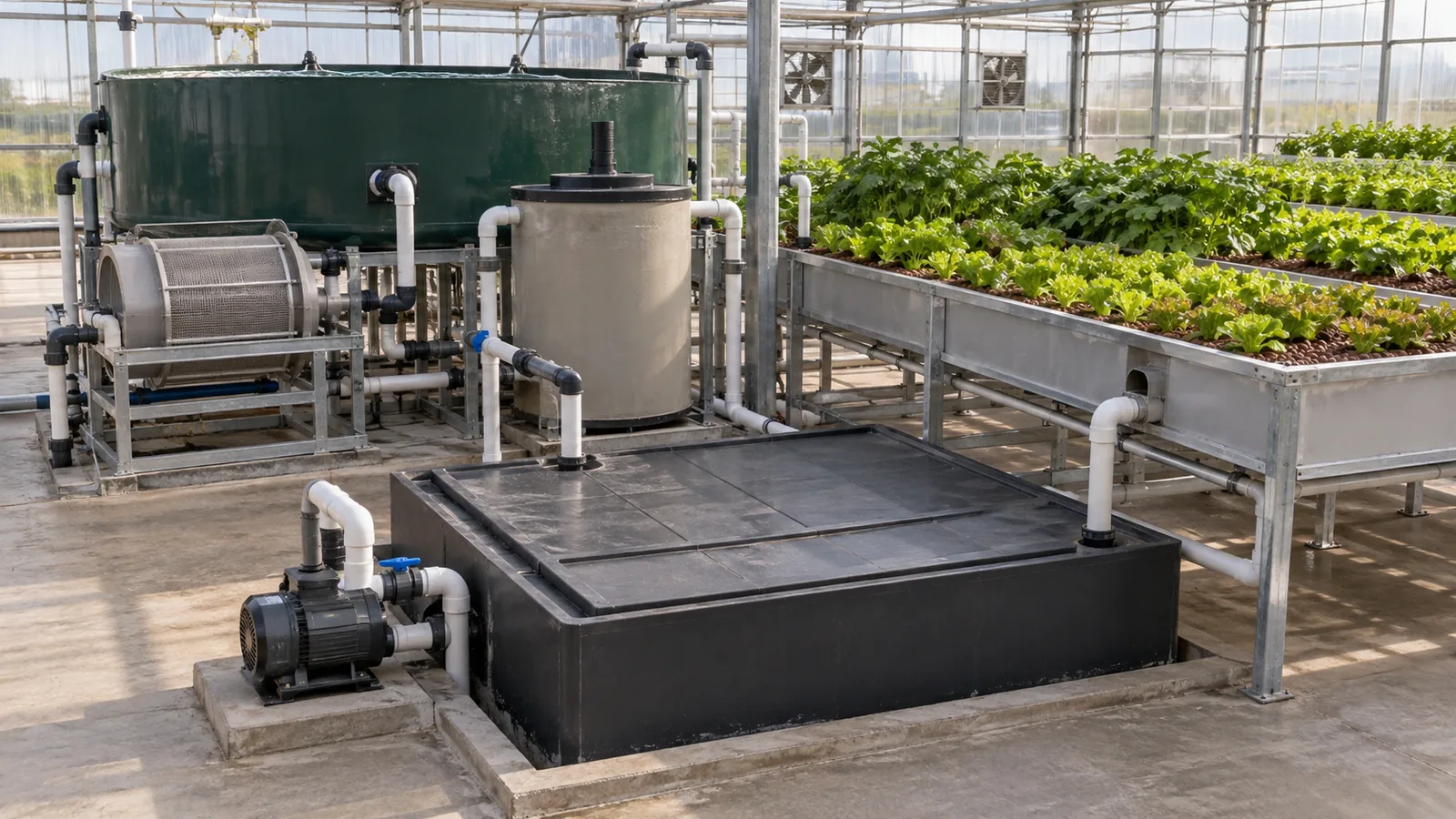
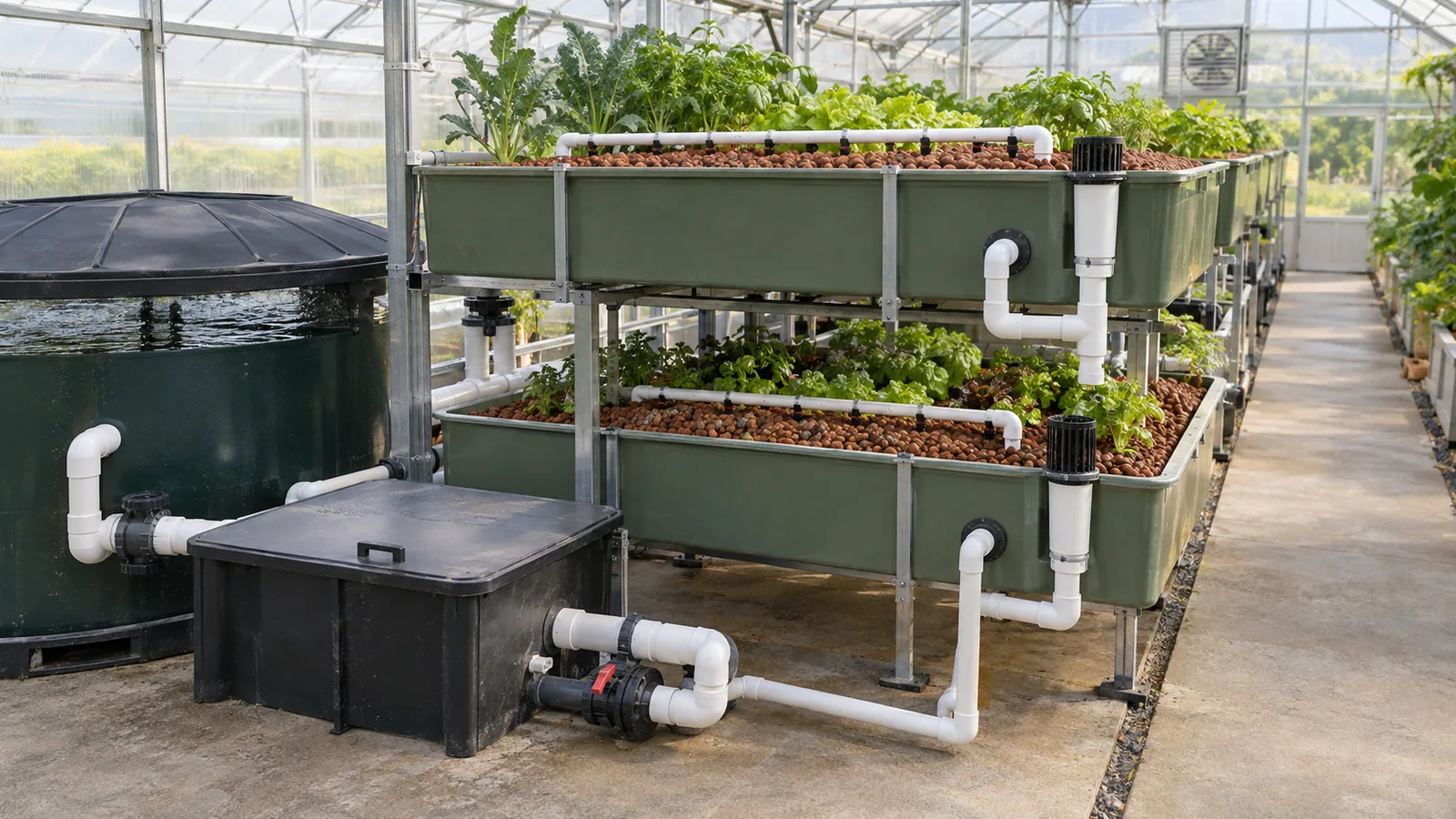
A media-filled aquaponics grow bed does not hold its full geometric volume in water. The aggregate occupies part of the bed, while water occupies connected spaces between and sometimes within the particles. The usable water volume also changes with media type, grading, compaction, root growth, solids accumulation, drain setting and whether the bed is at its high or low operating level.
For design work, calculate the flooded geometric volume and apply a provisional displacement factor only as a planning estimate. For commissioning and operating records, measure the real volume required to raise the installed bed from its drained condition to its normal high-water level. This measured value is more reliable than a percentage copied from another system.
The distinction matters. An incorrect estimate can leave a sump too small, expose a pump during a flood cycle, create a large fish-tank level swing or cause the project team to miscalculate supplement doses. The objective is therefore not to find one universal percentage. It is to define which water volume is needed, estimate it conservatively and verify it with the actual media and plumbing.
The Short Answer
Use three separate values for a media bed:
1. High-water volume: water present in the media-filled zone when the bed reaches its normal upper operating level.
2. Retained water: water remaining in the bed, media and plumbing after the normal drain period.
3. Cycle drawdown: the net water transferred from the sump or fish tank as the bed moves from its low level to its high level.
Start with:
Flooded geometric volume (L) = bed length (m) × bed width (m) × flooded depth (m) × 1,000
Then estimate:
Estimated high-water volume (L) = flooded geometric volume × provisional water-space factor
Do not assume the factor is fixed. Verify it by a controlled fill test. The measurement that normally governs sump sizing is the actual cycle drawdown plus the sump’s minimum pump submergence, reserve for evaporation and leakage, and safe overflow margin.
First Define Which “Water Volume” You Need
The phrase “water in the grow media” can refer to several different quantities. Mixing them creates errors even when the arithmetic is correct.
External bed capacity
This is the internal length multiplied by internal width and total bed depth. It describes the container, not the water it holds after media is installed. It is useful for ordering grow-bed material and estimating media quantity, but it should not be entered directly into a water balance.
Flooded-zone geometric volume
The water normally stops below the dry media surface. Therefore, use the operating flood depth—not the total wall height. If the bed is 300 mm deep but the high-water level is 250 mm above the inside floor, calculate with 0.25 m.
High-water volume inside the media
At the top of the operating cycle, water occupies connected voids below the high-water line. It may also enter internal pores in expanded media. The amount depends on the installed material and how it was placed.
Retained water after drainage
A bed rarely becomes completely dry. Water remains below the standpipe or outlet elevation, inside porous particles, around roots, in low spots and in pipes. Retained water is part of total system water, but it may not return to the sump during every cycle.
Cycle drawdown
Cycle drawdown is the volume removed from the supplying vessel between the bed’s low and high operating states. In flood-and-drain systems, this is often the most important value for sump design. It is not necessarily equal to the high-water volume because some water stays in the bed between cycles.
Our guide to sizing an aquaponics sump tank explains how cycle drawdown combines with pump protection, drainage reserve and freeboard.
Why Media Displacement Is Not One Universal Percentage
Media beds contain solid particles and pore spaces. The University of Arkansas Extension explains that container volume consists of solids plus spaces or voids, and that those voids can contain water or air. Its discussion of growing-media physical properties also shows why particle arrangement, container height and drainage conditions affect measured water content.
Aquaponic aggregates differ substantially from fine nursery substrates, so a nursery-media percentage should not be copied as an aquaponics design factor. The underlying physical principle remains useful: water volume depends on the installed pore structure, not merely the bed’s outside dimensions.
Important variables include:
- Particle size and the distribution of large and small particles
- Angular versus rounded particles
- Internal porosity of expanded clay, shale or lava rock
- Broken particles and fines
- How densely the media was placed or compacted
- Bed depth and drain elevation
- Root mass and retained organic solids
- Media saturation history
- Uneven bed floors and plumbing dead volume
Two batches sold under the same general name can behave differently. A sample test is especially valuable when a project is importing media, buying from several quarries or changing from expanded clay to stone.
Oklahoma State University’s aquaponics system guide notes that media selection should consider porosity, drainage, particle size and pH neutrality. It also explains that media beds and their supplying tanks must be considered together because filling multiple beds can create harmful water-level changes.
Calculate a Planning Estimate
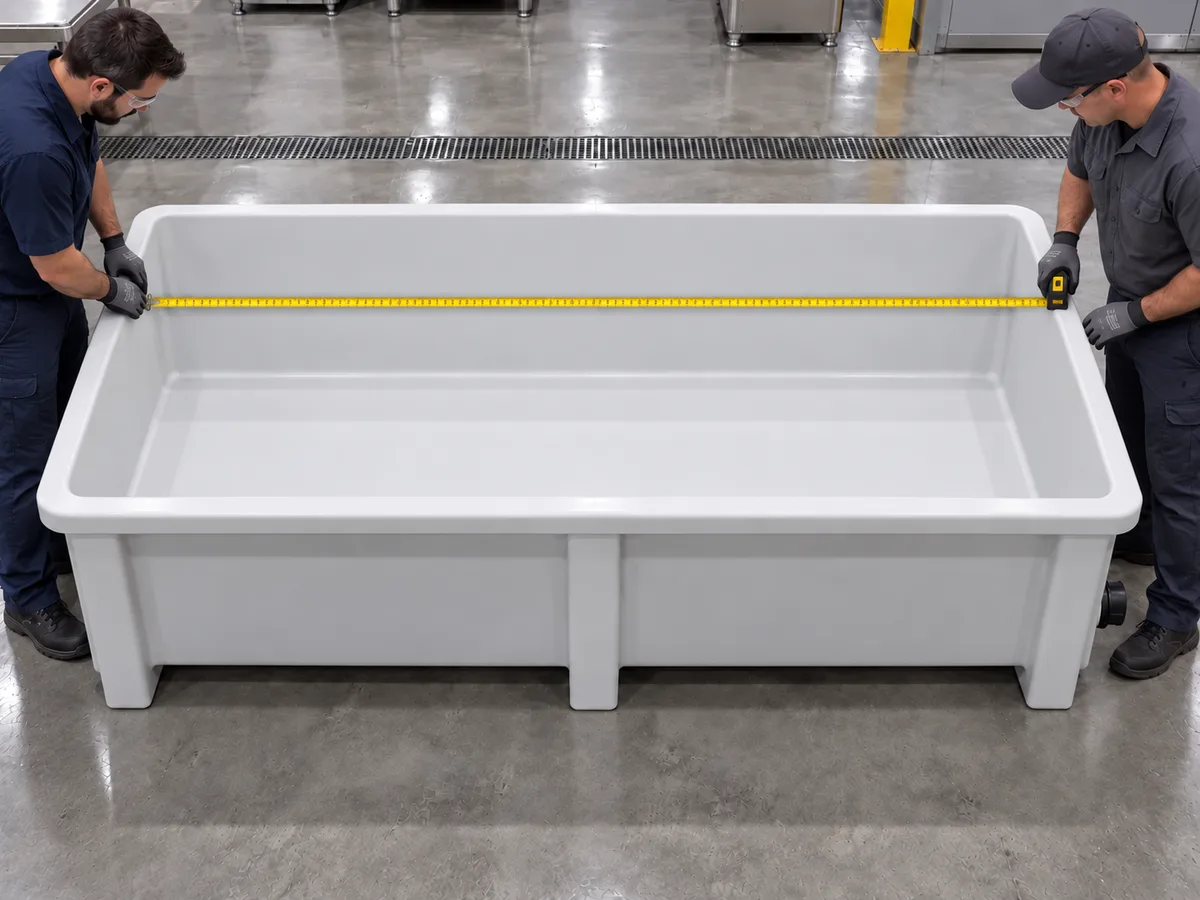
Use internal—not nominal—dimensions. Exclude double walls, rounded corners, internal ribs and any section above the normal flood line.
Step 1: Measure the flooded footprint
For a rectangular bed:
Footprint area (m²) = internal length × internal width
For irregular or tapered beds, divide the shape into measurable sections or use the manufacturer’s internal-volume drawing. Avoid calculating from shipping dimensions.
Step 2: Measure the operating flood depth
Measure vertically from the inside floor to the normal high-water level. Do not use the top rim. A dry surface layer is normally maintained so plant crowns and loose organic material are not continuously submerged.
Step 3: Calculate flooded geometric volume
Assume a bed has an internal flooded footprint of 1.20 m × 0.60 m and a high-water depth of 0.25 m:
1.20 × 0.60 × 0.25 × 1,000 = 180 L
The 180 L value describes an empty flooded zone. It is not the amount of water required after media is installed.
Step 4: Apply a provisional factor
If the selected project estimate uses a provisional water-space factor of 0.40:
180 L × 0.40 = 72 L estimated at the high-water condition
That factor is an assumption for planning, not a specification. Record its source and include a commissioning requirement to replace it with measured data. For procurement, ask the media supplier for bulk density, grading, particle-size distribution and any available porosity or water-absorption data. Even with documents, test a representative sample in the intended bed geometry.
Measure the Installed Bed Directly
Direct measurement is the preferred method because it includes the actual media, plumbing and high-water setting.
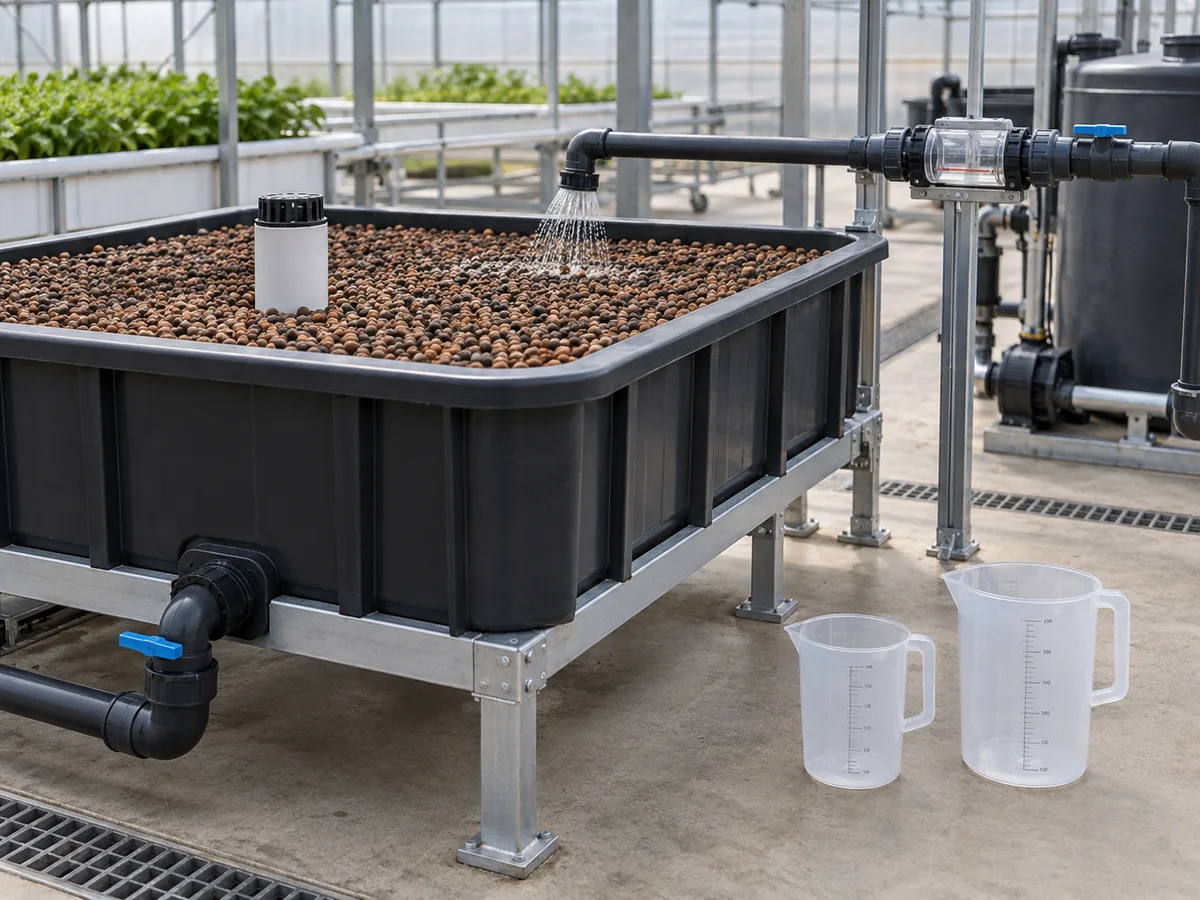
Method A: Metered filling
1. Wash and install the approved media.
2. Confirm the bed is level and the outlet is configured for the intended operating mode.
3. Bring the bed to a defined drained starting condition.
4. Isolate other changing water levels.
5. Fill through a calibrated water meter or from containers of known volume.
6. Stop at the normal high-water mark—not at the bed rim.
7. Record the water added and the elapsed fill time.
8. Repeat the test after a normal drain period.
If the second result differs materially, investigate trapped air, media saturation, leaks, changing valve positions or an inconsistent drain interval.
Method B: Calibrated source-tank drawdown
Mark the supplying tank or sump with a verified volume scale. Isolate automatic top-up, then measure the fall in water volume while the bed fills from its normal low state to its high state. This method measures cycle drawdown rather than total water within the bed.
The source vessel must have a known geometry. A vertical level change in a tapered or rounded tank does not represent a constant volume. Use a calibration table or weigh the added water during tank calibration.
Method C: Controlled drain collection
After filling the bed to the normal high level, direct the normal drain into a calibrated vessel. Collect only the water that would return during the actual operating cycle. Some water will remain in the bed and pipes; that is why collected drain volume may be lower than the metered fill required from a fully drained or initially dry condition.
Use the method that matches the design question. A sump calculation needs realistic simultaneous drawdown and return behavior. A chemical dose calculation needs total connected operating water, including water retained in beds, filters and pipes.
Distinguish Total System Volume From Media-Bed Exchange Volume
Total operating water may include:
- Fish-tank water at its normal operating level
- Sump water at a stated point in the cycle
- Mechanical and biological filter water
- Raft troughs or NFT manifolds in a hybrid system
- Water inside media beds at the chosen reference state
- Pipe, pump and header volume
- Mineralization or treatment vessels connected during operation
Choose one repeatable reference condition, such as “all media beds at normal low level and sump at operating high mark.” Without a reference condition, two staff members can measure the same system and report different totals.
For supplement calculations, verify whether the selected zone is actually connected. Never dose from the advertised tank capacity alone. For cycle design, use the aquaponics ebb-and-flow timing guide to separate fill time, dwell time and drain time from the water-volume calculation.
Account for Multiple Beds and Simultaneous Filling
Four beds that each draw 70 L do not always require a 280 L operating swing. It depends on sequencing.
- Simultaneous cycling: all beds may approach high level together, producing the largest drawdown.
- Staggered cycling: one bed may drain while another fills, reducing peak drawdown if controls remain reliable.
- Constant flood: water is largely retained in the beds after startup, but drain-down reserve is still required for shutdowns and maintenance.
- Continuous flow with standpipes: level may remain relatively stable, yet blocked returns or power loss can redirect water unexpectedly.
Do not depend on perfect timing to prevent pump exposure or overflow. Test the worst credible valve, timer and power-loss states. During factory testing, confirm standpipe heights and drain capacity. During installation preparation, mark tank levels and verify the receiving sump has freeboard for the real drain-down volume.
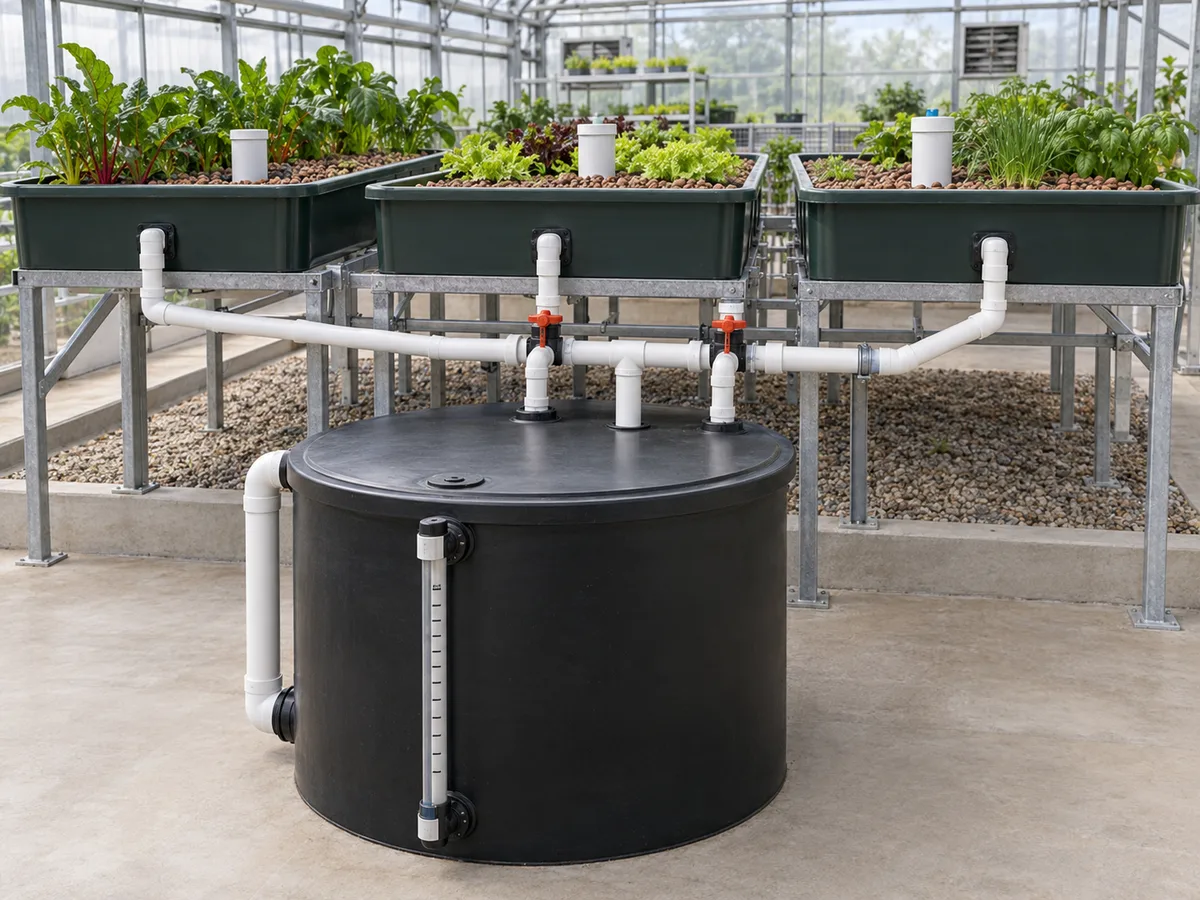
Media Selection Changes Hydraulic Behavior
The media must first be suitable for fish, plants and recirculating water. It should be structurally stable, appropriately graded and evaluated for pH effects. The existing guide on choosing gravel and other aquaponics media covers material safety and selection.
Hydraulically, large uniform particles can create large connected flow paths but may provide less capillary retention. A broad grading with many fines can reduce connected void space, slow drainage and trap solids. Highly porous aggregate may absorb water internally, particularly during initial saturation. Roots and biofilm change the bed further during operation.
This means the commissioning result is not permanent. Recheck fill and drain behavior after crop establishment and whenever the media is replaced, mixed or extensively cleaned.
A Practical Commissioning Record
Create one record for each bed or bed type:
| Field | Recorded value |
|---|---|
| Bed ID and internal dimensions | Measured on site |
| Media product and batch | Supplier and lot |
| Media depth | Installed depth |
| High-water depth | Operating set point |
| Drained starting condition | Drain time and outlet state |
| Water added to high level | Litres or gallons |
| Water returned during normal drain | Litres or gallons |
| Retained-volume estimate | Difference under stated conditions |
| Fill and drain time | Minutes |
| Sump low level | Above minimum pump submergence? |
| Power-off drain-down level | Below overflow elevation? |
Photograph the high- and low-water marks. Record pump, valve and standpipe configurations so the test can be reproduced after service work.
Mid-Article CTA — Verify the Hydraulic Balance Before Ordering
Planning a media-bed system with several tanks or grow zones? Send Your Requirements with bed dimensions, media type, fish-tank volume, proposed sump size and operating method. We can help translate customer requirements into a practical equipment and commissioning scope.
Common Calculation Mistakes
Using outside dimensions
Wall thickness, rounded corners and structural ribs reduce internal volume. Use measured internal dimensions or a verified manufacturer drawing.
Filling to the rim in the calculation
The operating water line should be below the dry media surface and below overflow freeboard. Total wall depth is not flooded depth.
Treating retained water as cycle drawdown
Water that remains after normal drainage belongs in the total water inventory but does not return to the sump each cycle.
Applying a universal 40 percent rule
A rule of thumb may support early budgeting, but it cannot replace a test of the installed media. State the assumption and design a safe margin.
Measuring only one bed in a mixed-media project
If beds use different materials, depths or drain fittings, measure each configuration. Do not average unlike zones without evidence.
Ignoring plant roots and solids
Hydraulic performance changes over time. Slow drainage, channeling or a rising high-water level may indicate root or solids restriction rather than a need to change the pump.
FAQ
How much water does expanded-clay media displace?
There is no universal percentage. Pellet size, breakage, internal porosity, packing and saturation change the result. Measure a representative installed volume instead of relying solely on a product category.
Is media-bed volume the same as fish-tank volume?
No. A design may compare nominal bed and fish-tank volumes, but the actual water inside a media-filled bed is smaller than its geometric volume. Fish-tank operating volume must be calculated separately.
Which water volume should be used to size the sump?
Use the maximum credible simultaneous drawdown plus minimum pump submergence, operating reserve and overflow freeboard. Also test power-off drain-down.
Which volume should be used for dosing supplements?
Use the measured total connected operating water for the zone being treated. Include water in tanks, beds, filters and pipes at a stated reference condition. Exclude isolated vessels.
Does a constant-flood bed need a sump-volume calculation?
Yes. Its normal level may be stable, but shutdown, maintenance, blocked returns or intentional draining can move water into another vessel.
Should a new bed be measured before fish are stocked?
Yes. Complete leak, flow, level, drain and power-loss tests with water only. Correct hydraulic problems before fish depend on the system.
Conclusion
The amount of water in a grow-media aquaponics system cannot be determined from bed dimensions alone. First calculate the flooded geometric zone, then use media displacement only as a documented planning assumption. During commissioning, measure high-water volume, retained water and cycle drawdown separately with the installed media and plumbing.
That measured record supports safer sump selection, more accurate dosing, stable fish-tank levels and better troubleshooting. Recheck it when media, roots, solids or drain settings change.
Final CTA — Request a Media-Bed System Review
Need tanks, media beds and filtration matched to a verified water balance? Get a Quote and provide the site layout, bed dimensions, media specification, crops, fish plan, power supply and destination.