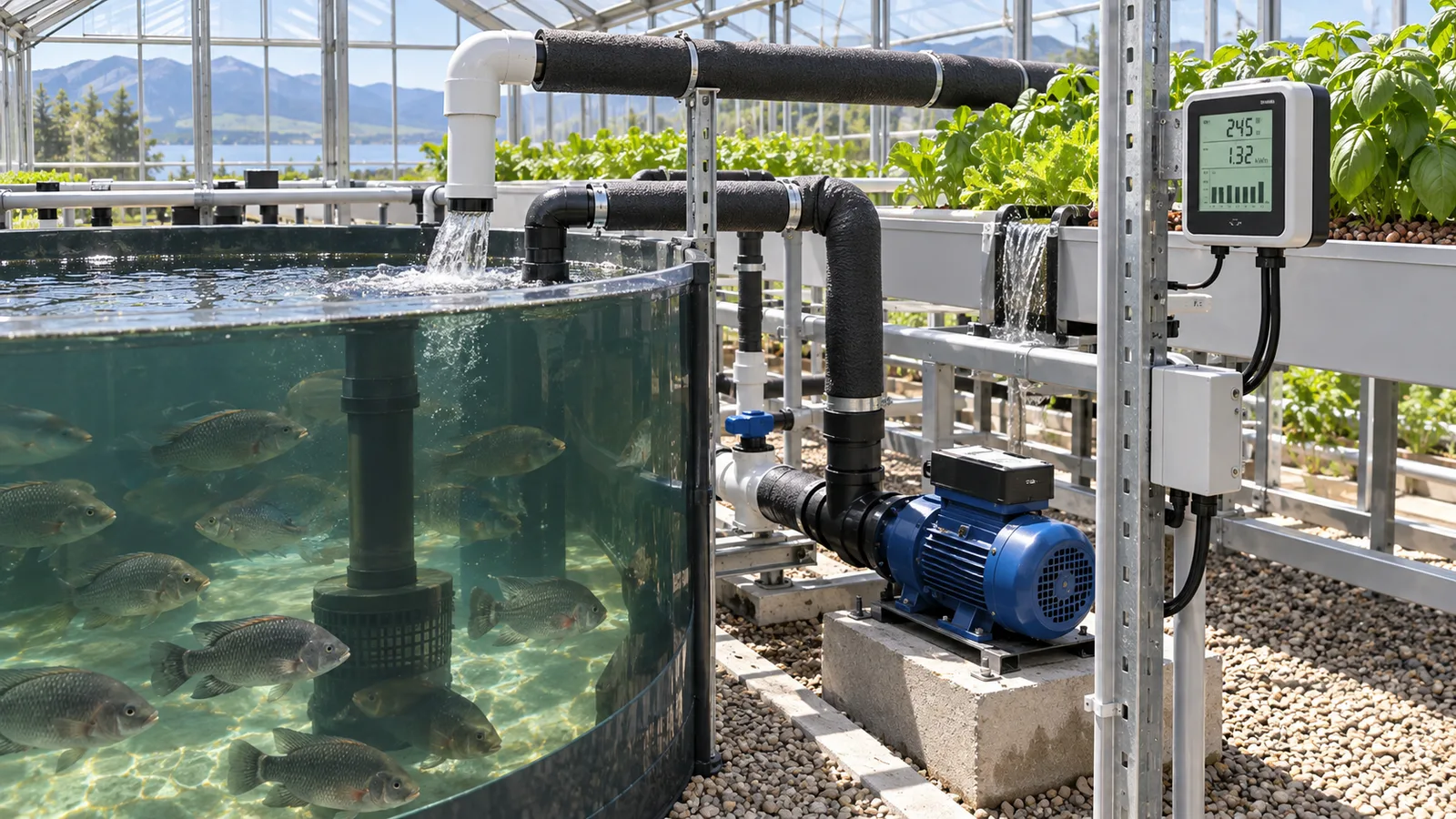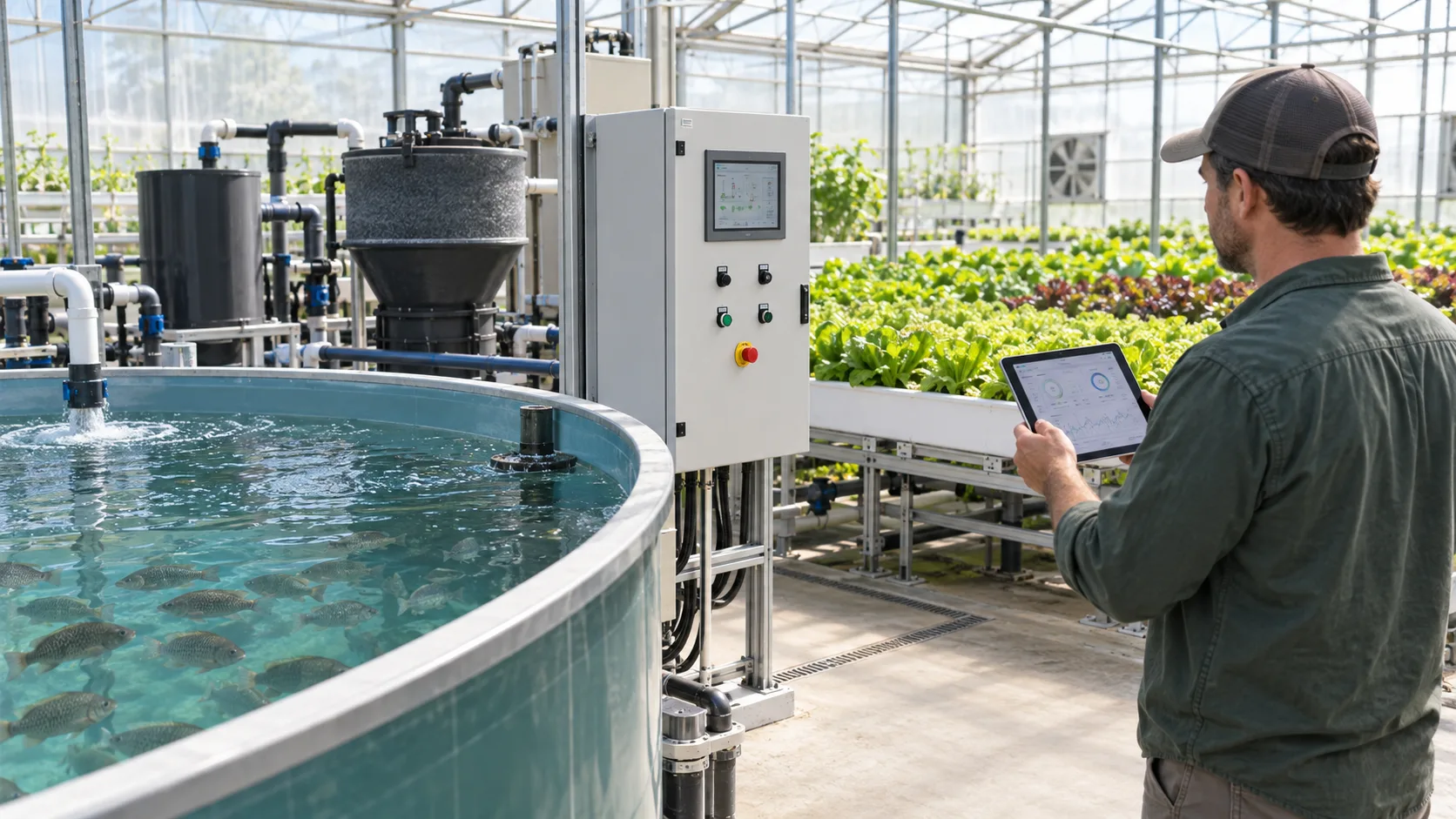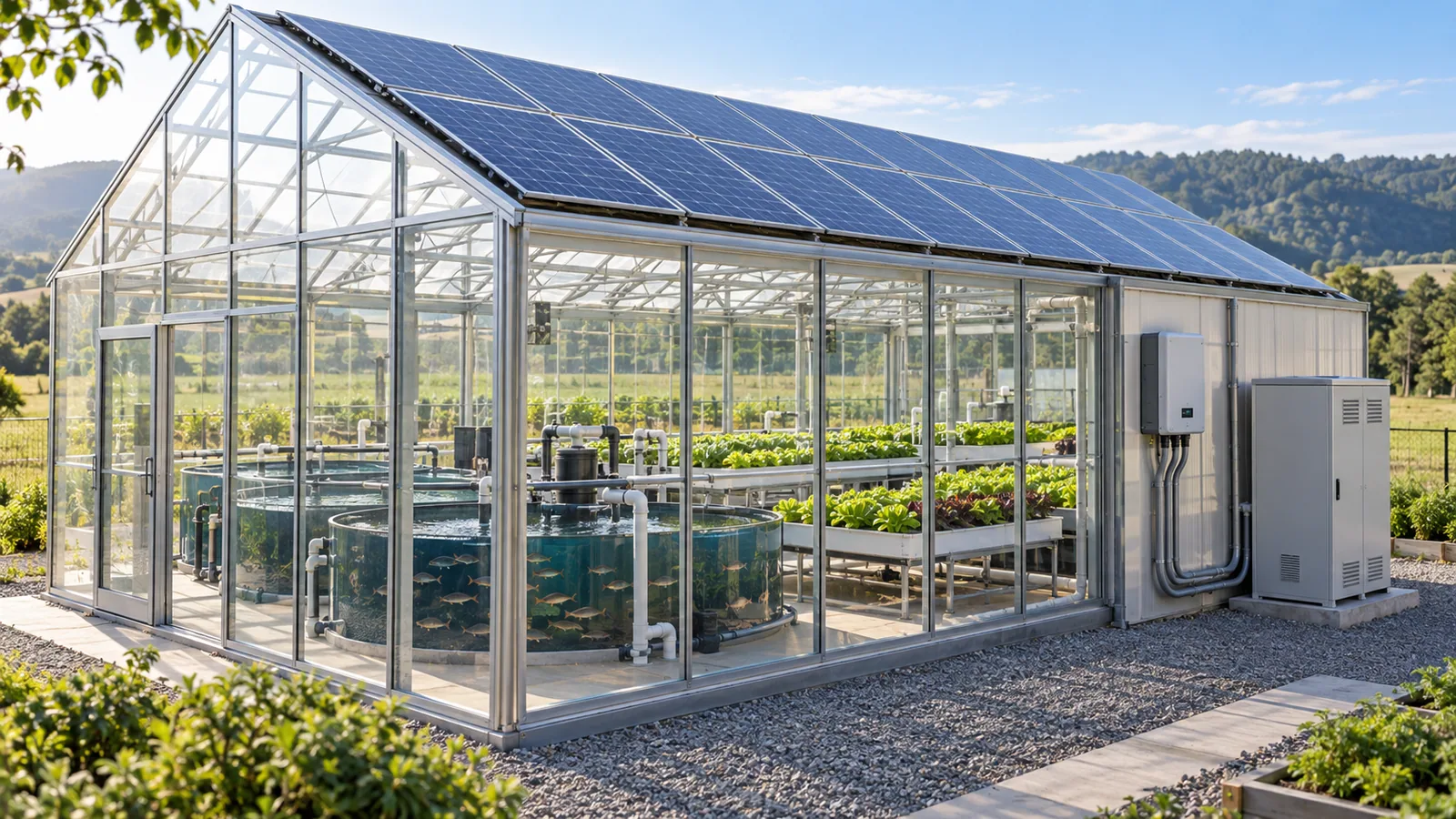
A solar-powered aquaponic system uses electricity generated by photovoltaic panels to operate water pumps, aeration equipment, controls and, when practical, selected auxiliary loads. Because fish and beneficial bacteria depend on reliable water movement and oxygen, most dependable installations also include a battery bank, controller and backup strategy.
The aquaponic process remains the same as in a grid-powered installation. Fish produce waste, bacteria convert ammonia into plant-available forms, plants absorb nutrients and treated water returns to the fish. Solar power changes how the equipment receives electricity; it does not remove the need for pumps, aeration, filtration or biological management.
A reliable design therefore starts with the actual aquaponics load—not with an arbitrary number of solar panels.
The Short Answer
A typical solar-powered system works through these stages:
1. Solar panels convert sunlight into DC electricity.
2. A charge controller manages electricity sent to the batteries.
3. Batteries store energy for nighttime and cloudy periods.
4. An inverter supplies AC equipment when AC pumps or controls are used.
5. Suitable DC loads may operate directly through protected circuits.
6. Water pumps circulate water through filtration and plant beds.
7. Air pumps or blowers maintain dissolved oxygen.
8. Monitoring equipment tracks water level, temperature, energy and equipment status.
9. A generator or grid connection may provide emergency backup.
The solar array must provide enough energy not only for average daily operation but also for conversion losses, battery charging, seasonal changes and reserve capacity.
What Solar Power Actually Operates
Aquaponics contains continuous and intermittent electrical loads.
Critical continuous loads
These may include:
- Fish-tank aeration
- Biological-filter aeration
- Main circulation pump
- Sump or transfer pump
- Essential control equipment
- Water-level and failure alarms
Intermittent or conditional loads
These can include:
- Supplemental lighting
- Water heating
- Water cooling
- Automatic feeders
- Monitoring devices
- Greenhouse ventilation
- Drum-filter motors
- UV equipment
- Backup pumps
Water heating, cooling and artificial grow lighting can consume much more energy than a small circulation pump. A proposal that describes a complete commercial greenhouse as “solar powered” without separating these loads may be misleading.
Solar Energy Flow Through the System
1. Photovoltaic panels generate electricity
Solar panels generate DC power when sunlight reaches their cells. Output changes with irradiance, panel temperature, shading, orientation, season, dust and equipment condition.
The rated wattage represents performance under standardized test conditions. Actual field output is lower and variable.
Panels should be installed where shadows from buildings, tanks, trees, greenhouse frames and nearby panels will not reduce production. Partial shading can affect more than the directly shaded section of an array, depending on its wiring and electronics.
2. The charge controller manages battery charging
The charge controller regulates electricity moving from the panels to the battery bank.
Maximum power point tracking controllers are commonly used because they can improve energy harvesting under changing solar conditions. The controller must be compatible with array voltage, battery voltage, battery chemistry and maximum current.
It should also provide appropriate protection against overcharging and excessive discharge.
3. Batteries support night operation
Fish do not stop consuming oxygen when the sun sets. Beneficial bacteria also require suitable oxygen and water flow.
A battery bank supplies critical equipment at night and during periods of limited solar production. Its usable capacity depends on battery chemistry, nominal capacity, permitted depth of discharge, temperature, age and charge/discharge efficiency.
A battery labeled 10 kWh does not necessarily provide 10 kWh of safely usable energy. The permitted discharge limit and system losses must be included.
Solar generation does not always coincide with the time electricity is needed, so energy storage can support essential loads after sunset or during short production interruptions. The U.S. Department of Energy explains this relationship in its solar energy and storage guide.
4. The inverter powers AC equipment
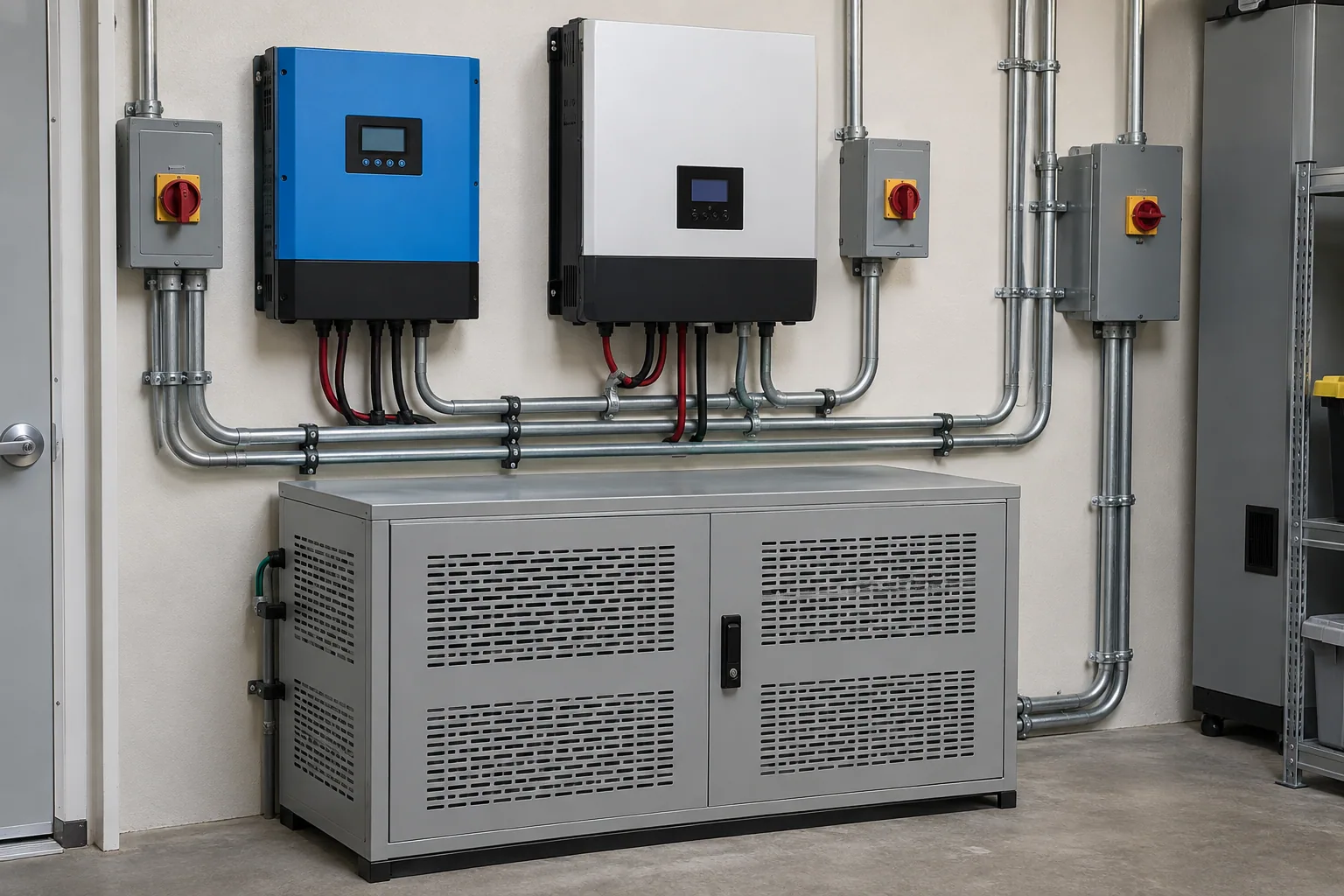
An inverter converts battery DC power into AC power for conventional pumps, blowers and controllers.
Every conversion introduces losses. Where suitable DC equipment is available, a designer may reduce conversion stages. However, selection must also consider availability, service support and replacement parts.
A highly efficient device that cannot be replaced locally may create a greater operating risk than a slightly less efficient standardized pump.
5. Pumps and aeration operate the aquaponic loop
The circulation pump moves water through the fish tank, filters and growing area. Air pumps or blowers deliver oxygen to fish, biological filters or plant troughs.
In many systems, aeration is the most time-critical electrical load. Fish can be affected by oxygen loss before plants show visible damage.
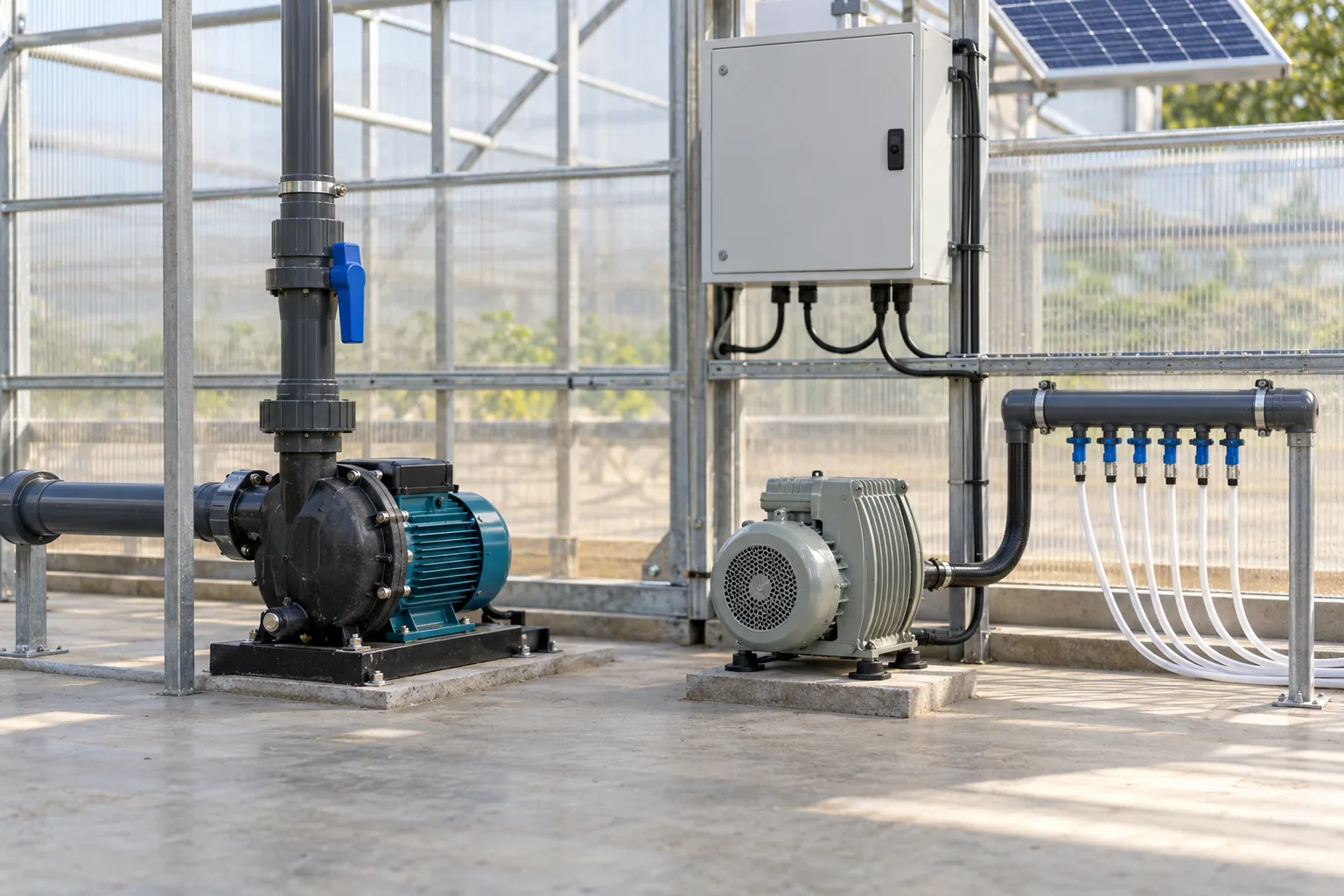
The energy-efficient aquaponics design guide explains how pipe layout, pump head and unnecessary restrictions affect consumption before solar equipment is sized.
Start with a Load Audit
Solar sizing begins with a list of electrical loads. For every item, record:
- Rated watts
- Measured running watts when possible
- Starting current
- Operating hours per day
- Whether it is critical
- Whether it can be scheduled
- Required backup duration
Daily energy is calculated approximately as:
Daily energy in watt-hours = equipment watts × daily operating hours
If a 120 W circulation pump operates for 24 hours:
120 W × 24 h = 2,880 Wh per day
If an 80 W air pump also operates continuously:
80 W × 24 h = 1,920 Wh per day
Together, they require 4,800 Wh per day before accounting for controllers, inverters, wiring and battery losses.
A realistic design margin must then be added. The appropriate allowance depends on the system architecture, temperature and local solar conditions.
Why Pump Head Matters
Pump efficiency can determine the size and cost of the solar system.
A pump must overcome vertical elevation, pipe friction, valves, elbows, filters, heat exchangers and distribution manifolds.
Oversized pumps controlled by throttling valves waste energy. Undersized pipes increase friction and operating cost. A better approach is to design a low-resistance hydraulic layout first, calculate total dynamic head and then select the pump at its expected operating point.
Factory testing should confirm that the selected pump produces the required flow at a representative head, not merely that the motor switches on.
Battery Sizing and Autonomy
Battery autonomy means how long critical loads can operate without meaningful solar input.
The required duration depends on:
- Local cloud patterns
- Whether grid or generator backup exists
- Fish biomass
- Tank oxygen demand
- Water temperature
- System type
- Operator response time
- Consequences of failure
A lightly stocked media-bed system may tolerate interruption differently from a high-density fish loop connected to NFT channels.
Battery capacity should be calculated from the critical load, desired autonomy, permitted depth of discharge and conversion efficiency. It should not be selected only by matching panel wattage.
Grid-Tied, Off-Grid and Hybrid Systems
Grid-tied solar
Solar power offsets electricity consumption while the utility grid supports the system when production is insufficient.
Standard grid-tied systems may shut down during a utility outage for safety. Unless backup equipment is included, panels alone do not guarantee that pumps continue operating.
Off-grid solar
The system depends on panels, batteries and possibly a generator.
Off-grid operation requires more conservative sizing because there is no utility supply to cover extended low-sun periods or unexpected equipment loads.
Hybrid solar
A hybrid arrangement combines solar generation, batteries and another source such as the grid or a generator.
For many commercial aquaponics projects, hybrid architecture offers a practical balance between reduced grid consumption and biological reliability.
What Happens at Night?
Panels produce little or no energy at night. Batteries therefore power the essential equipment.
Loads can be prioritized in this order:
1. Fish-tank aeration
2. Biofilter aeration
3. Essential circulation
4. Water-level and failure alarms
5. Temperature control required for animal welfare
6. Noncritical auxiliary loads
Grow lights, some ventilation and other discretionary loads may be delayed or reduced when battery state of charge is low. The control system should never disconnect critical aeration before a less important convenience load.
Can a System Run Without Batteries?
A direct-solar pump may operate only when sufficient sunlight is available. That arrangement can work for selected irrigation or transfer duties, but it is risky as the only source of fish-tank circulation or aeration.
Without storage or another power source, pumps slow when clouds pass, equipment stops at night, dissolved oxygen can decline, biofilter performance can deteriorate and NFT roots may dry.
Battery-free design is therefore more appropriate for noncritical daytime tasks than continuous life-support equipment.
Heating and Cooling Considerations
Water temperature affects fish metabolism, oxygen demand, feed consumption, plant growth and nitrification.
Electrical resistance heating can place a very large load on an off-grid system. Before increasing the photovoltaic array, consider passive measures such as tank insulation, pipe insulation, greenhouse thermal curtains, shading, reflective roof materials, reduced night heat loss, appropriate fish species and heat recovery.
Our guide to heating water in an aquaponics system provides more context for water-temperature management.
Solar thermal and solar photovoltaic systems are not the same. Photovoltaic panels produce electricity; solar-thermal collectors capture heat directly.
An inverter converts the DC electricity produced by photovoltaic panels or released by a battery into the AC electricity required by conventional equipment. The U.S. Department of Energy provides a practical overview in its solar inverter guide.
Monitoring and Remote Control
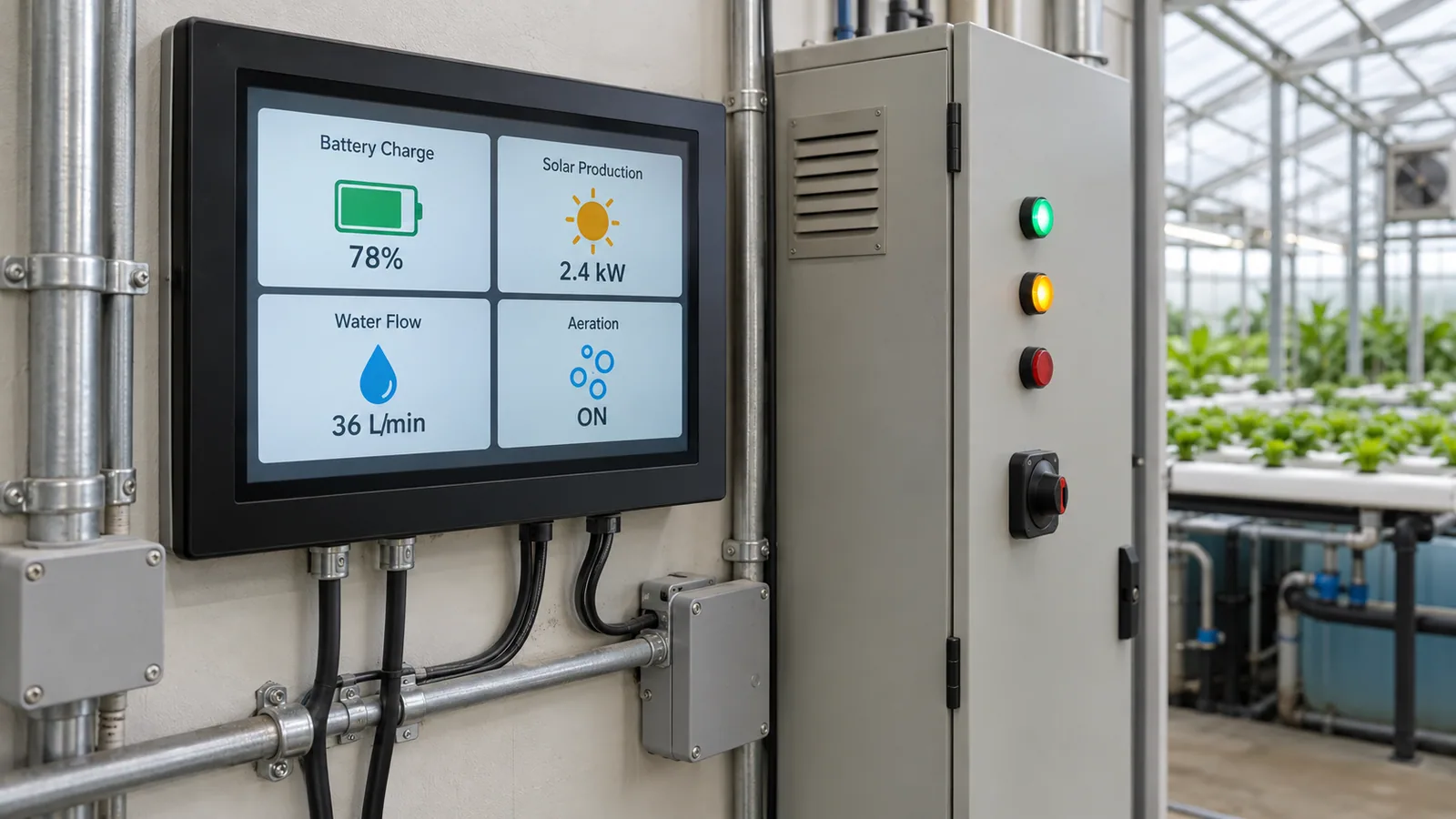
Useful monitoring points include:
- Battery state of charge
- Solar production
- Pump current
- Air pressure
- Water level
- Flow status
- Tank temperature
- Dissolved oxygen
- Grid or generator status
Remote control is useful, but alarms matter more than decorative dashboards. The operator needs to know when a critical condition requires action.
The monitoring system should retain a local alarm path. A cloud platform cannot help if the communication network and controller lose power together.
Reliability and Redundancy
A solar aquaponics system should be designed around failure modes.
Useful safeguards include separate critical and noncritical circuits, independent emergency aeration, low-voltage disconnect protection, spare pumps, water-level alarms, battery-temperature protection, manual bypass valves, generator connections, local alarms and remote notifications.
Backup aeration should not depend on the same failed inverter or electrical circuit as the primary equipment.
Installation Preparation
Before shipment or site installation, confirm:
- Local solar resource
- Panel mounting area
- Roof or ground structural capacity
- Cable route
- Battery location
- Ventilation and temperature control
- Moisture protection
- Earthing and surge protection
- Local electrical standards
- Pump voltage and frequency
- Generator or grid interface
- Service access
Aquaponics is a wet environment. Electrical equipment requires suitable enclosures, cable management and separation from splash zones.
Shipment inspection should verify panel condition, battery terminals, controller model, inverter rating, pump specifications, electrical protection devices and wiring documentation.
Commissioning Tests
Commissioning should include more than turning equipment on. Test:
1. Pump flow under actual head
2. Aeration output at the deepest diffuser
3. Daytime panel production
4. Battery charging
5. Night operation
6. Low-battery load shedding
7. Grid-loss response
8. Generator transfer
9. Alarm notifications
10. Emergency aeration
11. Restart behavior after shutdown
12. Operation during simulated low solar input
Equipment should restart safely without requiring a complicated sequence that an operator may forget during an emergency.
Mid-article CTA — Send Your Solar Project Requirements
Planning a solar-powered aquaponics project? **Send Your Requirements** with the pump list, operating hours, fish biomass, local climate, backup preference and installation location.
Common Design Mistakes
Sizing from panel watts alone
Panel capacity does not reveal nighttime autonomy, battery losses or seasonal energy availability.
Ignoring motor startup
Some AC motors require a brief starting current much higher than their running current. The inverter must tolerate this demand.
Adding grow lights without recalculating
Indoor lighting can dominate total energy use. A system sized for pumps and aeration may be far too small once grow lights are added.
Treating the battery as maintenance-free
Battery performance changes with temperature, charge history, age and depth of discharge.
No emergency oxygen plan
Fish losses can occur even when the plant side looks normal. Emergency aeration deserves its own failure analysis.
Assuming ideal sunlight every day
A schedule based only on ideal sun cannot protect fish through several cloudy days.
FAQ
Can aquaponics run entirely on solar power?
Yes, but off-grid operation requires load analysis, storage, seasonal solar data and backup planning. The answer depends on system size, climate and energy-intensive loads such as heating and lighting.
How many solar panels are needed?
There is no universal number. Add the daily energy of every load, account for losses and divide by the site’s conservative solar production. Battery charging and low-sun conditions must also be included.
Does a solar aquaponics system need batteries?
Most systems need batteries or another reliable source for nighttime aeration and circulation. Direct solar may be suitable for noncritical daytime pumping.
Can solar panels power grow lights?
Technically yes, but the energy requirement can be substantial. Indoor lighting may require a much larger array and battery bank than pumps alone.
What equipment must remain powered during an outage?
Fish aeration, biofilter aeration and essential circulation normally receive the highest priority. Exact priorities depend on system design and fish biomass.
Is DC equipment better than AC equipment?
DC equipment can reduce inverter losses, but efficiency is only one factor. Reliability, serviceability, local replacement availability and control compatibility also matter.
Conclusion
A solar-powered aquaponic system converts sunlight into electricity and uses that electricity to operate pumps, aeration, monitoring and selected auxiliary equipment.
The biological process remains unchanged. Fish, bacteria and plants still depend on reliable water quality and oxygen. Solar power must therefore be designed as life-support infrastructure, not as a decorative add-on.
A sound project begins with load measurement, hydraulic efficiency, battery autonomy and failure planning. When those elements are properly integrated, solar power can reduce grid dependence and make aquaponics practical in locations with limited electrical infrastructure.
Final CTA — Discuss a Solar-Ready System
Need a solar-ready aquaponics configuration? **Contact Us** with your equipment loads, project scale, location, operating schedule and required backup duration.