
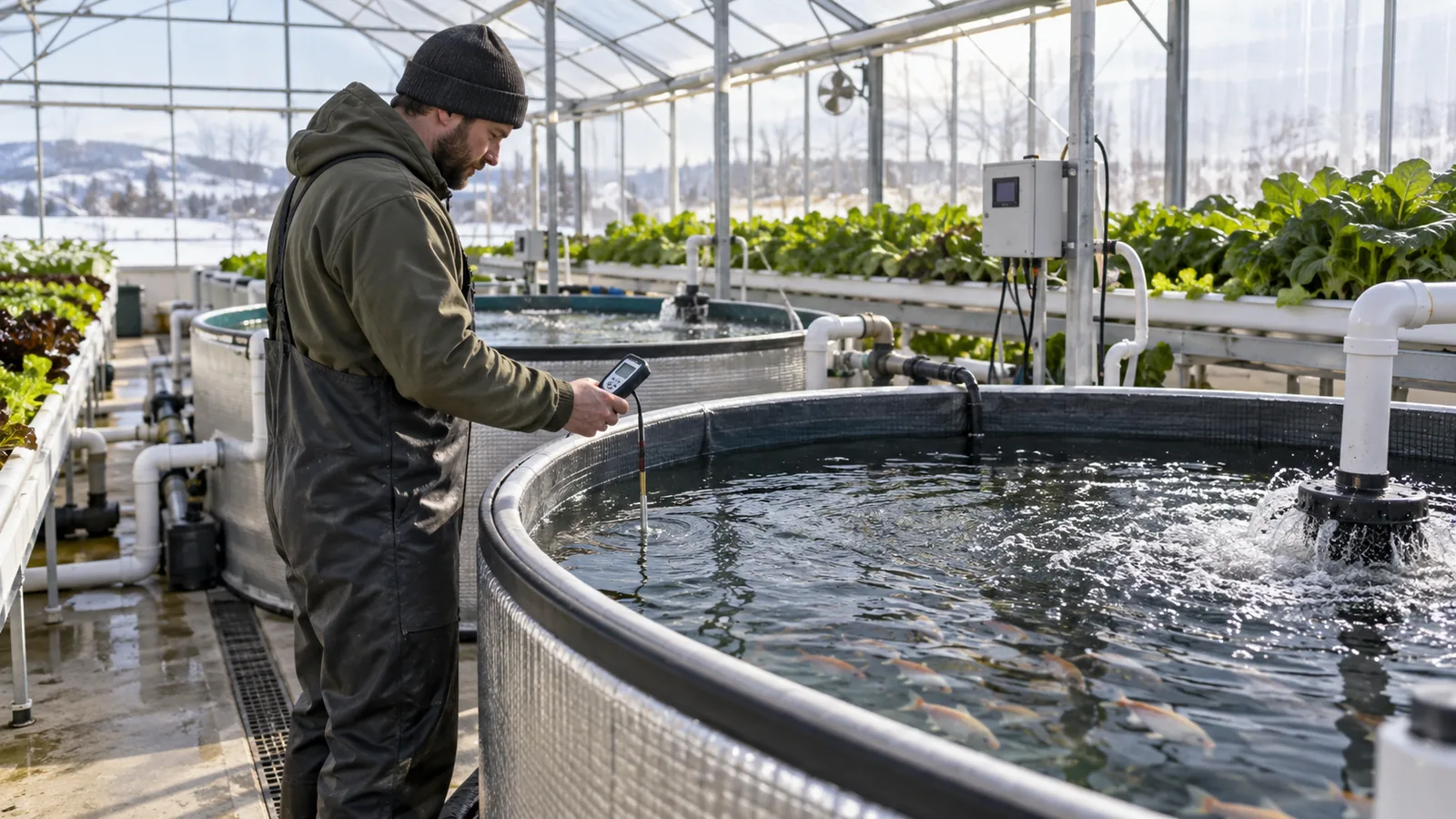
Heating aquaponics water is not simply a matter of placing a heater in the fish tank. Water temperature affects fish appetite and welfare, plant growth, dissolved oxygen, biological filtration and utility cost. The right approach begins with the species and site, then considers heat loss, insulation, the volume being heated, heater location, controls and emergency response.
For a small indoor unit, a guarded submersible heater may be suitable. For a commercial greenhouse, the solution may be a heat exchanger connected to a boiler, heat pump, solar thermal loop or another site utility. The equipment choice is secondary to the design question: how can the system hold an appropriate, stable temperature without creating electrical, scalding, oxygen or water-quality risk?
The short answer
Heat aquaponics water by reducing heat loss first, then selecting a correctly sized, fish-safe heating method with temperature sensing, circulation and backup planning. Possible methods include immersion heaters for small systems, inline heaters, heat exchangers, warm-water loops and heat-pump systems. Avoid direct, uncontrolled heating, and avoid sudden temperature changes.
University of Florida guidance on aquaculture facilities emphasizes that temperature control and building heat loss affect energy demand; the same system includes tanks, pumps, filtration and temperature-control equipment as a connected whole. Read the UF/IFAS heating comparison. The University of Southern California Sea Grant water guide also notes that temperature influences fish, oxygen availability and nitrification, and that rapid changes can be harmful. Read the USC Sea Grant guide.
Start with the temperature requirement, not the heater catalogue
There is no universal “best aquaponics temperature.” Fish species, fish size, crop selection, bacterial activity and local climate may have different preferred ranges. The operating target should be an agreed compromise that protects the fish and supports a stable system, not an attempt to optimize one component while stressing the others.
Before sizing equipment, define:
- fish species and its safe seasonal temperature range;
- crop mix and greenhouse air-temperature requirement;
- total water volume and which tanks or loops need heating;
- lowest expected outdoor and overnight temperatures;
- operating season and daily operating hours;
- existing building envelope, insulation, covers and ventilation; and
- electrical supply, fuel availability and backup capability.
If a buyer has not selected fish yet, temperature should be part of that decision. A warm-water species can be costly to maintain in a cold location; a cool-water species may conflict with a hot greenhouse crop plan. Use our fish selection guide to compare species, climate and operating requirements before specifying heating equipment.
Reduce heat loss before adding heat
Heating capacity compensates for heat loss. A poorly insulated greenhouse, uncovered tank, exposed pipe run or constantly opened door can turn a correctly sized heater into a costly and unstable solution. The first investment is often heat retention.
Insulate the building and water path
Assess roof and wall insulation, door seals, thermal curtains, tank covers, pipe insulation and exposure to cold floor surfaces. Covers must be designed to allow necessary air exchange and safe fish feeding; they should not seal a tank in a way that compromises oxygen management or access.
Keep heated water inside a controlled zone
Long outdoor pipe runs, uninsulated filter tanks and open sumps may lose heat faster than expected. Place heaters, sensitive controls and the most exposed vessels inside the protected envelope where possible. In a large layout, map the actual water path and identify the point at which heat is lost, rather than assuming the fish tank is the only problem.
Use a greenhouse climate strategy
Water heating cannot be considered separately from greenhouse heating, ventilation, humidity and lighting. A greenhouse that is too cold may pull heat from the water; a greenhouse that is too warm can lower dissolved oxygen and force cooling instead. The equipment scope should state which climate systems are supplied by the aquaponics vendor, which are provided by the site contractor and which are excluded.
Common ways to heat aquaponics water
Guarded immersion heaters
For small, accessible systems, a fish-safe submersible heater with a guard and thermostat can be practical. It must be installed according to manufacturer instructions, protected from physical damage and selected for the actual water volume and heat loss. A heater sized for a covered indoor tank may be inadequate in an uninsulated greenhouse.
Do not place equipment where fish can contact a hot surface or where low water exposes it. Use appropriate electrical protection, secure cable routing and routine inspection. An immersion heater is a small-system tool, not automatically a scalable commercial solution.
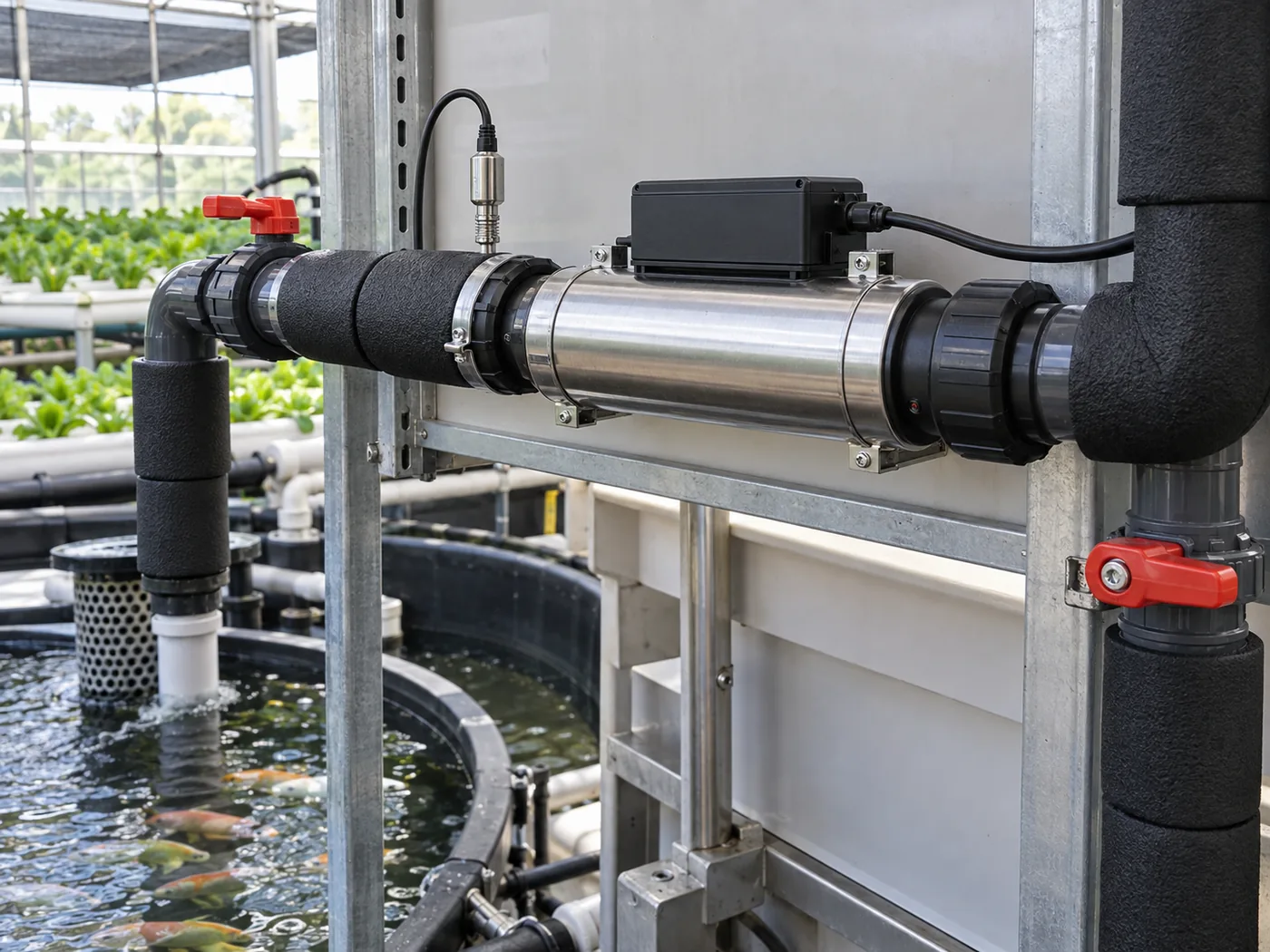
Inline electric heaters
An inline heater warms circulating water in a controlled pipe section. It can keep electrical heating outside the fish tank and may integrate with a controller, flow switch and isolation valves. It still needs correct flow, safe service access and a design that prevents heating when circulation stops.
Heat exchangers
For larger systems, a heat exchanger separates the aquaponics water from a boiler, heat-pump or warm-water utility loop. This can improve serviceability and avoid introducing unsuitable materials or treatment water into the fish loop. The heat exchanger and loop design must be compatible with water chemistry, pressure, maintenance access and the expected heat load.
Heat pumps, boilers and renewable heat sources
Air-source or ground-source heat pumps, boilers, solar thermal systems and recovered heat may be considered at project scale. Their suitability depends on climate, seasonal demand, energy price, available infrastructure and the ability to manage controls. A renewable source does not remove the need for backup capacity during prolonged cold, low sunlight or equipment failure.
Size the system from a heat-loss calculation
Heater wattage cannot be selected reliably from tank volume alone. A qualified designer should evaluate water volume, target temperature, ambient conditions, surface exposure, insulation, ventilation, pipe losses, operating schedule and recovery needs after water changes. A site that loses heat rapidly overnight may need a different solution from a similar-volume tank in an insulated room.
For a quotation, ask the supplier or site engineer to state the assumptions used for sizing. These should include the design outside temperature, target water range, building condition, total water volume, heater type, expected duty, control method and exclusions. If the assumptions are not written down, a buyer cannot compare one proposal with another.
Put safety and control ahead of fast heating
Use reliable sensing and a realistic set point
Place sensors where they represent actual system water, not only the warmest spot beside a heater. Verify sensor readings during commissioning with a second trusted method. Use a stable operating band and control logic that avoids frequent cycling or overshoot.
Heat gradually
Sudden temperature movement can stress fish and change oxygen availability and biological activity. When a cold system needs recovery, follow a controlled site-specific plan and observe fish behavior, flow, aeration and water-quality trends. Do not promise a universal temperature-change rate: species, volume and local technical guidance matter.
Maintain aeration and flow
Warmer water generally holds less dissolved oxygen. A heating plan must therefore review air supply, water movement and emergency aeration. A failed circulation pump can create a heater safety issue as well as a water-quality issue; use flow sensing, isolation, alarms or cut-outs where appropriate.
Protect electrical equipment
Water and electricity require professional installation, suitable breakers and ground-fault protection according to local rules. Keep junctions, controllers and outlets dry and accessible. During shipment inspection, confirm the supplied heater models, rated voltage, controller, sensors, guards, fittings and cable accessories against the approved equipment list. Local electrical connection and final compliance should be completed by qualified personnel.
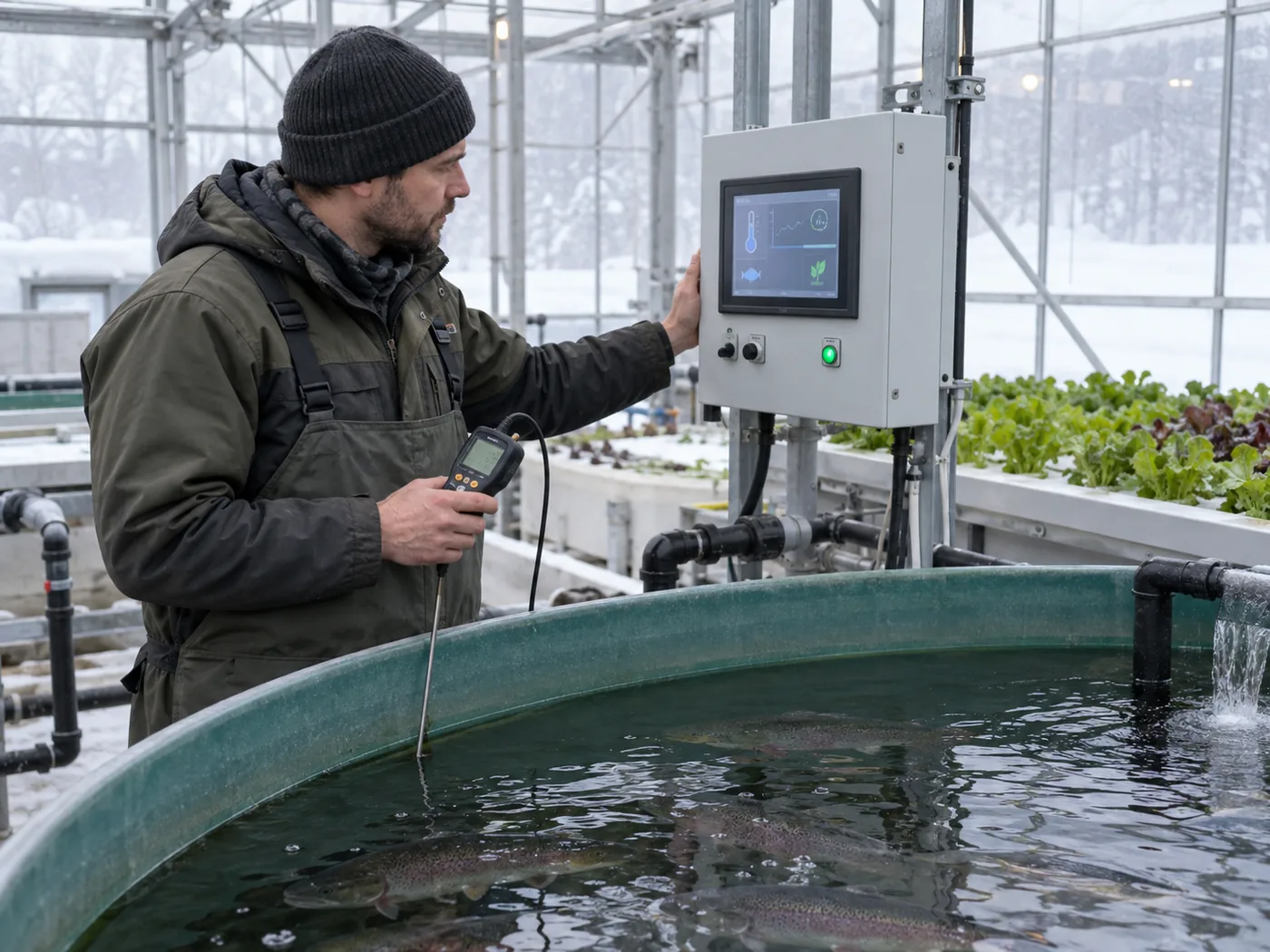
A practical winter commissioning sequence
1. Confirm tank, pipe and filter insulation is complete before filling.
2. Leak-test plumbing and verify safe drainage before electrical equipment is energized.
3. Confirm heater, pump, aeration and sensor connections match the approved drawing.
4. Test circulation and heater safety cut-outs with no fish present where the commissioning plan allows.
5. Compare displayed temperature with a second calibrated instrument at more than one point in the loop.
6. Confirm alarm recipients, backup power or aeration response, and spare-parts availability.
7. Introduce biological load only after the water loop and temperature-control routine are stable.
This is where factory testing and site commissioning should be separated. The manufacturer can verify components and an agreed functional test before shipment. The customer site must validate insulation, utility supply, local climate performance, electrical compliance and the final operating response.
When not to heat the water
Heating may not be the best first answer. If the fish choice conflicts with the local climate, if the greenhouse has uncontrolled heat loss, or if the utility cost makes the production plan unrealistic, redesign may be better than adding more heaters. Alternatives can include choosing a species suited to local water temperatures, adjusting the operating season, improving insulation, separating temperature zones or using a decoupled architecture where appropriate.
For broader layout decisions before purchasing equipment, see how to design an aquaponics system.
Operating records that make heating controllable
Temperature control improves when operators can see the relationship between weather, water temperature, equipment duty and fish response. Record the daily low and high water temperatures, air temperature where relevant, heater run time or energy reading if available, water level, pump and air status, and any adjustment made to ventilation or covers. During the first cold period, review the log each day. It will show whether the system is losing heat overnight, whether the heater is cycling excessively, or whether a sensor is placed in an unrepresentative location.
For larger projects, add a temperature section to the commissioning checklist: design conditions, control set point, sensor location, alarm limits, utility source, emergency contact and last inspection date. This gives the customer a usable operating document rather than a heater manual with no connection to the water loop.
Cost questions to include in an RFQ
A reliable request for quotation separates initial equipment cost from lifetime operating conditions. Ask for heater model and rating, controller and sensor scope, circulation requirements, insulation assumptions, installation interfaces, electrical or fuel requirements, exclusions, spare parts and recommended service intervals. If heat is supplied by site equipment, show the connection point and specify who is responsible for the heat exchanger, valves, control integration and final commissioning.
Do not compare equipment quotations only by heater capacity. A lower-priced unit may omit controls, safe isolation, installation hardware, insulation interfaces or backup provisions that are essential to stable operation. The more transparent scope is usually easier to install and support.
Example: separate the fish-water loop from the site heat source
In a project-scale greenhouse, the fish loop may circulate through a heat exchanger while a separate closed utility loop carries heat from a boiler or heat pump. This arrangement can make service and water-quality management clearer because the utility fluid does not enter the aquaponics water. It also creates defined responsibilities: the aquaponics supplier can specify the water-side connection, flow and control requirement, while the local mechanical contractor provides the heat source, pressure protection and utility piping.
The final scope should show valves for isolation, drain and vent points, sensor locations, access for service, and the safe condition when circulation stops. These details are often more important to reliable operation than the heater brand. During a site walk-through, ask an installer to explain how a technician will test the control, replace a sensor and isolate a component without draining the whole system.
Plan the first cold-weather review
After the first period of cold weather, compare the recorded temperatures with the design assumptions. Review overnight losses, heater duty, greenhouse air temperature, water additions, fish feeding response and any alarm events. If the target cannot be held, first inspect insulation, ventilation, sensors and flow before adding more capacity. This review provides real project experience for the next season and helps prevent an expensive quick fix based on one unusually cold night.
FAQ
Can I use a normal aquarium heater in aquaponics?
It may suit a small system if it is rated for the water volume, protected from fish contact and installed safely. It is not a substitute for a commercial heat-loss calculation, electrical protection or backup plan.
Should I heat the fish tank or the entire system?
The answer depends on the water path, fish and crop requirements, heat loss and hydraulic design. Heating only one point may create uneven temperatures if circulation is poor. A designer should identify the controlled zone and sensor locations.
Does heating water reduce dissolved oxygen?
Warmer water generally holds less oxygen, so aeration and fish observation are particularly important when temperature rises. Review the full water-quality plan rather than treating heating as an isolated change.
What should happen during a heater failure?
Follow the site emergency plan: verify the reading, check power and circulation, maintain aeration, protect against rapid temperature change and contact qualified support when needed. Backup equipment and clear responsibilities should be planned before winter operation.
Conclusion
Safe aquaponics water heating starts with species, climate and heat-loss control. Insulation, controlled circulation, reliable sensing, appropriate heater selection and emergency planning are more important than a high wattage number on a catalogue page. A documented equipment scope and a careful on-site commissioning process protect fish, crops and project operating cost.
Need help defining a temperature-control scope? Ask for Product Catalog and share your location, lowest seasonal temperature, water volume, fish plan, greenhouse details and available utilities.

