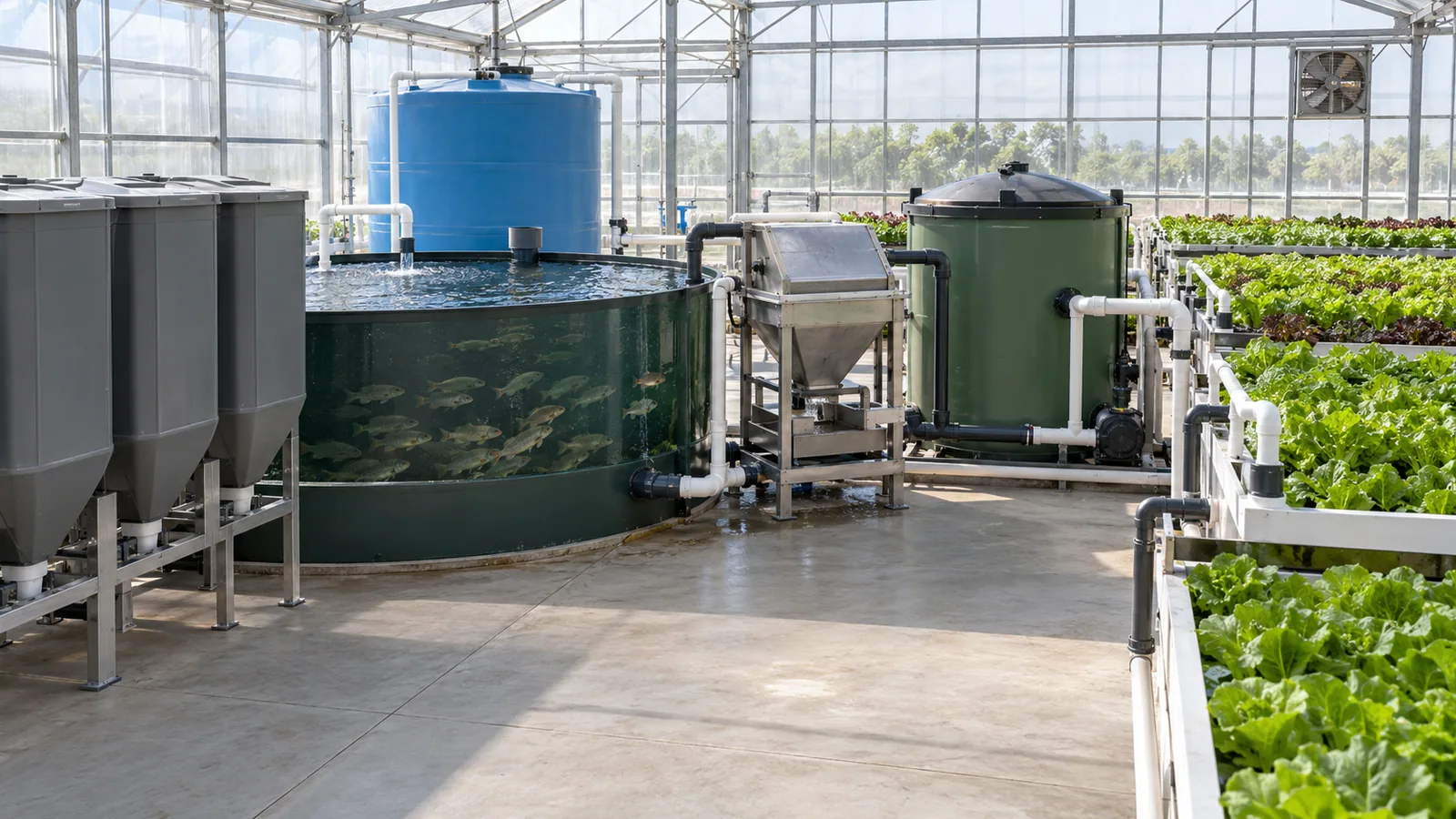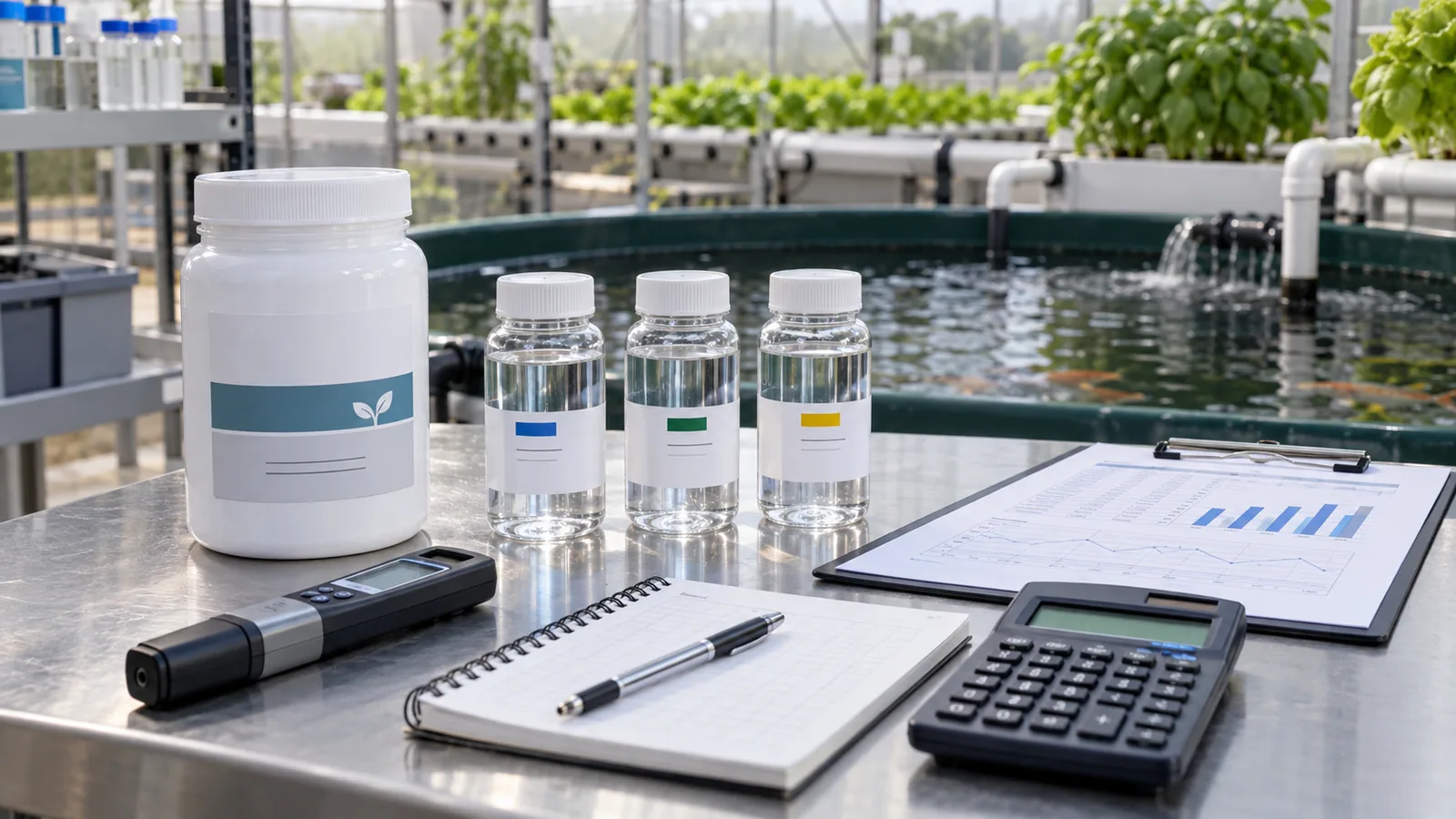
There is no responsible universal dose of Epsom salt for an aquaponics system. The amount depends on the measured magnesium concentration, desired increase, actual water volume, product purity, crop, source water and the concentrations of calcium, potassium, sulfate and other dissolved ions. If magnesium is already adequate, the correct amount may be zero.
Epsom salt is magnesium sulfate, usually sold as the hydrated crystal magnesium sulfate heptahydrate. It supplies magnesium and sulfate; it is not ordinary sodium chloride and it does not directly raise alkalinity in the way carbonate materials can. Adding it without diagnosis can raise dissolved salts, obscure the real cause of leaf symptoms and create a nutrient imbalance in water shared with fish and nitrifying microorganisms.
Use a measurement-first process: document symptoms, rule out environmental and root problems, test source and system water, identify the exact product, calculate only the verified magnesium gap, make a controlled correction, and retest before repeating.
The Short Answer
Do not add Epsom salt by a generic spoon-per-gallon rule. Use this calculation only after testing confirms a magnesium correction is justified:
Required product mass (g) = desired Mg increase (mg/L) × actual system water volume (L) ÷ [1,000 × product Mg fraction]
For pure magnesium sulfate heptahydrate, the theoretical magnesium fraction is approximately 0.0986, or 9.86 percent. A commercial label may state a different guaranteed analysis or purity; use the documented product value.
Example: raising magnesium by 10 mg/L in 1,000 L requires 10,000 mg, or 10 g, of elemental magnesium. At a 9.86 percent Mg fraction:
10 ÷ 0.0986 = approximately 101 g of pure MgSO₄·7H₂O
This demonstrates the mathematics; it is not a recommendation to add 101 g to every 1,000-L system. The target increase must come from water or tissue analysis interpreted for the specific crop and shared fish loop. A staged correction and follow-up test may be safer than attempting the full calculated change at once.
What Epsom Salt Adds to the Water
Pure Epsom salt is commonly represented as MgSO₄·7H₂O. When dissolved, it contributes magnesium ions and sulfate ions.
Magnesium is an essential plant nutrient. It has important roles in chlorophyll and plant metabolism. Sulfur is also essential. However, a useful nutrient can become an unnecessary dissolved load when added without a measured need.
Aquaponics water already receives minerals from fish feed, source water, captured solids, pH-management materials, corrosion, propagation media and previous supplements. The article on how minerals enter aquaponics systems explains why every addition must be considered as part of a continuing mass balance rather than an isolated treatment.
The Oklahoma State University overview of aquaponics plant-growth requirements notes that magnesium is one of the essential macronutrients and that high concentrations of calcium, potassium or magnesium can influence the availability of the others. That interaction is one reason a symptom cannot be diagnosed reliably from color alone.
When Magnesium Deficiency Is Plausible
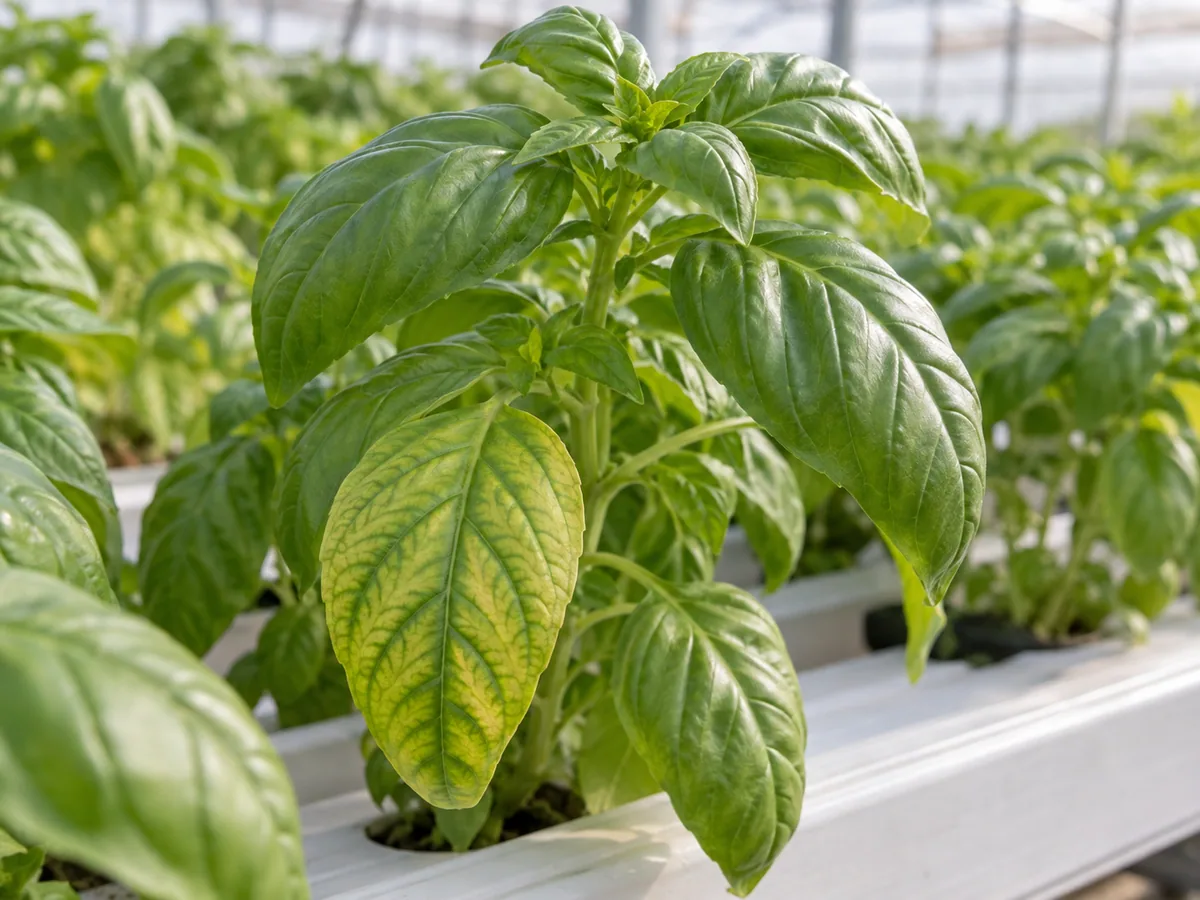
Magnesium is mobile within plants, so a true deficiency often appears first on older leaves. A common pattern is interveinal chlorosis: tissue between veins becomes pale or yellow while the veins remain greener. More advanced stress may lead to spotting, edge damage or leaf loss.
These signs are not exclusive to magnesium deficiency. Similar symptoms or poor growth can result from:
- Root damage or disease
- Low dissolved oxygen around roots
- Unsuitable pH and reduced nutrient availability
- Excess potassium or calcium affecting uptake
- Cold root-zone conditions
- High salinity
- Uneven flow
- Inadequate light
- Pest or disease damage
- Natural aging of older leaves
- A different nutrient deficiency
Look at the pattern across crops and zones. If symptoms occur only at one channel outlet, investigate flow and root conditions. If one cultivar is affected while others remain healthy, crop demand may differ. If symptoms appeared after a pH correction or supplement, review the entire input history before adding another product.
Test Before Calculating a Dose
Source-water analysis
Test the water used for initial filling and top-up. Hard water may already contribute meaningful magnesium and calcium. Rainwater or reverse-osmosis water may contribute very little. Seasonal source changes can alter the result.
At minimum, a useful laboratory panel may include magnesium, calcium, potassium, sodium, sulfate, alkalinity and electrical conductivity. The appropriate panel depends on the laboratory and project. Keep units clear: a result in mg/L is numerically equivalent to ppm for dilute water, but the report and method should still be retained.
System-water analysis
Sample the circulating system using the laboratory’s bottle, preservation and delivery instructions. Record date, time, sampling point, feeding condition, recent top-up, recent supplement additions and water temperature. Avoid sampling immediately beside a dosing point.
A single reading is a snapshot. Repeated results can show whether magnesium is stable, declining through plant uptake and discharge, or accumulating through top-up water and supplements.
Plant tissue analysis
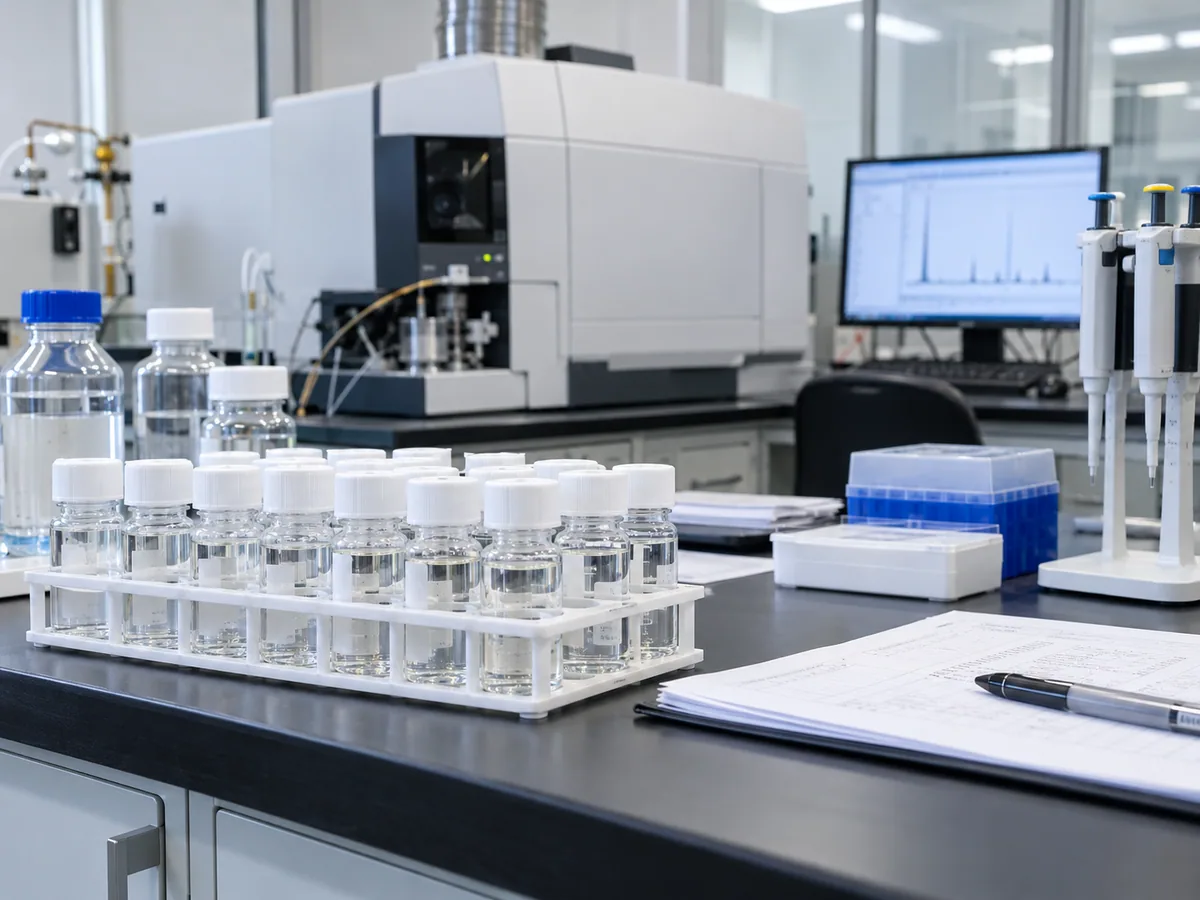
Water concentration shows what is present in solution; tissue analysis helps show what the plant absorbed. When symptoms persist despite apparently adequate water magnesium, tissue analysis and review of roots, pH and competing ions may be more informative than adding more material.
The University of Kentucky-hosted technical alert on magnesium deficiency in hydroponic basil illustrates both water-target and tissue-analysis approaches. It is a hydroponic crop reference, not a universal aquaponics dose; use it to understand diagnosis and calculation while protecting the shared fish system.
Electrical conductivity is not a magnesium test
EC measures the combined conductivity of dissolved ions. Magnesium contributes, but so do nitrate, sulfate, sodium, calcium, potassium, chloride and others. An acceptable or unchanged EC does not prove that magnesium is sufficient. A higher EC after adding Epsom salt confirms that ions were added, not that the plant problem was solved.
Determine the Actual Water Volume
Dosing by nominal fish-tank volume can be wrong because the active system may also include sumps, filters, pipes, raft troughs and water held in media beds. At the same time, tanks may not operate at their full moulded capacity.
Build a volume inventory:
| Component | Nominal volume | Normal operating volume | Included in shared loop? |
|---|---|---|---|
| Fish tank | Record | Measure or calculate | Yes/No |
| Sump | Record | Normal level | Yes/No |
| DWC troughs | Calculate | Water depth × area | Yes/No |
| Media beds | Calculate | Apply measured void fraction | Yes/No |
| Filters and pipes | Estimate | Normal filled volume | Yes/No |
| Isolated plant loop | Record | Current volume | Yes/No |
Use the water volume actually exposed to the addition. If a decoupled crop loop is treated separately, do not use the fish-side volume in the calculation. Recheck water level after large harvest, cleaning or seasonal shutdown.
Convert a Test Result Into Product Mass
Step 1: define the desired magnesium increase
Subtract the measured concentration from the technically justified target:
Desired Mg increase = target Mg concentration − measured Mg concentration
If the result is zero or negative, do not add magnesium solely to follow a schedule. If the target is uncertain, obtain qualified crop and water advice instead of inventing a number.
Step 2: calculate elemental magnesium required
Elemental Mg required (mg) = desired increase (mg/L) × actual water volume (L)
Divide by 1,000 to convert milligrams to grams.
Step 3: correct for product analysis
Product required (g) = elemental Mg required (g) ÷ product Mg fraction
If the label guarantees 9.8 percent Mg, use 0.098. Do not assume a bath product, scented product or blended garden product is pure magnesium sulfate. Products with fragrances, oils, colorants or undisclosed additives are inappropriate for a shared aquaponics loop.
Step 4: account for displacement and recent inputs
Review top-up water, previous doses, pH buffers and other supplements. If a laboratory sample was taken before a major water addition, the current concentration may differ. Update the volume and mass balance before dosing.
Step 5: choose a controlled correction stage
The calculated amount represents the full theoretical mass for the selected increase. It does not establish application speed or confirm fish compatibility. For a coupled system, use product documentation and qualified advice to determine whether the change should be divided into smaller stages. Retest before repeating.
A Worked Calculation With Boundaries
Assume laboratory analysis reports 22 mg/L magnesium and the project’s crop specialist approves an initial target of 32 mg/L for this particular system. The active shared volume has been measured at 1,500 L. The selected product is documented pure magnesium sulfate heptahydrate with 9.86 percent magnesium.
1. Desired increase: 32 − 22 = 10 mg/L Mg
2. Elemental Mg: 10 mg/L × 1,500 L = 15,000 mg = 15 g Mg
3. Product mass: 15 g ÷ 0.0986 = approximately 152 g product
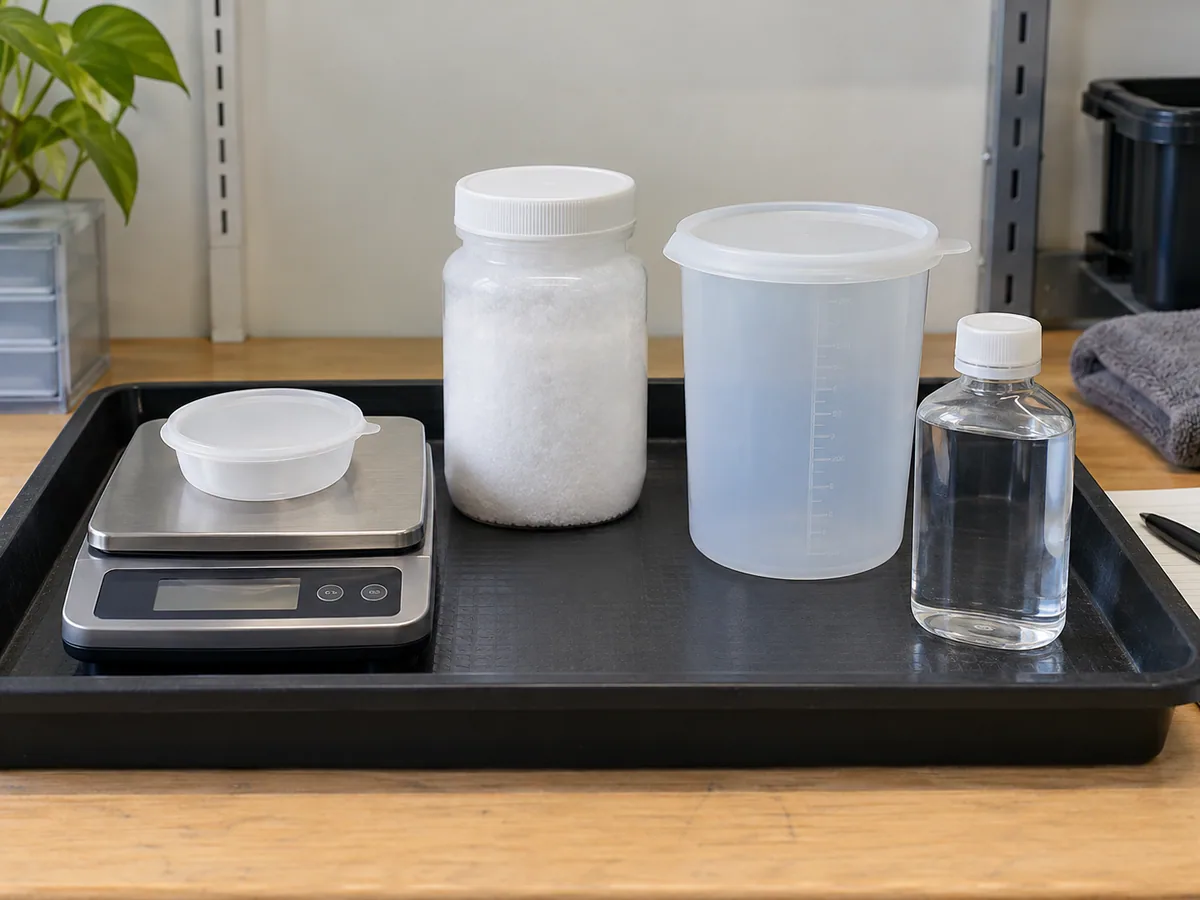
The calculation does not authorize immediate addition. The operator must still verify the sample date, product, fish compatibility, sulfate history, current volume and approved staged-application procedure. The result should be weighed with a suitable scale, not converted casually into tablespoons because crystal density and packing vary.
Select and Receive the Product Carefully
Use a clearly labelled product with manufacturer, chemical identity, guaranteed analysis or purity, lot number and storage instructions. For a food-production project, confirm applicable input and regulatory requirements in the destination market. “Natural,” “garden,” “USP,” “food grade” or “organic” are not interchangeable claims and do not automatically establish suitability for aquaponics.
Before purchase, request the product label and Safety Data Sheet where applicable. Confirm whether the material is magnesium sulfate heptahydrate or another form. Different hydration states contain different percentages of magnesium, so the same product mass may not deliver the same elemental amount.
During shipment inspection, check seals, moisture exposure, lot identification, quantity and label consistency. Keep nutrient products separate from fish feed and from cleaning chemicals. Store the bag sealed and dry, and prevent an opened container from becoming an unidentified white powder.
The procurement guide for aquaponics nutrient supplements and additives provides a fuller supplier-document and receiving checklist.
Add Only Through a Written Procedure
The following is a process-control framework, not a universal application instruction:
1. Confirm the approved reason, test result and calculation.
2. Record product name, lot, analysis and measured mass.
3. Use clean, dedicated weighing and mixing equipment.
4. Follow the manufacturer’s solubility and handling instructions.
5. If an application to the shared loop is approved, avoid placing concentrated material directly on fish, roots, sensors or biofilter media.
6. Apply according to the site’s defined dilution, flow and staging procedure.
7. Observe fish behavior, circulation and plant response.
8. Retest after the selected equilibration period.
9. Stop and investigate if an unexpected response occurs.
Do not combine concentrates in the same small container unless chemical compatibility is established. A precipitate can remove nutrients from solution and block equipment. Label all temporary vessels and dispose of residues according to the product and local requirements.
Mid-Article CTA — Verify the Input Before Ordering
Need a supplier-ready nutrient and water-data checklist? Contact Us with your system volume, crop, fish species, source-water report and the exact product label you are considering.
Monitor More Than Leaf Color
After a technically approved correction, record:
- Magnesium result at the planned retest
- Calcium and potassium where relevant
- Sulfate and EC trend
- pH and alkalinity
- Water temperature and dissolved oxygen
- Fish behavior and feeding response
- New growth versus old damaged leaves
- Root condition
- Date, lot and amount added
Old chlorotic tissue may not become fully green again. Judge recovery from healthy new growth, stabilized symptoms and follow-up analysis rather than expecting damaged leaves to reverse immediately.
If magnesium remains low after a calculated addition, investigate water exchange, discharge, crop uptake, measurement error and product identity. If the water result rises but plants remain deficient, examine pH, roots, temperature and nutrient antagonism rather than automatically repeating the dose.
Balance Magnesium With Calcium and Potassium
Plants require all three nutrients, and their availability is interrelated. Adding magnesium while ignoring excessive potassium or calcium may not correct uptake. Conversely, reducing one nutrient based on a generic ratio can create another deficiency.
Measure individual elements. Potassium deserves its own method because EC and general aquarium strips do not isolate it; see the guide to measuring potassium in an aquaponic system. Interpret results with crop, pH, source water and tissue condition.
Do not use Epsom salt as a complete plant nutrient. It supplies no nitrogen, phosphorus, potassium, calcium or iron. If several nutrients are low, diagnose system balance, feed input, mineralization and source water before adding several separate salts.
Epsom Salt Versus Other Magnesium Sources
Magnesium sulfate is soluble and adds sulfate without directly supplying alkalinity. Dolomitic materials supply magnesium and calcium carbonate, so they can also affect alkalinity and pH and may dissolve slowly. Commercial magnesium products may have different hydration, purity or companion ions.
These materials are not interchangeable gram for gram. Select a source for the measured need and desired water-chemistry effect. If pH or alkalinity also needs correction, use an integrated management plan rather than expecting one material to solve every parameter.
Common Mistakes to Avoid
Adding a weekly spoonful without testing
Routine dosing can accumulate magnesium and sulfate even after the original deficiency is corrected. A calendar is not evidence of continuing need.
Treating every yellow leaf as magnesium deficiency
Check leaf age, pattern, roots, pH, light, flow, pests and other nutrients. Photograph and label affected zones before changing the water.
Dosing from nominal tank capacity
Include the actual shared water volume and exclude isolated or empty components. A large error in volume becomes a large error in product mass.
Confusing Epsom salt with aquarium or pool salt
Magnesium sulfate and sodium chloride have different compositions and uses. Do not substitute one for the other.
Using an unlabeled household product
Fragrance, oil, color, anti-caking agents or uncertain purity may be unsuitable. Use a traceable product whose composition is documented.
Repeating the full calculation before retesting
The first addition changed the mass balance. Recalculate from the new measured condition; do not stack identical doses based on the original sample.
FAQ
How many tablespoons of Epsom salt should I add per gallon?
There is no safe universal tablespoon-per-gallon answer for aquaponics. Test magnesium, calculate the elemental gap from actual system volume and use the product’s guaranteed Mg percentage. Weigh the result rather than relying on variable spoon volume.
Can Epsom salt harm fish?
Any water-chemistry change can create risk when the product, concentration, application rate or fish condition is unsuitable. Confirm product identity and species compatibility, avoid direct contact with concentrated material, and use a staged, monitored procedure approved for the system.
Does Epsom salt raise pH?
Magnesium sulfate is not a carbonate alkalinity buffer and should not be selected as a general pH-raising material. Measure pH and alkalinity separately and choose a management method suited to both the fish and plant sides.
Can EC tell me when to add more?
No. EC represents all conductive ions together and cannot identify magnesium. Use elemental water analysis or an appropriate validated method, supported by plant observations and tissue analysis where necessary.
Should I spray Epsom salt on aquaponics plants?
Foliar application has crop, concentration, worker-safety and harvest considerations, and overspray can enter the fish loop. Do not improvise a spray from a general gardening recipe. Follow crop-specific professional advice and applicable product directions.
How soon should I retest?
The interval depends on system mixing, crop, laboratory turnaround and the approved correction plan. Define it before application. Do not repeat a dose merely because old damaged leaves have not changed appearance.
Conclusion
The correct Epsom-salt amount for aquaponics comes from a measured magnesium gap, actual water volume and verified product analysis. In some systems the correct dose is zero. When a correction is justified, calculate elemental magnesium first, convert it to product mass, stage the change according to a qualified procedure and retest before adding more.
This measurement-first approach protects fish, plants and biofiltration while producing better evidence for future nutrient management. It also makes purchasing more reliable: the operator can specify the required chemical identity, purity, batch records and intended use instead of buying an unverified white powder from a generic listing.
Final CTA — Request a Water and Supplement Checklist
Planning a modular aquaponics system with documented nutrient management? Ask for a Product Catalog and send your project scale, crops, fish plan, source-water information, destination and customer requirements.