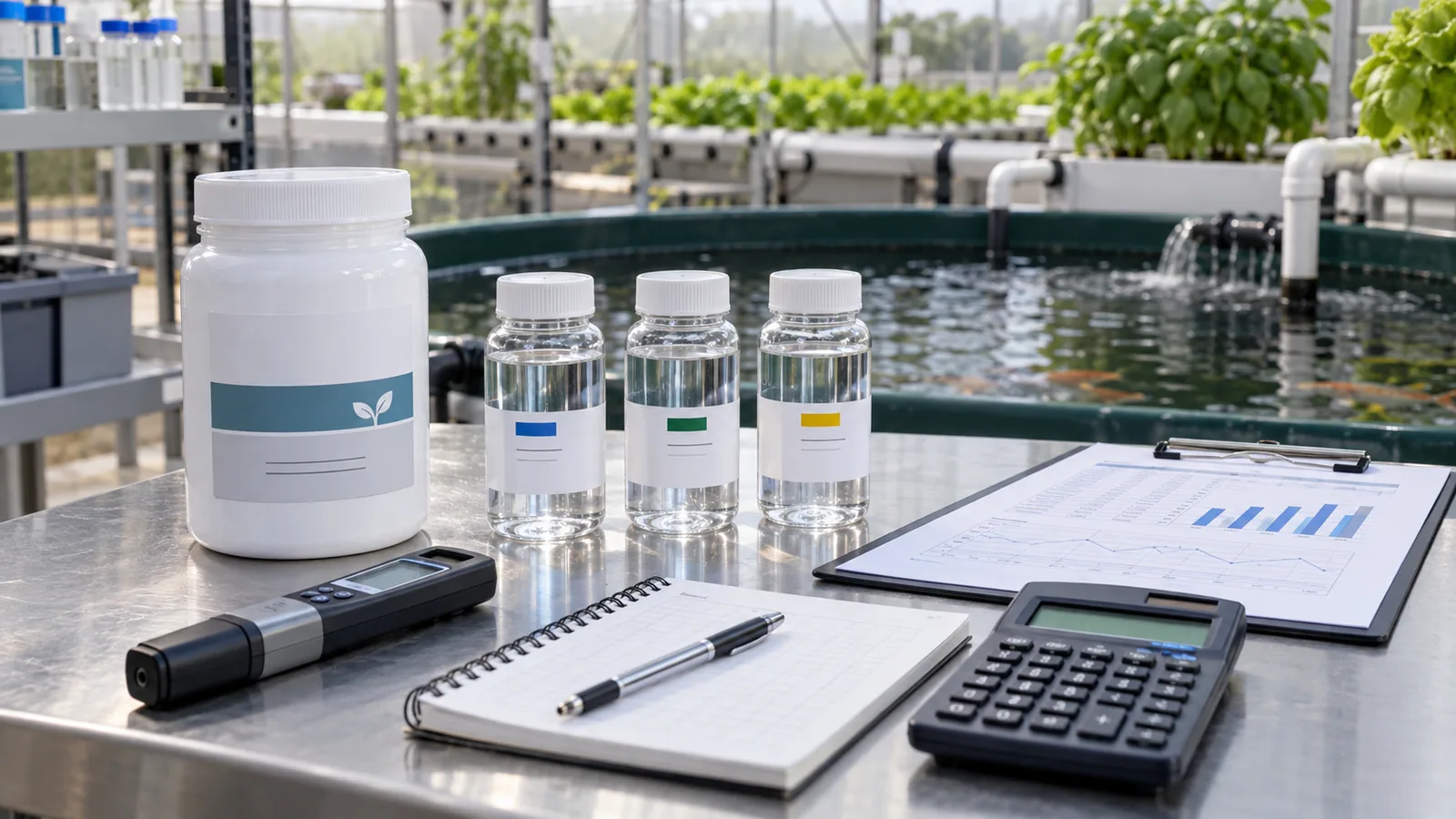
There is no universal quantity of salt that should be added to every aquaponics system. In this guide, salt means sodium chloride, or NaCl—not Epsom salt, which is magnesium sulfate, and not a general mineral blend. Sodium chloride may be considered for a defined aquaculture purpose such as managing chloride relative to measured nitrite, supporting fish during specific handling procedures, or conducting a prescribed treatment outside the plant loop. It should not be added as a routine plant nutrient.
The correct amount depends on the purpose, measured nitrite and chloride, fish species, crop salt tolerance, actual water volume, existing salinity, product purity and whether treatment occurs in the coupled system or a separate vessel. In many stable systems, the correct addition is zero.
Aquaponics creates a special constraint: salt that helps fish in one situation can accumulate in recirculating water and damage salt-sensitive crops. The responsible process is to define the problem, test the water, calculate the smallest justified change, assess plant exposure, use a traceable product and verify the result. Fish disease diagnosis and therapeutic baths require an aquatic-animal health professional or other qualified adviser—not a generic online dosage.
The Short Answer
Do not use a fixed “pounds per 100 gallons” rule without stating the target. For a general concentration calculation:
Additional NaCl (kg) = desired salt increase (ppt) × actual water volume (L) ÷ 1,000
Because 1 ppt = 1 g/L, raising 1,000 L of water by 1 ppt theoretically requires 1 kg of pure sodium chloride. If salinity is already 0.4 ppt and a technically approved target is 1.0 ppt, the difference is 0.6 ppt:
0.6 × 1,000 ÷ 1,000 = 0.6 kg NaCl
This equation does not determine whether 1.0 ppt is appropriate. It only converts an approved concentration change into product mass. Correct for product purity and verify the starting salinity with an appropriate method.
For nitrite management, calculate from measured nitrite and chloride rather than total salinity alone. The University of Florida IFAS guide on fish-health management in recirculating aquaculture systems includes salinity among the parameters that may need monitoring and notes the defined use of salt in managing nitrite-related risk. Apply aquaculture guidance to aquaponics only after considering the plant loop and species-specific advice.
First Identify Which “Salt” You Mean
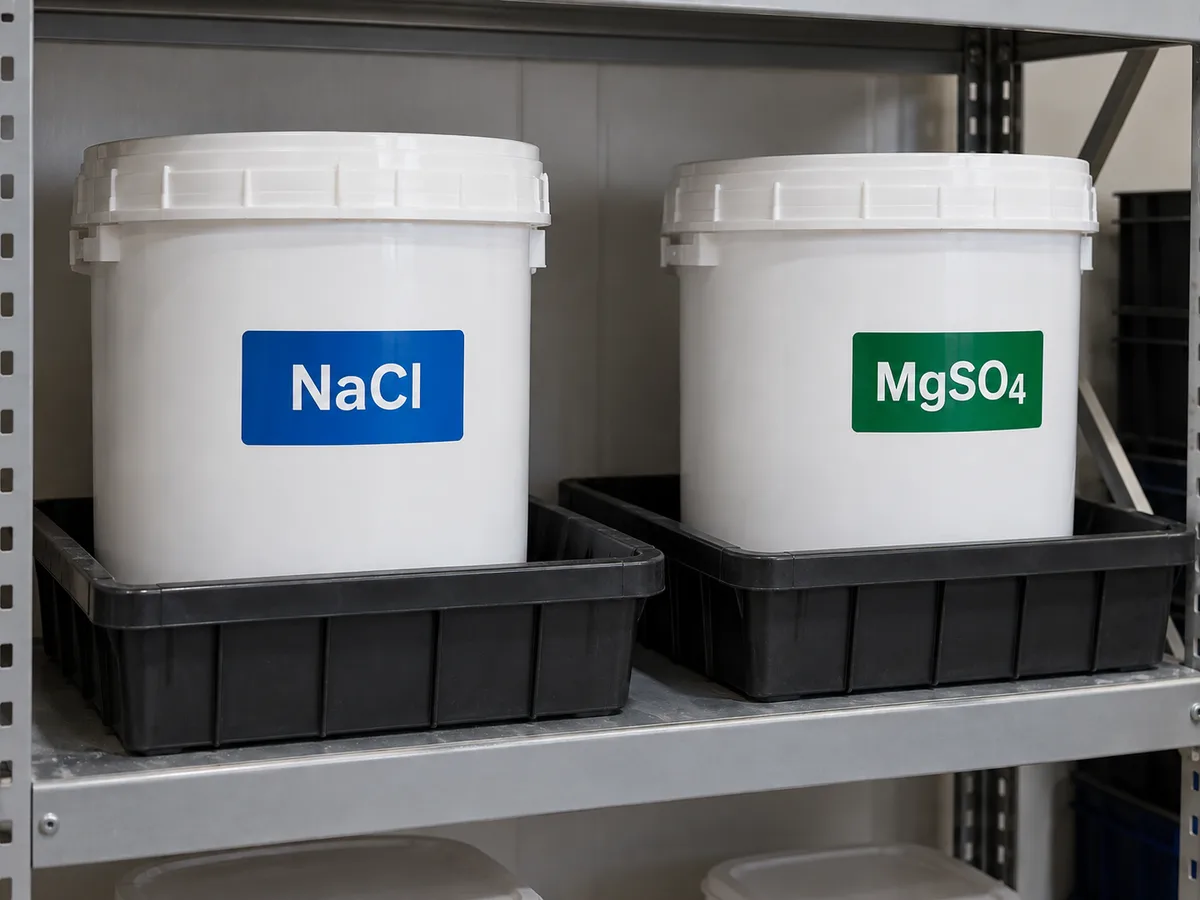
*Confirm the chemical identity before calculating any aquaponics treatment.*
The word salt is chemically broad and commercially ambiguous. Common products include:
- Sodium chloride: aquarium, solar, pool or non-iodized salt, depending on purity and additives
- Magnesium sulfate: Epsom salt, used as a magnesium and sulfate source
- Potassium chloride: a potassium and chloride source that also changes potassium loading
- Calcium chloride: a calcium and chloride source that behaves differently from NaCl
- Marine salt mixes: multi-mineral blends designed to create seawater chemistry
These products are not interchangeable. If the objective is magnesium correction, use the separate guide on how much Epsom salt to add to aquaponics. The calculations, companion ions and biological effects differ.
This article addresses only documented sodium chloride. Read the label and Safety Data Sheet. Do not assume that white crystals from an unmarked container are NaCl.
Why Sodium Chloride May Be Considered
Nitrite risk management
Nitrite can interfere with oxygen transport in freshwater fish. Chloride competes with nitrite at the gills, so increasing chloride relative to nitrite can reduce risk under defined conditions. This is not a substitute for restoring biofilter performance, reducing feed when appropriate, maintaining oxygen or correcting the cause of a nitrite increase.
Handling and transport support
Aquaculture professionals sometimes use salt during fish transport or handling. The concentration, duration, temperature, fish condition and water chemistry are procedure-specific. A transport-tank protocol should not be copied into the permanent aquaponic loop.
External parasite or fish-health treatment
Salt may be used for particular fish-health applications, often at concentrations unsuitable for plants. Diagnosis matters because not every disease responds to salt, and delayed correct treatment can worsen losses. Follow the response framework in reliable treatment decisions for fish disease signs and involve a qualified fish-health professional.
What salt does not do
Sodium chloride does not cycle a biofilter, replace alkalinity, correct ammonia, provide a balanced plant nutrient or disinfect a poorly maintained system. Adding salt because fish “look stressed” can mask the real issue and create a second problem for crops.
Test Nitrite, Chloride and Existing Salinity
Nitrite
Use a method with an appropriate range and resolution. Confirm units and whether the kit reports nitrite ion or nitrite-nitrogen; these are not numerically interchangeable. Record the sampling point, temperature, pH, feeding status and time.
If nitrite is detected unexpectedly, immediately review dissolved oxygen, feed input, recent fish additions, biofilter flow, temperature, pH and ammonia. Repeat the test with a validated method if the result is surprising.
Chloride
Chloride concentration cannot be inferred reliably from total salinity or EC when other ions are present. Use a chloride test or laboratory analysis suitable for the expected range. Source water may already contain enough chloride for the selected nitrite-management ratio, making an addition unnecessary.
Salinity or conductivity
A calibrated salinity meter or refractometer may help verify a broad NaCl change, but instruments differ in scale and temperature compensation. EC measures all conductive ions; fertilizer salts, source-water minerals and supplements affect it. Treat EC as a supporting trend, not a sodium-chloride-specific result.
Calculate Salt for a Chloride Target
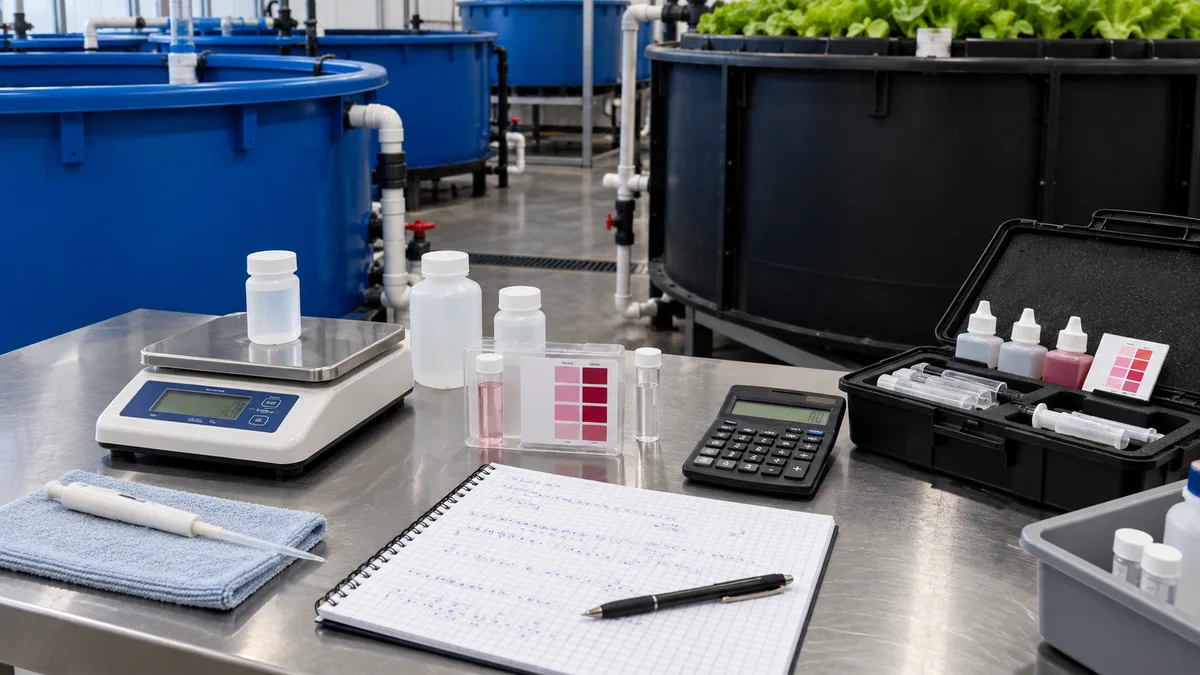
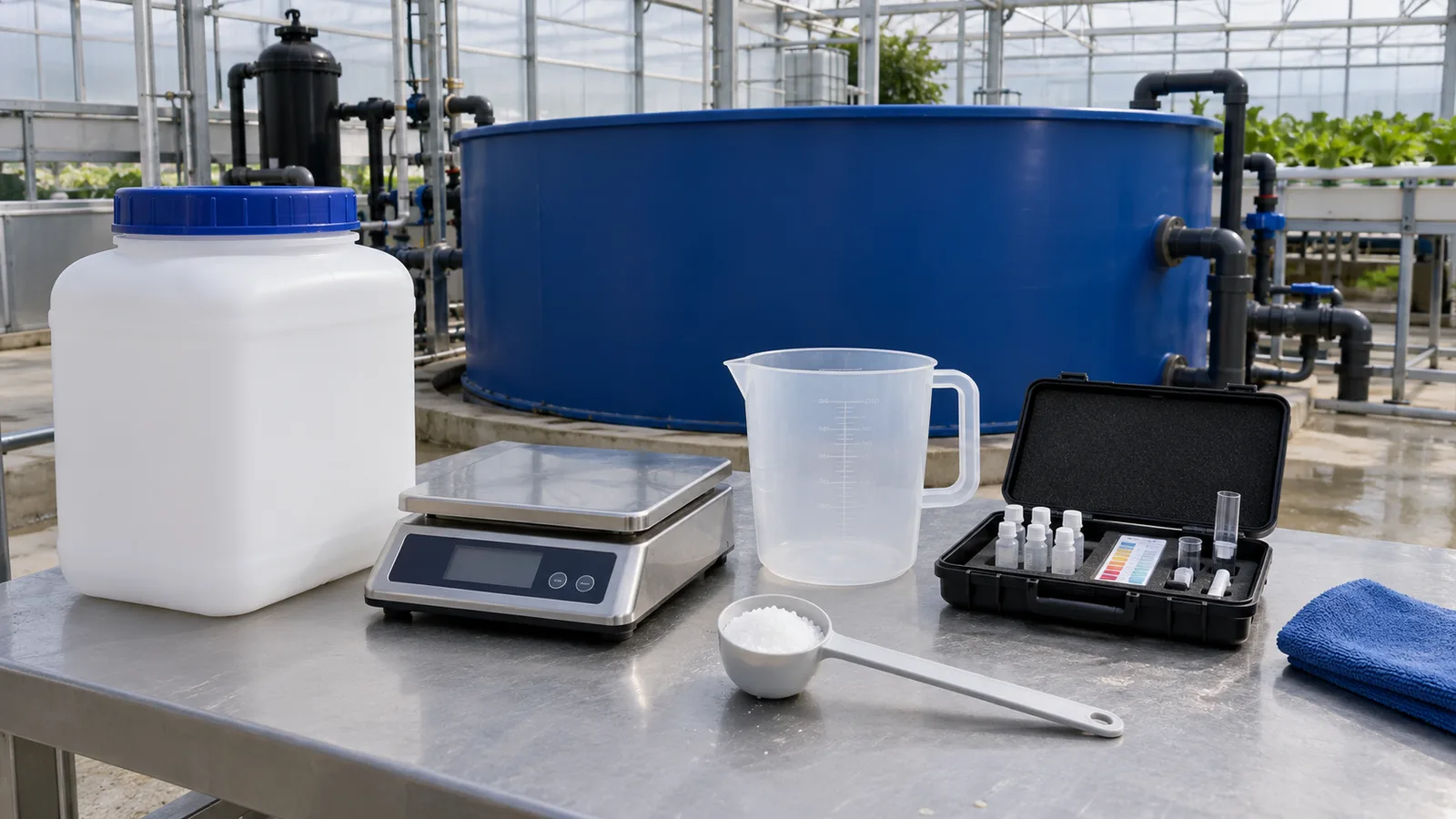
*Concentration, actual water volume and product purity belong in the same calculation record.*
Pure sodium chloride is approximately 60.66 percent chloride by mass. When an aquaculture procedure defines a required chloride increase, calculate NaCl from the chloride fraction:
NaCl required (g) = chloride increase (mg/L) × water volume (L) ÷ [1,000 × 0.6066 × product purity]
Use product purity as a decimal. A documented 99.5 percent product uses 0.995.
Worked nitrite-and-chloride example
Assume a qualified procedure uses a minimum chloride-to-nitrite ratio of 6:1. A 2,000-L system measures:
- Nitrite: 2.0 mg/L
- Chloride: 4 mg/L
- NaCl product purity: 99.5 percent
The selected chloride target is:
6 × 2.0 = 12 mg/L chloride
The measured chloride is already 4 mg/L, so the increase is:
12 − 4 = 8 mg/L chloride
The theoretical product mass is:
8 × 2,000 ÷ (1,000 × 0.6066 × 0.995) = approximately 26.5 g NaCl
This example shows why measuring existing chloride matters. Applying a generic 1-ppt whole-system dose would add roughly 2 kg to 2,000 L—far more than the calculated chloride gap in this scenario. The example is educational, not a treatment instruction. Confirm the ratio, species, method and plant implications with the applicable technical authority.
The University of Arkansas Aquaculture Producer’s Quick Reference Handbook likewise emphasizes measuring nitrite and chloride and then calculating the salt required, rather than adding an unmeasured standard quantity.
Calculate Salt for a Total Salinity Target
When a competent plan specifies a total NaCl increase instead of a chloride target:
1. Measure current salinity.
2. Subtract it from the approved target.
3. Multiply the difference in ppt by actual litres.
4. Divide by 1,000 to obtain kilograms of pure NaCl.
5. Divide by product purity.
Example: current salinity is 0.2 ppt, approved target is 0.5 ppt, water volume is 3,000 L and product purity is 99.8 percent.
Difference = 0.5 − 0.2 = 0.3 ppt
Pure NaCl = 0.3 × 3,000 ÷ 1,000 = 0.9 kg
Product = 0.9 ÷ 0.998 = approximately 0.902 kg
Do not use this calculation if the objective was a chloride-to-nitrite ratio; use the chemistry relevant to the stated target. Also remember that salinity meters may display practical salinity units, ppt or percent. Verify the display and calibration.
Determine the Actual Water Volume
Include all connected water exposed to the addition:
| Component | Volume basis |
|---|---|
| Fish tank | Normal operating level, not moulded maximum |
| Sump | Typical level during operation |
| DWC troughs | Internal area × water depth |
| Media beds | Flooded volume × measured void fraction |
| Filters | Normal filled operating volume |
| Pipes | Filled internal volume |
Subtract isolated loops and tanks. If salt will be used in a separate hospital or transport tank, calculate only that vessel’s verified water volume. Mark the tank in litres and remeasure after displacement by equipment.
Protect Plants From Salt Exposure
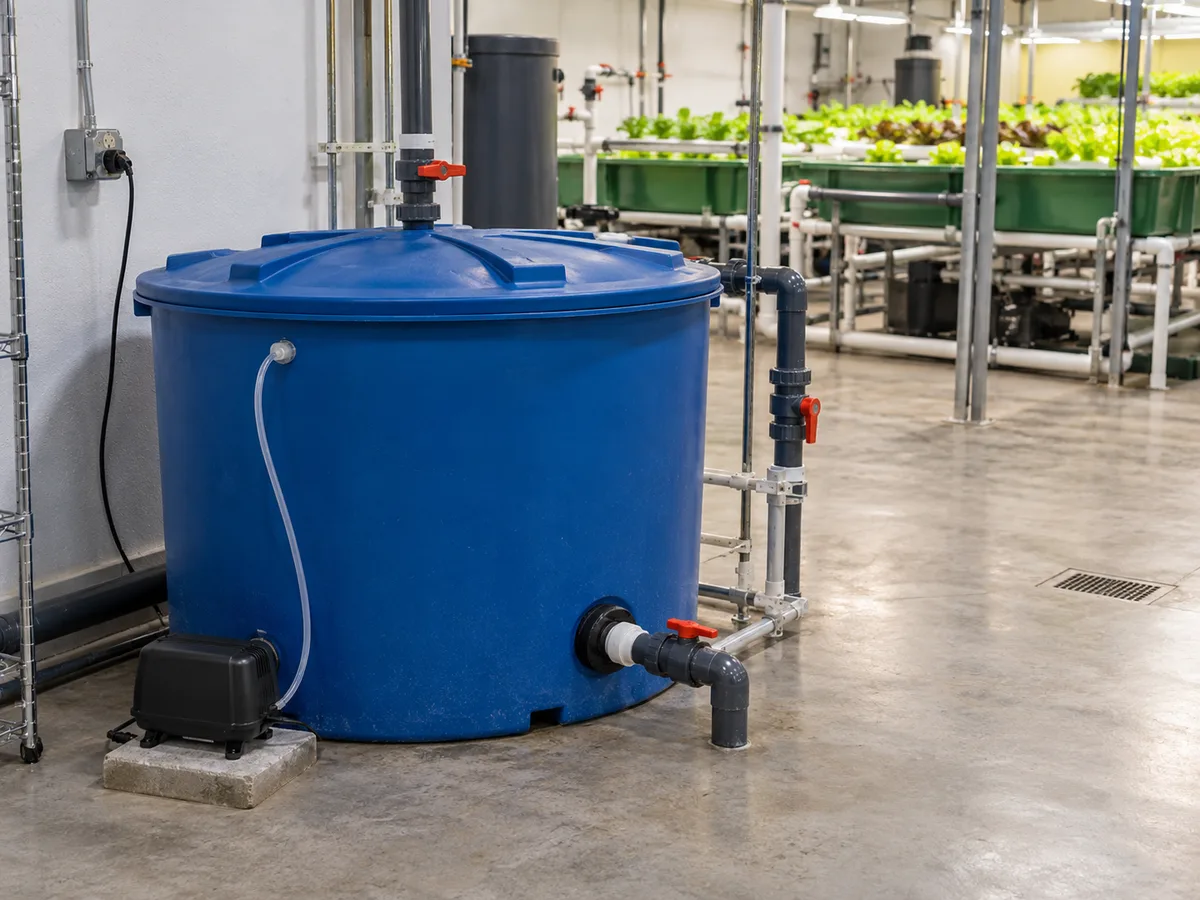
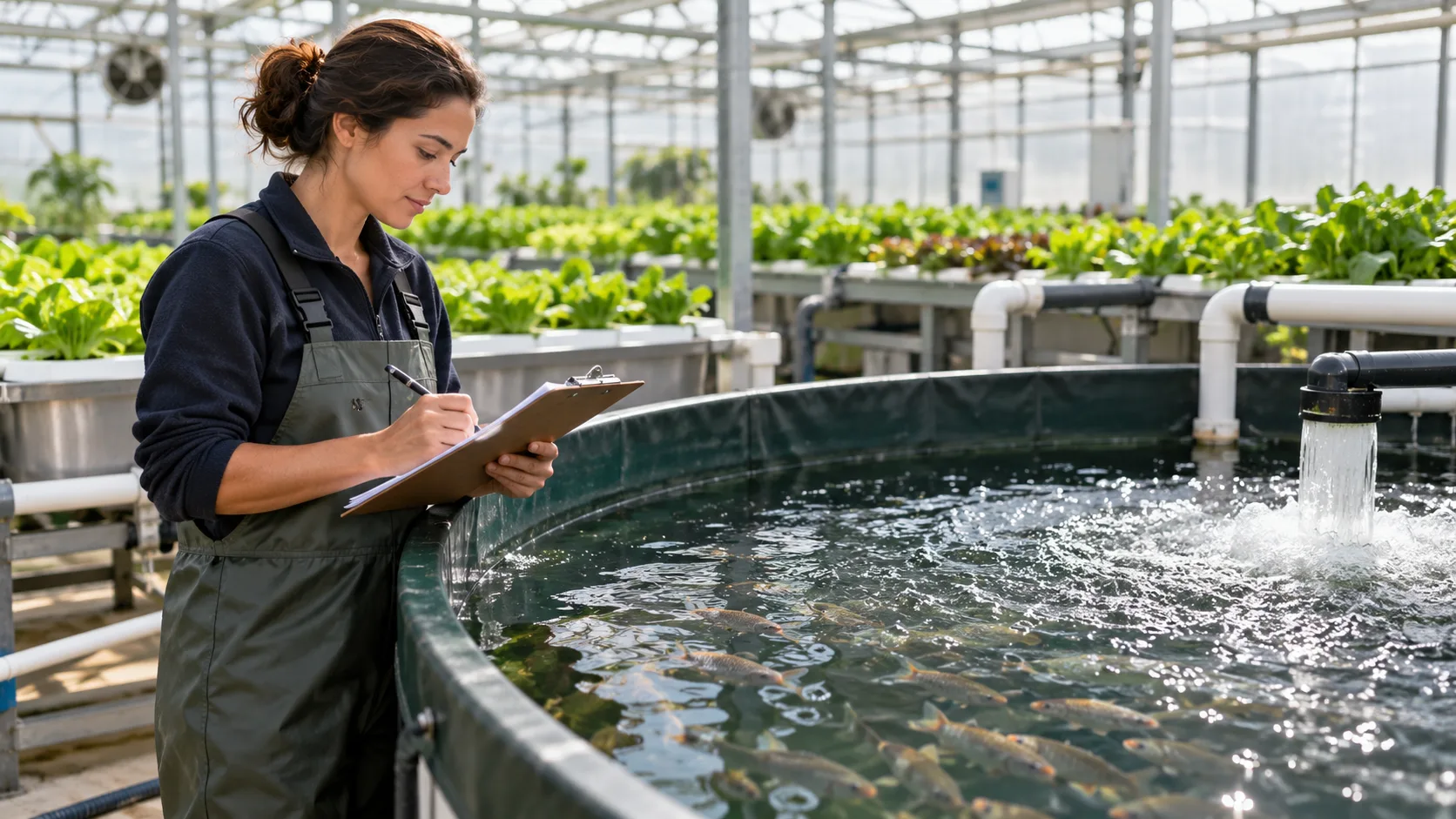
*When treatment is necessary, an isolated fish-treatment tank can reduce unnecessary crop exposure.*
Plant tolerance varies by species, cultivar, growth stage, root-zone conditions and duration. Sodium and chloride can accumulate in recirculating water. Sensitive crops may show reduced growth, marginal burn, wilting or nutrient imbalance before fish show a problem.
This is why a short separate fish treatment may be preferable to salting the full crop loop when the health professional approves it. Isolation also makes the treatment volume smaller and prevents a therapeutic concentration from circulating through plant roots.
Do not rely on evaporation to remove salt. Water evaporates while most dissolved sodium and chloride remain, so concentration can rise. Removal generally requires controlled water replacement, crop uptake of limited amounts, or separation through appropriate treatment. Discharge must comply with local requirements and should not damage soil, freshwater or sensitive vegetation.
Select a Suitable Sodium Chloride Product
Use a traceable product with chemical identity, purity, lot number and additive information. Confirm the absence or acceptability of anti-caking agents, fragrances, dyes, iodine and other ingredients for the intended aquaculture use. “Pool salt” and “aquarium salt” are marketing categories, not complete specifications.
Inspect packaging for moisture, contamination and broken seals. Store salt dry, labelled and separate from feed, magnesium sulfate, pH buffers and cleaning chemicals. During shipment inspection, reconcile the product with the approved purchasing specification rather than accepting a substitute based on appearance.
For a new facility, customer requirements should state whether a hospital or quarantine tank is included. A separate treatment vessel, dedicated aeration, accurate volume marks and controlled discharge plan can reduce the pressure to medicate the production loop.
Add Salt Through a Controlled Procedure
The following framework supports traceability; it does not replace a treatment prescription:
1. Confirm the purpose, approved target and responsible adviser.
2. Verify nitrite, chloride or salinity with the correct test.
3. Confirm actual water volume.
4. Check product identity and purity.
5. Complete and independently review the calculation.
6. Weigh the product on a suitable scale.
7. Dissolve it in clean system-compatible water according to the procedure.
8. Add the diluted solution gradually in a high-flow location without contacting fish or roots with concentrate.
9. Maintain aeration and observe fish behavior.
10. Retest after complete mixing before considering any additional salt.
Never dump crystals onto fish, biofilter media or plant roots. Do not mix concentrated salt with other treatment chemicals unless compatibility and procedure are established. Use dedicated containers and label temporary solutions.
Mid-Article CTA — Plan Fish-Side Isolation Before It Is Needed
Designing a system that needs quarantine, treatment and production continuity? Contact Us with the fish species, tank volumes, plant area, filtration plan and destination so these functions can be discussed before equipment is ordered.
Respond to Nitrite Without Treating Salt as the Fix
Salt may reduce a specific nitrite hazard, but the system still needs the cause corrected. Review:
- Recent increase in fish biomass or feed
- Incomplete cycling or loss of nitrifying bacteria
- Low dissolved oxygen
- Biofilter bypass, clogging or insufficient flow
- Water temperature or pH outside the biofilter’s operating range
- Cleaning or chemical exposure that damaged the biofilm
- Excessive solids accumulation
- Test error or unit confusion
Reduce loading only according to the facility’s fish-management procedure. Preserve circulation and aeration. Do not make several major changes at once without records, because the team will not know which action restored control.
The guide on cycling an aquaponics system explains how ammonia and nitrite should be monitored before normal fish loading. Salt is not a substitute for a commissioned biofilter.
Monitor After an Approved Addition
Record:
- Product, lot, purity and mass
- Date, time and application location
- Water volume used in the calculation
- Nitrite, chloride and salinity before and after
- Ammonia, pH, temperature and dissolved oxygen
- Fish respiration, swimming and feeding
- Plant appearance by crop and zone
- Water removed and top-up water added
- Any discharge destination
Trend the data. If salinity does not match the calculated change, investigate volume, meter calibration, mixing, leakage and calculation units before adding more. If fish continue to show distress, seek diagnosis rather than assuming the system needs a higher salt concentration.
Factory Testing and Installation Preparation
Factory testing should verify tank volume markings, valves, drain-down behavior, aeration, alarms and isolation plumbing. It cannot confirm a treatment concentration because site water chemistry, fish species and plant choices are unknown.
Before shipment, include clear component labels and drawings for quarantine or treatment circuits. Equipment should ship clean and dry; production tanks should not contain fish, water or crops during export shipment. Shipment inspection should confirm that aeration components, isolation valves, covers, sampling ports and spare parts match the packing list.
At installation, perform water-only leak testing, calibrate meters, verify tank volumes and train operators on chemical separation. Keep sodium chloride physically separate from Epsom salt so similar-looking materials are not confused during an urgent response.
Common Mistakes
Confusing NaCl with Epsom salt
They supply different ions and solve different problems. Label and store them separately.
Adding 1–3 ppt “just in case”
A broad salinity target may greatly exceed the chloride mass required for measured nitrite and may stress crops. Define the purpose first.
Ignoring background chloride
Source water and prior additions may already provide chloride. Test it before calculating.
Using EC as a salt-specific test
EC reflects all dissolved ions. It cannot separate NaCl from plant nutrients and alkalinity materials.
Treating the coupled system when isolation is possible
Some fish-health procedures use concentrations or durations unsuitable for plants. A designed treatment tank can reduce whole-system exposure.
Repeating the original amount after water loss
Evaporation changes water volume without proportionally removing salt. Recalculate from a new measurement.
FAQ
How many grams of salt are needed per litre for 1 ppt?
The theoretical increase is 1 gram of pure NaCl per litre. Correct for current salinity and product purity, and do not assume 1 ppt is an appropriate aquaponic target.
Should aquaponics always contain salt?
No. Stable systems do not automatically need routine NaCl additions. Use it only for a defined, measured purpose supported by the fish, plant and water conditions.
Can table salt be used?
Do not select a product by household name. Review purity and additives and obtain approval for the intended aquaculture use. Iodine, anti-caking agents or other ingredients may make a product unsuitable.
Does salt lower ammonia?
No. Sodium chloride does not remove ammonia or replace biological filtration. Test ammonia separately and correct loading, oxygen, flow and biofilter issues.
Can plants tolerate 1 ppt salt?
Tolerance varies widely, and long-term recirculating exposure differs from a short test. Evaluate the actual crops, duration, water chemistry and alternative of treating fish separately.
How soon should salinity be retested?
Retest after the product has fully dissolved and the entire treated volume has mixed according to the site procedure. The required time depends on circulation and tank geometry.
Can salt treat all fish diseases?
No. It is not effective for every pathogen or condition. Incorrect treatment can delay diagnosis and expose plants unnecessarily. Use qualified fish-health guidance.
Conclusion
The right sodium-chloride amount for aquaponics begins with a defined purpose and measured water chemistry. For nitrite risk, measure both nitrite and chloride and calculate the actual chloride gap. For an approved salinity target, subtract the existing salinity and calculate from actual water volume. In either case, correct for product purity and verify the result before adding more.
Because aquaponics shares water between fish and plants, the lowest-risk solution may be a separate treatment tank rather than salting the production loop. Sodium chloride should support a documented response—not replace biofilter correction, fish diagnosis or good system design.
Final CTA — Request a System With Practical Fish-Side Isolation
Planning a home, education or commercial aquaponics project? Get a Quote and send your site dimensions, fish species, crop plan, destination, utilities and quarantine requirements.