
Introduction
An aquaponics sump should be large enough to receive the maximum credible returning water without overflowing while retaining enough water to keep the pump safely submerged at the lowest operating level. It also needs usable reserve for evaporation, transpiration, maintenance and normal control variation. That requirement cannot be reduced to one universal percentage of the fish-tank volume.
A constant-flow raft or NFT system may have small level changes. A flood-and-drain installation can send substantial water back to the sump, especially if several siphons discharge together or a shutdown drains elevated pipework. Equal fish-tank capacity therefore does not imply equal sump size.
This guide provides a transparent sizing process for home, educational and commercial inquiries. It helps buyers prepare an RFQ and challenge an unexplained supplier number. Final tank structure, overflow, electrical protection and hydraulic design should still be checked for the actual site by qualified local professionals.
The Short Answer
Determine four volumes:
1. The maximum drain-back volume that can reach the sump during normal cycles, shutdown or a credible fault.
2. The minimum retained volume needed above the pump inlet to prevent vortexing, air entrainment, overheating or dry running.
3. A water-loss and operating allowance for evaporation, plant transpiration, filter cleaning, sampling and control variation between top-ups.
4. A freeboard and uncertainty allowance so the highest credible level remains below the overflow or rim.
The sump’s total physical capacity must accommodate all four without relying on an operator to watch the level continuously. The normal operating level should sit between a marked minimum and maximum, not at the rim and not just above the pump.
What a Sump Does
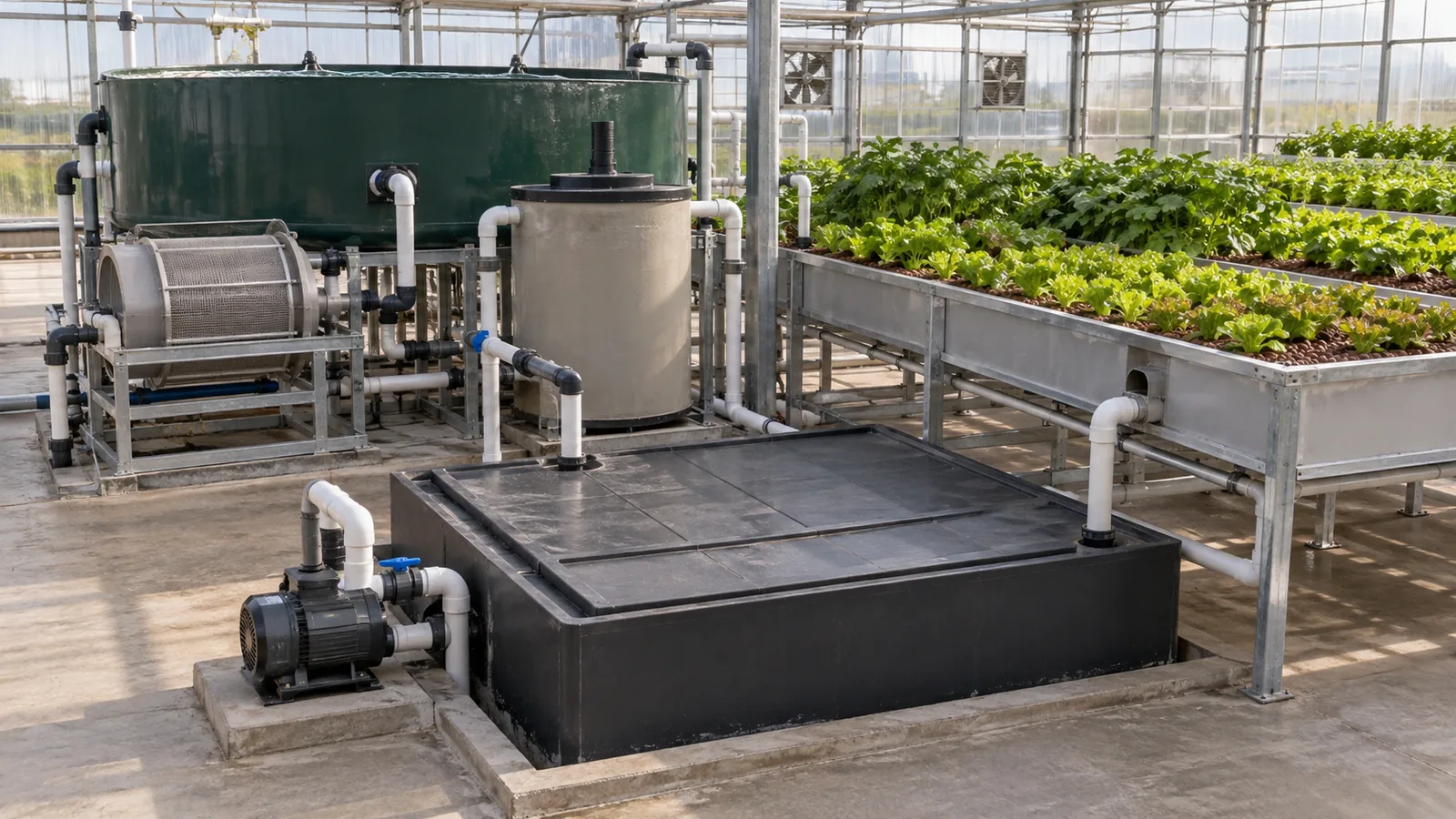
The sump is normally the lowest hydraulic point in a recirculating aquaponics loop. Water returns to it by gravity, and a pump sends water back to a higher component. In a CHOP or CHIFT-PIST arrangement, this allows the fish tank to remain at a comparatively constant level while changes caused by grow-bed cycles and water loss appear in the sump.
The sump may also provide a sampling point. It is not automatically a solids separator, quarantine tank or safe chemical-mixing vessel; those functions require their own design. The article on designing an aquaponics system provides the broader process-flow context.
Kentucky State University’s *Aquaponics Production Manual*, preserved in FarmHub’s structure-and-design resource, describes the sump as the lowest collection and redistribution point. It also notes that media can displace much of a grow bed’s apparent volume and that fish tanks or sumps must be sized to avoid pump dry-running and overflow during flood-and-drain cycles.
Clemson Cooperative Extension’s system-layout publication provides an independent component-planning reference. Use such layouts to identify every vessel and flow path, then calculate the site-specific sump envelope rather than copying the capacity shown in an example system.
Do All Aquaponics Systems Need a Sump?
No. A small fish-tank-and-grow-bed system may pump directly from the fish tank and return water to it. Some layouts use another process vessel as the low collection point. However, the absence of a sump transfers level fluctuation and pump risk somewhere else; it does not remove the hydraulic volume balance.
A dedicated sump becomes useful when the design needs:
- a constant fish-tank water level;
- one low pump serving several gravity-return components;
- flood-and-drain beds whose water volume changes cyclically;
- a visible point for make-up water and low-level protection;
- isolation or expansion that would otherwise make the fish tank fluctuate;
- separation between livestock space and pump access.
The decision should follow a process-flow drawing. Do not add a sump simply because a diagram online includes one, and do not remove it from a supplier design without understanding where the displaced water will go.
The Four-Volume Sizing Method
1. Calculate maximum normal drain-back
List every component that can send water to the sump faster than the pump removes it. For flood-and-drain media beds, determine the actual water held between the high and low cycle levels after media displacement—not the full outside volume of the bed. Use manufacturer data for the chosen media or measure a representative filled bed.
If several beds use bell siphons, do not assume they will always drain one at a time. Independent siphons can synchronize as flow or maintenance conditions change. Use the maximum credible simultaneous discharge unless the control system positively sequences beds and its failure behavior has been evaluated.
For timed flood-and-drain systems, include any water that returns when valves or pumps stop. For constant-flood beds, DWC troughs and NFT channels, normal level variation may be smaller, but return pipes and distribution headers still contain water that may drain down.
2. Calculate shutdown drain-down
Turn off the circulation pump in the design calculation and trace what happens. Water above each overflow or standpipe level may continue moving. Elevated pipes can siphon backward unless a deliberate, maintained break prevents it. Filters, degassing columns, tower planters and long supply lines may release stored water.
The correct shutdown volume is established from elevations and component geometry, then verified during filled-water commissioning. A check valve should not be treated as the only protection against overflow; debris and wear can prevent it from sealing. A physical high point, air gap, anti-siphon feature or protected overflow can provide more observable control where appropriate.
3. Protect the pump at minimum level
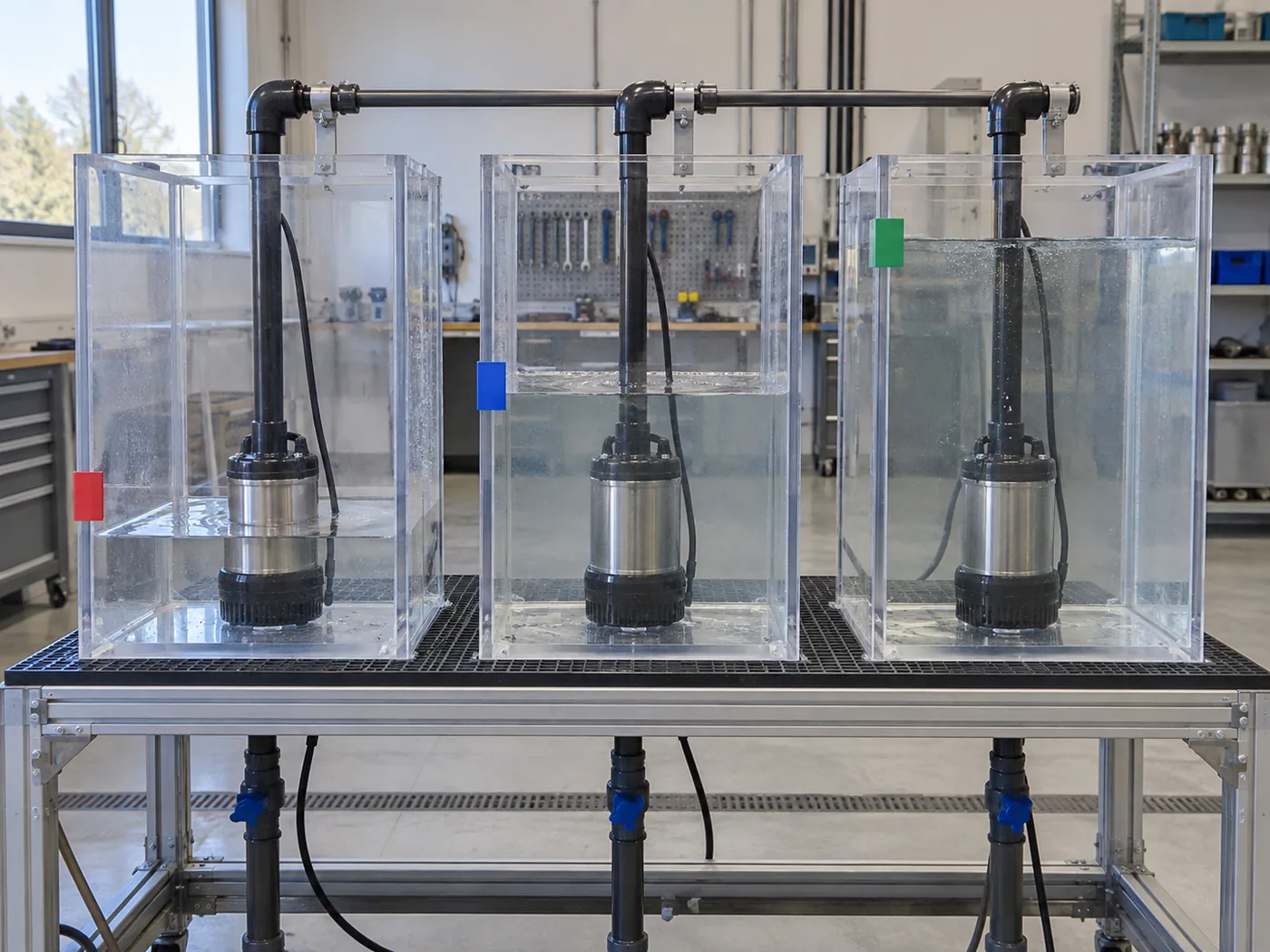
The pump cannot use every litre in the sump. A submersible pump needs the manufacturer’s minimum immersion and service clearance. An external pump needs a flooded, well-designed suction or another approved priming arrangement. Both can draw air if the inlet creates a vortex or if return flow temporarily falls.
Define the lowest permitted operating level above the inlet and mark it on the tank. Include level-sensor location, pump heat, inlet screen, sediment clearance and the volume that remains inaccessible below the pump. For pump selection based on flow and head, see Do You Need a Pump for an Aquaponics System?.
4. Add loss allowance and freeboard
Between top-ups, water leaves through evaporation, plant transpiration, sludge removal, sampling, harvest handling, splash and small leaks. Estimate the expected interval between inspections or automatic make-up events under the worst normal season, then provide usable operating volume above the pump minimum.
At the other end, keep freeboard above the highest calculated water level. Freeboard is empty capacity reserved for wave action, control tolerance, measurement error and uncertainty; it is not normal working volume. Route a protected overflow to a lawful, visible location that will not flood electrical equipment, foundations or public walkways.
A Worked Example
Consider a hypothetical small greenhouse with four media beds and one sump. This is an illustration, not a design prescription.
- Each filled bed holds an estimated 90 L between its low and high water levels after media displacement.
- The design assumes all four beds could drain together: 4 × 90 L = 360 L.
- Elevated pipes and filters can add 70 L during pump shutdown.
- The pump and inlet arrangement require 140 L to remain above the marked minimum.
- The operating allowance between planned top-ups is 120 L.
- The designer reserves 110 L of freeboard and uncertainty capacity.
The resulting physical capacity is:
`360 + 70 + 140 + 120 + 110 = 800 L`
An 800 L nominal tank is not automatically adequate. “Nominal” capacity may be measured to the rim, while fittings, rounded corners and the required freeboard reduce usable capacity. The team should select a commercially available tank whose documented geometry provides at least the calculated operating envelope, then validate the actual levels during commissioning.
| Level condition | Example water volume | Purpose |
|---|---|---|
| Minimum retained volume | 140 L | Keeps the pump safely supplied |
| Normal operating band | 120 L | Covers planned water loss between top-ups |
| Maximum drain-back | 430 L | Four beds plus pipe/filter shutdown return |
| Reserved freeboard | 110 L | Prevents normal maximum from reaching the rim |
| Illustrative total | 800 L | Starting point before selecting actual tank geometry |
This method also reveals where design changes help. Sequencing beds may reduce normal peak return, but only if controls and failure modes are dependable. Lowering unnecessary pipe volume may reduce shutdown return. A larger sump may be simpler and safer than adding complex control to save a small floor area.
Flood-and-Drain Systems Need Special Attention
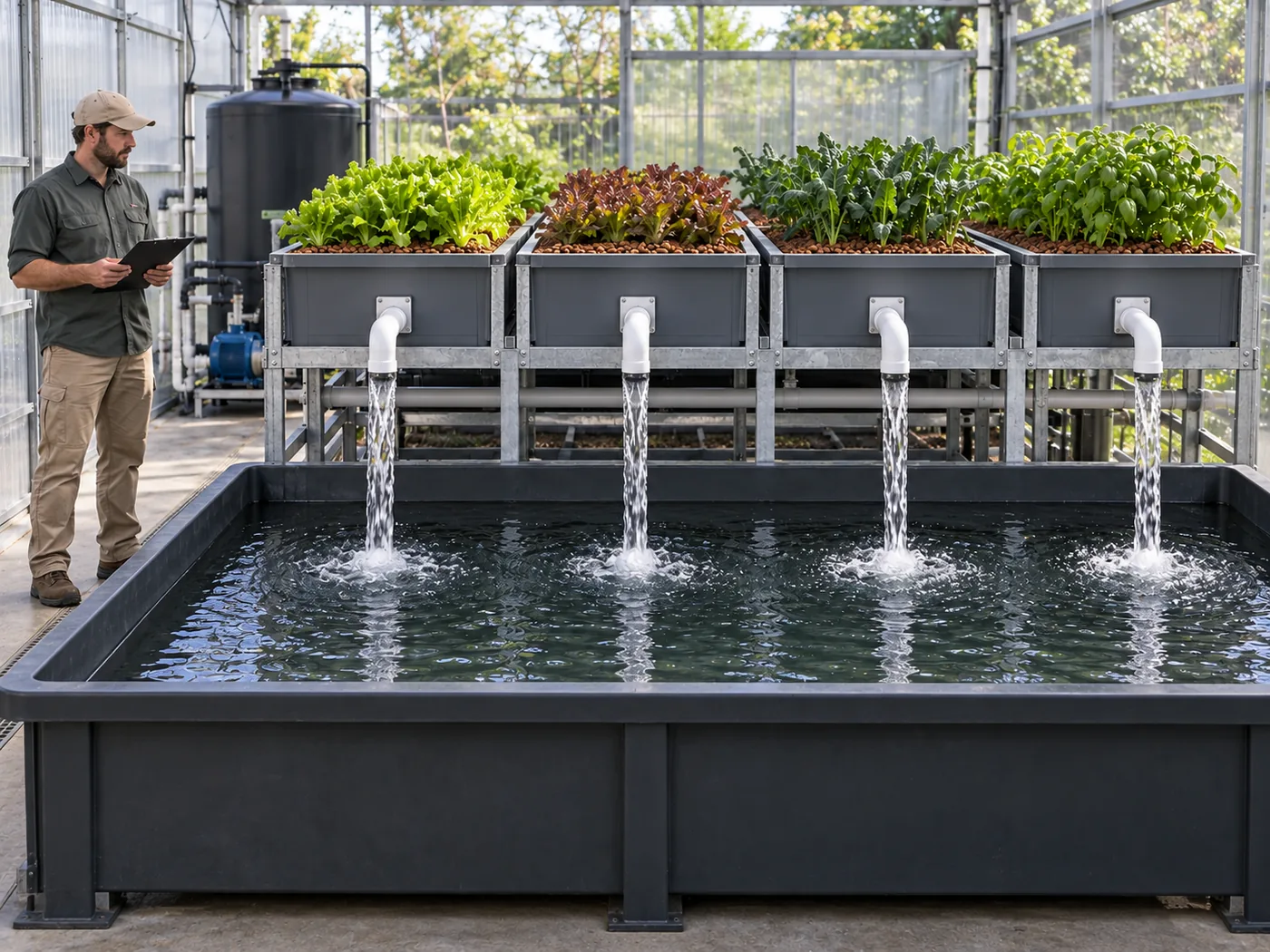
Flood-and-drain media beds are the most common reason a home system underestimates sump size. The external bed volume is not the flood volume because media displaces water. Conversely, the volume returned is not always the same as the pump-on addition because part of the bed remains wet below the drain level.
Measure one representative bed after media is installed. Mark the sump level, operate the bed through a complete cycle and record the change under controlled conditions. Repeat after roots develop and after the plumbing has settled, because drain behavior can change. If siphons are used, test staggered and simultaneous discharges. Do not manually “tune” the test to produce the desired answer.
Plant beds and sumps must also be considered together when the system expands. An added bed changes both the water demand and the return peak. The existing fish tank may appear large enough while the sump and pump operating band are no longer safe. Our guide on scaling up a home aquaponics system discusses why expansion should be treated as a new design condition.
Constant-Flood, DWC and NFT Systems
Constant-flood media beds
Once filled, a constant-flood bed may have little cyclical level change. Shutdown can still return water from supply pipes and any section above the standpipe level. Confirm whether the bed stays full during an outage or drains through the pump line.
DWC or floating raft troughs
DWC contains a large stable water volume, but that entire volume should not normally drain into the sump. Overflow elevations and isolation valves should preserve the trough’s operating level. Calculate water released from pipework, filters and any intentionally drainable zone. If the entire trough can empty after one fitting failure, tank containment and floor drainage—not just sump size—must address the event.
NFT and vertical growing systems
NFT channels hold less water than DWC, but many channels and long headers can create a meaningful drain-down volume. Tower planters can empty rapidly after power loss. Include the full wetted network above the sump and protect returns from blockage or splash.
Tank Shape, Material and Installation
Capacity alone does not make a good sump. A shallow tank increases evaporation area; a tall tank may put equipment beyond safe reach. Select an opaque, UV-suitable, aquaculture-compatible material and avoid unidentified recycled containers. Use a removable cover that blocks debris and light without becoming a work platform. Check floor loading and burial conditions; an empty buried tank can float or deform when groundwater rises.
Locate unions, valves, sensors and pump lifting points where they can be serviced without entering a confined space or leaning over an unsafe opening. The long-lasting aquaponics plumbing materials guide can support material discussions, but final fittings must match the specific tank and local standards.
Level Controls, Make-Up Water and Alarms
An automatic top-up valve can maintain the operating band, but it can also hide a leak or introduce unsuitable source water. Meter additions, alert on abnormal volume and verify source-water compatibility.
Use separate high- and low-level protections where consequences justify them. A low-level switch may stop the circulation pump before damage; that shutdown also interrupts life support, so the alarm and emergency aeration response must be clear. A high-level alarm can warn of blocked returns or excessive top-up. Sensors should be accessible for cleaning and tested through the actual control logic.
Place the top-up valve and sensor away from the pump vortex. Label minimum, normal and maximum levels on the tank and in the manual.
Mid-article CTA — Request a Hydraulic Information Checklist
Preparing a sump and pump inquiry? Send YAFAN your component volumes, bed cycles, elevations, pipe layout and destination. We can help organize the information a supplier needs before quoting.
Factory Testing and Shipment Inspection
Factory testing can verify a supplied pump, control panel, level switches and alarms when the agreed assembly permits. It cannot prove the final sump operating range without the site’s actual pipe elevations, grow beds, filters and return routes. State which tests occur at the factory and which must be repeated after installation.
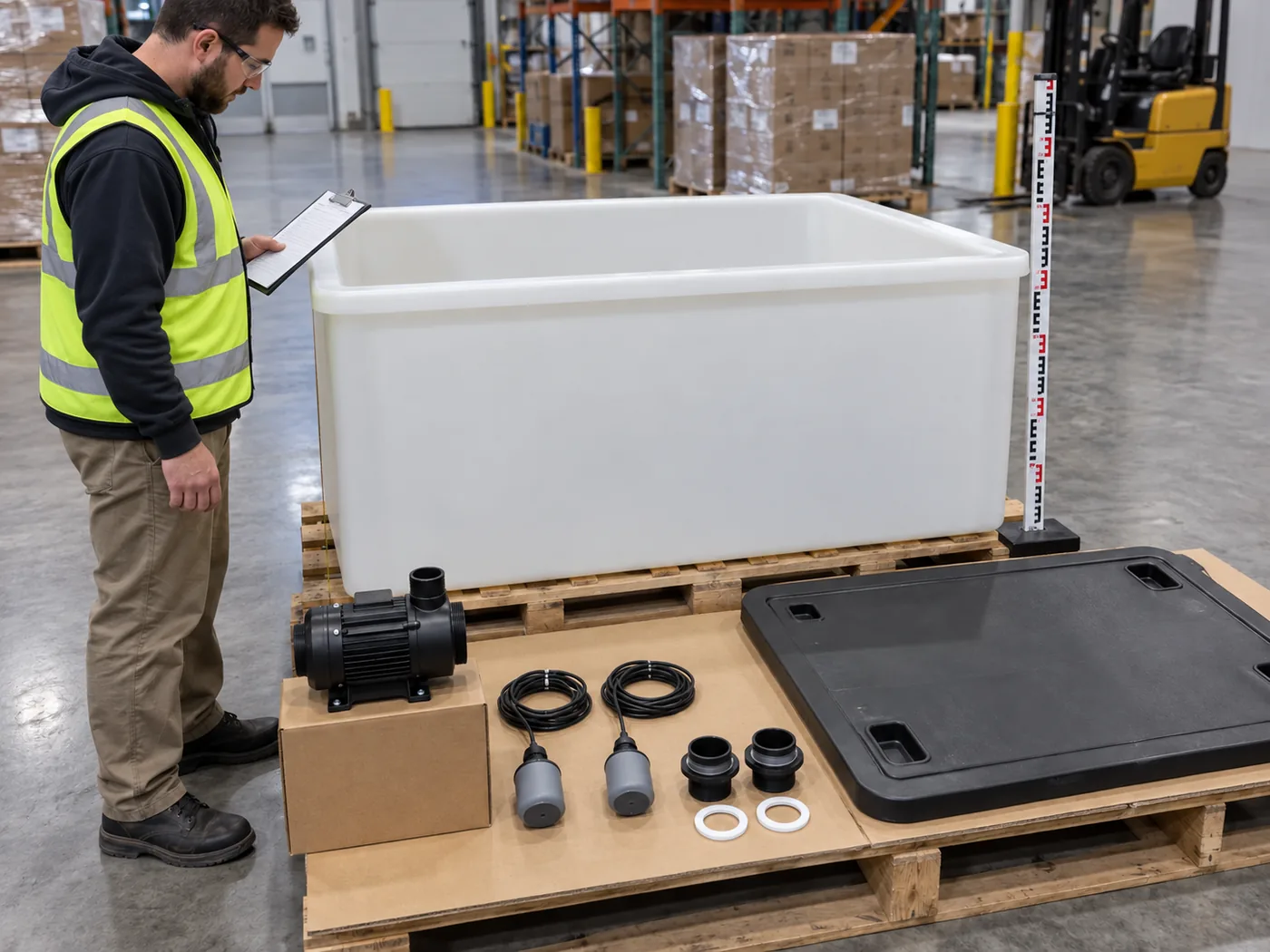
During shipment inspection, confirm tank model, dimensions, wall condition, fittings, bulkheads, covers, pump, sensors and spare seals against the approved list. Tanks and aquaponics equipment in a shipping container must be dry and empty—without fish, water or growing crops. Protect tank walls and rims from straps or components that can distort them in transit.
At site acceptance, fill in controlled stages, inspect leaks and test:
1. Normal operating level with all zones running.
2. The lowest level during the most demanding cycle.
3. Simultaneous media-bed discharge where credible.
4. Pump-off drain-down.
5. Restart and pump priming behavior.
6. High- and low-level alarms.
7. Top-up shutoff and abnormal-use indication.
8. The emergency overflow route.
Record the resulting levels and photograph the marked tank for future operators.
Common Sump-Sizing Mistakes
Using a percentage of fish-tank volume
Fish-tank size does not describe how much water the plant beds and pipes release. Use the hydraulic volume balance.
Calculating from empty grow-bed dimensions
Media displacement changes the water held between cycle levels. Measure or use verified material data.
Assuming siphons remain staggered
Flow changes can cause independent siphons to synchronize. Test the credible simultaneous return.
Filling the sump to the top
A full sump has no room for shutdown water. Establish a normal maximum below the emergency overflow.
Ignoring the minimum pump volume
The bottom portion of the sump is not freely usable if the pump needs immersion, inlet clearance or vortex protection.
Adding a larger tank without checking access
A tank that cannot be delivered through the door, safely supported or serviced is not an effective solution. Confirm dimensions and route before shipment.
FAQ
Can a sump tank be too large?
A larger sump generally provides level stability and reserve, but it costs more, occupies space and adds water weight and conditioning volume. Oversizing should solve a documented need rather than compensate for an undefined layout.
Should the sump equal the fish-tank volume?
Not necessarily. Sump capacity is driven by drain-back, pump minimum, water-loss allowance and freeboard. Two systems with equal fish tanks can need different sumps.
Where should the sump be located?
It is normally at the lowest hydraulic point so water can return by gravity. Its location must also support safe access, drainage, structural loading, electrical protection and delivery installation.
Can I put fish in the sump?
Routine fish holding is usually undesirable because the sump level changes and contains pump and sensor hazards. Temporary use requires appropriate oxygen, water depth, screening, access and welfare planning.
Should an aquaponics sump be covered?
An opaque removable cover can reduce debris, algae, accidental access and some evaporation. It must preserve gas exchange, inspection, cable and pipe access, and safe removal.
How much freeboard should I leave?
There is no universal number. Reserve enough empty capacity above the highest calculated and tested level for uncertainty, transient return and safe overflow behavior. Document the final maximum mark after commissioning.
Conclusion
The right aquaponics sump size is a hydraulic result, not a percentage selected from tank volume alone. Add maximum credible drain-back, minimum pump-retention volume, the operating allowance between top-ups and reserved freeboard. Then select a real tank whose usable geometry—not just catalogue capacity—meets that envelope.
A conservative sump with clear level marks, accessible equipment, metered make-up water and tested shutdown behavior protects the pump, stabilizes the fish tank and gives operators time to respond. Verify the calculations during filled-water commissioning before fish or full crop load is introduced.
Final CTA — Send Your System Requirements
Contact YAFAN with your fish-tank volume, grow-bed type, number of beds, planned operating sequence, pump data, site dimensions and country. We can help prepare a clearer equipment inquiry and installation-preparation checklist.

