
Introduction
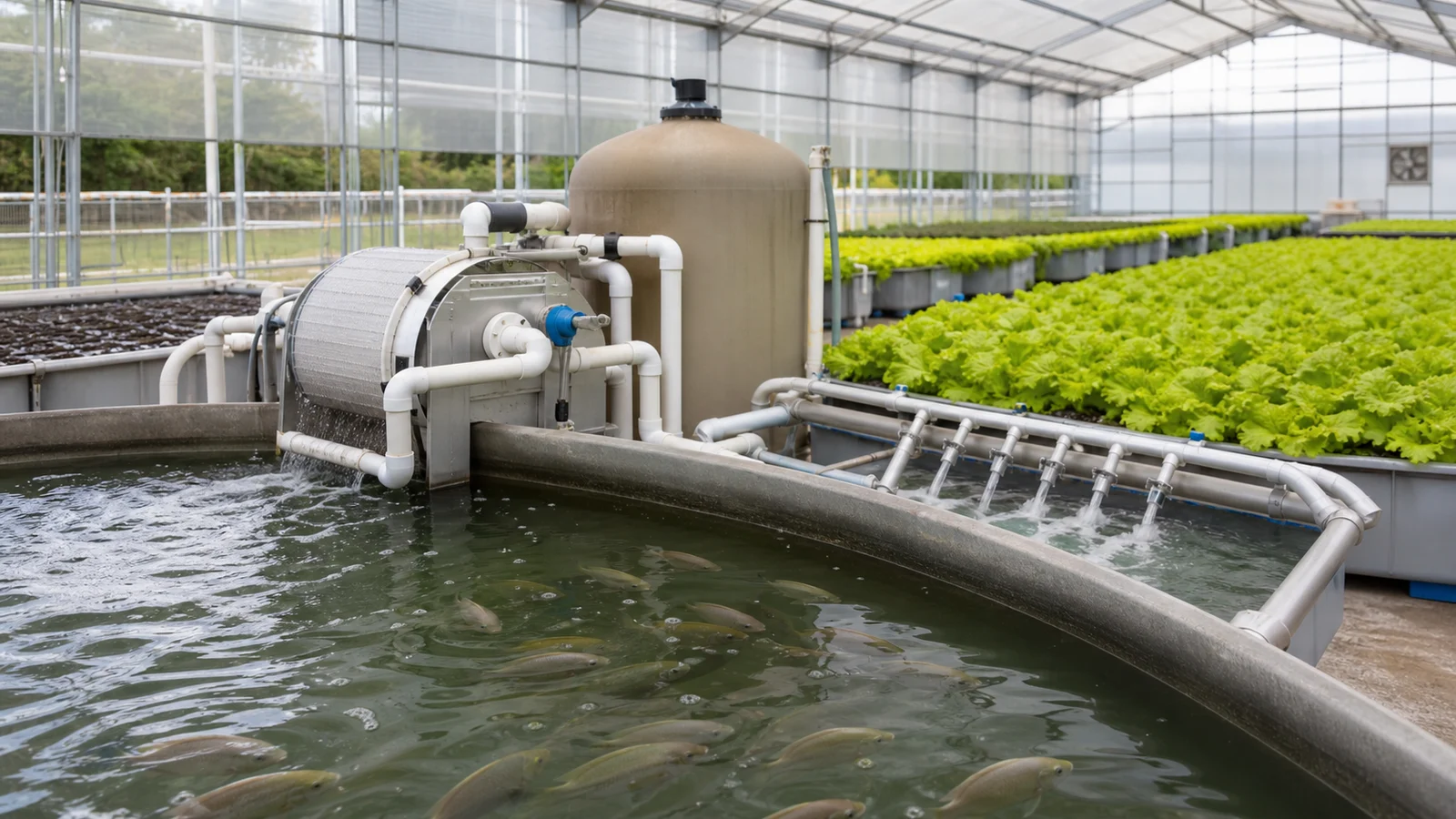
Aquaponics is a food-production system that combines recirculating aquaculture (raising fish in managed water) with soilless plant production. Fish feed creates waste; microorganisms convert part of that waste into forms plants can use; plants and filters help clean the water before it returns to the fish. It is not simply “fish water used to water vegetables.” It is a living water-management system whose fish, plants, bacteria, equipment and operator routines must stay in balance.
This distinction matters to a homeowner considering a learning project and to a farm, school or greenhouse developer comparing equipment. Aquaponics can be an engaging way to grow leafy crops and raise aquatic animals in one managed loop, but it does not remove the need for testing, feeding, cleaning, climate management or local compliance. The Food and Agriculture Organization of the United Nations (FAO) describes aquaponics as the integration of recirculating aquaculture and hydroponics and treats the nitrogen cycle, water quality and system balance as core design subjects—not optional add-ons. FAO’s technical manual is a useful starting point.
This guide explains the definition, the biological relationship, common system formats and the practical questions to answer before you buy or build anything.
Aquaponics, Explained in Plain English
An aquaponics system contains three living groups: aquatic animals, plants and beneficial microorganisms. Water circulates between the areas that support them. Fish are the most common aquatic animal in commercial and hobby examples, although species selection must follow local law, temperature and the purpose of the project.
The basic process is straightforward:
1. Fish are fed and produce solid and dissolved waste.
2. Mechanical treatment removes or manages solids, depending on the design.
3. Nitrifying microorganisms convert ammonia first to nitrite and then to nitrate.
4. Plants take up nitrate and other available nutrients while their roots sit in or receive the circulating water.
5. Treated water is aerated and returned to the fish tank.
The simplicity of that explanation should not hide the operating work. Fish require suitable oxygen, temperature, feed and health management. Bacteria require stable conditions and time to colonize. Plants need light, suitable temperature, root-zone oxygen and enough available nutrients. If one group is stressed, the other two do not automatically compensate.
Why the Nitrogen Cycle Matters
From feed to plant-available nitrogen
Fish do not convert all feed into growth. Some becomes waste, including ammonia compounds in the water. At harmful concentrations, ammonia can stress fish. In an established system, nitrifying microorganisms living on wetted surfaces and biofilter media oxidize ammonia to nitrite and then nitrate. Nitrate is generally less toxic to fish at ordinary operating levels and is useful to plants as a nitrogen source.
Texas A&M AgriLife Extension likewise identifies nitrifying bacteria as the crucial biological link in a recirculating fish-and-plant system. Its aquaponics overview helps explain why fish, bacteria and plants must be considered as one managed process rather than as separate add-ons.
What plants do—and do not do
Plants are not a universal filter. They can take up dissolved nutrients, but they cannot reliably handle a sudden feed increase, a blocked pipe or an oxygen failure. They also do not eliminate the need for solids management. In many designs, a solids filter, settling device, mineralization process, media bed or a combination of these handles particles before water reaches sensitive components such as pumps, channels or raft beds.
For a buyer, the useful question is not “Does the system have plants?” It is “How does this proposal remove solids, provide biofiltration, deliver aeration and make every component accessible for inspection and cleaning?” A labelled process-flow drawing is more valuable than a generic greenhouse photo.
What Equipment Is Usually Included?
The exact equipment changes with the scale and growing method, but a well-explained system commonly includes the following zones.
Fish tank and circulation
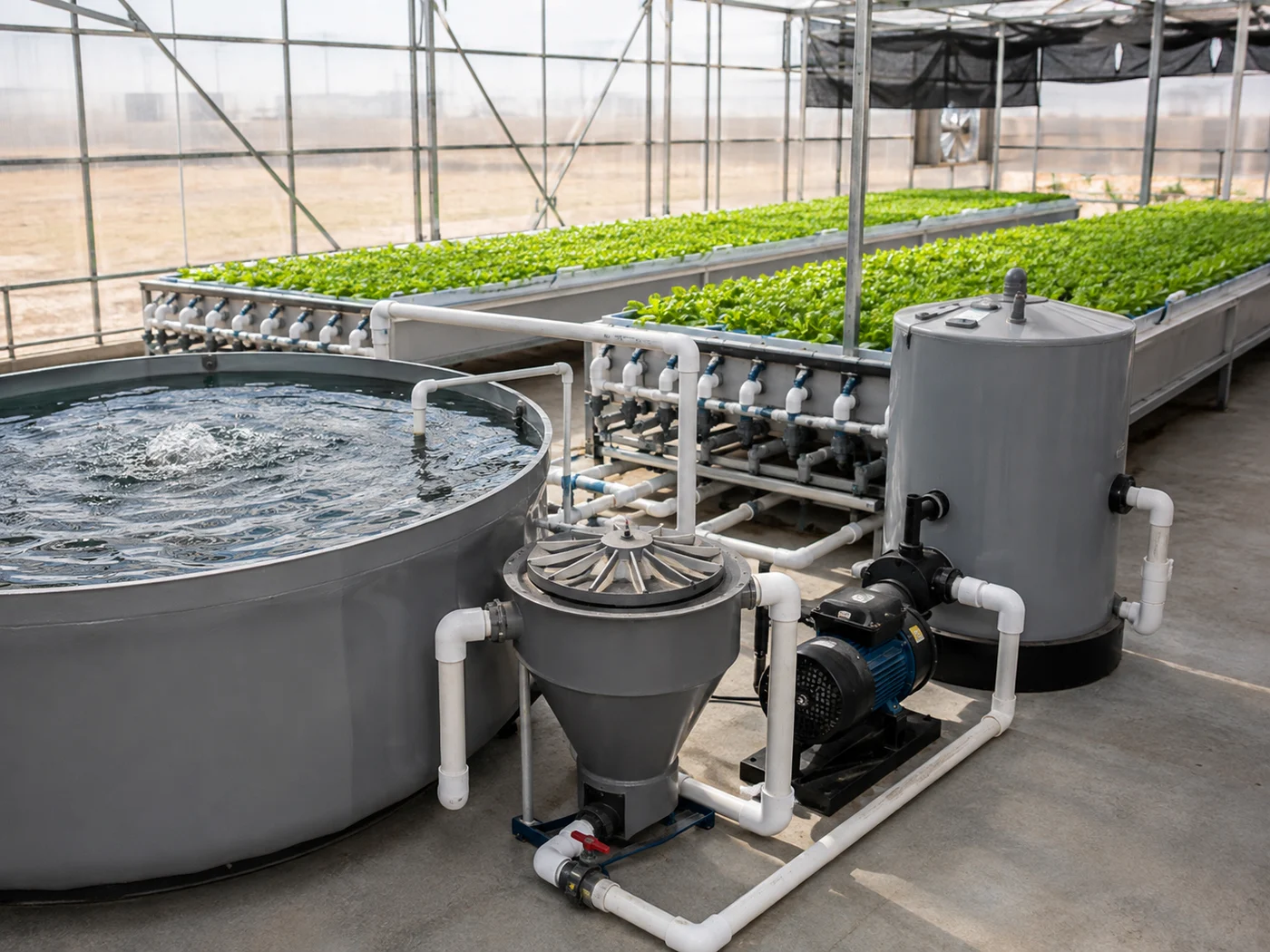
The tank holds the fish and usually includes a drain, overflow path, aeration points and pipe connections. The pump moves water through the treatment and plant zones. The right tank material, drain arrangement and pump duty depend on the application; tank volume alone does not define system capacity or expected crop output.
Solids management and biofiltration
Solids can affect water quality, block small channels and create maintenance burdens if neglected. A system may use a radial-flow separator, screen, settling stage, media bed or another approach appropriate to its hydraulic design. Biofilter media provides a high-surface-area home for microorganisms. In media-bed systems, the growing media can provide some filtration and biological surface area, but it still needs a cleaning routine to avoid clogging.
Plant-growing area
The three common formats are media beds, deep-water culture (DWC or raft culture) and nutrient film technique (NFT). Media beds are often approachable for small learning systems and versatile crops. DWC is commonly used for leafy-green workflows when solids control and aeration are sound. NFT uses shallow flowing channels and needs carefully treated water because fine solids and roots can restrict flow. A project may also use a hybrid design.
Aeration, testing and safety equipment
Air pumps or blowers, diffusers, valves, plumbing and test equipment are fundamental, not decorative extras. A practical starter set normally includes ways to observe temperature, pH and nitrogen compounds; more demanding projects may also use a dissolved-oxygen meter, alarms and backup-power planning. Electrical work and any safety protection must meet local requirements.
Mid-article CTA — Ask for a System Overview
Not sure which system format matches your site? Send YAFAN your available space, country, intended crops and project purpose. We can help you separate a learning kit, a modular system and a commercial equipment inquiry before a quotation is prepared.
What Can You Grow and Raise?
Leafy greens and herbs are common starting crops because their nutrient demands are usually more compatible with a young or modestly loaded system than those of fruiting crops. Lettuce, basil, leafy Asian greens and herbs are common examples, although climate, variety, seedling quality and market requirements still matter. Tomatoes, cucumbers and peppers may be possible in suitable systems, but they often require more nutrient management, crop support and operational attention. Do not assume fish feed alone will satisfy every nutrient need throughout every crop cycle.
Fish selection is equally local. Tilapia appears frequently in educational material because it tolerates warm conditions well, but availability and legal restrictions vary. Some regions use catfish, trout, carp or ornamental fish; each choice affects water temperature, stocking plans, handling and permits. Confirm local aquaculture rules before purchase or transport. Match the species to the climate and to the level of care the team can provide, rather than selecting fish only because they appear in an online video.
What Aquaponics Is Not
Aquaponics is often described with claims that are too broad to guide a real project. A credible plan avoids the following shortcuts:
- It is not maintenance-free. Feeding, observation, water tests, cleaning and recordkeeping are routine operating tasks.
- It is not automatically organic. Certification and input rules vary by country and programme; check the applicable standard rather than assuming a growing method creates a label claim.
- It is not a guaranteed business model. Crop prices, energy, labour, fish survival, seedling supply, packaging, market access and local regulation all affect viability.
- It is not a replacement for site design. Power, drainage, water source, greenhouse climate, service access and unloading routes matter before equipment is ordered.
- It is not a closed system forever. Water can be lost through evaporation, transpiration, splashing and maintenance; make-up water quality must be checked.
These limitations do not make aquaponics less interesting. They make a first project safer to scope and easier to operate responsibly.
When Does Aquaponics Make Sense?
Aquaponics can suit several applications. A school may value a visible ecosystem for science lessons. A restaurant or community project may value local demonstration and education. A greenhouse operator may evaluate it as one production model within a larger crop and market plan. A distributor may need modular equipment that is easy to ship, inspect and support locally.
The strongest fit occurs when the project has a clear purpose, a suitable site and an accountable operator. Before proceeding, document these basics: who will run daily checks; which crops and fish are permitted and realistic; what the water source contains; how outages are handled; and whether the project is for education, demonstration, household use or commercial sales. That short brief prevents a supplier from guessing at requirements.
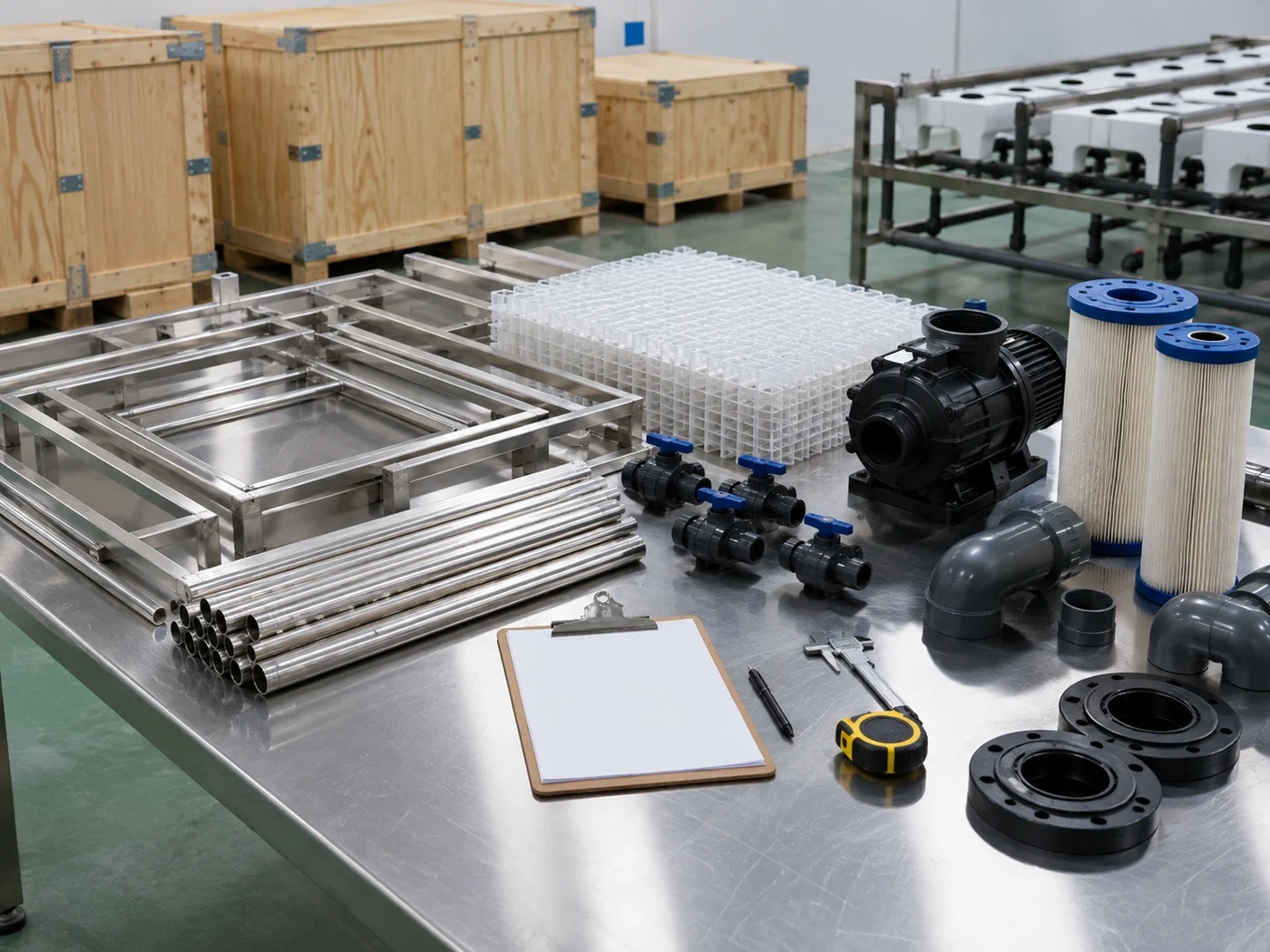
For equipment procurement, ask to see the configuration before shipment: a process-flow diagram, itemized equipment list, electrical standard, packing list and installation sequence. A factory fit-up or shipment inspection can confirm the agreed components, labelling and package count where it is included in the purchase scope. It cannot replace final leak testing, electrical verification or biological start-up at the destination.
Frequently Asked Questions
Is aquaponics the same as hydroponics?
No. Hydroponics grows plants without soil, usually using a nutrient solution prepared for the crop. Aquaponics combines soilless plant production with recirculating aquaculture. Fish feed and biological conversion contribute nutrients, which creates a shared management challenge across fish, plants and microorganisms.
Does aquaponics use soil?
Plant roots do not grow in field soil. They may grow in inert media, on floating rafts or in channels, depending on the system. The system still needs hygienic handling, crop protection and cleaning practices.
Is aquaponics suitable for beginners?
It can be, if the beginner starts with a modest, observable system and commits to routine testing and recordkeeping. Begin with crops and species that suit the local climate, and do not stock fish heavily before the biofilter has matured.
How much water does an aquaponics system use?
It recirculates water, but it needs make-up water for evaporation, plant transpiration, maintenance and occasional management actions. Water savings depend on design, climate, crop, leaks and operation; avoid fixed percentage claims without site-specific measurement.
Can I buy only aquaponics components?
Yes. Buyers may source tanks, grow beds, filtration, pumps, aeration components, fittings or a complete system. Share existing dimensions, pipe sizes, electrical standard and intended use so compatibility can be assessed.
Conclusion
Aquaponics is a managed partnership between fish, plants, microorganisms and equipment. Its appeal comes from that integration: one water loop can support aquatic and plant production when it is designed, monitored and maintained as a whole. Its challenge comes from the same integration: fish health, water quality and crop performance cannot be treated as separate jobs.
For a first project, start with the definition and then move to the operating details: water source, local rules, crop choice, fish choice, growing method, testing routine and site readiness. The next guide, How Does an Aquaponics System Work?, explains the water loop and control points in greater detail.
Final CTA — Discuss Your Aquaponics Requirements
Share your application, available space, destination country and intended crops. Contact YAFAN to request product information or a preliminary system discussion.

