
Introduction
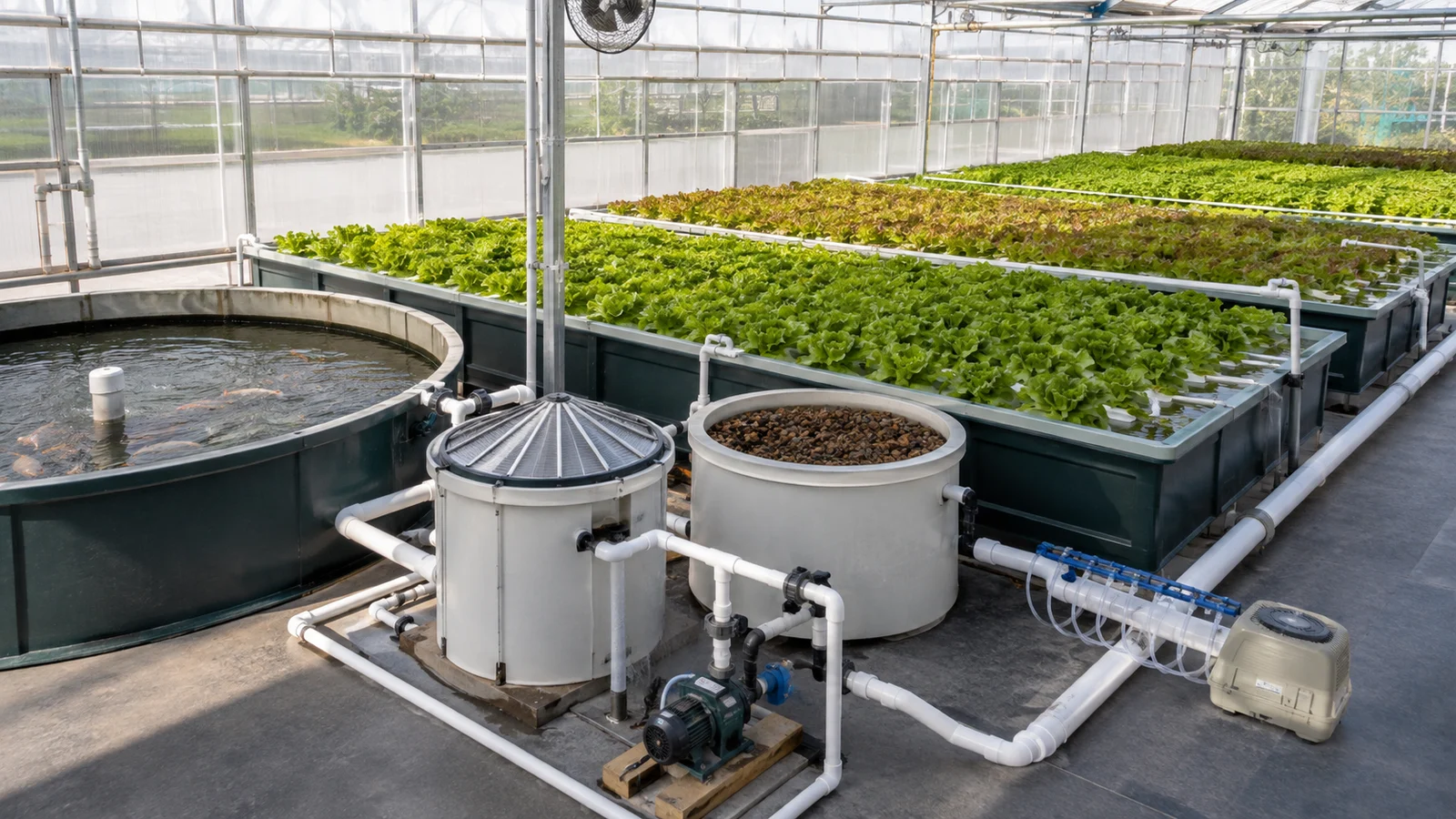
An aquaponics system works by continuously moving water through fish culture, solids management, biological filtration and plant-growing areas. Fish feed supplies nutrients; bacteria convert ammonia into nitrate; plants use some dissolved nutrients; aeration and circulation keep the system viable for fish, roots and microbes. The loop is simple to sketch, but reliable operation depends on flow rates, oxygen, water chemistry, maintenance access and the person reading the results.
This article answers the “how does it work?” question at the process level. It is not a design guarantee or stocking prescription. Exact tank size, pipe diameter, filter capacity, plant area and backup equipment must be set against the selected fish species, feed rate, crop plan, water source, climate and local requirements. For an introduction to the overall concept, read What Is Aquaponics?.
The Aquaponics Water Loop, Step by Step
1. Fish are fed in a managed tank
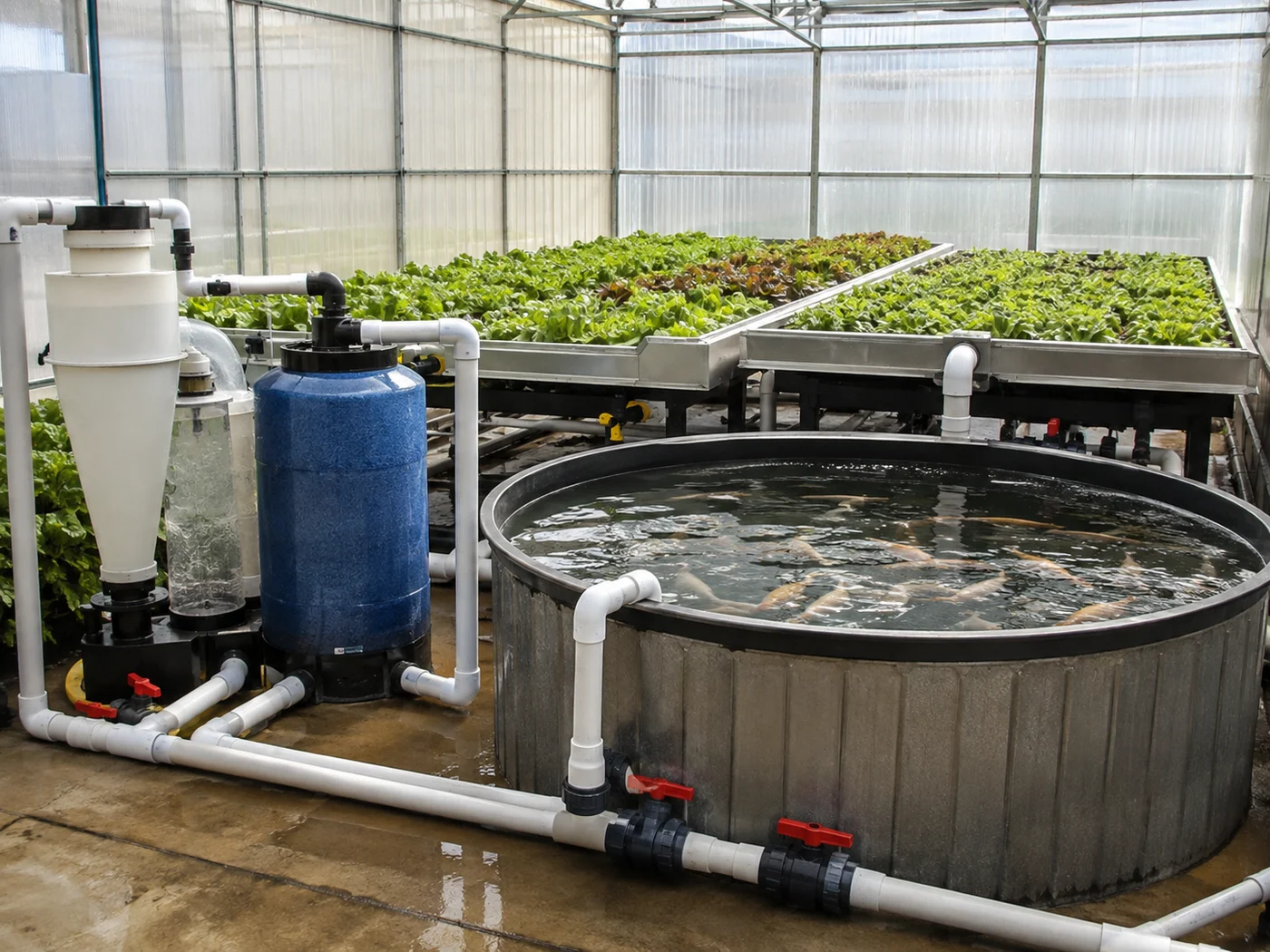
The fish tank is the nutrient source and a critical animal-welfare zone. Feed not converted to fish growth becomes solid waste and dissolved nitrogen compounds. The tank needs circulation, oxygen transfer, safe drainage and access for observation and cleaning. Tank shape, stocking level and drain arrangement influence how solids move toward removal equipment.
The operator’s daily observation matters as much as hardware: feeding response, unusual behaviour, water appearance, equipment noise and water temperature can reveal a problem before a laboratory result does. Any fish species must be lawful, available and suited to the local temperature range.
2. Solids are removed or managed
Particles can collect in pipes, pumps and plant roots. Depending on the design, water may pass through a settling chamber, radial-flow separator, screen filter, swirl device, mineralization stage or media bed. The purpose is to prevent excessive solids from accumulating where they restrict flow or create unwanted low-oxygen zones.
There is no universal “best filter.” The appropriate equipment depends on fish biomass, feed input, growing method, hydraulic flow and the team’s ability to clean it. A DWC or NFT area normally needs especially well-managed solids because roots and channels are sensitive to clogging. In a media-bed layout, the media may capture solids, but that convenience creates a periodic cleaning responsibility.
3. Beneficial bacteria process nitrogen
The biological heart of the system is nitrification. Microorganisms colonize biofilter media, pipes, tank walls and other wet surfaces. They convert ammonia to nitrite, then nitrite to nitrate. This does not happen instantly in a new system; it develops as the biofilter cycles and stable conditions are maintained.
Clemson Cooperative Extension explains that a productive biofilter depends on water flow, adequate surface area for bacteria and dissolved oxygen. Its system-layout and components guide is particularly useful when reviewing how filtration equipment is expected to support the nitrogen-conversion process.
4. Plants receive circulating nutrient water
Plant roots are placed in media beds, DWC rafts or NFT channels. They take up nitrate and other available minerals, helping to reduce dissolved nutrient load before water returns to fish. Plant choice should match the system’s nutrient supply and climate. Leafy greens and herbs often make sensible early crops; fruiting crops may need more intensive nutrient and crop management.
Plants contribute to the system, but they are not an emergency treatment device. A sudden ammonia rise, a clogged return line or an aeration interruption needs immediate technical attention; a healthy crop cannot make that event harmless.
5. Water returns with oxygen and circulation restored
A pump, gravity return or a combination moves water around the loop. Air diffusers, waterfalls, venturi devices or dedicated blowers help dissolve oxygen. Oxygen is important for fish, root zones and nitrifying bacteria. The design should show isolation valves, overflow paths, unions or service connections, and a safe response to a pump or power failure.
For commercial-scale planning, request a process-flow diagram that names every major tank, filter, pump, air line, valve, growing zone, drain and return. The diagram makes supplier assumptions reviewable before production begins. It is also a better foundation for installation preparation and factory functional testing than a product catalogue alone.
Mid-article CTA — Request a Process-Flow Review
If you are comparing layouts, send YAFAN your crop plan, fish plan, site dimensions and destination country. We can help identify the information needed for a clearer equipment discussion.
The Three Biological Balances
Fish needs
Fish need appropriate temperature, oxygen, feed, water quality and handling. A change that benefits plants can harm fish, and vice versa. Warm-water fish and cool-season crops, for example, may ask for different conditions. Start with a lawful species and a realistic care plan, not a headline claim about yield.
Plant needs
Plants need light, root-zone oxygen, suitable temperature and a balanced nutrient supply. Aquaponic water may require careful adjustment or supplementation in some situations. It is misleading to say that any fish feed supplies every nutrient in every season. Crop symptoms, water testing and local horticultural advice should guide corrective action.
Microbial needs
Nitrifying microorganisms need oxygenated water, suitable pH and temperature, and time. Rapid changes in water chemistry, some chemicals and prolonged interruptions in flow or aeration can reduce their activity. That is why a new system should be started gradually and why changes should be logged rather than made all at once.
How the Main Growing Methods Change the Flow
Media beds
Media beds support plant roots in inert aggregate such as expanded clay or suitable rock. Water may flood and drain or flow continuously. Their simplicity and visibility make them common in education and starter systems. Their limitation is that solids retained in media need management; neglected beds can clog.
Deep-water culture (DWC)
In DWC, plants sit in holes in floating rafts while roots grow in aerated water. It can support organized leafy-green production, but water reaching the raft zone needs good solids control and root-zone aeration. Rafts and channels also need hygienic cleaning without damaging the biological balance.
Nutrient film technique (NFT)
NFT carries a thin film of nutrient water through channels. It can be space-efficient for appropriate crops, but it is less forgiving of fine solids, root congestion, pump failures and uneven slopes. A buyer should ask how the filtration sequence protects channels and how sections are cleaned or isolated.
For a system-level reference, SRAC Publication No. 454 shows the fish tank, solids removal, biofilter, hydroponic subsystem and sump as connected operating components. It is a useful reminder that the growing method must be evaluated together with the filtration and return-water path—not as an isolated choice.
What Must Be Monitored?
Monitoring is how the operator sees the system rather than guesses. The exact schedule and thresholds must follow the design and species, but the routine commonly includes temperature, pH, ammonia, nitrite, nitrate and dissolved oxygen. Fish feeding, behaviour, mortalities, water level, pump operation, air flow, leaks and crop observations should also be recorded.
Do not copy a target number from another climate, fish species or project without checking its relevance. The point of a log is to establish a baseline, spot a trend and record the action taken. One unusually high reading should lead to confirmation and a diagnosis of feed, fish load, flow, aeration, filter condition and source water—not indiscriminate chemical additions.
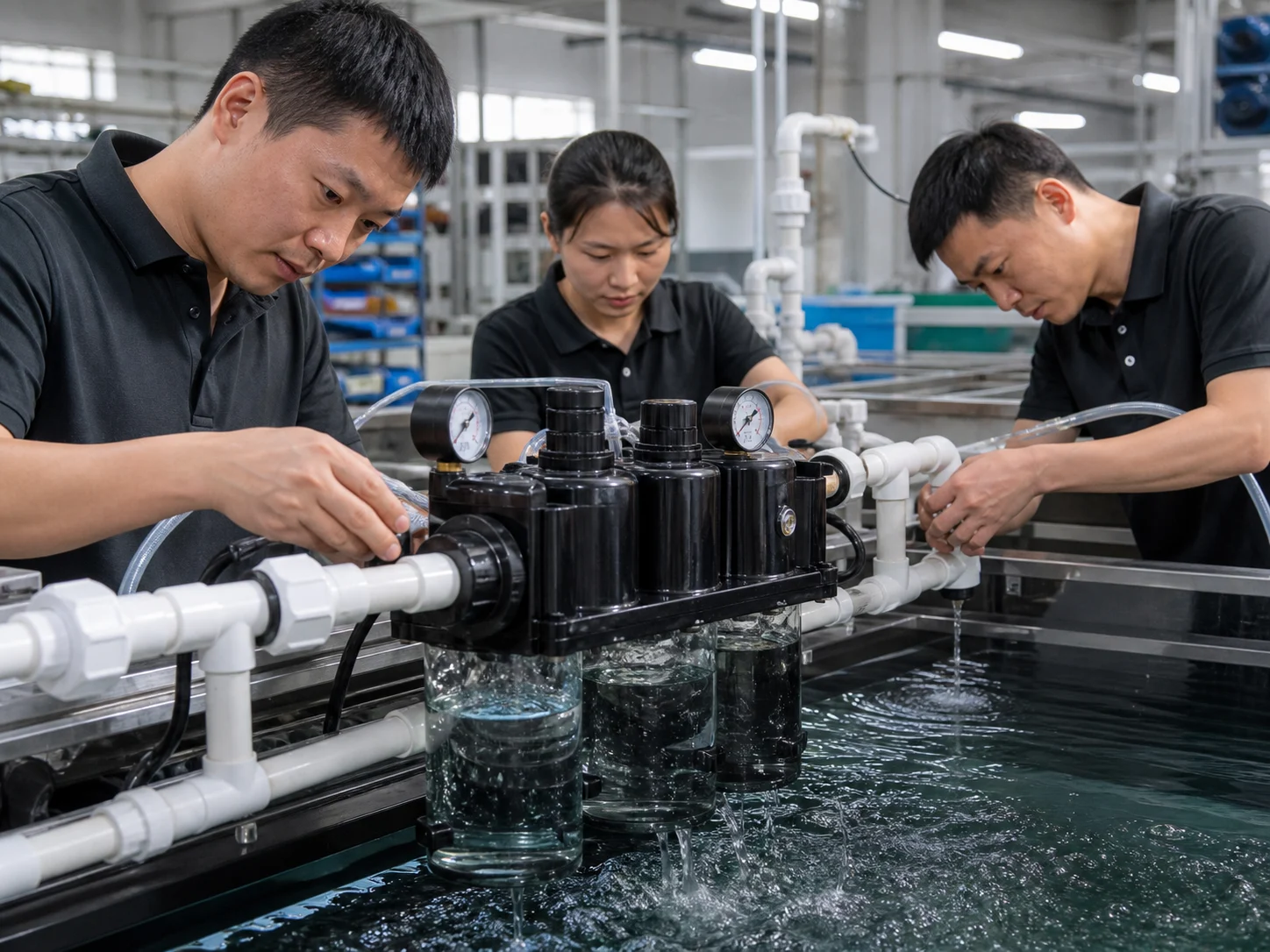
For a purchased system, build monitoring into delivery preparation: confirm what test equipment, sensors, manuals and alarms are included; label pipework and valves; and identify the operating team before shipment. Factory testing can verify the installed equipment scope and visible function agreed in the inspection plan. On-site commissioning remains essential because site utilities, local water and final installation conditions cannot be fully duplicated at the factory.
Common Operating Problems and First Checks
Cloudy water or accumulating solids
Check feeding rate, fish activity, drain performance, solids filter condition and whether the cleaning routine has been completed. Do not simply increase pump size without determining where solids are accumulating.
Rising ammonia or nitrite
Treat this as a water-quality concern for fish. Confirm the test result, inspect aeration and circulation, review feeding and stocking changes, and check whether the biofilter is mature and receiving oxygenated flow. Seek qualified local aquaculture advice where fish welfare is at risk.
Yellowing or weak plant growth
Check crop suitability, light, temperature, root condition, pH, pest pressure and available nutrients. A plant symptom is not proof of one missing element; record the context before correcting it.
Pump or power interruption
Have a written response plan. It may include a backup power interface, emergency aeration, alarm notification, a trained responder and a safe way to isolate sections. The appropriate contingency level depends on stock value, grid reliability and response time.
What makes the loop stable in daily operation
Aquaponics works because several processes remain balanced over time, not because water simply passes through a grow bed. Fish feed introduces nutrients; fish release waste; mechanical treatment captures solids; bacteria convert nitrogen compounds; plants remove part of the dissolved nutrient load; and pumps and aeration keep water moving and oxygen available. Each process has a limit. A change in feed, fish biomass, temperature, crop area, cleaning schedule or pump performance can alter the balance.
For that reason, operators should observe both numbers and physical conditions. Test results provide a snapshot, while water level, flow pattern, filter condition, root appearance and fish behavior show whether the equipment is functioning as intended. A clear tank is not proof that the water is safe, and a healthy-looking plant does not prove that ammonia or nitrite is controlled.
Follow the water path during commissioning
Before fish and plants are fully loaded, trace water from the fish tank through each treatment stage and back again. Confirm that the pump can be isolated and removed, solids can be cleaned, biological media remains aerated where required, every grow zone receives flow, and the return does not overflow or drain the tank too far when power stops. This is a useful factory-testing and installation-preparation exercise because it exposes inaccessible fittings and incorrect elevations early.
Document valve positions, pump model, normal water level and expected flow direction. If the system has more than one grow module, check that a change in one module does not leave another without circulation. The drawings and records created at this stage make future maintenance more reliable.
Interpret change before correcting it
When a reading or crop condition changes, avoid changing several variables at once. Review recent feed rate, water temperature, plant harvest, cleaning, new livestock, new equipment and power events. Then confirm the reading with an appropriate test and compare it with the system’s previous trend. A measured correction is safer for fish and bacteria than an immediate chemical or equipment change based on one observation.
This operating discipline explains why aquaponics can be both productive and demanding. The same recirculating loop that conserves water links every decision together. Stable operation comes from designing for access, monitoring trends and responding before a small equipment or water-quality problem becomes a biological emergency.
FAQ
Does water flow from the plants back to the fish?
In a coupled system, it commonly does: treated water moves through plant areas and returns to the fish loop. In decoupled or hybrid systems, fish and plant water may be managed more independently. Read the coupled-versus-decoupled comparison before assuming every design uses the same return flow.
Why are bacteria needed in aquaponics?
They convert ammonia and nitrite into nitrate through nitrification. This supports water quality and makes nitrogen more accessible to plants. The bacteria need stable oxygenated conditions and time to establish.
Do plants clean all fish waste?
No. Plants take up dissolved nutrients, while solids still need physical management. Filters, biofiltration, plumbing maintenance and daily observation remain necessary.
Does an aquaponics system need electricity?
Most modern systems use electric pumps and aeration. A design should specify the local voltage, phase, frequency, protection, backup strategy and responsibilities for final electrical connection.
Conclusion
An aquaponics system works as a controlled loop: feed enters through fish culture; solids and biological filters manage the resulting waste; plants use part of the dissolved nutrient stream; and water returns under continuous circulation and aeration. The loop only works well when its biological and mechanical parts are sized, observed and maintained together.
The practical next question is not just how the loop works, but how to establish one responsibly. Continue with How to Start Aquaponics for a step-by-step planning and start-up guide.
Final CTA — Send Your System Requirements
For a project-specific equipment discussion, contact YAFAN with your application, site plan, water and power information, crop goals and destination.

