
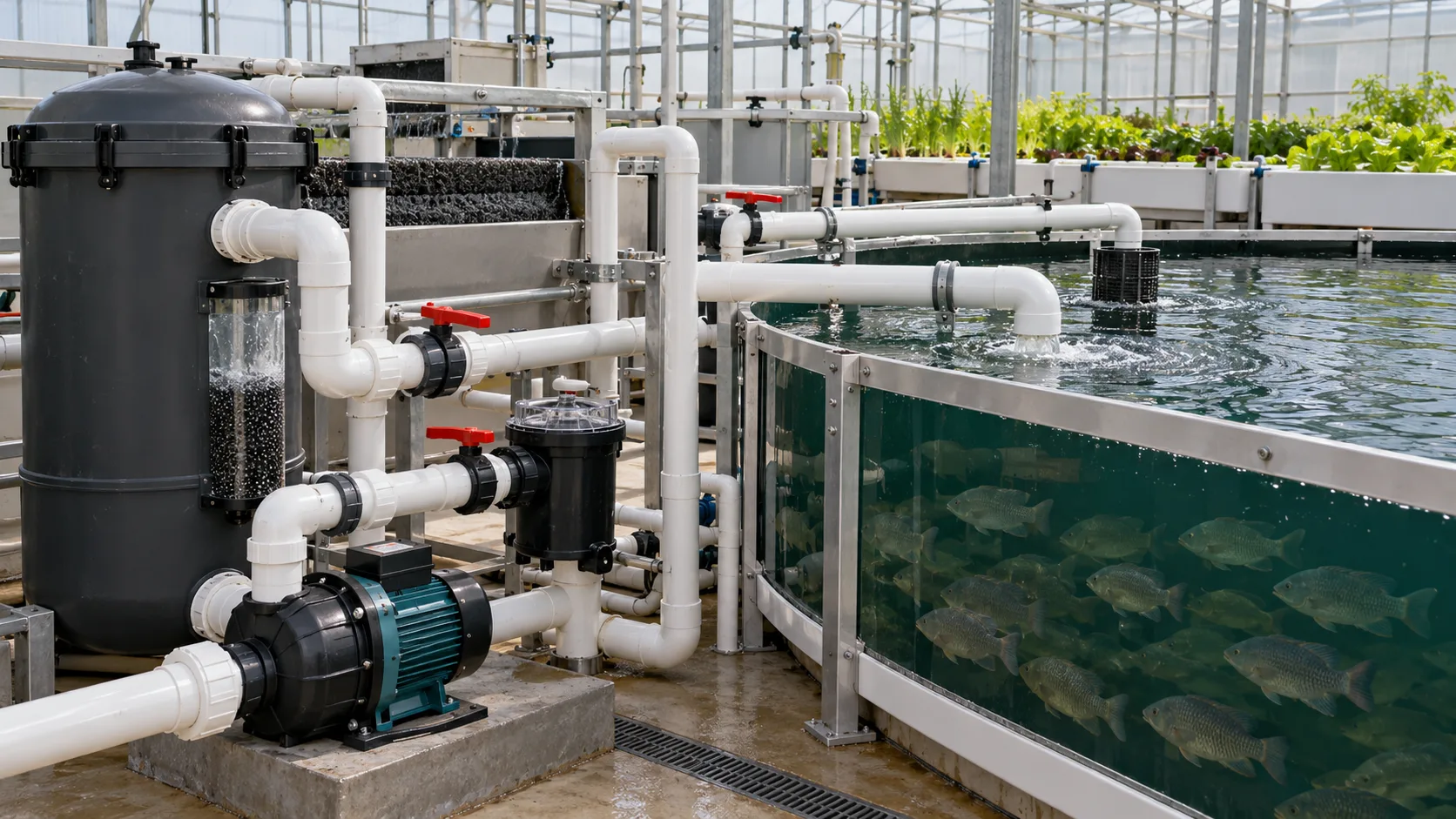
Long-lasting aquaponics plumbing is not defined by one “best” pipe material. It is a compatible, documented and serviceable water path: pipe, fittings, valves, seals, supports and penetrations selected for the actual temperature, pressure, sunlight exposure, water chemistry, cleaning routine and maintenance access. For many protected aquaponics installations, commonly available rigid PVC pressure pipe and fittings are a practical choice when the correct product class, joining method and support are specified. Polyethylene pipe is often useful for flexible runs or outdoor water services. The correct combination depends on the project rather than a catalogue claim.
Buyers should treat plumbing as life-support infrastructure. A low-cost fitting hidden behind a fish tank can cause more downtime than a visible pump. Ask the supplier to show the whole process path, identify every isolation point and state which components are supplied, which must be obtained locally, and how a damaged part can be replaced years after installation.
Begin with the operating conditions
Before naming a material, write the design inputs: planned water temperature range; maximum pump head and expected pressure; indoor, greenhouse or outdoor exposure; local sunlight and freeze risk; cleaning approach; water source; diameter and flow requirement; and whether a line must be dismantled for maintenance. The product application may use gravity return on some routes and pressurised flow on others, so one pipe type does not automatically fit every location.
Also document local plumbing, building and potable-water rules. A pipe marketed as “food grade” is not a complete engineering or regulatory answer. Where a project requires drinking-water contact certification, the buyer should request the applicable documentation for the exact pipe, fitting, cement, gasket and service condition. NSF/ANSI 61 is one common North American health-effects standard for drinking-water system components; it does not by itself certify an entire aquaponics design.
Rigid PVC: a practical option when selected and installed correctly
Rigid PVC is widely used because it is accessible, corrosion resistant, simple to cut and assemble, and available in many pipe and valve formats. It can be particularly practical for straight, visible equipment-room runs, manifolds, tank penetrations and removable service sections. However, “PVC” is too broad for a purchase order. Specify pressure-rated pipe where pressure is expected, nominal size, schedule or local equivalent, fitting type, valve type, colour/UV exposure approach, approved joining materials and the required manufacturer documentation.
PVC joints deserve the same discipline as a pump installation. Clean and prepare the surfaces according to the product instructions, use the right primer/cement where required, permit cure time and support the pipe so a heavy valve does not load a joint. Avoid mixing incompatible pipe systems merely because nominal diameters look similar. During factory testing, request photographs or video of representative glued joints, valves and union locations; after shipment inspection, verify that the labelled pipe/fitting package matches the drawing.
For exterior exposure, ask the manufacturer how the specific product should be protected from UV. Do not assume that any white pipe will tolerate years of direct sunlight without consequences. Physical guards, shading, suitable product selection and sensible routing can be more reliable than an unverified coating.
Polyethylene and flexible pipe: useful where movement and outdoor routing matter
Polyethylene can be useful for make-up water, buried services, flexible links and layouts where a long continuous run reduces the number of joints. It has a different connection method and support behaviour from rigid PVC. Specify the pipe classification, pressure rating, approved insert or compression fittings where relevant, bend radius, thermal movement allowance and transition fittings to rigid equipment connections.
Flexibility is not an excuse for untidy routing. Unsupported flexible pipe can sag, trap sediment, rub against a frame or become a trip hazard. It should be clipped, protected from abrasion and arranged so that a leak can be seen. If a line will be disconnected during cleaning, make the connection accessible and repeatable rather than relying on a hose clamp hidden under a grow bed.
Fittings, valves and seals are the parts most likely to decide serviceability
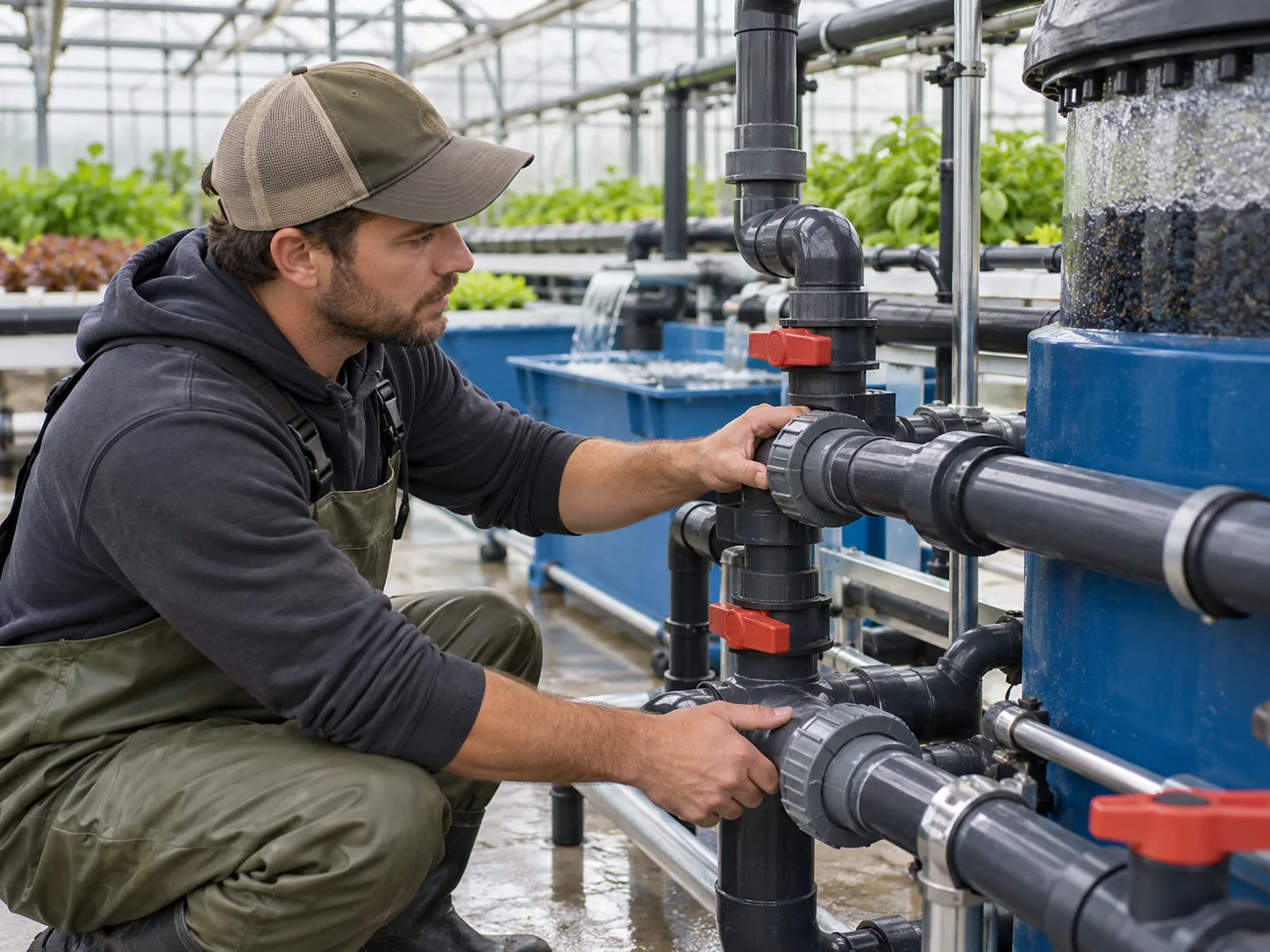
Use unions deliberately
Place unions where a pump, filter, UV unit, valve manifold or tank connection may need removal. A union costs more than a fixed coupler, but it can prevent pipe cutting during routine replacement. Leave enough straight pipe and hand clearance to operate it. Do not place a union exactly where it will be permanently blocked by a frame, wall or tank.
Choose valves for the job
Ball valves can provide simple isolation. Larger or more frequently operated lines may need a different valve type and actuation arrangement. Do not use a partly closed isolation valve as a vague substitute for a designed flow-control method. Label normal positions, identify the direction of any check valve and record which valve closes a tank, filter, grow zone or drain path.
Treat seals as specified components
Bulkhead fittings, gaskets, O-rings and threaded connections should be selected for the tank material, wall thickness, temperature and expected service. Incorrect tightening or incompatible sealants can create slow leaks that are hard to diagnose. The supplier should state what seal is supplied, what replacement part number applies and whether lubricant or thread sealant is permitted.
> Need a pipe-and-fitting schedule for your project? Send Your Requirements with tank dimensions, intended grow method, local voltage/water details and site layout for a compatibility review.
Design for flow, solids and cleaning—not only connection convenience
Pipe diameter follows required flow and acceptable velocity, not the smallest fitting in stock. A narrow line can create unnecessary head loss, reduce pump performance and collect solids where flow slows. A very large line can also be difficult to drain, support or clean if the design does not account for it. The process drawing should show normal direction, elevation changes, return route, venting where needed, drain points, overflow path and every place water can be isolated.
Aquaponics solids make cleanable geometry important. Avoid unnecessary sharp dead ends, long unsupported low points and inaccessible elbows. In media-bed or NFT layouts, keep the route to the grow zone inspectable and ensure a root or solids obstruction can be investigated without dismantling half the system. Our screen-filter selection guide explains why mechanical filtration must be matched to the broader water-treatment sequence, not treated as a separate accessory.
Support, expansion and access protect the plumbing investment
Pipe support should carry the pipe and water weight without concentrating force on fittings or tank penetrations. Long runs may move with temperature changes; respect manufacturer recommendations and avoid hard restraints that force movement into glued joints. Keep penetrations protected from accidental impact by carts, ladders or foot traffic. In a public or school setting, guard low pipework without removing service access.
Installation preparation should include a maintenance aisle. An operator needs space to open a filter, remove a pump, read a valve label, clean a floor drain and see a drip. Take final photographs after pressure testing and label the pipe routes on an as-built drawing. These records help a future technician identify the correct replacement rather than guessing from a faded fitting.
Use a material schedule instead of informal descriptions
A purchase order should convert broad descriptions into a schedule. One practical format groups components by zone: fish tank outlet and drain; solids handling; biofilter; pump discharge; grow-zone supply; gravity return; make-up water; overflow; and emergency drain. For each zone, list material, nominal size, pressure/service class, connection method, valve type, union location, support requirement and spare part. This makes quotation comparisons more meaningful and prevents a later substitution of an unknown component.
The schedule should also identify what is intentionally *not* supplied. For example, a factory may provide equipment-side pipework and fittings while the destination contractor provides building penetrations, water-service connection, floor drains or local code-compliant backflow protection. Ambiguity at this boundary is a common source of late cost and improvised pipework.
Do not specify a material merely because it appears in an earlier project photograph. A greenhouse with high solar exposure, a conditioned indoor facility and a seasonal outdoor teaching system can have different UV, temperature, impact and access conditions. Reconfirm the design basis when the site or customer requirements change.
Commission the plumbing in a controlled sequence
Before biological start-up, conduct a dry visual review followed by a filled-water test according to the system design. Check that normal and emergency routes flow as drawn; verify that each union and valve can be reached; inspect tank penetrations and joints under operating pressure; confirm that a stopped pump does not create an unintended overflow or drain-down; and identify areas that need a drip tray or splash guard.
Record valve positions, water levels and observations at commissioning. Then repeat a limited check after filters have been cleaned and after the system has experienced normal thermal cycling. This is not a substitute for local code inspections or qualified trade work. It is an operating check that catches an inaccessible valve, vibrating unsupported line or unexpectedly difficult cleaning route before the system carries its full fish and crop load.
Compare lifecycle cost, not only pipe price
The quotation with the lowest plumbing price can become the most expensive option when it omits service access, spare seals, labels or compatible replacement fittings. When comparing proposals, separate first cost from lifecycle items: how long it takes to replace a pump; whether a valve can be removed without draining a tank; whether common fittings are locally available; whether the supplier provides a spare kit; and whether the team can identify every component after handover.
Include planned downtime in the comparison. A union and two isolation valves may cost more during manufacture, but can make a replacement task possible in a short scheduled window. Conversely, a fixed pipe run that requires cutting, re-gluing and a long cure period may interrupt a fish system at the wrong time. The value of a component is therefore linked to service sequence, not its purchase price alone.
Ask a supplier to show the maintenance route for the three most likely service events: circulation-pump replacement, filter cleaning and a tank-side valve repair. If the answer requires moving grow beds, emptying a tank or working in an unprotected splash zone, redesign the layout before manufacturing. This is a useful, simple test of whether the proposed plumbing is truly long-lasting.
Make changes traceable after commissioning
Plumbing is often altered after the site is running: a flow meter is added, a grow zone is extended, a temporary bypass becomes permanent or a new tank is connected. Treat every alteration as an engineering change. Update the drawing, photograph the final route, note the component rating and test the modified section before returning it to normal service. An undocumented “small change” can make later troubleshooting, warranty review and staff handover unnecessarily difficult.
Keep the original bill of materials, packing list and final as-built drawing together. The documentation is especially valuable when a system is expanded years later or when a different installer must work on it. It also gives the buyer a clearer basis for confirming whether a replacement component is equivalent rather than merely similar in appearance.
Make procurement evidence part of the order
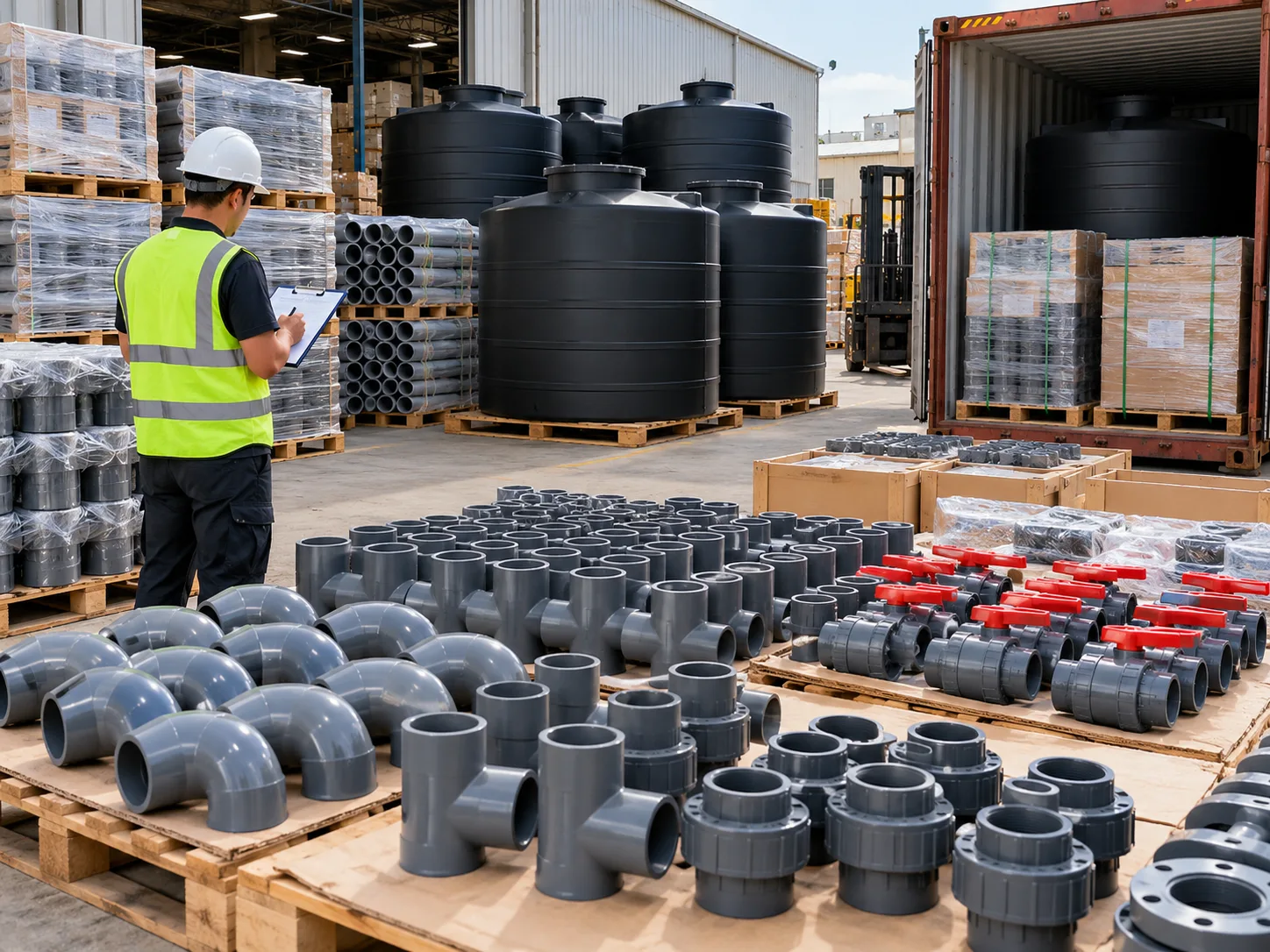
Ask for a bill of materials that identifies pipe size, material class, valve and union type, tank penetrations, seal type and spare quantity. For a custom export project, request a packing list broken down by plumbing zone. At shipment inspection, count fittings, check visible thread or socket damage and set aside seals and hardware in labelled bags before installation begins. Containers should carry dry, empty tanks, pipework and components—not a simulated live fish-and-plant system.
A factory test can verify that a representative manifold or equipment skid was assembled and checked. It cannot prove destination-site floor drainage, local water pressure, electrical isolation or final pipe support. Keep those responsibilities clear in the quotation and commissioning checklist. The commercial system buyer’s guide offers a wider checklist for separating supplier scope from local site work.
Common purchasing mistakes
- Selecting only by nominal diameter while ignoring pressure, temperature and connection standard.
- Omitting unions and then cutting pipe for every pump replacement.
- Using unlabelled fittings from several systems without a compatibility record.
- Hiding drain, overflow or isolation components behind equipment.
- Leaving UV-exposed or freeze-exposed routes unspecified.
- Assuming a water-path material claim proves compliance for the whole installation.
FAQ
Is PVC safe for aquaponics?
Suitability depends on the specific product, service conditions and local requirements. Select pipe and fittings designed for their intended pressure and application, request documentation where needed, and avoid treating a generic material name as proof of suitability.
Should every component use the same material?
Not necessarily. A protected equipment-room manifold, flexible outdoor make-up line and tank penetration may each need a different appropriate component. The key is compatible transitions, documented ratings and accessible service points.
How often should aquaponics plumbing be inspected?
Visually inspect accessible joints, supports, valves, unions and tank penetrations in the normal maintenance routine. Frequency depends on the system, but new installs deserve extra checks after filling, after thermal changes and after the first cleaning cycles.
Conclusion
Recommended aquaponics plumbing materials are the ones that meet the real hydraulic and site conditions while remaining inspectable and replaceable. Specify the entire assembly, not just pipe; preserve evidence through factory testing and shipment inspection; and make access a design requirement. Durable plumbing is a quieter, safer foundation for fish care and crop production.
Planning a system with custom tank, filter and grow-zone connections? Contact Us for a component schedule and installation-preparation discussion.

