
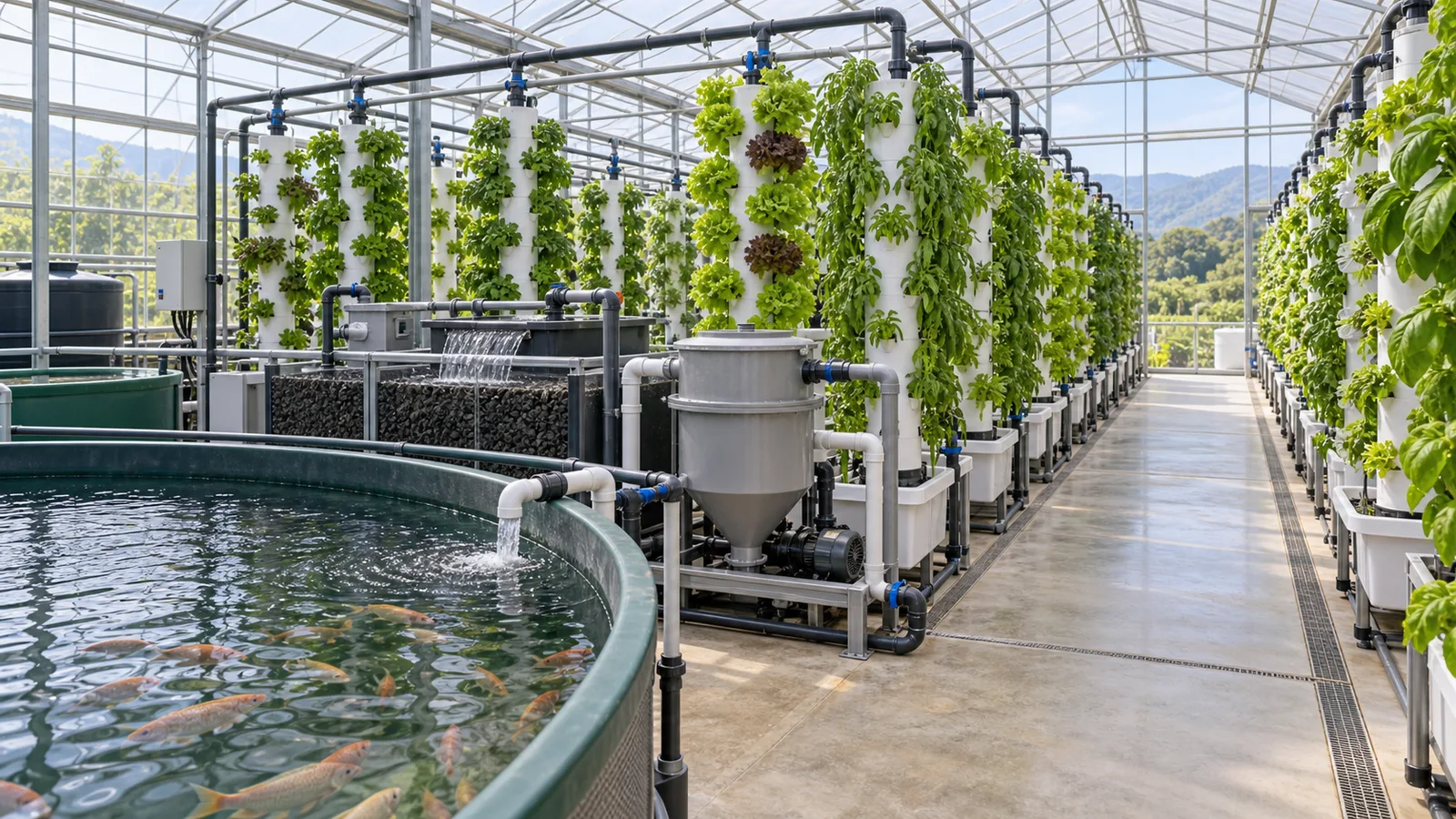
Yes—provided the tower is treated as a carefully integrated growing component, not simply a hydroponic accessory placed on a fish loop. A tower planter can make productive use of vertical space for leafy greens, herbs and some smaller crops. But its narrow distribution passages, exposed roots and top-fed water path make it less forgiving of solids, uneven flow and poor access than a broad media bed or raft trough.
For a home, school or commercial project, the useful question is not “can water reach a tower?” It is whether the fish load, mechanical filtration, pump curve, return path, crop plan and daily cleaning routine can support it. A tower that clogs, shades lower plants or returns poorly oxygenated water can create more work than production value.
FarmHub’s vertical-aquaponics guidance describes towers as top-fed vertical tubes and notes both their high space efficiency and the practical limits created by light, crop position and management access. Read the FarmHub growing-towers guide. Engineering for Change’s vertical aquaponics chapter is also useful technical context for reviewing tower flow and construction decisions.
The short answer
A tower planter is a good candidate when the project has reliable solids management, stable flow, accessible plumbing, crops suited to vertical planting and staff able to inspect emitters and roots. It is a weaker choice when fish solids are poorly controlled, power reliability is low, the only available crop is a heavy fruiting plant, or tower rows will be too dense to receive even light and service access.
Before purchasing, confirm five points:
- the tower’s required inlet flow and the delivered flow at actual lift height;
- the filtration stage that protects the distributor, emitters and root zone;
- where water drains after leaving the tower, including splash and overflow control;
- the crop, plant spacing, support and light exposure at each tower level; and
- who will flush lines, inspect roots and clean the tower between crops.
This article is about adding a tower planter to a fish-and-plant loop. For a broader comparison of media beds, DWC, NFT and hybrid layouts, read What Are the Different Types of Aquaponics Systems?.
What changes when a tower is added to the loop?
Water moves vertically and returns quickly
Most towers receive water at the top and distribute it down through an internal channel, media or root zone. The return water may fall into a trough, sump or grow bed. That route can add oxygenation, but it also creates points where leaks, splash, blocked emitters and root intrusion need attention. Never assume a tower’s advertised hydroponic pump rating will match an aquaponics installation with longer pipe runs, elbows, filter head loss and changing screen condition.
Small passages make solids control more important
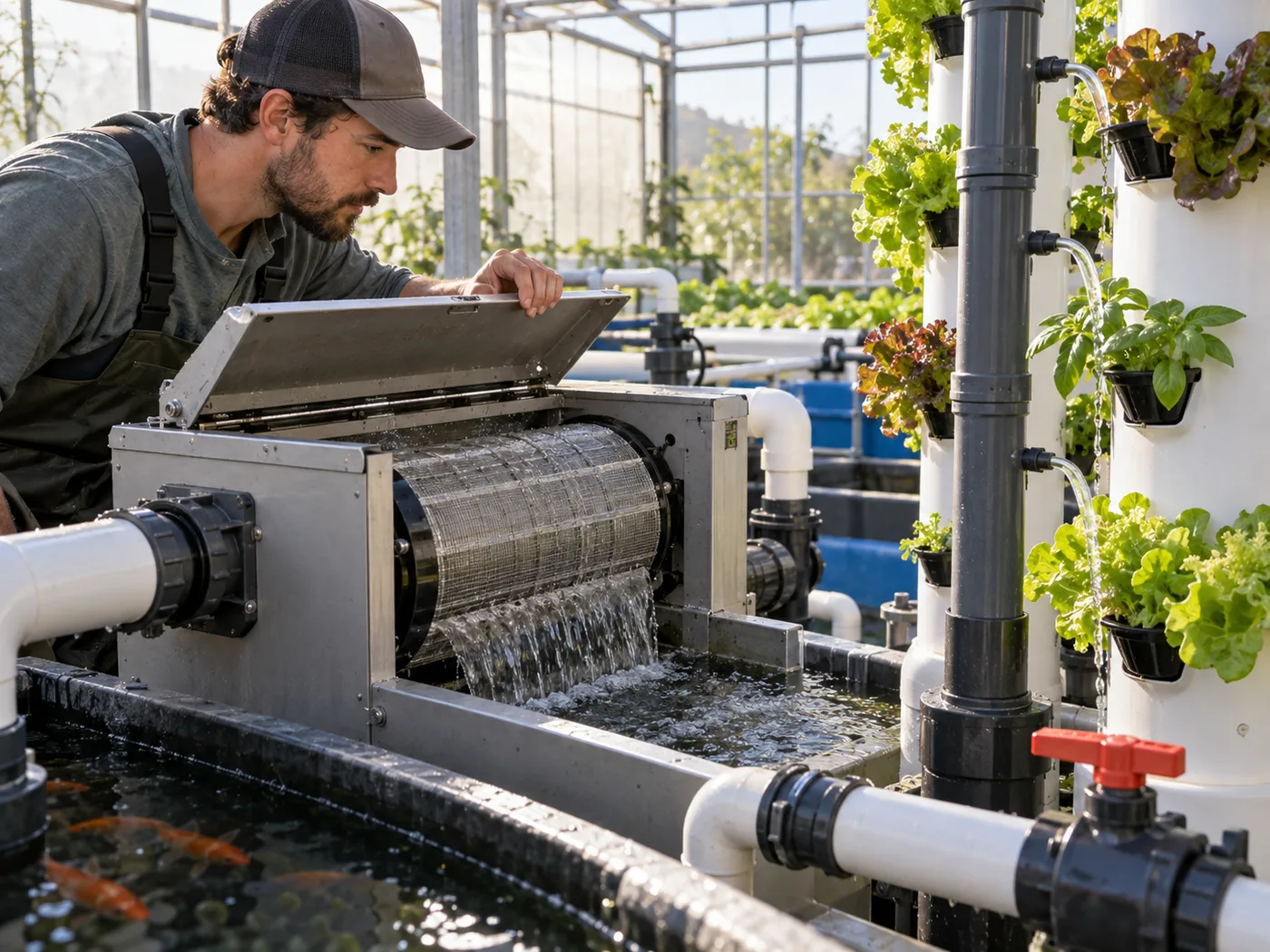
Uneaten feed, fish feces, biofilm fragments and root material can block a narrow emitter or collect in the lower portion of a tower. Mechanical filtration should remove the particle load that the tower cannot tolerate, while biofiltration manages dissolved nitrogen. A filter is not optional simply because plants are present. For a component-level explanation, see Can You Use a Screen Filter in an Aquaponics System?.
Vertical space does not remove light and labor constraints
Towers increase planting positions per floor area, but lower and rear plants can receive less light. A tightly packed tower row can also make planting, harvest, scouting and sanitation harder. Build aisle clearance into the layout before ordering. In a commercial greenhouse, confirm whether workers can move a cart, ladder or lift safely without damaging plants or pipework.
A practical integration sequence
1. Define the production job
Decide whether the tower is intended for herbs, lettuce-sized leafy crops, seedlings, demonstration use or a specific market crop. Crop choice controls plant opening size, support needs, harvest technique and nutrient demand. A compact basil or lettuce crop is usually easier to manage than a heavy tomato or cucumber crop that requires strong support and can shade adjacent planting sites.
2. Map the water path before installation
Draw the normal route from fish tank through solids removal, biofilter, pump, tower inlet, tower drain and return. Mark every isolation valve, union, drain, overflow and sample point. A practical design allows one tower or row to be isolated for cleaning without stopping essential fish circulation or aeration.
3. Verify filtration against the narrowest component
Ask what screen opening or solids-removal method protects the smallest emitter, inlet or passage—not just the main pump. A coarse filter that appears clean can still pass material that blocks a small distribution point. Include a visible pressure or flow check so the operator can see when a line begins to foul.
4. Test real flow, not catalogue flow
During factory testing or installation preparation, run water through the actual tower height, pipe length and fittings. Check that the top distributor wets all intended planting positions and that lower positions are not starved. Inspect the drain under normal flow and during a partial blockage. A pump that delivers enough water at floor level may be inadequate at the top of a tower.
5. Make cleaning a designed operation
Plan where the tower is opened, where debris falls, how a line is flushed and where cleaning water drains. Give staff a written sequence for isolation, inspection, cleaning, restart and post-cleaning flow confirmation. Poor access is one of the most common reasons a technically viable component becomes unreliable in daily use.
> CTA — Planning a vertical aquaponics project? Send your greenhouse dimensions, fish species, crop plan and proposed tower count. We can help define filtration, water-flow and installation requirements for a clearer equipment quotation. Send Your Requirements.
Crop and tower-fit decisions
Good starting crops
Leafy greens, herbs and compact plants are usually the easiest first crops because they have lighter root and canopy loads, shorter production cycles and simpler support requirements. Select varieties that fit the tower opening and are compatible with the local light and temperature profile.
Crops that require extra planning
Fruiting crops can be grown in some stacked-pot or purpose-built towers, but they need structural support, more root volume, careful pruning and better light access. Do not hang a heavy crop from a light residential tower or assume a tower can replace a greenhouse trellis system.
Plan plant demand with fish input
More planting holes do not automatically mean better nutrient balance. Plant uptake changes with crop age, season, temperature and harvest rhythm; fish nutrient production changes with feed rate and biomass. Start with a measured, manageable crop area and adjust after observing water-quality and crop records rather than filling every opening on day one.
Common tower-planter mistakes
Connecting it before the mechanical filter
This puts tower internals in direct contact with the highest solids load. The result may be clogged emitters, accumulating organic matter and difficult cleaning. Position the tower after the relevant treatment stages unless an engineer has documented a different hydraulic plan.
Using a tower as the only biofilter without validation
Some tower media can provide biological surface area, but that does not prove it has enough protected, oxygenated capacity for the selected fish load. Maintain conservative loading and verify water quality during commissioning.
Ignoring drainage and splash
Water falling from a high outlet can wet floors, create algae, corrode equipment and become a slip hazard. Design an enclosed or controlled drain route and confirm it during site commissioning.
Choosing density before access
Maximising tower count can reduce light and make plant and filter maintenance impractical. Draw working aisles first, then place towers.
A simple pre-purchase scorecard
Before committing to a tower planter, score the project against the following practical questions. A “no” answer does not automatically reject the tower; it identifies a design item that must be resolved before fish and crops are exposed to it.
Water and filtration
Can the existing pump deliver the manufacturer’s required flow at the top of the proposed tower after filter head loss? Is there a measurable flow check at the inlet? Can solids be captured before the smallest passage? Is there an accessible drain route for filter cleaning and tower flushing? A tower should never be the place where a project discovers that its filtration was undersized.
Crop and structure
Does the selected crop fit the opening, root volume and support system? Are heavy fruiting plants supported independently of thin tower walls? Has the layout allowed for seasonal solar angle and lower-level shading? A tower may offer a high count of planting positions yet still produce uneven marketable output if crop placement is not planned.
Operating owner
Who checks each tower after a pump alarm, cleans a blocked emitter and removes roots after harvest? Is a spare emitter, seal or distributor available locally? Can one tower be isolated without changing fish-tank level or leaving a dead-water section? These questions turn a visually attractive concept into an operable system.
Trial before scale-up
For a commercial project, begin with a representative row or small zone during commissioning. Record inlet flow, return-water appearance, filter-cleaning interval, crop uniformity, labor time and plant survival at each vertical level. Use that evidence to set tower spacing and final quantity. It is more reliable than extrapolating from a supplier photograph or a hydroponic-only installation.
Supplier, factory and shipment checks
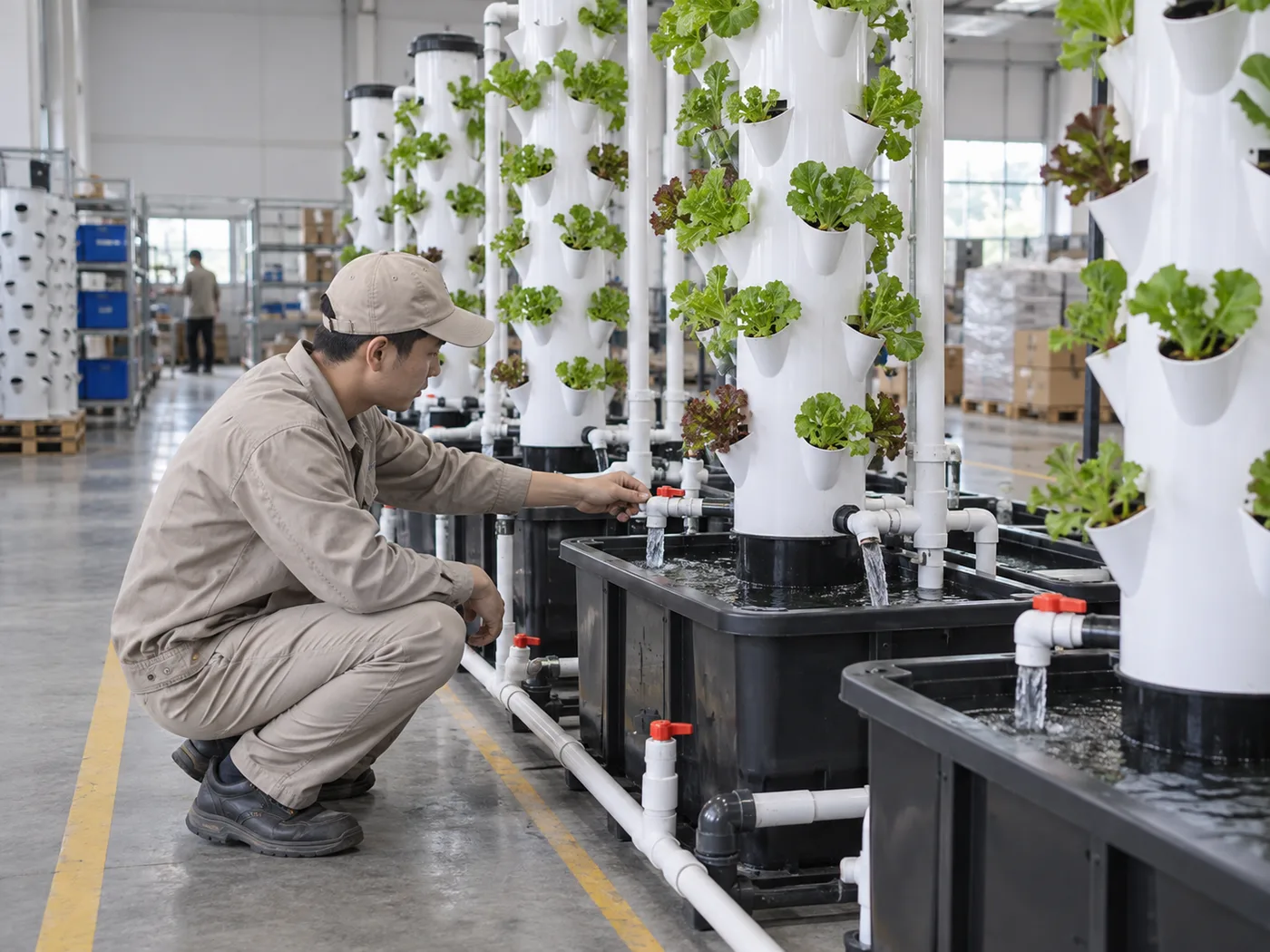
Ask a supplier to identify tower material, dimensions, planting-site count, required flow, inlet and drain connections, mounting method, included pump or distribution components, filter requirement and cleaning tools. During factory testing, confirm water reaches all planting positions, connections do not leak and the tower can be accessed safely. During shipment inspection, verify tower count, fittings, mounting hardware, spare emitters, valves and manuals against the packing list.
At installation, check level, anchoring, pipe support, drain routing, electrical safety, service clearance and actual water distribution before fish stocking or crop loading increases. Photograph the final pipe route and retain the process-flow drawing as an operating record.
FAQ
Can a hydroponic tower be connected directly to fish-tank water?
It may circulate water, but direct untreated fish-tank water can carry solids into small tower passages. Use a documented treatment path and evaluate filtration, flow and food-safety implications before connection.
Do towers need a separate pump?
Not always. The decision depends on head height, required flow, existing pump capacity, ability to isolate the tower and risk during a pump failure. Confirm the complete hydraulic calculation rather than adding equipment by assumption.
Are tower planters good for commercial aquaponics?
They can be, particularly for high-value leafy crops and herbs where vertical space, labor access and light can be managed. Evaluate maintenance and crop uniformity alongside floor-area productivity.
Conclusion
A tower planter can work well in aquaponics when flow, filtration, crop fit and service access are designed together. Start with a measured trial, protect narrow distribution points from solids, verify real flow at installed height and leave room for people to clean and harvest. The tower should improve a stable system—not become the component that makes it hard to operate.
CTA — Need a tower-compatible system scope? Contact Us with your site drawing, intended crops, fish plan and country. We will help clarify the practical equipment and installation-preparation questions before shipment.

