

The best aquaponics installation training course is not necessarily the one with the most impressive certificate or the longest equipment list. It is the one that prepares the intended participant to assemble, commission, operate and hand over the type of system they will actually encounter. A useful course explains where supplier scope ends and qualified local work begins; gives participants supervised practice with water flow, filtration, testing and fault response; and assesses evidence of competence rather than attendance alone.
For a buyer, course selection also has a commercial consequence. A well-trained owner’s team can carry out routine checks, identify a site-readiness issue early and communicate clearly during a warranty claim. Training cannot turn an inexperienced person into a licensed electrician, structural engineer, veterinarian or local code authority. It should make those boundaries explicit.
First decide what “installation training” needs to mean for your project
The phrase covers several very different offerings. A one-hour product orientation can help a school team understand daily feeding and water tests. A multi-day build-and-operate program can teach a prospective grower how components interact. A supplier’s project handover may focus on the equipment actually delivered. A formal academic or professional-development course may give wider RAS, horticulture, fish-health and business context without teaching the exact model you are purchasing.
Write down who will attend and what they must be able to do independently after the course. Typical roles include the project manager accepting shipment, the site coordinator coordinating contractors, the technician carrying out daily system checks, the educator using the system safely with learners, and the supplier service contact. One person rarely needs every depth of training.
The Cornell Aquaponics Short Course illustrates the breadth a systems-oriented course can cover: water quality, solids capture, pipe flow, biofiltration, fish health, monitoring and feasibility. The Chicago Botanic Garden’s intensive course is a useful example of a programme that describes hands-on work alongside design, construction and maintenance. Neither example is a universal recommendation; prospective attendees should verify current format, location, price, prerequisites and assessment directly with the provider.
What a credible curriculum should cover
1. Scope, drawings and site readiness
Participants should learn to read a flow diagram, packing list and equipment schedule. They should know the difference between equipment supplied by the manufacturer and work normally completed locally: floor preparation, drainage, water connection, protected electrical supply, ventilation, anchoring, permits and final electrical work. A course that says “installation is easy” but does not address utility interfaces can create costly assumptions.
Good training uses a realistic installation-preparation checklist. It asks participants to locate a drain, measure service aisles, identify isolation points, confirm voltage/frequency and document access for unloading and future maintenance. This creates a useful bridge between customer requirements and the equipment supplied.
2. Mechanical assembly and water-path reasoning
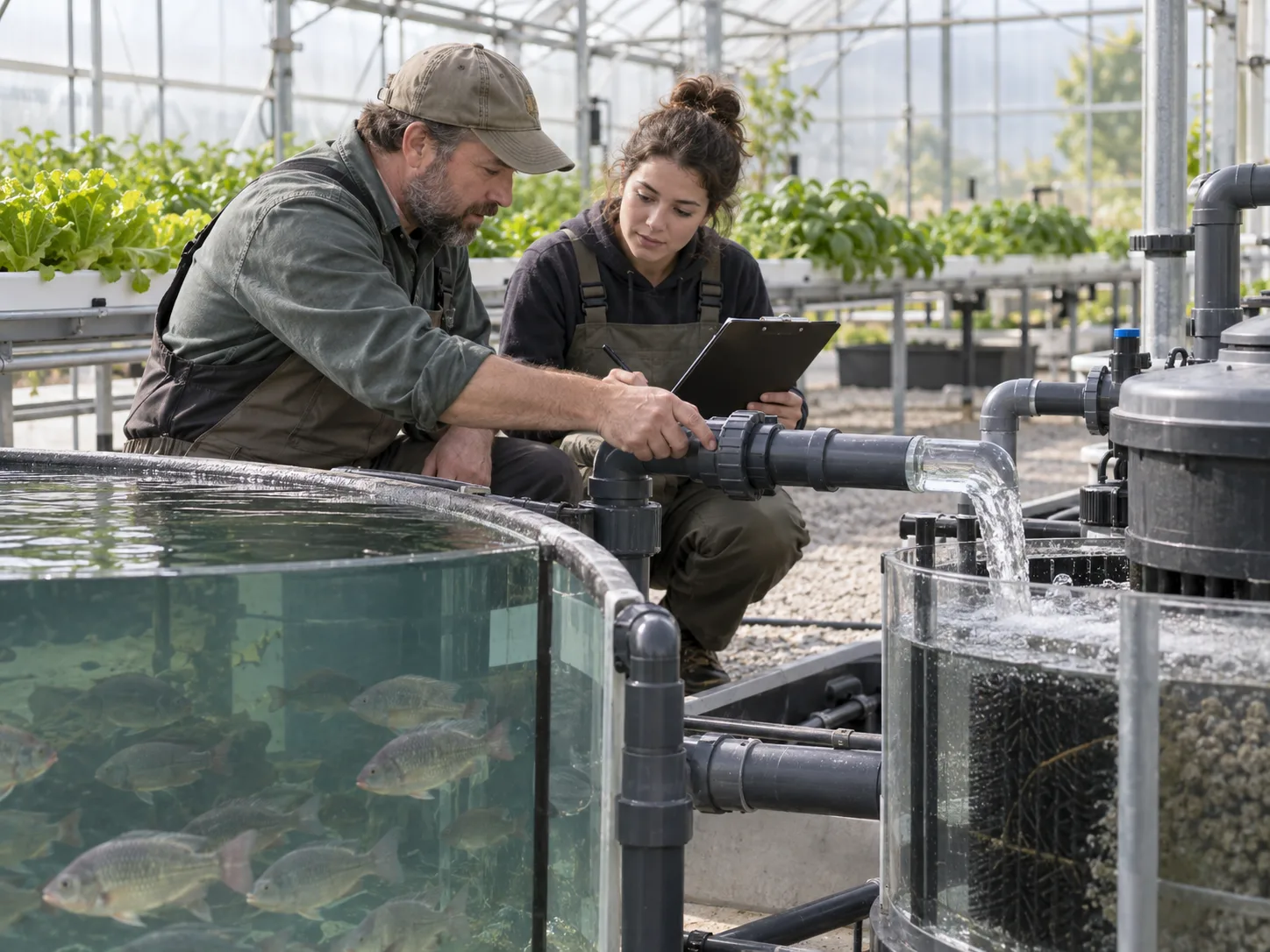
Hands-on time should include safe assembly sequence, gasket and union checks, support alignment, valve orientation, pipe support and leak-test procedure. The aim is not memorising one colour-coded pipe layout. It is understanding water direction, why a component is placed at that point, and how to isolate it without draining or contaminating the rest of the system.
Ask whether the instructor explains normal flow, emergency overflow, solids capture, biological treatment, grow-zone return and pump protection. The learner should leave able to trace water from tank to return and identify what evidence would indicate a blockage, bypass or low-flow event.
3. Commissioning before livestock is added
Assembly is not commissioning. A strong course teaches dry checks, filled-water leak inspection, circulation verification, aeration verification, sensor checks, source-water conditioning, biological start-up and gradual stocking. It distinguishes a clean, stable-looking water loop from a mature biological system.
Request a practical exercise: identify a missing valve, diagnose a poor return pattern, verify an air branch, or complete a commissioning record. These are closer to real handover work than a slide deck alone.
4. Routine operations and safety
Daily checks should cover fish behaviour, feeding records, water quality, plant condition, solids devices, pump and air equipment, alarms and housekeeping. Training should also define safe isolation near water, chemical handling, biosecurity, lifting, slips and trips, and escalation when a fish-health or electrical issue exceeds the operator’s scope.
Our aquaponics maintenance guide can be used as a supplementary daily/weekly record template, while the course should make the site-specific thresholds and responsibilities clear.
5. Troubleshooting and evidence collection
The most valuable teaching often happens when something is not normal. A provider should explain what to record before adjusting the system: timestamps, temperature, test results, feeding, pump and air status, photographs of fittings, filter condition and recent changes. This allows a supplier or advisor to distinguish a probable equipment issue from a water-quality, stock-management or site issue.
Avoid courses that promise a fixed answer to every symptom. Aquaponics troubleshooting requires context. In reliable online support for aquaponics troubleshooting, we explain how a concise evidence pack improves remote technical advice.
Assess the instructors and training environment
Ask who teaches the course and what they have actually installed, commissioned or operated. Practical experience matters, but it should be relevant: a home demonstration, a commercial greenhouse and a public educational facility have different risks and daily routines. Look for transparent biographies, a clear agenda, realistic maximum class size, a stated proportion of practical work and equipment that participants can inspect safely.
For a supplier-delivered programme, ask whether the trainer knows the exact bill of materials, revision of controls and service procedure for your order. A generic factory video does not substitute for project-specific handover. For an independent provider, ask how instruction is kept current with local regulations and whether participants can bring drawings or project questions.
Treat “certification” carefully
Certification can mean an attendance certificate, a provider assessment, continuing-education credit or a credential issued under a recognised external framework. These are not equivalent. Before buying a course, ask:
- Who issues the certificate and what does it verify?
- Is there a practical and/or written assessment?
- What specific competencies are assessed?
- Is it valid for a defined period or subject to renewal?
- Is it recognised by an employer, insurer, regulator or only by the course provider?
- Does it replace any local trade licence, food-safety requirement, aquaculture approval or site training? (Usually it does not.)
Trustworthy providers state those limits plainly. Do not use a completion document to claim compliance, professional licensure or authority that it does not confer.
> Planning a supplier handover for a new project? Ask for a Product Catalog and tell us the proposed team roles, site location and preferred training format so the installation and operator-training scope can be discussed early.
Compare delivery formats against the project stage
Online courses can efficiently explain concepts, drawings, calculations and records. They are helpful before procurement or for a distributed operations team. They are weaker for confirming torque, pipe support, leak identification, air balancing or safe physical access unless combined with live supervision.
On-site supplier training is most valuable around installation, commissioning and acceptance because it uses the real tank geometry, pipework, control panel and utilities. Its quality depends on preparation: the equipment should be accessible, the site should be safe, the attendee list should be known and all manuals should be available in a workable language.
Hybrid training often works well: theory before delivery, an on-site build/commissioning session, then a defined remote review after the first operating weeks. Specify the number of hours, attendee maximum, language, documents supplied, follow-up support and travel assumptions in the quotation rather than assuming they are included.
Request training deliverables in the purchase order
For a B2B system, training should be part of the deliverable set, not a goodwill promise. Include:
- training agenda and attendee roles;
- latest drawings, labelled equipment schedule and operating manual;
- commissioning and acceptance checklist;
- normal maintenance schedule and spare-parts list;
- water-testing/log sheet and emergency contact/escalation card;
- record of attendance and any assessment result;
- factory testing evidence, shipment inspection checklist and site-handover record; and
- post-training support channel, response scope and exclusions.
At shipment inspection, confirm the manuals, wiring references, valves, sensors and supplied spares are present. During site handover, let each intended operator locate the isolation point, check a filter, identify the emergency aeration route and explain the first response to an alarm. This reveals gaps while the installer is still available.

Questions to send a provider before enrolling
Ask for the current agenda rather than relying on an old course description. Confirm whether the programme covers coupled and decoupled systems if that distinction matters to your project, whether participants will work around a live fish system, and what personal protective equipment or prior knowledge is expected. Ask how many learners share a practical station and whether the course uses real pumps, manifolds, solids devices, water-test equipment and control hardware rather than demonstrations from a distance.
Request examples of the actual outputs: a commissioning checklist, a daily log, a simplified flow diagram, a fault-report form or an assessment rubric. Sensitive client documents do not need to be shared, but the provider should be able to describe the type of evidence learners create. A course provider that can explain its assessment is generally easier to compare than one that uses broad promises such as “become an expert.”
For an employer-funded group, ask whether the provider can tailor exercises to the attendee roles. A purchasing manager may need to understand acceptance criteria and service boundaries; a technician needs practical operation and fault reporting; an educator needs safe demonstration procedures. Tailoring should preserve core technical content, not reduce training to a sales presentation.
Finally, ask what happens after the session. Is a question-and-answer period included? Are revised manuals accessible? Is remote support available only for the supplied equipment, or can it address general operation? State those boundaries before travel is booked. This avoids an unrealistic expectation that a course certificate creates unlimited technical support.
Use training to improve supplier communication
Training records are valuable when linked to the project record. Keep the agenda, attendance list, manuals, version-controlled drawings, commissioning readings and accepted punch-list items together. When a question arises later, the team can report the actual equipment revision and measured condition instead of relying on memory. It also makes staff changes less disruptive: the next coordinator can see what the original team was taught and where additional coaching is needed.
A fair course-comparison scorecard
Score each course against your actual needs, not marketing claims. Give weight to hands-on relevance, instructor/project experience, clearly stated safety limits, assessment evidence, support after completion, documentation, class size and total cost including travel and lost operating time. A programme with fewer glamorous features can be the better choice if it gives your team a repeatable commissioning process and a reliable line to technical support.
FAQ
Do I need a certificate to operate an aquaponics system?
Requirements vary by location, system purpose, fish species, food handling and business model. A course certificate may demonstrate participation or assessed learning, but it does not automatically satisfy permits, food-safety rules, local electrical requirements or employer training obligations.
Is supplier training better than an independent course?
They solve different needs. Supplier training should address the exact supplied equipment and handover. An independent course can provide broader engineering, crop and fish-management context. Larger projects may benefit from both.
What should an installation course never encourage trainees to do?
It should not encourage unqualified work on electrical systems, structural changes, pressurised gas systems, regulated fish-health treatments or matters requiring local professional approval. A good trainer teaches recognition and escalation, not false confidence.
How long should training last?
Duration follows scope. A short orientation may suit a simple teaching unit; a commercial installation needs structured preparation, commissioning participation and follow-up. Judge the learning outcomes and practical evidence, not hours alone.
Conclusion
Choose aquaponics installation training that turns a project team into informed operators and reliable partners during commissioning—not one that merely produces a certificate. Define roles, demand hands-on relevance, check the provider’s transparency, include training deliverables in the contract and document handover. That approach protects equipment, improves communication and supports a safer start-up.
Need to align equipment supply, installation preparation and operator handover? Contact Us with your proposed project scope and team structure.

