
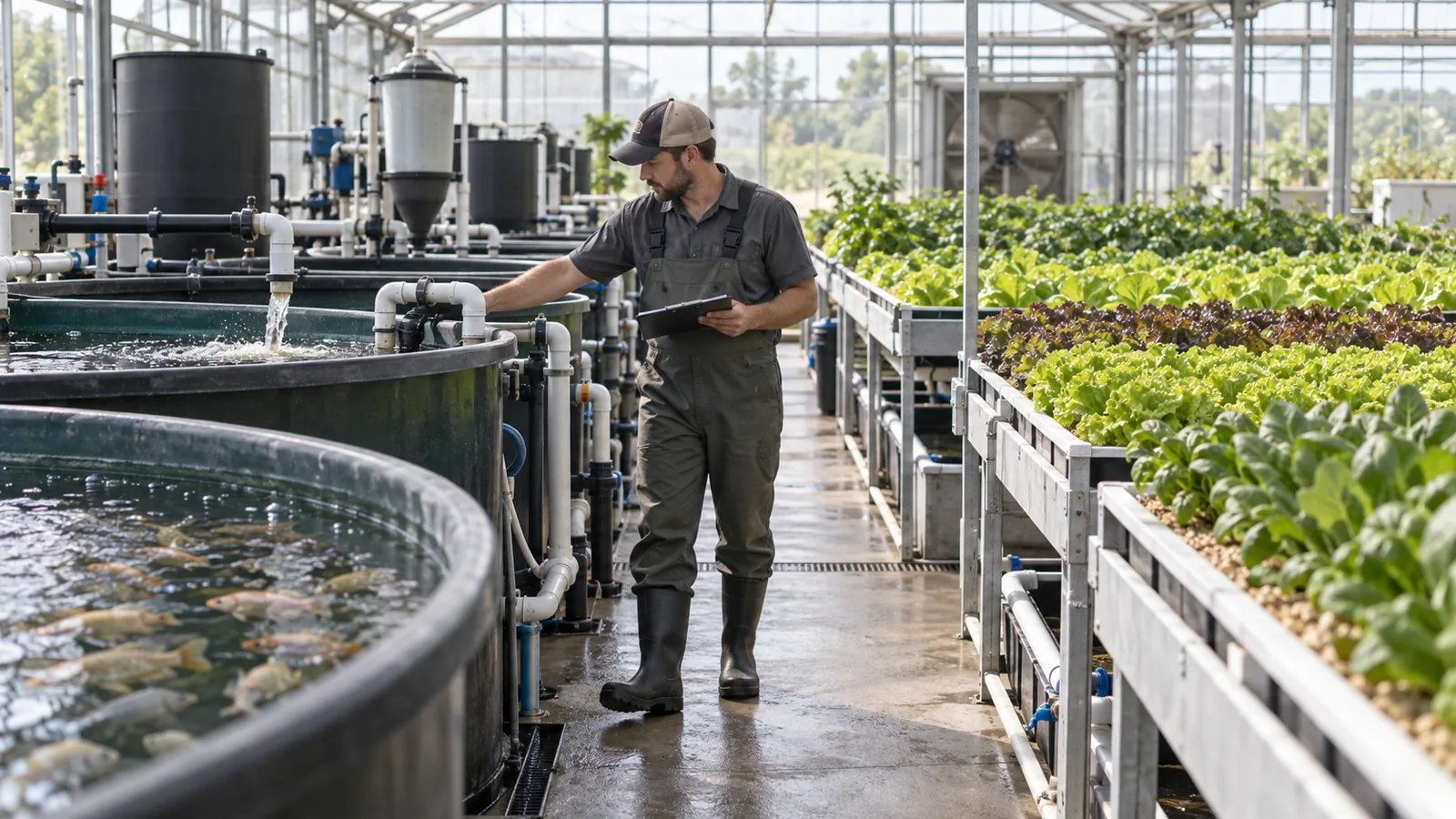
Aquaponics maintenance is a repeatable operating routine, not an occasional deep clean. Fish, bacteria, plants, filters, pumps and pipes share one water loop. A small problem—uneaten feed, a blocked pump inlet, weak aeration, a leak or an incorrect test result—can affect the whole system if it is missed for too long.
The goal is not to make maintenance complicated. It is to assign clear daily, weekly and monthly tasks; record what was observed; and respond to changes before they become an emergency. This guide is designed for project owners, greenhouse staff, schools and distributors preparing an operating handover after installation.
The short answer
Maintain an aquaponics system by checking fish, water flow, aeration, leaks and plant condition every day; testing and recording water quality and cleaning planned components every week; and reviewing filters, pumps, solids, crop roots, backup systems and records on a monthly schedule. The exact frequency depends on fish species, system size, water source, climate and operating stage.
The University of Vermont’s produce-safety guidance emphasizes water-quality tracking, farm hygiene and written standard operating procedures for hydroponic and aquaponic operations. Read the UVM resource. Clemson Extension also explains that water pH and ammonia are important operating checks in aquaponics and that maintenance differs from hydroponics because fish and bacteria share the system. Read the Clemson Extension comparison.
Set up the operating system before problems occur
Maintenance starts with responsibilities. A supplier may complete factory testing and shipment inspection, but after delivery the owner needs a site routine that fits the final water source, electrical supply, local climate and fish plan. Before stocking at the intended production level, prepare:
- a daily checklist and water-quality log;
- a list of normal operating ranges approved for the fish and crop plan;
- labelled isolation valves, electrical circuits and emergency contacts;
- test equipment, calibration supplies and spare consumables;
- a cleaning schedule for solids collection and filters;
- a simple escalation plan for pump, air, power, leak and temperature events; and
- a handover record showing which equipment was factory tested and which site checks remain.
The best checklist is short enough to be used. A complicated form that is completed from memory at the end of the week is less useful than a clear record completed during each inspection.
Daily aquaponics maintenance
1. Look at fish before feeding
Observe swimming, breathing, grouping, surface behavior, appetite and visible injury. Fish behavior is not a diagnosis by itself, but a change from the normal pattern is a reason to inspect water quality, aeration, flow and recent operating events. Remove mortalities promptly and record them.
Feed the documented amount for the stock and season. Remove obvious uneaten feed where practical and investigate repeated leftovers. Overfeeding increases solids and nitrogen load; cutting feed drastically without understanding the cause can also complicate fish management. Record feed offered, not only feed purchased.
2. Confirm water movement and aeration
Check that the main circulation pump and air pump are operating, that water reaches every intended zone, and that return flows are not blocked. Inspect inlets, screens and accessible pipework for debris, roots or solids. Listen for unusual pump noise and look for vibration, reduced flow or air-line disconnection.
Do not wait for a water test to reveal a failed pump. A visual and audible check is often the fastest way to find a mechanical problem.
3. Check water level, leaks and temperature
Compare the system water level with the normal mark. Look below tanks, filters, valves and pipe connections. A small pool, wet fitting or unexplained drop in water level needs an immediate inspection because it can become a fish-welfare and electrical safety issue.
Read and record temperature at the agreed point. During unusual weather, heater changes or ventilation adjustments, increase observation. If high pH is also an issue, use our separate troubleshooting guide on how to lower pH in an aquaponics system rather than making an unrecorded large correction.
4. Inspect plants and production areas
Walk the grow area. Look for wilt, discoloration, pest pressure, root congestion, blocked channels and crop material that may enter drains. Remove dead plant material using the site hygiene plan. Avoid spraying or cleaning practices that can enter fish water or contaminate harvest areas.
Weekly maintenance: test, clean and compare trends
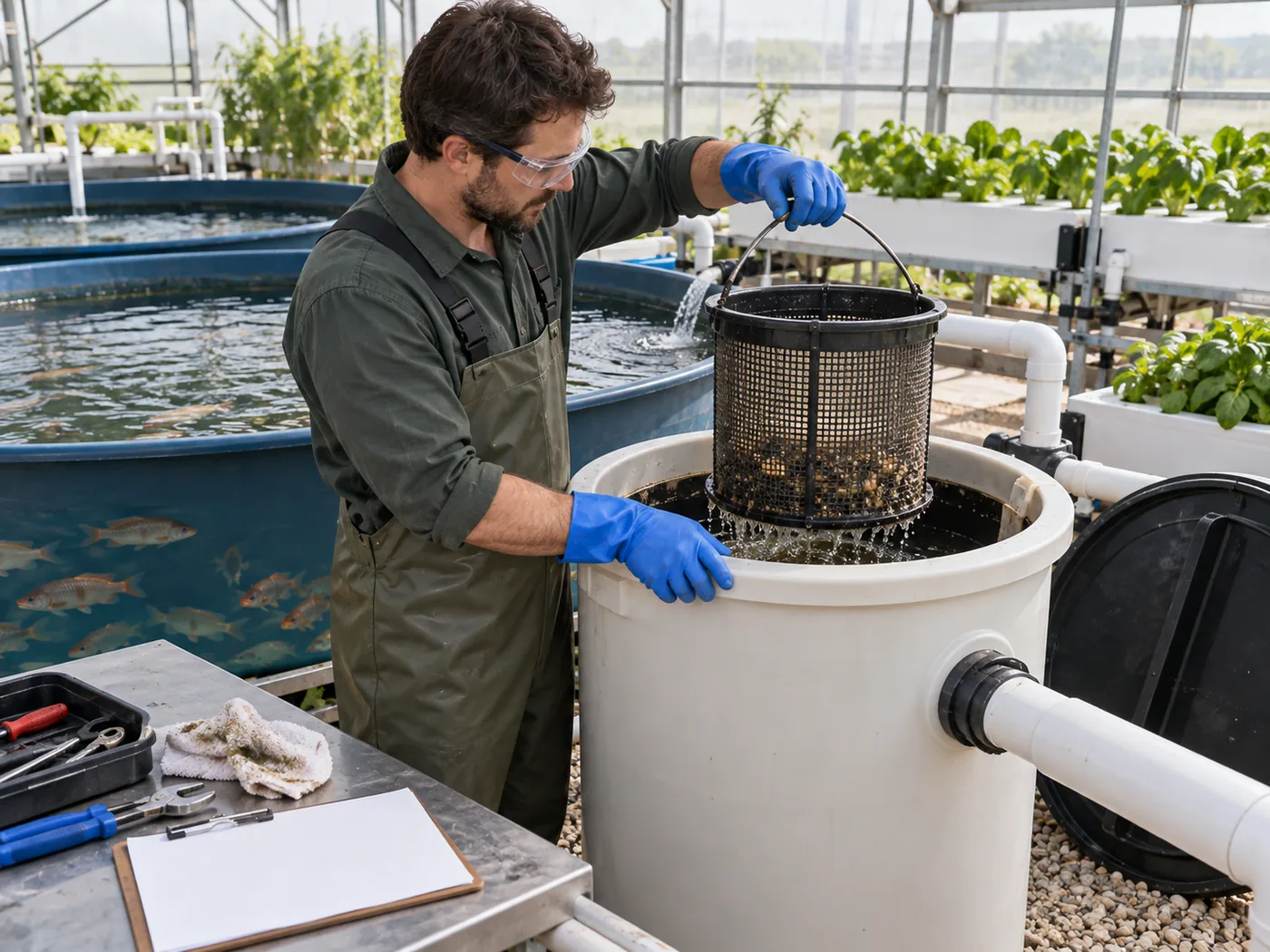
Water-quality testing
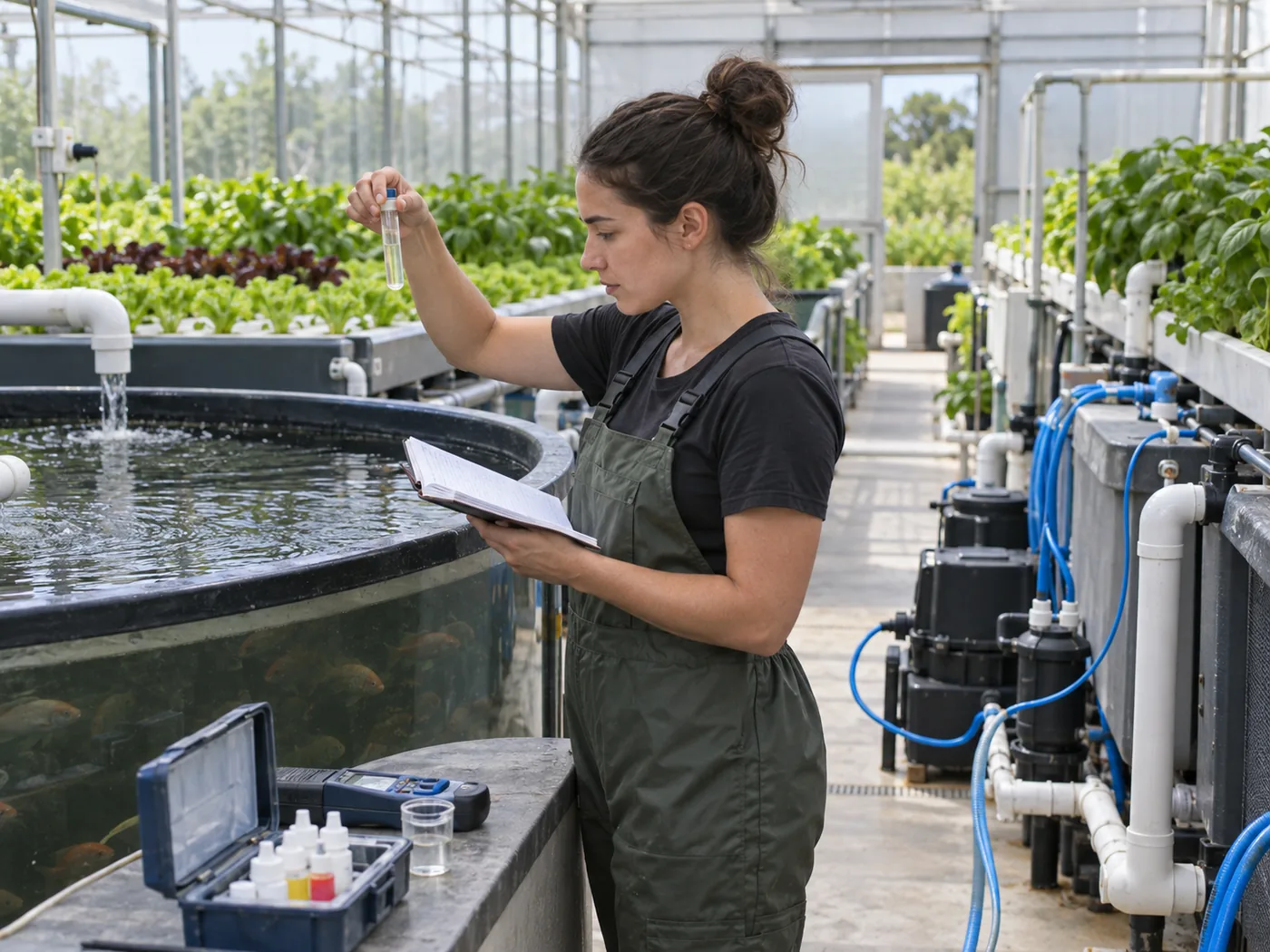
The exact test schedule depends on the system and its maturity, but weekly review often includes pH, ammonia, nitrite, nitrate, temperature and other parameters defined by the operating plan. Dissolved oxygen, alkalinity, hardness, electrical conductivity or source-water characteristics may be relevant depending on the project.
Test consistently: use clean containers, follow kit instructions, calibrate meters as required and record units, date, time and person performing the test. A single result is less useful than a trend next to feeding, water additions, weather, cleaning and fish observations.
Do not change several variables at once unless responding to an immediate emergency. If a result is unexpected, confirm it, inspect likely causes and record the response. This approach protects the biofilter and makes later troubleshooting possible.
Solids and filter service
Remove solids from clarifiers, screens or settling components according to the design and loading. Clean mechanical components in a way that restores flow without unnecessarily disrupting biological filtration. Do not aggressively sterilize every wet surface simply because the system is being cleaned; bacteria need stable habitat.
The job should specify where solids go after removal. Keep waste handling separate from crop harvest and potable-water areas. If solids are planned for composting or another reuse route, follow local food-safety, agricultural and environmental requirements.
Crop and plumbing inspection
Trim roots only where the crop and system layout require it. Check channels, standpipes, siphons, screens and drain inlets for obstruction. Verify that water distribution remains even across beds or troughs. In a raft system, inspect raft condition and access for planting and harvest; in NFT, focus on channel slope, root intrusion and clean flow; in media beds, look for uneven flooding, compacted media or solids buildup.
Monthly maintenance: review equipment and resilience
Pumps, air and controls
Inspect pump inlets, impellers where serviceable, air stones, air lines, check valves, sensor mounts and control enclosures according to manufacturer instructions. Look for wear, heat, corrosion, loose fittings and loss of output. Keep spare parts that are critical for the system’s risk profile, such as an air-pump diaphragm kit, spare pump, fuses, tubing or test reagents.
Biofilter and water path
Review whether water flows through the intended treatment sequence. Excess solids before a biofilter can reduce oxygen and cause clogging; a neglected filter can undermine fish and crop performance. Clean only the portions and in the manner defined by the maintenance plan. For the underlying biology, see what role bacteria play in an aquaponics system.
Emergency readiness
Test the communication path for alarms, verify backup aeration or power arrangements, and make sure staff know who can make decisions after hours. Inspect the emergency contact list, electrical safety provisions and access to isolation valves. A backup device that has never been checked is not a completed contingency plan.
Record review
At least once a month, compare water tests, feed use, fish behavior, crop output, water additions, electricity events, maintenance labor and corrective actions. Look for slow changes: increasing top-up water can indicate a leak; more frequent pump cleaning can indicate solids or root problems; lower feed response may signal water quality, temperature or health concerns.
How maintenance changes by system type
Media beds, raft systems, NFT channels and hybrids require different attention points. Do not copy a routine from another layout without checking the flow diagram and equipment manual.
- Media beds: inspect flooding/drainage, media condition and retained solids.
- DWC rafts: manage solids upstream, clean rafts and trough edges, and protect root-zone oxygen.
- NFT: prioritize pre-filtration, channel cleanliness, root control and pump-outage response.
- Hybrid systems: document the role of every filter, tank, valve and grow zone so staff know what can be isolated for service.
If the project is still stabilizing after installation, maintenance includes cycling discipline. Refer to how to cycle an aquaponics system for a controlled biological start-up sequence instead of treating a new system as fully mature.
What not to do during routine maintenance
Do not clean everything at once
Mechanical solids removal is important, but stripping all biological media and filters at the same time can disturb the bacteria that process nitrogen. Follow a staged plan where applicable.
Do not add unverified chemicals to the shared loop
Cleaning agents, pesticides, water treatments and supplements can affect fish, plants and biofiltration. Keep products controlled, labelled and evaluated for the application before use.
Do not treat records as paperwork only
The log is a diagnostic tool. It helps identify whether a change followed feed, temperature, top-up water, cleaning, a power interruption or a new fish delivery.
Do not delay a suspected electrical or oxygen event
Water, electricity and fish welfare can become urgent quickly. Isolate hazards safely, maintain aeration if possible and follow the site emergency procedure rather than improvising with unsuitable equipment.
A practical maintenance handover for B2B projects
When a system is shipped internationally, include the operating routine in the customer requirements and delivery package. The handover should connect the packing list and layout drawing to actual operating tasks: which pump serves which zone, where filters are cleaned, which valves isolate a bed, where water is tested, and who is responsible for daily checks.
At shipment inspection, confirm the equipment count, visible assembly quality, labels, spare items and manuals. At site commissioning, confirm utility connections, drainage, water flow, air supply, safety devices and local training. The distinction keeps expectations credible: factory testing can verify supplied equipment, while stable fish, plant and microbial operation must be established at the final site.
Turn observations into corrective action
The log should help the team decide what to do next. A falling water level may prompt a leak inspection and source-water review. Reduced flow may prompt screen, root and pump-inlet checks. A change in fish appetite may prompt a review of temperature, dissolved oxygen, ammonia, nitrite and recent handling. Yellowing plants may require a crop, nutrient, root-zone and pH review rather than an immediate unverified addition.
Keep corrective actions proportional. Confirm a surprising measurement with a second test where possible, identify the likely cause, change one controllable factor, then observe and record the result. This practice is especially important after a new fish delivery, a significant feed-rate change, a water-source change or a power interruption. It gives a remote supplier or local technician enough history to provide useful support.
Prepare a small critical-spares kit
The right spares depend on system design, but most projects benefit from a documented list of items that could stop circulation, aeration or measurement: a compatible backup pump or repair kit, air-line fittings, fuses, check valves, test reagents, calibration materials, basic seals and cleaning tools. Store them dry, labelled and separate from food-contact and harvest supplies. Review stock before the high-risk season rather than after a failure.
This is not an instruction to replace equipment without diagnosis. It is a way to shorten the response time when an identified critical part fails. The maintenance manual should identify the approved model and safe isolation procedure for each replacement.
Train the operating team around real scenarios
Maintenance training should use the site equipment, not only a generic presentation. Ask each operator to locate the pump inlet, air pump, critical valves, filter drain, electrical isolation point, test station, water top-up point and emergency contact list. Then walk through realistic scenarios: a blocked screen, low water level, a pump that runs but does not deliver flow, a failed air line, unexpected fish behavior or a test result outside the agreed range.
The purpose is not to make every staff member a fish-health specialist or electrician. It is to make sure they can recognize an abnormal condition, take the safe first action defined by the site procedure, record what happened and escalate quickly. This is especially valuable for schools, multi-shift greenhouses and export projects where the installer may not be physically present after commissioning.
Keep hygiene tools separated
Use clearly assigned tools and storage for fish-water work, crop harvest, floors, toilets and chemical handling. Cleaning equipment that moves between waste areas and production areas can create avoidable food-safety risk. Labeling, dry storage and a written cleaning sequence make the routine easier to follow. If a treatment, sanitizing action or pest-control measure is proposed, assess its compatibility with fish, plants, bacteria, food-contact surfaces and local regulations before it is used.
Review the SOP after any incident
After a power interruption, major leak, fish mortality event, pump failure or unexpected water-quality problem, hold a short review. What was observed first? Which action worked? Was a spare part available? Did the alarm reach the right person? Update the checklist or contact list while the event is still clear. A maintenance SOP should improve with real operating experience rather than remain unchanged in a binder.
FAQ
How often should I test aquaponics water?
Start-up, changes in stocking or feed, unusual weather and troubleshooting may require more frequent testing. A stable system may use a planned weekly routine, but the schedule should fit the fish species, system design and local technical guidance.
Can I rinse filters with tap water?
The safest method depends on whether the component is mechanical or biological and on local water chemistry. Avoid exposing established biological media to unsuitable disinfectants or removing too much biofilm at once. Follow the project maintenance plan.
What is the most important daily check?
There is no single substitute for the daily walk-through: fish behavior, water flow, aeration, leaks, water level and plant condition together give a better early warning than one check alone.
Should every operator be allowed to adjust pH or feed?
Assign authority clearly. Routine observations can be shared, but changes to feed, chemicals, pH, stocking or controls should follow a written decision process and be recorded.
Conclusion
Good aquaponics maintenance is routine observation, measured cleaning, trend-based water testing and prepared emergency response. The system stays healthier when staff can see the water path, reach filters, understand their responsibilities and record changes before they become larger losses.
Need an equipment package with a clearer operating handover? Contact Us with your system type, location, fish plan, crop plan and maintenance capacity. We can help you prepare a project-specific equipment and commissioning discussion.

