
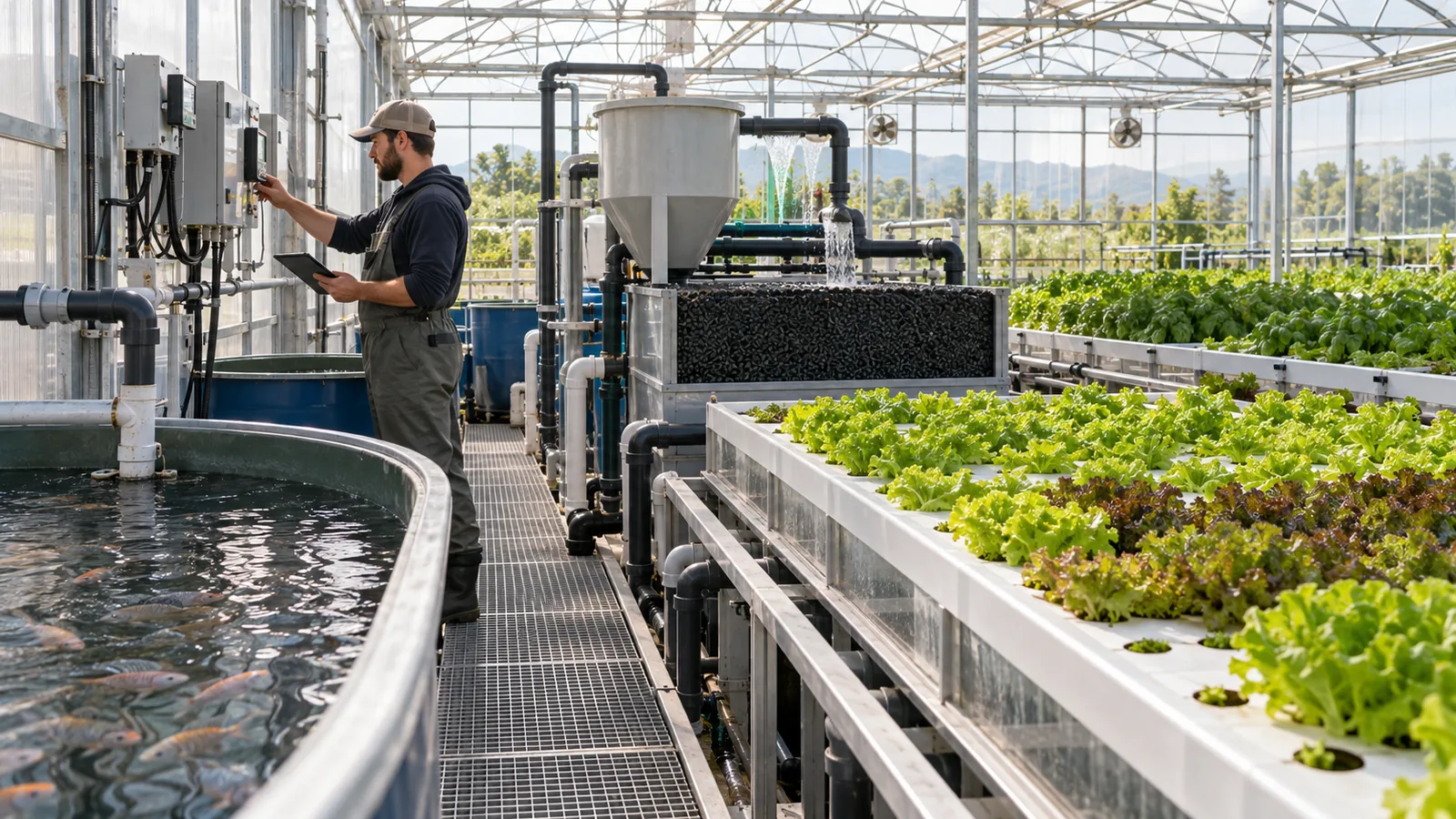
Aquaponics can help the environment by recirculating water, recovering part of the nutrients in fish waste for plant production, and producing fish and crops within one managed footprint. Those are useful advantages, but they are not automatic environmental guarantees. Pumps, aeration, heating, cooling, greenhouse construction, fish feed, replacement parts and local operating practices all affect the final result.
For overseas buyers, the most credible environmental conversation is therefore not “aquaponics is zero waste.” It is: which environmental pressures can this project reduce, which inputs remain significant, and what equipment and operating records are needed to prove improvement over time? This guide answers that question for greenhouse developers, farms, schools, distributors and project teams considering an integrated fish-and-plant system.
The short answer
Aquaponics can reduce fresh-water replacement and nutrient-rich discharge because water is recirculated and plant production can use dissolved nutrients generated by fish culture. It can also support compact controlled-environment production where soil quality, land availability or water scarcity are constraints. However, electricity and fish feed can be major contributors to environmental impact, particularly in climate-controlled facilities.
A commercial-scale life-cycle assessment from the University of South Florida found that electricity and feed were important contributors to impact, while water treatment and co-products could reduce certain burdens. Read the University of South Florida research record. Virginia Tech’s overview of aquaponics in recirculating aquaculture also explains how plant production can use nutrients that would otherwise require conventional treatment or discharge management. Read the Virginia Tech publication record.
These are useful decision references, not a reason to claim a fixed water, carbon or fertilizer saving for every site. A credible project measures its own water, energy, feed, crop and waste streams.
1. Water recirculation can reduce replacement demand
In a conventional open flow-through fish system, water is used once or exchanged frequently. In aquaponics, water is pumped through solids removal, biological filtration and plant-growing zones before returning to the fish side. The system still loses water through crop transpiration, evaporation, cleaning, harvest handling, leaks and occasional management actions, but it can operate with far less routine exchange than a flow-through arrangement.
That benefit is most relevant where a project has a constrained, expensive or variable water supply. It is not enough to install tanks and declare water savings. During installation preparation, the team should document the source-water quality, expected top-up route, drainage plan, leak-inspection points and meter locations. Once operating, log make-up water separately from wash-down water and discharge. Those records allow an owner to compare actual use with the production output rather than relying on a generic marketing percentage.
What buyers should ask
- Where will make-up water enter, and can it be conditioned safely before reaching fish?
- Which parts of the system are metered or can be practically monitored?
- How are filter flushes, solids and emergency water changes managed?
- Does the layout make leak detection and repair easy?
2. Plants can recover part of a nutrient stream
Fish feed is the principal nutrient input in a coupled aquaponics system. Fish retain only part of that feed for growth; the remaining nutrients appear in dissolved and solid waste streams. With appropriate solids management and biological filtration, some dissolved nutrients become available for plant uptake. This is the core environmental logic: a nutrient that would otherwise need separate treatment may contribute to a second crop.
The word some matters. Fish waste does not provide a perfectly balanced nutrient recipe for every crop at every growth stage. Crop plants may still need carefully managed supplements, and solids may require separate processing. A project should not promise that all fish waste becomes plant fertilizer, nor should it assume that vegetables alone eliminate every water-quality risk.
The practical design question is whether the fish biomass, feed rate, crop type and filtration capacity are matched. Our guide to how aquaponics is used in agriculture helps teams compare greenhouse, education and farm applications before they make environmental claims.
3. Controlled production can reduce pressure on soil and land
Aquaponics is soilless. That can be useful on sites with poor soils, limited urban land, saline conditions or an existing building or greenhouse suitable for controlled production. Plant spacing, water delivery, crop cycles and harvest access can be designed around the production goal rather than around field soil conditions.
This is not a claim that aquaponics replaces all field agriculture. Field production, hydroponics, recirculating aquaculture and aquaponics all have different strengths. The relevant environmental benefit is that a suitable aquaponics project can produce two types of food in a compact, managed area when site constraints make other systems less practical.
For procurement, assess land use honestly: include the footprint of tanks, filters, grow beds, packing, feed storage, walkways, drainage, utility equipment and service access. A dense diagram that omits maintenance corridors is not a more sustainable layout if it makes cleaning, harvest or repair difficult.
4. Recirculation can help limit nutrient discharge—but only when operated well
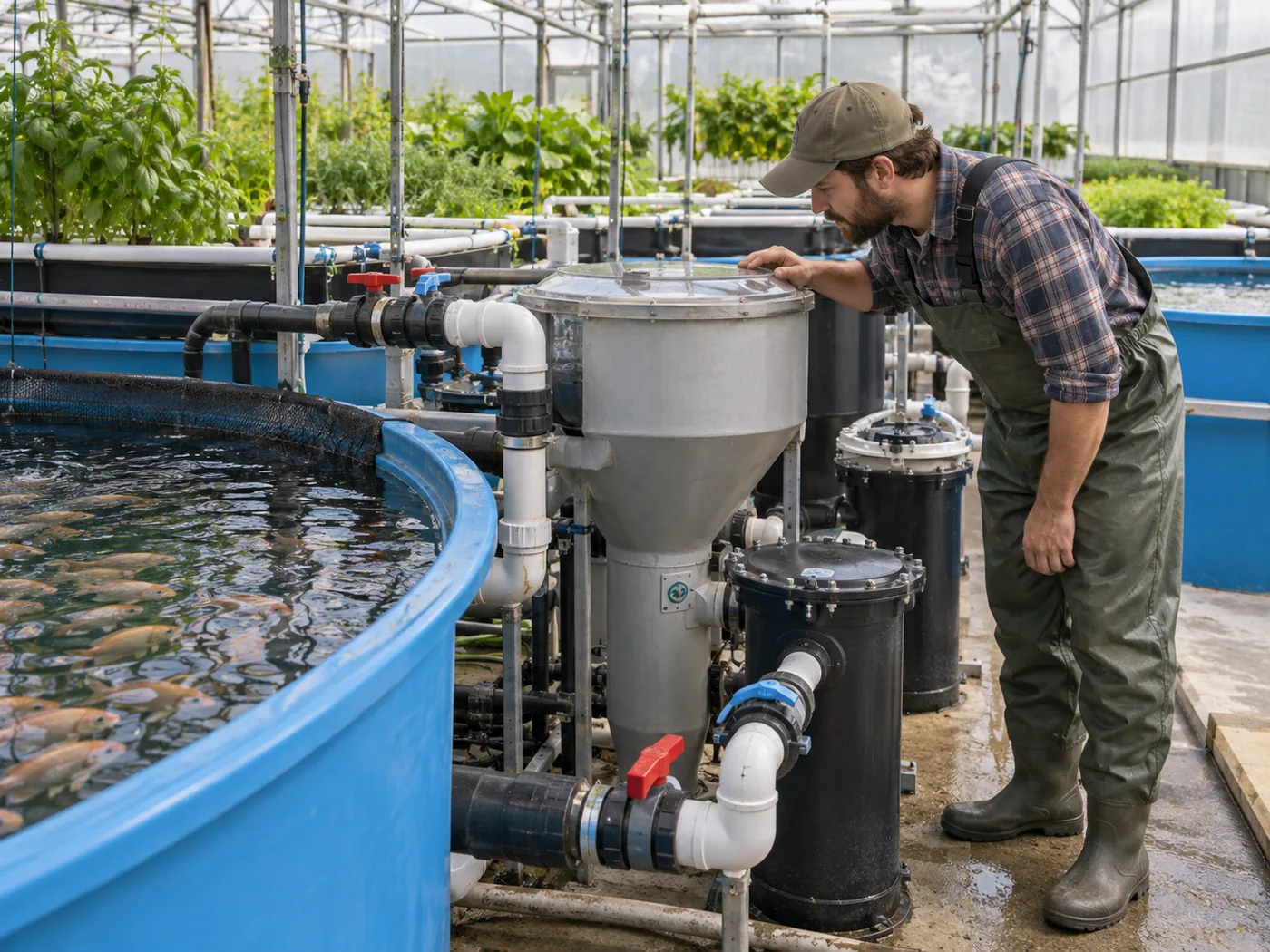
Nutrient discharge from aquaculture can contribute to local water-quality concerns if it is unmanaged. Recirculating systems reduce routine exchange, and aquaponics gives part of the dissolved nutrient stream a productive plant destination. Solids separators, mineralization strategies where appropriate, biofilters and crop beds each have distinct roles.
But recirculation concentrates responsibility. If solids are not removed, filters are neglected, feeding is excessive or an operator ignores rising ammonia and nitrite, the same water-saving loop can become unstable. The environmental benefit depends on daily operations: observing fish, checking flow and aeration, removing accumulated solids and keeping a record of adjustments.
That is why a supplier’s factory testing and shipment inspection should be described accurately. A factory can verify fabricated tanks, filter housings, plumbing assemblies, pumps, air equipment, packing condition and an agreed demonstration loop. It cannot prove future water savings, biological stability or nutrient recovery at a customer’s site. Those outcomes must be verified after commissioning under local water, climate, crop and fish conditions.
5. Environmental performance has energy and feed boundaries
The strongest sustainability articles acknowledge trade-offs. An aquaponics system normally needs power for water circulation and aeration. A greenhouse in a cold or hot climate may also need heating, cooling, ventilation, dehumidification, lighting or controls. Fish feed has its own production and transport footprint. Pumps, media, plastic components and building materials also matter over the life of a project.
Energy use can be especially important in projects that maintain warm-water fish through a cold season or use intensive supplemental lighting. Before purchase, request a clear electrical load list: pumps, air blowers, heaters, controls, lighting and backup equipment. Separate equipment included in the supplier scope from site systems supplied by others. This avoids claiming a low-impact installation while overlooking the largest utility loads.
Better questions than “Is aquaponics green?”
- What water source, top-up volume and discharge route will the site use?
- Which fish species and crops fit the local climate with the least additional conditioning?
- What is the expected electrical demand by component and season?
- Which local energy source will operate the pumps, air and climate equipment?
- How will feed use, mortality, crop losses and solids be recorded?
6. System design determines whether the benefit is practical
Aquaponics systems are not identical. Media beds, deep-water culture rafts, nutrient film technique channels and hybrid layouts place different demands on filtration, water volume, cleaning access and crop management. For example, small channels need very clean flow and dependable pumping; raft systems require carefully managed solids removal and aeration; media beds may provide biological surface area but can accumulate solids if neglected.
Selecting the growing method is therefore an environmental and operational choice, not a visual preference. A layout that suits the crop, service routine and water-treatment process is more likely to maintain recirculation without unnecessary loss. Compare the formats in our guide to the different types of aquaponics systems.
7. Build an environmental record from commissioning onward
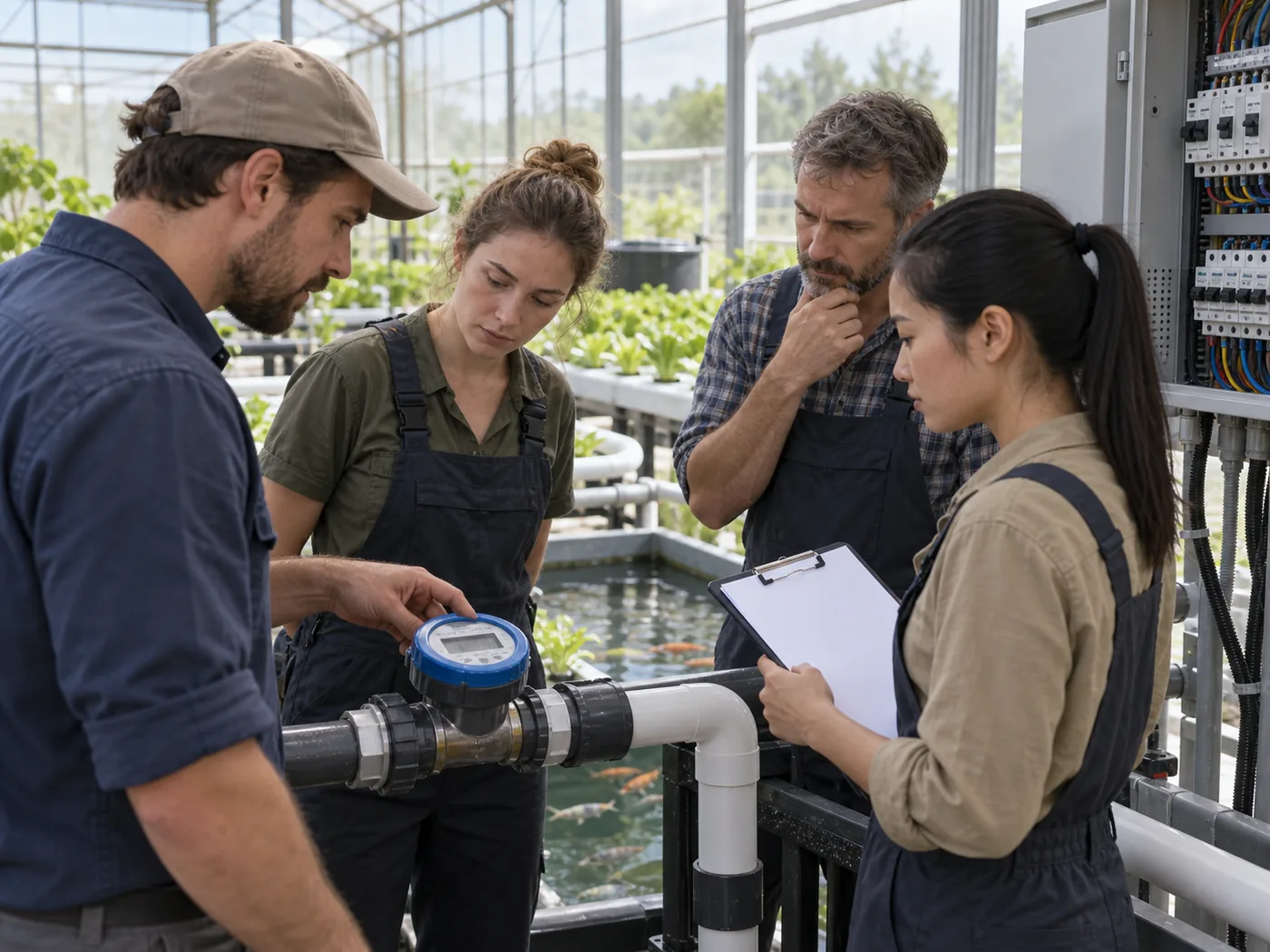
If a buyer wants credible sustainability reporting, start with a practical baseline during installation and commissioning. Keep the record manageable enough that staff will use it.
At installation preparation
Record source-water test results, equipment list, tank and grow-bed volume, expected fish species, crop plan, electrical supply, drainage route and any planned heating or cooling equipment. Photograph meter locations, valve labels and service points as part of handover documentation.
During the first production cycle
Track water added, water discharged, feed used, plant harvest, fish mortality, crop losses, electricity where separately metered, filter cleaning and major maintenance. Explain unusual readings or losses in the log rather than deleting inconvenient data.
At review time
Compare outputs with inputs over a defined period. If water demand is high, inspect leaks, flush routines, climate conditions and crop transpiration. If energy demand is high, review insulation, temperature set points, pump duty, aeration design and lighting schedule. The point is continuous improvement, not a one-time sustainability slogan.
Match environmental goals to the project type
Different projects should measure different outcomes. A school system may prioritize a visible nutrient-cycle lesson, safe fish care and a simple water-use record. An urban greenhouse may focus on crop output per usable floor area, water top-up and electricity use. A commercial farm may need documented solids handling, discharge control, food-safety routines and seasonal energy data. A distributor may need to confirm that a modular package can be packed efficiently, installed without unnecessary rework and supported locally.
This is where customer requirements matter. Ask the buyer to state whether the primary objective is education, food production, demonstration, water management, research or a combination. Then specify equipment and records that match that purpose. Environmental benefits are more credible when the metric follows a defined operating goal.
Procurement checklist for a lower-impact scope
Before release for production, verify tank and grow-bed materials, pump and blower ratings, insulation interfaces, pipe lengths, filter service access, meter points, packaging method and spare-parts list. During shipment inspection, confirm the equipment list against the approved scope and record any site-supplied utilities that are excluded. This avoids a common problem: a project claims efficiency while the final installation requires unplanned replacement parts, extra pumps or an unsuitable water-treatment arrangement.
At commissioning, compare the design drawing with the installed water path. Confirm that filter cleaning, solids removal and drainage can be completed without carrying waste through the crop or packing area. A well-documented handover does not make a project impact-free, but it gives the operating team a practical route to reduce avoidable losses.
Example: how a greenhouse team can improve the baseline
Consider a greenhouse project that begins with a water meter at the make-up tank, an electrical submeter for pumps and aeration, and a weekly record of feed and harvest. In the first month, the team may discover that most water use occurs during filter flushing rather than crop transpiration, or that a pump is operating for longer than the original process drawing assumed. That evidence can lead to a practical improvement: repair a leak, revise a cleaning interval, improve a cover or alter a pump-control schedule.
The lesson is not that one meter proves sustainability. It is that small, verifiable operating changes can be more valuable than broad claims. A supplier can support this process by providing flow diagrams, equipment data sheets, spare-parts recommendations and clear maintenance access. The customer can support it by assigning an operator and retaining the records after handover.
Consider transport and service life
For an export project, environmental choices also include packing efficiency, component durability and repairability. Modular equipment that can be inspected, packed securely, installed with standard tools and serviced with available spare parts may avoid premature replacement. Ask how tanks, pipes, valves, pumps and media are protected in shipment, which items are consumable, and what can be maintained locally. Long service life is not a headline claim; it is the result of suitable material selection, documented installation and routine care.
Common environmental claims to avoid
“Aquaponics uses no water.”
It recirculates water but still needs make-up water and may require cleaning or emergency management. Measure rather than claim zero use.
“There is no waste.”
Solids, spent media, damaged plants, fish mortalities, packaging and occasional discharge still need responsible handling.
“It always has a lower carbon footprint.”
The result depends heavily on climate control, electricity source, feed, construction, transport and production performance.
“Plant beds replace all treatment equipment.”
Plants contribute to nutrient uptake, but solids removal, biofiltration, aeration and monitoring remain necessary.
FAQ
Does aquaponics save water compared with conventional farming?
It can reduce water replacement because the system recirculates water, especially compared with flow-through fish production. The amount saved is site-specific and should be measured against water added, discharged and harvested production.
Does aquaponics eliminate fertilizer use?
Fish feed supplies nutrients, but crop needs may not always match the nutrient profile available in the water. Supplements can be needed depending on crop, source water and operating conditions.
Is aquaponics suitable for an environmental education project?
Yes, provided the project has accountable daily operators, safe electrical and water arrangements, a fish-care plan and a realistic maintenance schedule. Its visible water and nutrient cycle can be valuable for education, but it is still a living production system.
What is the largest environmental risk in a commercial project?
There is no single answer. Energy demand, feed sourcing, poor solids management, preventable leakage and unplanned discharge can each be significant. A project should identify and monitor its major local risks.
Conclusion
Aquaponics can help the environment through water recirculation, nutrient recovery, compact production and reduced routine discharge. The result is strongest when the system is designed for the local climate and operated with measured inputs, practical maintenance and transparent records. It is not a zero-input system—and treating it as one can create poor decisions.
Planning an aquaponics project with measurable environmental goals? Send Your Requirements with your location, water source, crops, fish plan and utility conditions. We can help you prepare a clearer equipment and commissioning discussion.

