
Introduction
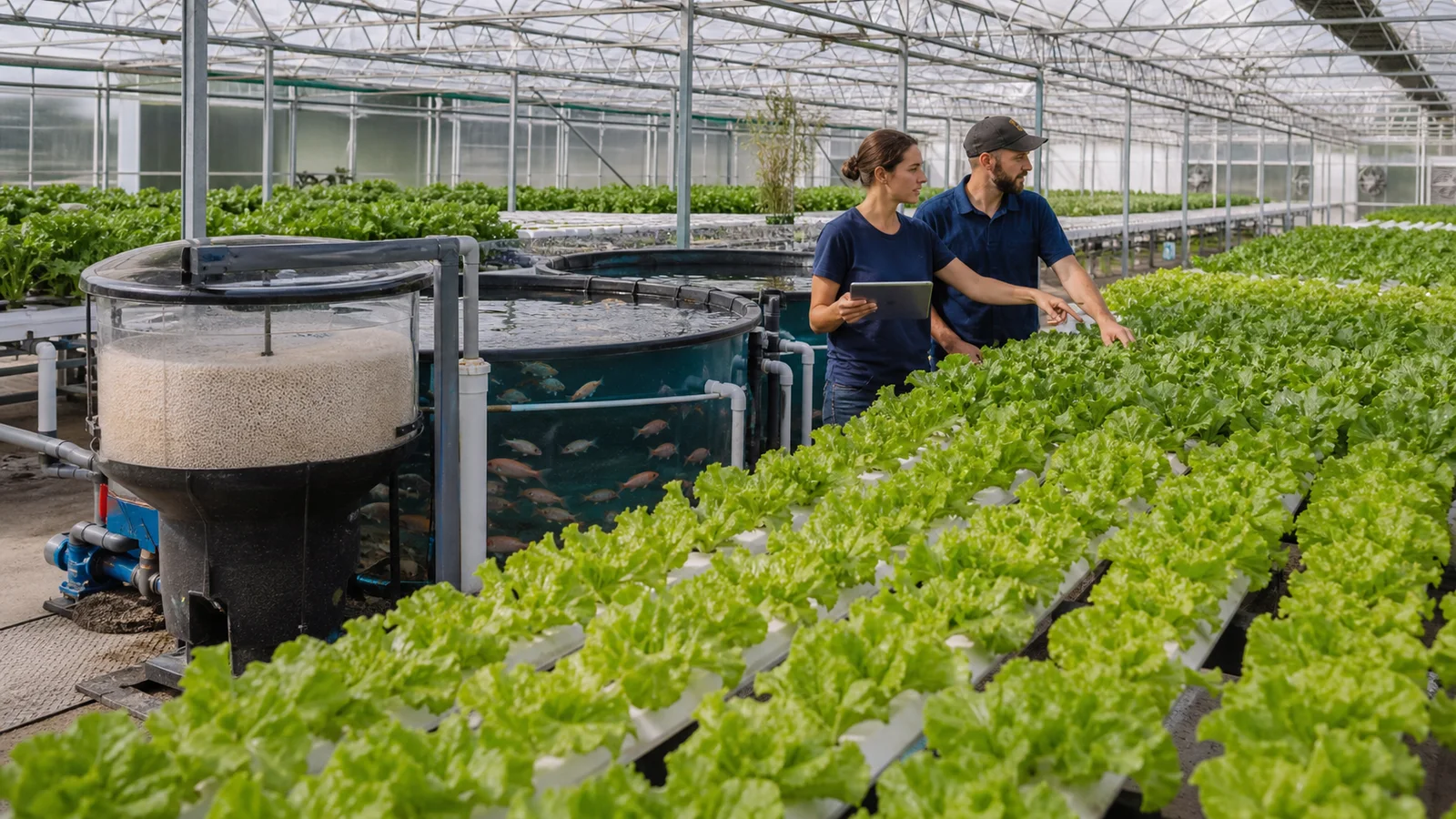
Aquaponics is used in agriculture as a managed production approach that links aquaculture with soilless crop growing. In practice, it can support greenhouse leafy greens and herbs, mixed fish-and-vegetable projects, education farms, research facilities, community food initiatives and selected controlled-environment agriculture (CEA) operations. It is not a replacement for every field crop, nor is it a simple way to avoid farm planning.
The agricultural value of aquaponics comes from integration: nutrient-bearing fish water is treated, monitored and used in plant production while the water is recirculated or managed through a defined system design. The operational challenge is equally integrated. Fish welfare, crop quality, water chemistry, energy, climate, food safety, labour and market access must be planned together.
This guide focuses on where aquaponics can fit in agriculture, what application models look like and how a farm team should evaluate the opportunity. If you first need the biological explanation, see What Is Aquaponics?.
Where Aquaponics Fits in Modern Agriculture
Aquaponics is usually most relevant where a grower is already considering controlled conditions, water management and high-value crops. It may operate in a greenhouse, insulated building, urban farm, research centre, school or community facility. The production design can be coupled, with water returning to fish after plant treatment, or decoupled, with water moving one way from aquaculture to plant production under separately managed conditions.
UC Davis describes aquaponics as using aquaculture effluent as a fertilizer source for fruits and vegetables and highlights applications in controlled-environment agriculture, nutrient reuse and commercial research. Its aquaponics program overview is a useful reminder that agricultural application is broader than one standard layout or one crop.
For a farm, the question is not “Can aquaponics grow food?” It is “Which production problem does it solve here, at this scale, with these markets and operating resources?” A good answer may involve production, education, diversification or research—but it needs a defined business and management model.
Five Practical Agricultural Applications
1. Greenhouse leafy greens and herbs
Leafy greens and herbs are common candidates because they can fit rafts, channels or media systems and can be grown in planned, staggered cycles. Lettuce, basil, Asian greens, mint and similar crops may suit a system when temperature, plant density, harvest schedule and nutrient availability are compatible.
This does not mean every leafy crop will perform identically. Crop choice should reflect local buyer demand, greenhouse climate, plant health practices, harvest specification, packaging and labour. A restaurant or retailer may need a certain variety, root condition, size and delivery schedule; those requirements should be decided before system capacity is presented as a sales claim.
2. Fish-and-produce farm diversification
Some farms use aquaponics to add a controlled-environment crop line alongside existing aquaculture or horticulture activity. The opportunity may be to use treated nutrient streams, broaden the product mix or create a year-round customer offer. The risk is assuming that two outputs automatically create two profitable businesses.
Fish sales, plant sales, feed, seed, packaging, energy, labour, maintenance, processing and delivery need separate cost and market assumptions. A project plan should show who manages each activity and what happens when one side of the system changes. For example, a lower fish-feed rate can affect crop nutrients; an unplanned crop gap can change nutrient uptake.
3. Urban and peri-urban food production
Aquaponics can be considered where land is limited but a greenhouse, building or warehouse has adequate utilities, drainage, loading access and a nearby customer base. Urban location alone is not enough. Operators still need reliable water, electricity, ventilation, waste-management procedures, staff and a clear route to market.
The smaller footprint of CEA may support local production, but enclosed production can raise energy, climate-control and maintenance requirements. Before installation, assess heat load, humidity, backup power, water-source quality and service access. A clean-looking room without drainage or emergency aeration is not production-ready.
4. Education, extension and demonstration farms
Schools, agricultural colleges, visitor centres and community projects can use aquaponics as a visible teaching platform. The system can connect biology, water testing, engineering, crop production, animal care and recordkeeping in one setting. A modest, observable system can be more useful than a large unit whose maintenance exceeds staff capacity.
For these sites, plan holiday care, handover notes, safe public access, training, fish-welfare responsibility and a clear policy for harvest or disposal. Educational value comes from transparent operation—including routine tests and maintenance—not only from a finished greenhouse photograph.
5. Research, trials and product development
Universities, suppliers and advanced growers may use aquaponics to test crop varieties, nutrient management, water treatment, controls, sensors, growing methods or decoupled production approaches. A trial system should define the question being tested, the measurements, the control conditions and the limits of any conclusion.
Do not turn a small trial result into a broad commercial promise. A research facility and a farm can share equipment categories, but their economics, staffing, biosecurity and data requirements may be different.
What an Agricultural Aquaponics System Needs
A site prepared for water, power and service
Every agricultural system begins with the site. Confirm water source, make-up-water treatment, drainage, floor loading, electrical supply, ventilation, lighting, crop access, fish access, unloading route and maintenance clearance. For greenhouses, include seasonal heat, cold, humidity and shade conditions—not just the building dimensions.
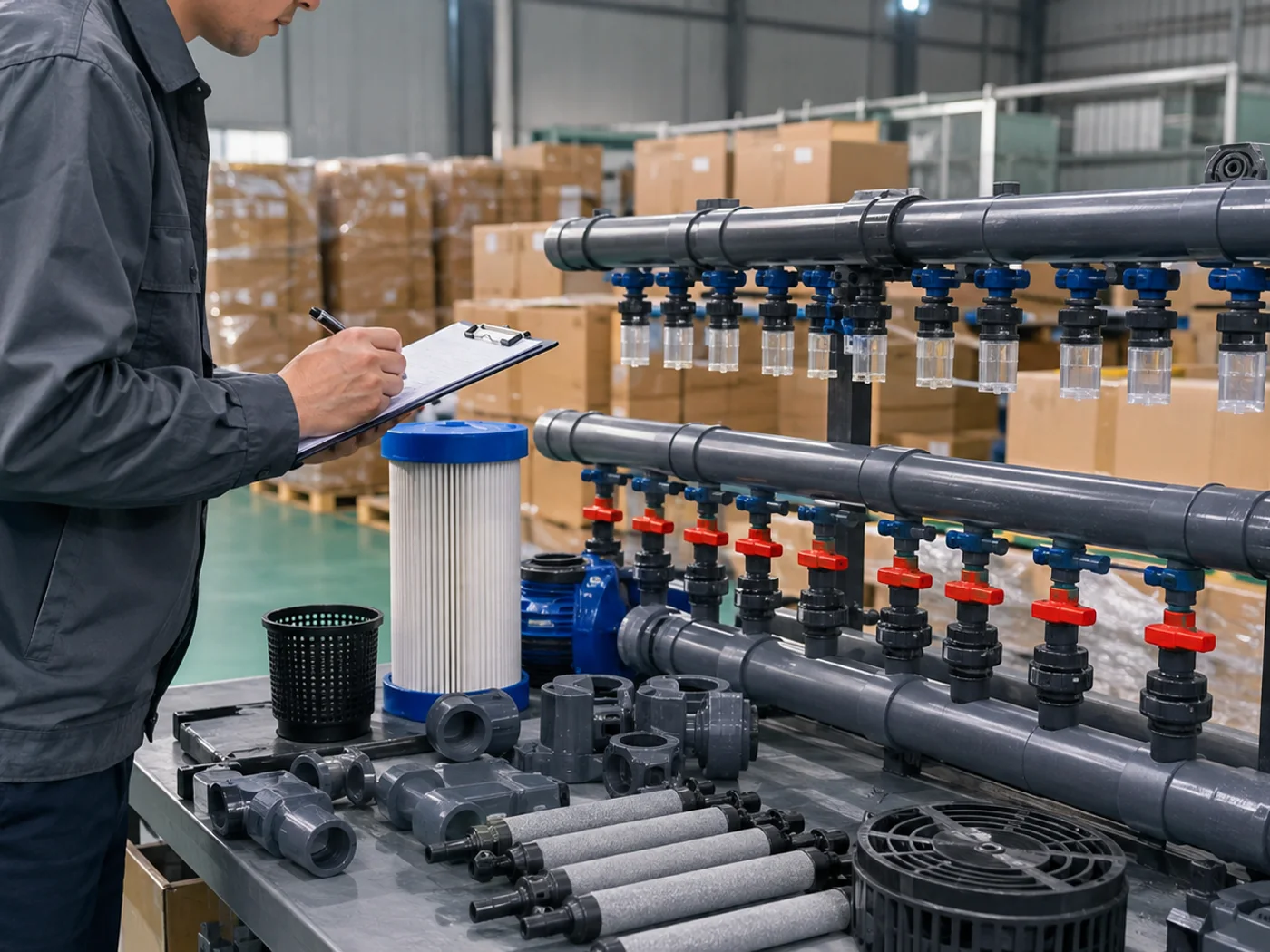
Installation preparation is part of risk control. Tanks and grow beds must be level; filters must be reachable; plumbing needs isolation points; electrical work must meet local code; and an outage response must be defined. During shipment inspection, a buyer can confirm the equipment count and visible configuration, but site plumbing, commissioning and biological start-up still require local work.
A production plan that matches feed and crops
Plants use nutrients at different rates as they grow. Fish generate nutrient inputs through feed, not through a fixed number of fish. The plant schedule, harvest rhythm and fish-feeding plan need to be considered together. Staggered planting can help create steadier demand than planting and harvesting the entire greenhouse at once.
The Southern Regional Aquaculture Center’s commercial greenhouse crop guide discusses crop systems that can be adapted to aquaponic production and the importance of greenhouse production foundations. It is useful for evaluating crop and growing-method claims before ordering equipment.
Water-quality and biosecurity routines
An agricultural aquaponics system needs a routine for observing fish, inspecting roots, cleaning solids-management equipment, recording water conditions and responding to equipment faults. The exact testing plan depends on species and design, but temperature, pH, nitrogen compounds, dissolved oxygen, water level, pump performance and air flow are common operating concerns.
Biosecurity and food safety also need site-specific planning. Control visitor access where appropriate; establish procedures for tools, inputs, fish handling and plant harvest; and understand local produce and aquaculture rules. Avoid broad claims such as “chemical-free,” “organic” or “food-safe” unless the project can meet the relevant definition and documentation.
Choosing an Agricultural System Model
Coupled production
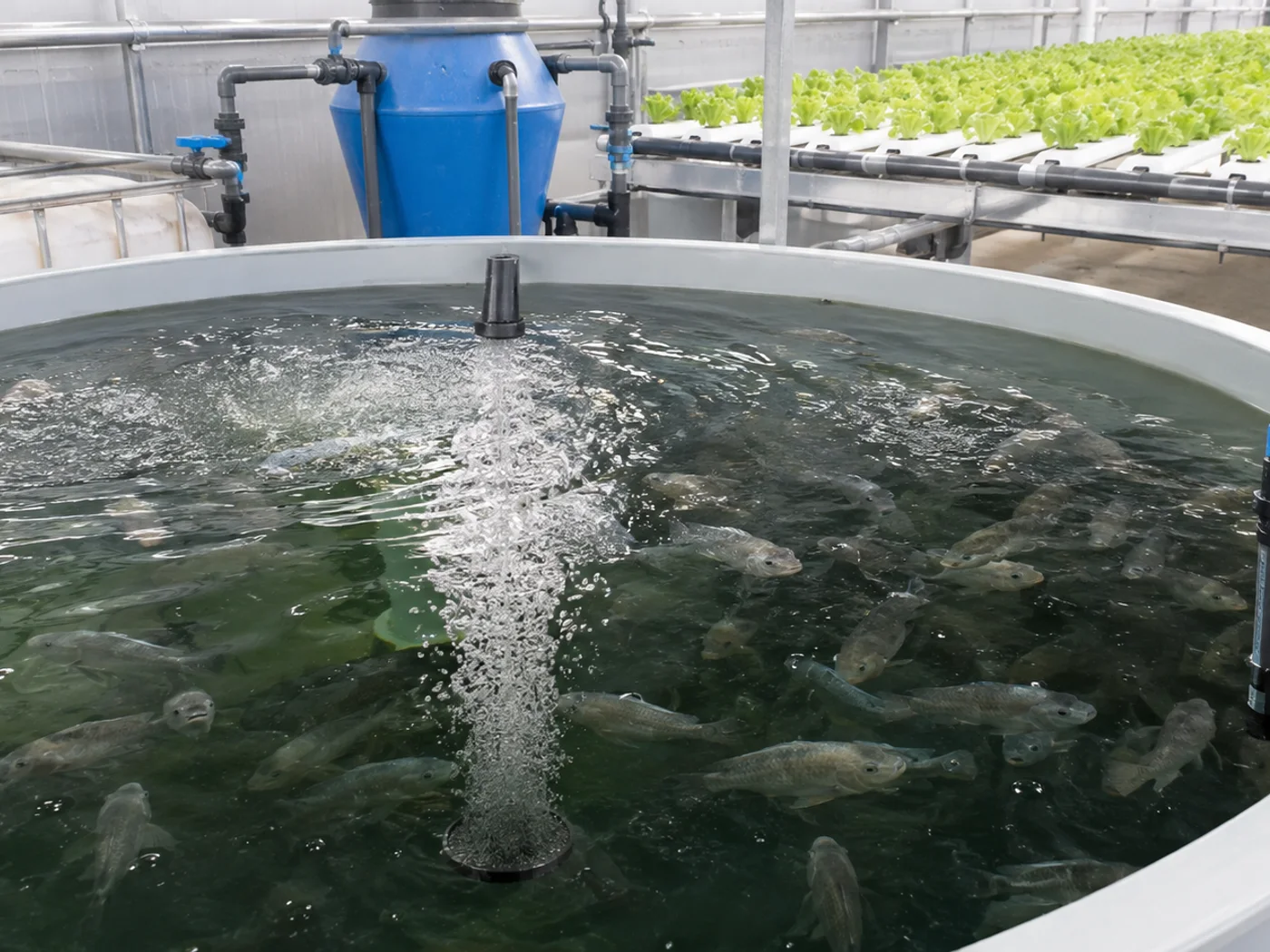
In a coupled system, fish, bacteria and plants share a recirculating water loop. This can be an integrated educational or production model, but it requires careful compromise between fish and plant conditions. Changes intended for one part of the system can affect the others.
Decoupled production
In a decoupled model, water can move from aquaculture to the plant side without being returned to fish. This may offer more flexibility for crop management, but it brings additional equipment, water, nutrient and operational decisions. It is not automatically easier or more profitable.
For an in-depth comparison, use Coupled vs Decoupled Aquaponics. The right choice depends on the crops, fish, climate, operator skill and business model.
Media beds, DWC and NFT
Media beds can provide root support and biological surface area, but they need solids and cleaning management. Deep-water culture can be suitable for organised leafy-green production when aeration and solids control are reliable. NFT can be efficient for selected crops but needs clean water, level channels and strong contingency planning because roots or solids can restrict flow.
Do not choose a growing method from a product photo. Ask for a process-flow drawing, a component list, cleaning access, pump duty, air system, filter sequence and a description of what happens during a power interruption.
Turn an Agricultural Idea Into an Operating Model
An agricultural aquaponics project becomes credible when it is translated into daily work. Define who checks the fish before feeding, who records water tests, who harvests and packs crops, who cleans solids-management equipment, who receives an alarm and who can make decisions when readings move outside the expected range. A greenhouse can look complete at handover while still lacking the labour plan required to operate it safely.
Build a weekly rhythm before the first order is placed. It might include feed and fish observations every day; a documented inspection of pumps, filters, air supply and water readings; staggered seeding and transplanting; planned harvest days; sanitation tasks; and a review of energy and water use. The exact schedule depends on the system, but assigning ownership is more important than writing an impressive equipment list.
Separate the production claims from the operating assumptions
When evaluating suppliers, ask which performance statements are based on an agreed crop, climate, fish species, feed rate and operating schedule. Avoid presenting a theoretical plant capacity as an annual sales forecast. Crop yield and fish growth change with seedling quality, disease pressure, weather, water quality, labour, market specification and downtime.
It is better to state the physical scope clearly: number and type of tanks, plant-growing area, filtration stages, pump duty, aeration equipment, controls, materials, electrical requirements, packing and installation exclusions. Then let the farm develop its own validated production and market targets. This is more trustworthy for purchasers and more useful for later expansion.
Use phases when uncertainty is high
For a new market or a team new to aquaculture, a pilot can reduce risk. The pilot should have a stated objective—such as validating water source, crop acceptance, fish supply, operator training or energy use—and a review point before expansion. It should not be marketed as automatic proof that a larger facility will operate with the same economics.
Phased installation also helps the site team learn commissioning tasks. They can test leaks, observe return flow, establish the biofilter, document normal readings and refine crop routines before a larger fish biomass or full planting area is introduced. A factory inspection before shipment confirms the agreed equipment; the controlled pilot confirms whether the site can operate it as intended.
Agricultural Risk Controls Worth Planning Early
Water and nutrient risk
Test the source water and document how make-up water will be treated. Water conditions can change by season or source. Keep records of water additions, filter maintenance, feed changes and crop observations, because these events can explain a later trend in pH, nitrogen compounds or plant condition.
Energy and climate risk
Pumps, aeration, ventilation, heating, cooling and lighting can all be essential to the selected production model. Identify which loads require backup, what event triggers a response and what can be safely paused. Calculate energy costs with local rates and actual seasonal conditions instead of assuming a greenhouse has one constant operating cost.
Market and traceability risk
Define the product, buyer and pack-out requirement before choosing the crop calendar. Keep harvest, batch and maintenance records appropriate to the local regulatory and customer context. A farm supplying restaurants may require different harvest timing and packing than an education site or direct-market operation.
A Pre-Order Checklist for Farm Teams
Prepare the following before requesting a commercial proposal:
- Farm location, structure type and seasonal climate data
- Water source and available treatment approach
- Electrical standard, capacity and backup-power expectation
- Drainage and legal wastewater route
- Intended fish, crops, growing method and market outlets
- Target planting and harvest schedule
- Daily operator and maintenance responsibility
- Food-safety, processing and aquaculture compliance questions
- Loading access, installation constraints and available service clearance
- Required training, manual language, spare parts and commissioning support
This brief reduces vague quotations and enables a supplier to align tank configuration, filtration, grow beds, pumps, aeration, controls and packing with the actual project. It also creates a clear checklist for factory testing and shipment inspection.
Mid-article CTA — Request an Agricultural Project Checklist
Send YAFAN your site, crops, fish plan and destination country. We can help you prepare the equipment information needed for a structured agricultural aquaponics inquiry.
FAQ
Can aquaponics replace soil farming?
No. It is one production approach, generally suited to defined crops and controlled or managed environments. Whether it fits a farm depends on site, market, skills, costs and regulations.
Which crops are most suitable for agricultural aquaponics?
Leafy greens and herbs are common starting crops, but the right choice depends on temperature, nutrients, market specification, production schedule and system design.
Is aquaponics suitable for commercial agriculture?
It can be, but commercial success depends on validated markets, skilled operation, dependable utilities, production planning and risk management. Equipment alone does not create a commercial model.
Can an existing greenhouse use aquaponics?
Possibly. Assess structural layout, water, drainage, electricity, ventilation, temperature control, loading access and available maintenance space before selecting equipment.
What should a farm request from a supplier?
Request a process-flow drawing, itemised equipment list, electrical specification, materials, installation information, packing list, testing scope, manuals, exclusions and recommended spares.
Conclusion
Aquaponics is used in agriculture where a project can manage fish culture, plant production and water treatment as one operating system. It can support greenhouse crops, diversification, urban production, training and research, but it requires a real site plan, a production schedule and accountable daily management.
The strongest next step is to translate the agricultural goal into technical requirements: which crops, which fish, which growing method, how much feed, what water and power infrastructure, and who operates the site. For capacity planning, continue with How Many Fish Should You Put in an Aquaponics System?.
Final CTA — Discuss an Agricultural Aquaponics Project
Contact YAFAN with your farm application, greenhouse dimensions, crop plan and country for a preliminary system discussion.

