
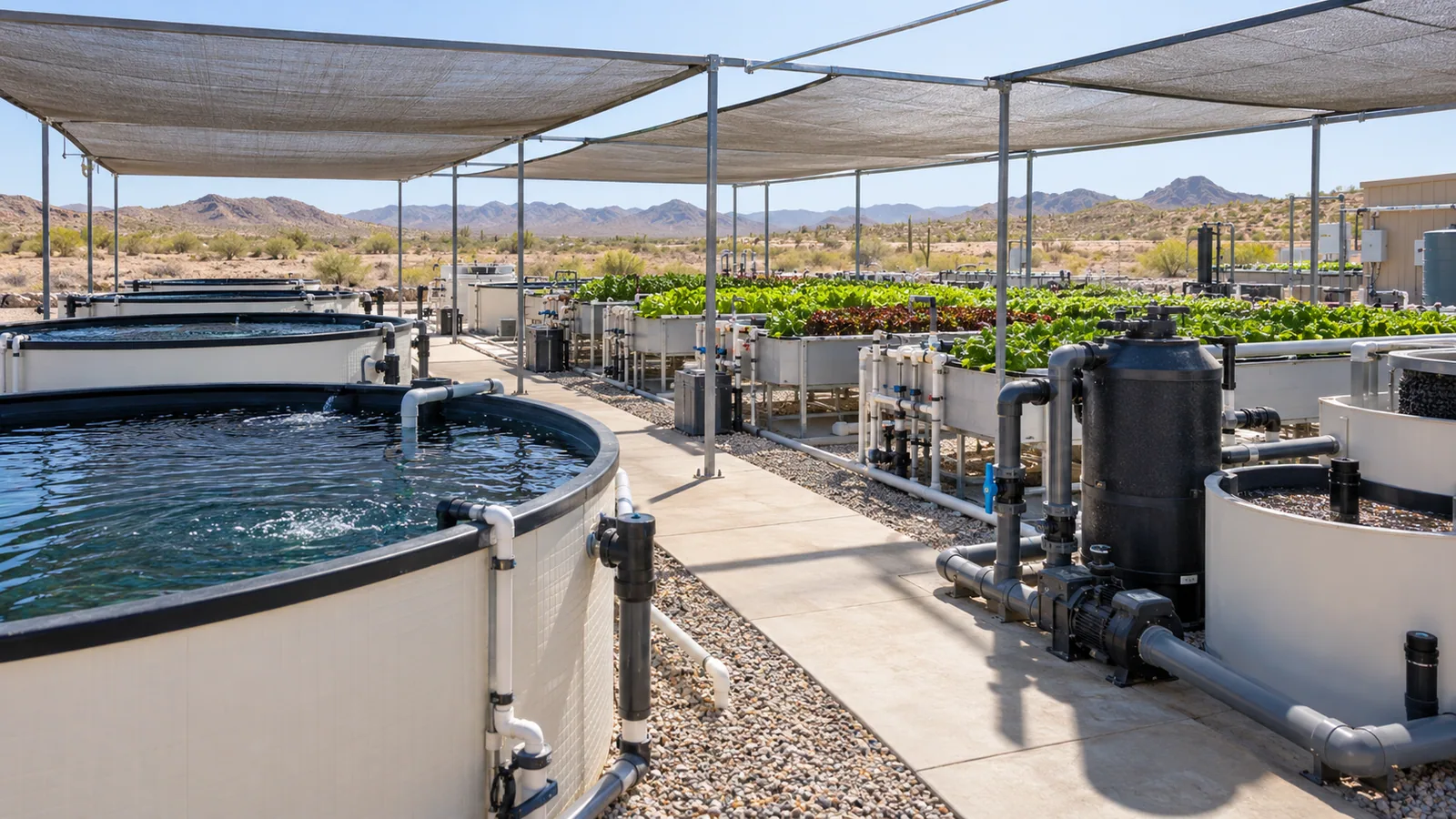
Yes, an aquaponics system can operate outdoors in a desert climate, but it should be designed as a heat-, evaporation- and utility-management project rather than a standard backyard system placed in full sun. The main challenges are high water temperature, intense solar radiation, low humidity, wind, rapid evaporation, source-water mineral accumulation, plant heat stress and the increased importance of reliable aeration. A workable project normally needs shade, insulated or protected tanks, measured make-up water, climate-appropriate fish and crops, accessible filtration and a power-outage response.
Aquaponics can reduce routine water replacement because water is recirculated, but it does not eliminate water use. Plants transpire, water evaporates and filters require cleaning. In a desert site, those losses and the quality of replacement water can determine whether the system remains stable. The correct question is therefore not simply “Will aquaponics work in the desert?” but “Can this site keep water, fish, plants and equipment within a manageable operating range throughout the hottest and coldest periods?”
Begin with climate and site data
Use local monthly and daily climate data rather than a general label such as “hot.” Record typical and extreme air temperatures, solar exposure, nighttime temperature drop, humidity, wind, dust events and seasonal frost risk. Measure the exact proposed location at different times of day; a wall, roof edge or nearby building can create useful afternoon shade or unwanted reflected heat.
The University of Arizona notes that aquaponics in hot, dry conditions requires attention to shade, cooling, aeration, water quality and species selection, while reliable power and daily monitoring remain important project conditions. Its aquaponics overview for Arizona and similar arid regions provides a useful climate-specific starting point.
For a commercial or community project, create a site-readiness sheet covering water source and pressure, laboratory water analysis where appropriate, drainage route, electrical service, backup power, delivery access, security, wind exposure, floor or foundation loading and maintenance clearance. Installation preparation should resolve these interfaces before tanks and grow modules arrive.
Shade the system without creating a dark, stagnant enclosure
Protect the fish tank and treatment equipment
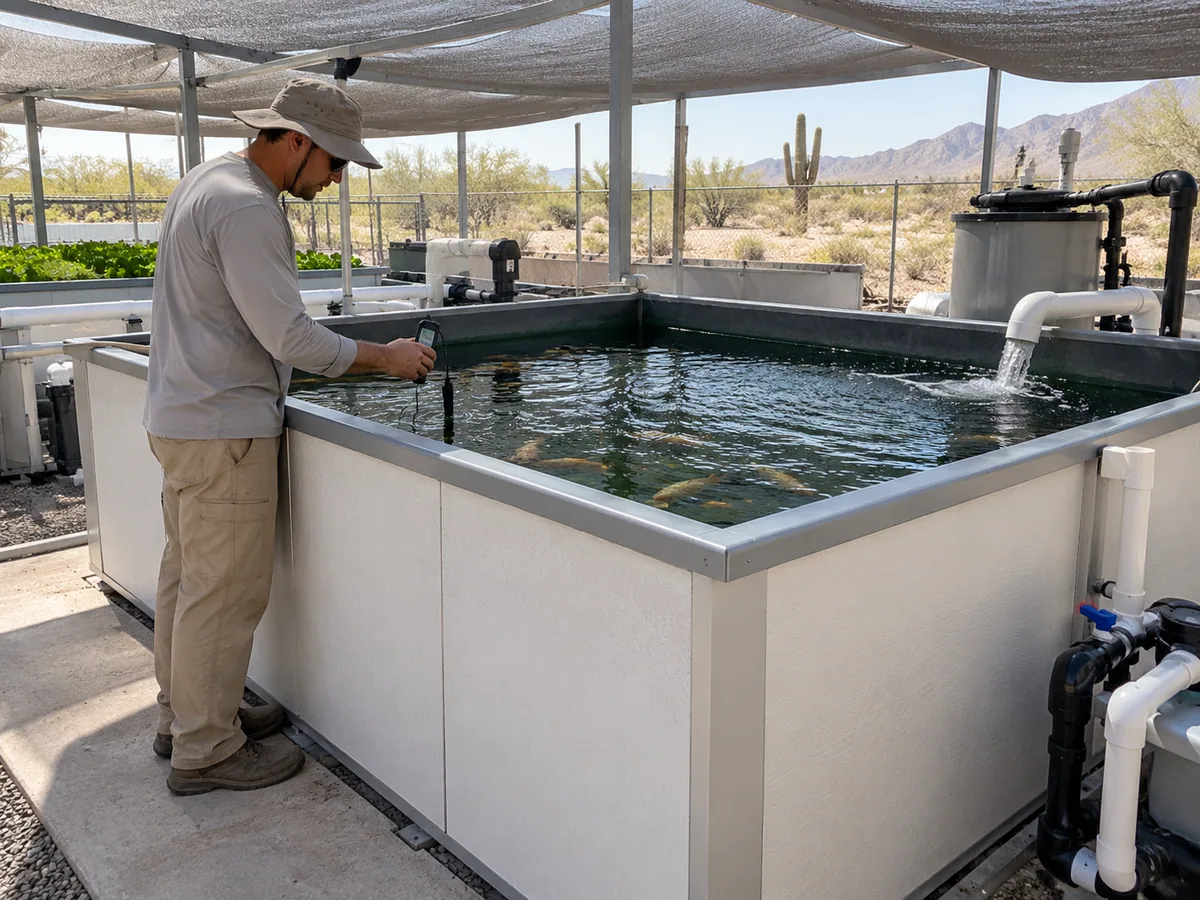
Direct sunlight on a dark fish tank can raise water temperature and encourage algae where light reaches nutrient-rich water. Place the tank under a roof, shade structure or appropriately selected shade fabric while preserving air movement and service access. Insulate exposed walls or use a light-coloured external protective surface compatible with the tank material. Do not cover a tank so tightly that gas exchange, inspection, feeding or safe access is compromised.
Filters, pumps, air equipment and control panels also need protection. A pump motor or blower installed in a sealed hot box may overheat even if it is shaded. Provide manufacturer-required ventilation, dust protection, electrical safety and clearance for service. Keep air intakes away from dust, chemical storage and exhaust sources.
Match crop shade to season and crop type
Leafy greens may need more protection during extreme summer heat, while excessive year-round shade can reduce growth in cooler months. Use a removable or seasonally adjustable shade strategy. Measure plant response, air temperature and water temperature rather than relying on fabric percentage alone. Oklahoma State University’s greenhouse shading and cooling guidance explains how adjustable shade and evaporative cooling behave under changing sunlight and humidity; these principles are useful context, although an aquaponics project still needs its own fish-water temperature and oxygen limits.
Control water temperature before adding more equipment
Water temperature affects fish metabolism, feed intake, dissolved oxygen capacity, nitrification and crop root conditions. Start with passive measures: shade the tank and pipes, reduce exposed dark surfaces, avoid shallow unprotected reservoirs, insulate where appropriate, and position the system to avoid afternoon reflected heat. A larger, well-protected water volume may change temperature more slowly, but it also requires more structural support and increases the consequence of a leak.
If active cooling is needed, define a real heat-load calculation and operating target. Evaporative cooling can be effective in dry air but uses water and may contribute to mineral concentration as evaporation removes water but leaves many dissolved salts behind. Chillers add electrical demand, heat rejection and maintenance requirements. Nighttime cooling or ventilation may help in some climates, but it should be evaluated against local humidity, dust and security.
Do not add ice, cold water or make-up water rapidly without understanding the temperature and chemistry change. Sudden correction can be more stressful than a controlled response. Establish warning and action levels with species-appropriate technical advice, and record the system’s temperature pattern before increasing fish biomass.
Plan evaporation and make-up water as a measured balance
Cover suitable open water surfaces, reduce unnecessary splashing and repair leaks promptly. Covers must remain safe, removable and compatible with aeration and access. Windbreaks can reduce wind-driven loss, but should not trap heat or block maintenance routes. Grow-bed and raft areas may still lose water through crop transpiration; that is productive water use, not a leak.
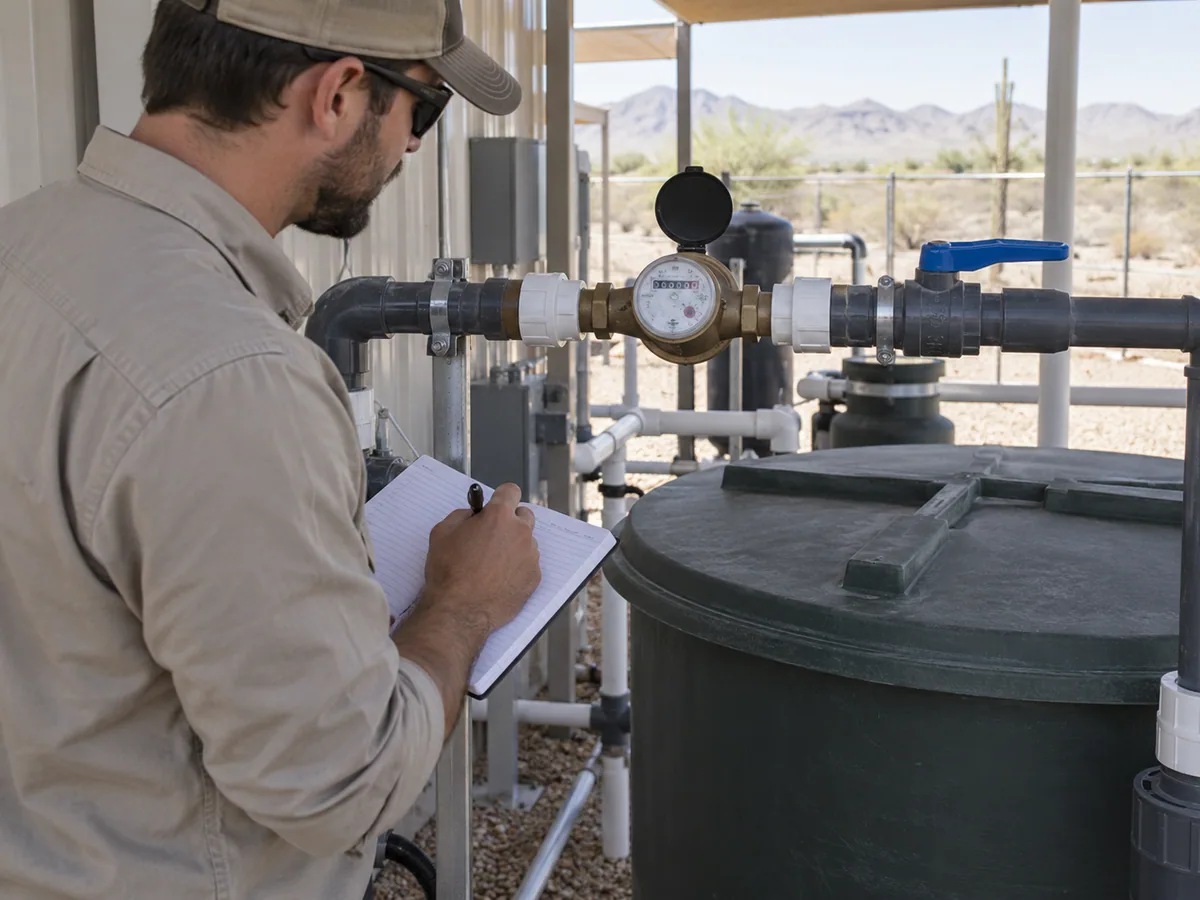
Install a visible make-up-water meter or use a repeatable volume record. Log additions with date, weather, water temperature and any filter cleaning. A rising make-up requirement can indicate hotter weather, crop growth, a hidden leak, excessive splash or a change in operating practice. Our guide to water-conserving aquaponics system designs explains how a measurable water balance improves both design and troubleshooting.
> Planning an aquaponics project for an arid or high-temperature site? Send Your Requirements with monthly climate data, source-water analysis, tank volume, crop plan and available utilities.
Check source-water chemistry and salt accumulation
Desert groundwater and municipal supplies may contain significant hardness, alkalinity, salinity or specific ions. Test the actual source and identify seasonal variation. Aquaponics recirculates water; when evaporation removes water, many dissolved minerals remain. Repeated top-up can therefore increase conductivity or particular ions even when the source looks acceptable in a single test.
Avoid treating electrical conductivity as a complete diagnosis. It measures combined ionic conductivity, not which ions are present. Review source-water chemistry, system inputs, feed, supplements and discharge strategy with qualified local advice. If treatment such as reverse osmosis or blending is considered, account for reject water, storage, operating cost and the need to preserve appropriate alkalinity and minerals.
Select fish and crops for the real seasonal envelope
Choose fish only after defining water-temperature range, market or educational purpose, local legality, seed/fingerling availability and operator capability. A heat-tolerant species may still suffer when oxygen is low, ammonia risk rises or temperature changes quickly. Cold desert nights and winter periods can also require protection. Do not use a species name as a substitute for a temperature and oxygen plan.
Crop planning should acknowledge that a crop thriving in cool winter sun may fail in midsummer. Use seasonal crop calendars, heat-tolerant varieties, adjusted planting density and shade management. In some desert projects, year-round operation may mean different summer and winter crop mixes rather than forcing one crop through every season.
Aeration and power reliability become more important in heat
Warm water holds less dissolved oxygen, while fish and microbes may have higher oxygen demand. Specify aeration from expected fish biomass, feed rate, water temperature, tank depth and biofilter demand. Use accessible diffusers and zoned manifolds, and maintain an independent emergency air route. Our aquaponics fish-tank aeration guide provides a component and backup checklist.
Solar power can support remote sites, but a panel rating alone does not prove reliability. Calculate continuous loads, starting currents, battery autonomy, high-temperature derating, dust cleaning, inverter losses and seasonal solar availability. Critical aeration should have a failure response independent from the primary circulation system where practical. During commissioning, simulate loss of grid or primary power and confirm who receives the alarm and how long backup equipment operates under realistic load.
Design against dust, wind and intense sunlight
Use protected electrical enclosures appropriate to the environment and local code, with qualified electrical installation. Support and shield cables and pipes. Secure lightweight covers and shade structures for local wind loads. Protect pump and blower intakes without restricting manufacturer-required airflow, and include filter or intake inspection in the maintenance routine.
UV exposure can degrade unsuitable plastics, tubing, cable jackets and labels. Request material and outdoor-exposure information for the exact supplied components. During factory testing, confirm model numbers and intended environmental protection. At shipment inspection, check that shade components, covers, spare seals and outdoor-rated accessories match the packing list.
Commission the system through a hot-weather test plan
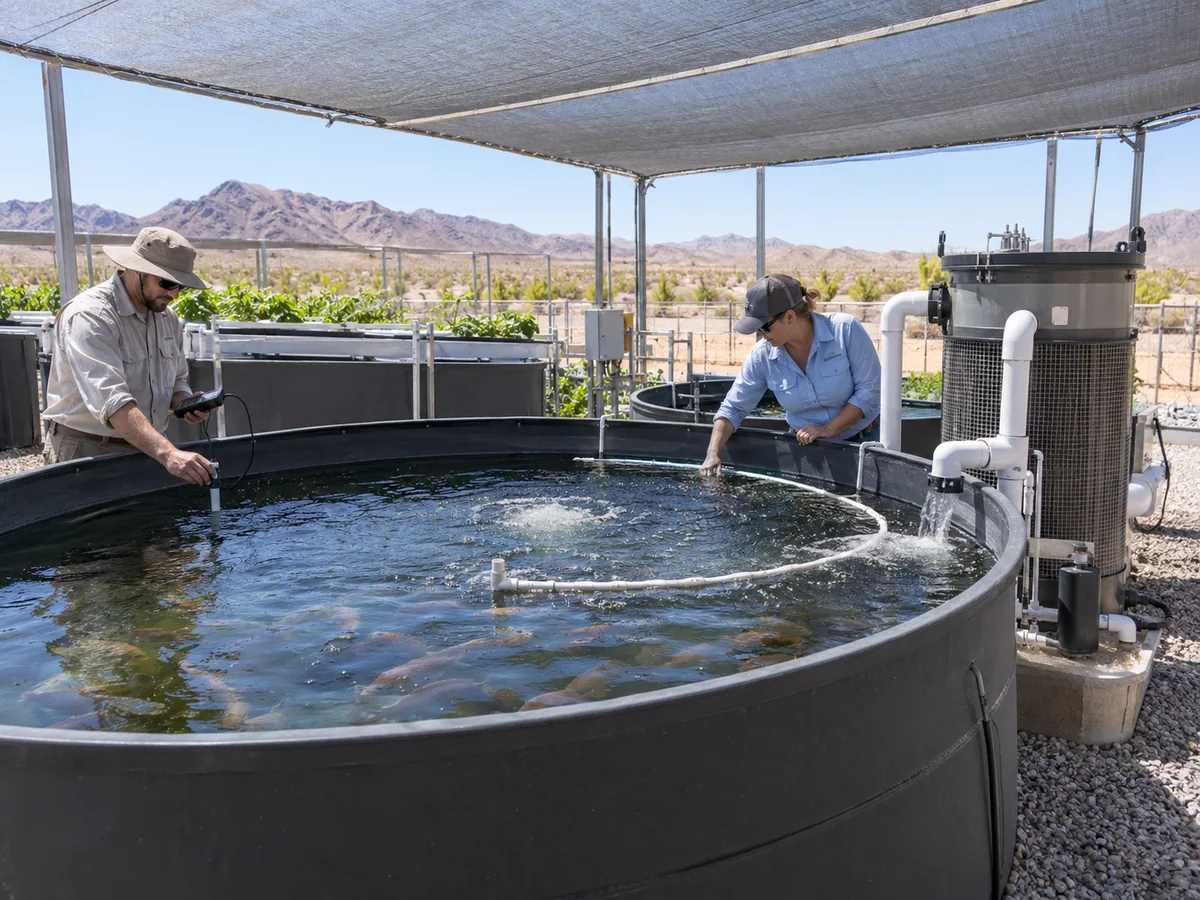
Before full stocking, operate the water and air systems through representative hot periods. Record air temperature, shaded water temperature, return temperature, dissolved oxygen where measured, make-up water, pump/air equipment state and plant-zone observations. Check tank shade at midday and late afternoon. Test overflow routes, filter-cleaning water use and the emergency aeration plan.
Increase fish and feed gradually only after the system demonstrates stable water treatment and the operators can maintain the records. Factory testing can verify equipment function; only site commissioning can verify the real desert heat, wind, water and power conditions.
Define a seasonal operating envelope and lifecycle budget
A desert design should state the conditions under which it is expected to operate, not merely the maximum local air temperature. The operating envelope should include allowable water-temperature range, expected daily make-up water, design fish biomass and feed input, target dissolved oxygen, shade configuration, cooling duty and emergency backup duration. It should identify which value triggers a management response, such as reducing feed, increasing aeration, changing the crop plan or moving to an emergency stocking procedure.
Create separate summer, shoulder-season and winter operating sheets. For each season, estimate pump, aeration, cooling or heating, lighting, ventilation and water-treatment demand. Include consumables, replacement diffusers and seals, source-water treatment, filter-cleaning labor, dust cleaning and periodic instrument verification. A low purchase price can be misleading if the layout requires continuous active cooling or if inaccessible filters add daily labor.
Procurement comparisons should therefore request annualized operating assumptions as well as equipment prices. Ask suppliers to distinguish included equipment from site work, shade structures, electrical installation, backup power, water conditioning and local permits. If performance depends on a water analysis or a site temperature that has not been provided, that dependency should appear as an explicit qualification rather than an unstated promise.
Finally, define what successful acceptance looks like. A practical handover can require verified circulation and air delivery, leak-free operation, functioning alarms, a measured make-up-water baseline, demonstrated filter cleaning, recorded hot-period temperatures and trained operators. These criteria turn “desert-ready” from a marketing phrase into a testable project scope.
Decide whether year-round production is justified
An outdoor system does not have to carry the same fish and crop load through every month. In locations with extreme summer heat or cold desert nights, a seasonal production plan may be safer and less expensive than forcing full output with large cooling and heating equipment. Compare the value of the intended harvest with water, electricity, labor and biological risk during the difficult season.
A reduced-load mode can mean lowering biomass in advance, selecting crops for the expected temperature, reducing nonessential grow area and maintaining only the circulation and aeration needed for the remaining living load. It must be planned early; fish cannot be responsibly removed or marketed at the last moment simply because a heat wave arrives. Any stocking change should follow welfare, transport and local regulatory requirements.
A complete seasonal shutdown also requires a written sequence. Remove fish and crops through an appropriate plan, recover or discharge water lawfully, clean solids without sending nutrient-rich waste into storm drains, protect pumps and pipes, and keep biofilter media according to the intended restart method. Sun-exposed empty plastics, seals and cables may still need UV protection. Before restarting, inspect stored equipment, verify water quality, recommission circulation and aeration, and re-establish biological filtration before normal loading.
The supplier and customer should agree on whether the system is designed for continuous operation, reduced seasonal loading or planned shutdown. That decision affects equipment sizing, warranty assumptions, operator training and spare-parts planning. It also prevents a project from being judged against a year-round output target that was never technically or economically realistic.
Buyer checklist for desert-climate aquaponics
- Site climate and extreme-temperature assumptions
- Shade and seasonal adjustment plan
- Tank and pipe insulation/protection
- Source-water analysis and make-up-water record
- Fish and crop seasonal plan
- Normal and emergency aeration duties
- Cooling approach and water/energy demand
- Dust, UV and wind protection
- Drainage and filter-cleaning route
- Factory-test, shipment-inspection and site-commissioning responsibilities
FAQ
Can an aquaponics fish tank stay in full desert sun?
It is generally safer to protect the tank from direct solar heat while preserving ventilation and access. The exact shade and insulation design depends on tank material, colour, climate and water-temperature target.
Does aquaponics use no water in a desert?
No. Water is recirculated, but plants transpire, surfaces evaporate and maintenance consumes water. Measure make-up volume and account for source-water minerals.
Is evaporative cooling always the best option?
No. It can work well in dry air, but consumes water and can contribute to mineral concentration. Compare passive measures, water availability, cooling duty, maintenance and electrical alternatives.
Can solar panels make the system independent?
They can support an off-grid design when loads, batteries, inverters, temperature, dust and backup duration are properly calculated. A panel-only system without storage and emergency planning is not sufficient for continuous fish life support.
Conclusion
Outdoor desert aquaponics is feasible when the design protects water from excessive heat and evaporation, manages source-water minerals, matches species to seasonal conditions and keeps aeration reliable. Start with measured climate and water data, reduce heat passively, document the water balance and prove backup operation before increasing fish load. A smaller system that remains stable through summer is more valuable than a larger installation designed only for mild weather.
Need a desert-site equipment and installation checklist? Contact Us with the project location, climate, intended fish and crops, and available water and power.

