
Introduction
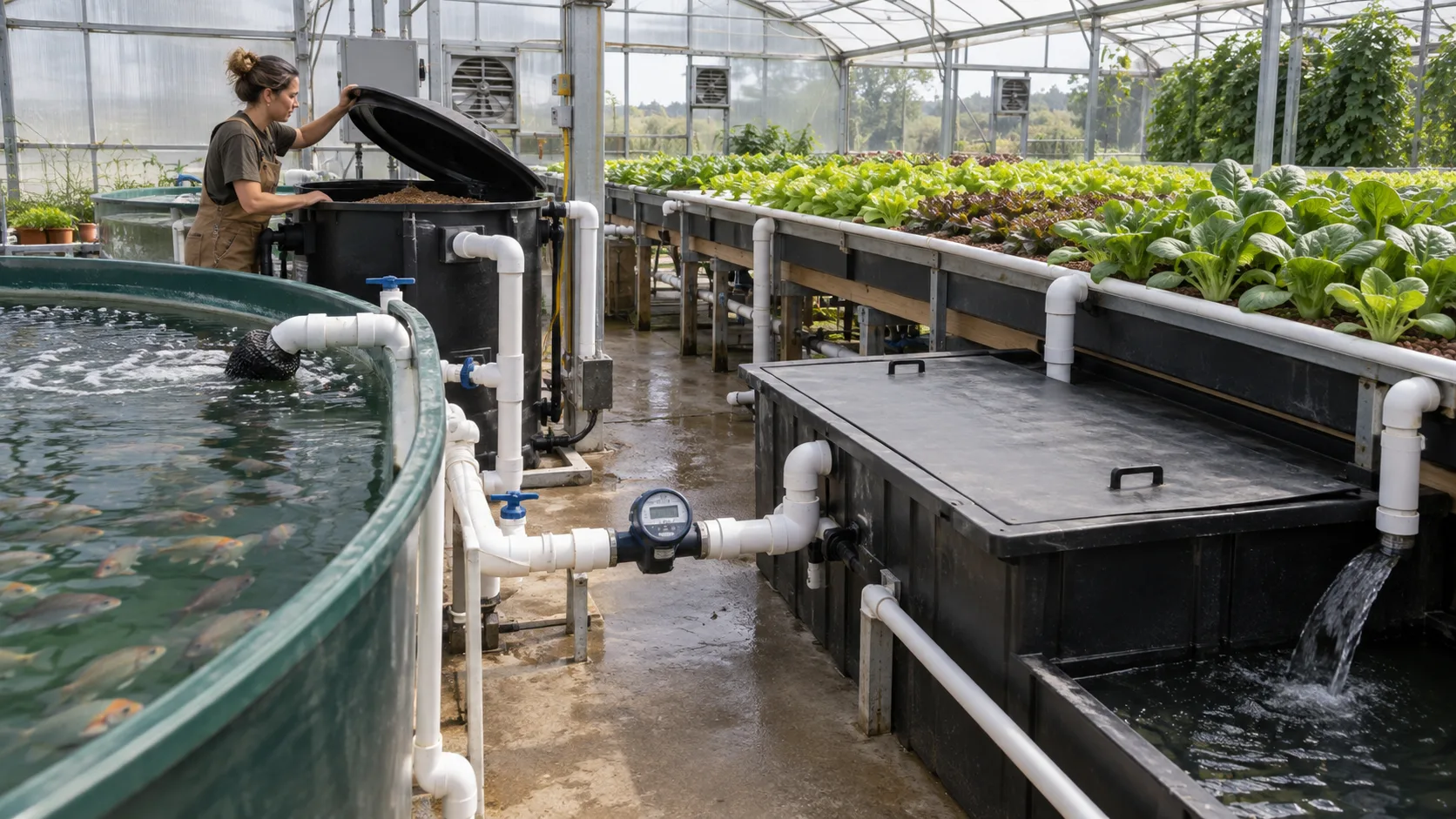
Aquaponics recirculates water, but a recirculating system is not automatically water-efficient. Water still leaves through plant transpiration, evaporation, splash, filter cleaning, sludge removal, overflow, leaks and occasional corrective management. A well-designed project makes those paths visible, keeps clean water separate from waste streams where possible and records additions so that unusual consumption becomes an early warning rather than an unexplained cost.
For a buyer, the important question is not “How much water does aquaponics save?” as if every site had one answer. Climate, crop area, fish biomass, grow method, solids handling, source water, maintenance habits and equipment design all change the result. The more useful question is: does this proposed system help an operator measure and reduce avoidable losses without compromising fish health, plant performance or hygiene?
The short answer
The best water-conserving aquaponics designs use a contained, accessible water path; a correctly located sump; practical solids management; protected overflow routes; measured make-up water; and equipment that can be cleaned without wasting more water than necessary. Specify a water-balance record, meter additions, test for leaks at commissioning and compare suppliers by their process drawings and maintenance access—not by an unqualified percentage-saving claim.
Establish the project water balance first
Before choosing a filter or grow bed, list all water inputs and exits. Inputs can include treated municipal water, a tested well source, harvested rainwater where appropriate, or water transferred from a storage tank. Outputs include planned solids discharge, plant uptake, evaporation, washing, overflow, leaks and any water removed during maintenance. The purpose is not to create false precision on day one. It is to establish a starting record that can be checked against real operation.
Use three simple measures:
1. Make-up water volume over a stated period.
2. Water removed deliberately for sludge, cleaning or maintenance.
3. Unplanned loss indicated by a change that cannot be explained by crop demand, weather or known maintenance.
The sump is usually the logical observation point because it reflects the combined water level of the loop. Oklahoma State University notes that the sump is normally the point where overall losses from evaporation, transpiration, sludge removal and splash appear, and recommends metering replacement water so unusually high use can signal a leak. Its aquaponics systems guide is useful for understanding why water management must be tied to the full hydraulic system.
Design a water path that can be seen and serviced
Use gravity where it makes sense
A clear sequence—fish tank, solids handling, biological treatment, plant zone, sump and return—helps both water conservation and fault finding. Gravity return can reduce unnecessary lift and makes many leaks easier to observe, but it requires accurate levels, sufficient pipe size, access to drains and protection from accidental blockage. A design should show normal flow direction, floor elevation, emergency overflow direction and every isolation valve.
Do not choose a complicated arrangement simply to claim low water use. A hidden pipe route or inaccessible drain may turn routine cleaning into a spill risk. Ask the supplier for a process-flow drawing with tank volumes, flow direction, planned operating water levels, sump range, clean-out points and overflow destination. If the operator cannot reach a valve or observe a return, the theoretical efficiency will not survive daily work.
Contain splash and evaporation realistically
Covers, splash guards, sensible inlet heights and protected pipe transitions can reduce avoidable loss. They also affect oxygen exchange, heat, access and cleaning, so they need to be designed rather than improvised. In hot, dry or windy locations, crop transpiration may be the largest intended water use; in a humid indoor room, condensation and drainage become more relevant. Record climate conditions alongside water additions instead of treating every seasonal change as a system fault.
Match solids handling to feed load and crop area
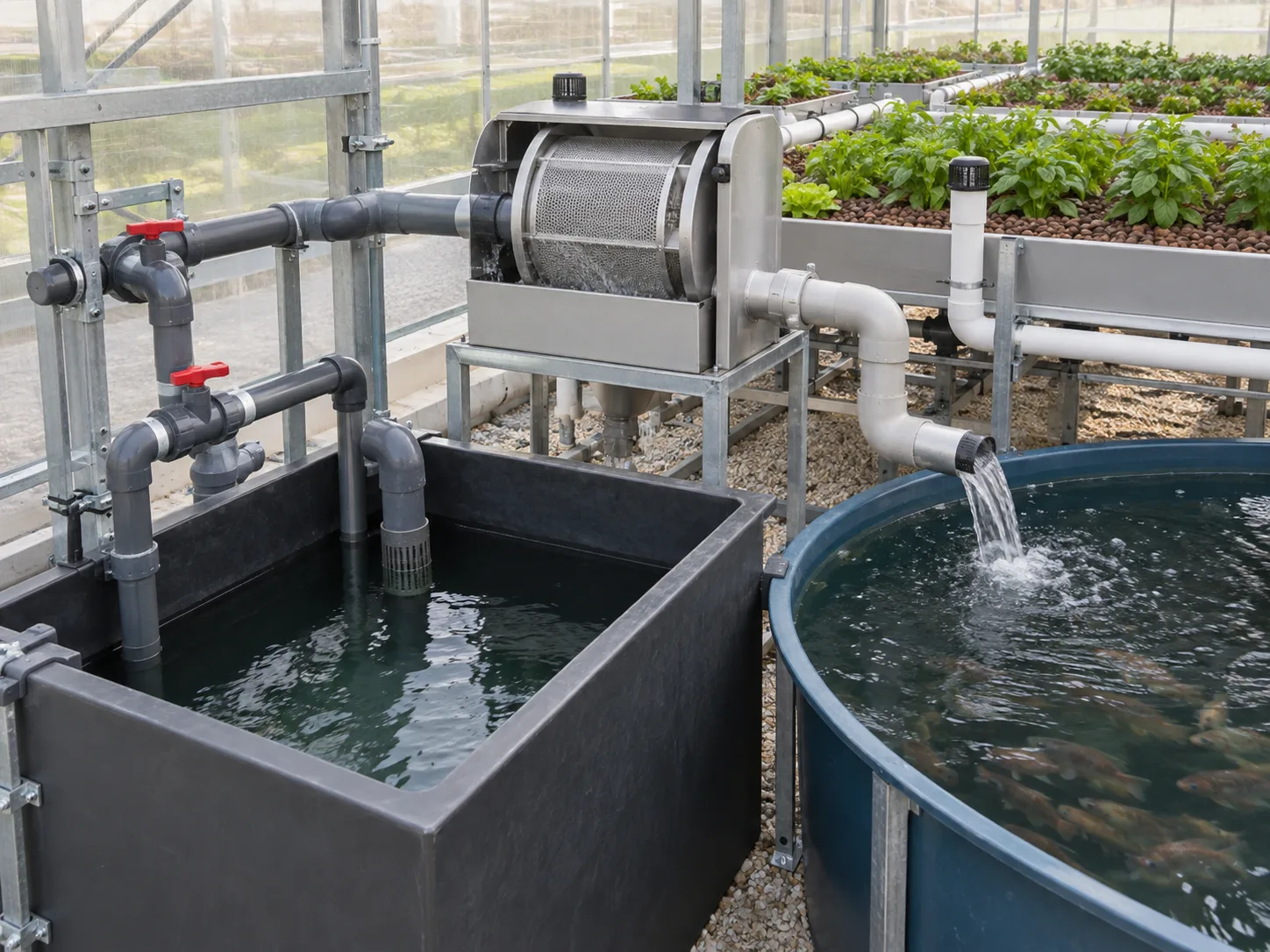
Solids are where water conservation can conflict with system health if the project is badly specified. Removing too little can create oxygen demand, anaerobic accumulation, blocked distribution points and difficult cleaning. Removing too aggressively or with an unsuitable backwash arrangement can discard water and nutrients unnecessarily. The design should therefore state what solids device is included, how it is cleaned, where captured material goes, how much water a cleaning event uses, and who performs it.
Settlers, screen filters, radial-flow units, drum filters and mineralization processes have different operating implications. The correct selection follows actual feed input, fish size, crop system, labour and desired water quality—not a catalogue image. Clemson’s system layout and components guide explains the connection between mechanical solids removal, biological filtration and the water quality plants and fish require.
For a commercial quotation, request a cleaning and discharge schedule. It should distinguish planned sludge removal from emergency flushing. If the proposal says “automatic cleaning,” ask what triggers it, where the rinse water goes, how the screen is inspected and what happens when a drain is blocked. Water conservation requires controlled maintenance, not neglected maintenance.
Our guide to screen filters in aquaponics can help buyers compare placement and cleaning access when reviewing this part of the system.
Protect make-up water and overflow points
Treat replacement water as an operating input
Replacement water must be suitable for fish, bacteria and plants. A make-up line should have a meter, an accessible shutoff, appropriate backflow protection and an intentional route for conditioning when local water needs it. Do not connect an unexamined municipal source directly to a live system and assume it is harmless. Local water treatment, source-water testing and final plumbing work are site responsibilities that should be named before installation.
Automatic make-up can stabilize water level, but it can also conceal a leak. Set a daily or shift-based upper limit for normal additions and create an alarm or review point when it is exceeded. A visible meter reading in the operator log is often more useful than an automatic valve with no record.
Design overflow as protection, not a normal discharge path
Every tank, sump and grow zone needs a considered overflow route. The route should prevent flood damage, not permit nutrient-rich water to reach an unsuitable drain, soil or public area. Check screen protection, pipe support, air gaps where needed, floor drains, containment and local compliance requirements. During installation preparation, ensure that an overflow is accessible and does not create a trip, electrical or hygiene hazard.
An overflow that operates frequently is a fault indicator. Investigate the cause: blocked return, incorrect level, stuck valve, excessive pump flow, unexpected rainfall in an outdoor component or a change made during maintenance. Logging the event prevents a “small” recurring loss from becoming normalised.
Choose plant areas that fit the hydraulic plan
Water-conserving design is also crop design. Dense leafy-green production, media beds, rafts, towers and NFT channels have different exposed water surfaces, root behaviour, cleaning access and distribution needs. The right option is the one that supports the intended crop and can be supplied uniformly without persistent overflow or manual correction.
Do not add more planting positions simply because there is empty floor space. The fish feed input, filtration, circulation, nutrient availability, temperature and operator time must support the larger crop area. An oversized plant zone can lead to extra top-up, unstable nutrient management and disappointing crops; an oversized fish component can create solids load and water-quality pressure. For wider environmental boundaries, see our aquaponics environmental guide, which explains why energy, feed and operating discipline also affect the outcome.
Make maintenance water-efficient as well as biologically safe
Daily choices often decide whether the design meets its water objective. A filter that is easy to open and inspect is more likely to be cleaned on a planned schedule than one hidden below a grow bed. A properly supported drain line is less likely to be disconnected carelessly. A dedicated bucket, hose connection and marked waste route reduce the temptation to flush clean system water merely to clear a small task quickly.
Create standard work for the most frequent water-using jobs: screen rinsing, settling-tank discharge, grow-bed cleaning, pipe flushing and replacement-water preparation. Each instruction should state the purpose, normal frequency, safe stop point, expected water route and record to complete. The objective is not to make staff rigid; it is to let them recognise when a routine amount of water has become unusually high.
Consider recovery only after water quality, labour and hygiene have been assessed. Captured solids may have a potential off-system use under an appropriate local management plan, but they must not be casually returned to a fish loop or handled as a guaranteed fertiliser product. Keep any external recovery area separate from food handling and record the route. In many installations, reliable capture and responsible disposal are the better first choice.
Seasonal review is also useful. Compare water additions during hot weather, crop turnover, ventilation changes, rainy periods for outdoor sections and changes in fish biomass. A sudden increase may be normal only when it can be matched to a documented operational change. If not, start with a walk-through of tanks, floor drains, valves, filter seals, returns and overflow lines before adding more automated equipment.
Where a site has several loops or grow zones, meter or observe them separately when practical. A total building meter may show that consumption increased, but it cannot tell the operator whether a wash-down point, one NFT return, a filter rinse or a tank connection is responsible. Start with the simplest division that people can maintain: main system make-up, planned cleaning water and any external plant-wash or packing use. Keep those numbers separate rather than presenting all site water as aquaponics consumption.
Test conservation features before livestock arrives
Factory testing and shipment inspection
Factory testing can verify component fit-up, valves, tank penetrations, pump connections, drain ports and labelled overflow points. It should not be presented as proof of long-term on-site water performance. Ask for a dry or wet functional test record appropriate to the supplied scope, photographs of the intended clean-out and overflow connections, and a packing list that includes meters, valves, gaskets and spare seals.
At shipment inspection, examine tanks and fittings for cracks, deformation, missing caps and damage that could become slow leaks. For container loading, the equipment should be dry, empty and protected; fish, water and planted grow beds do not belong in an export shipment. Count loose fittings and identify each valve before it is buried in installation work.
Site leak and level test
After installation and before fish stocking, fill in stages and observe tank levels, penetrations, unions, filters, drains, return lines and sumps. Mark normal operating levels. Run the pump through expected conditions, briefly simulate a stopped return where safely possible, and verify that overflow routes work as designed. Record initial meter readings and establish the first weekly water-balance log.
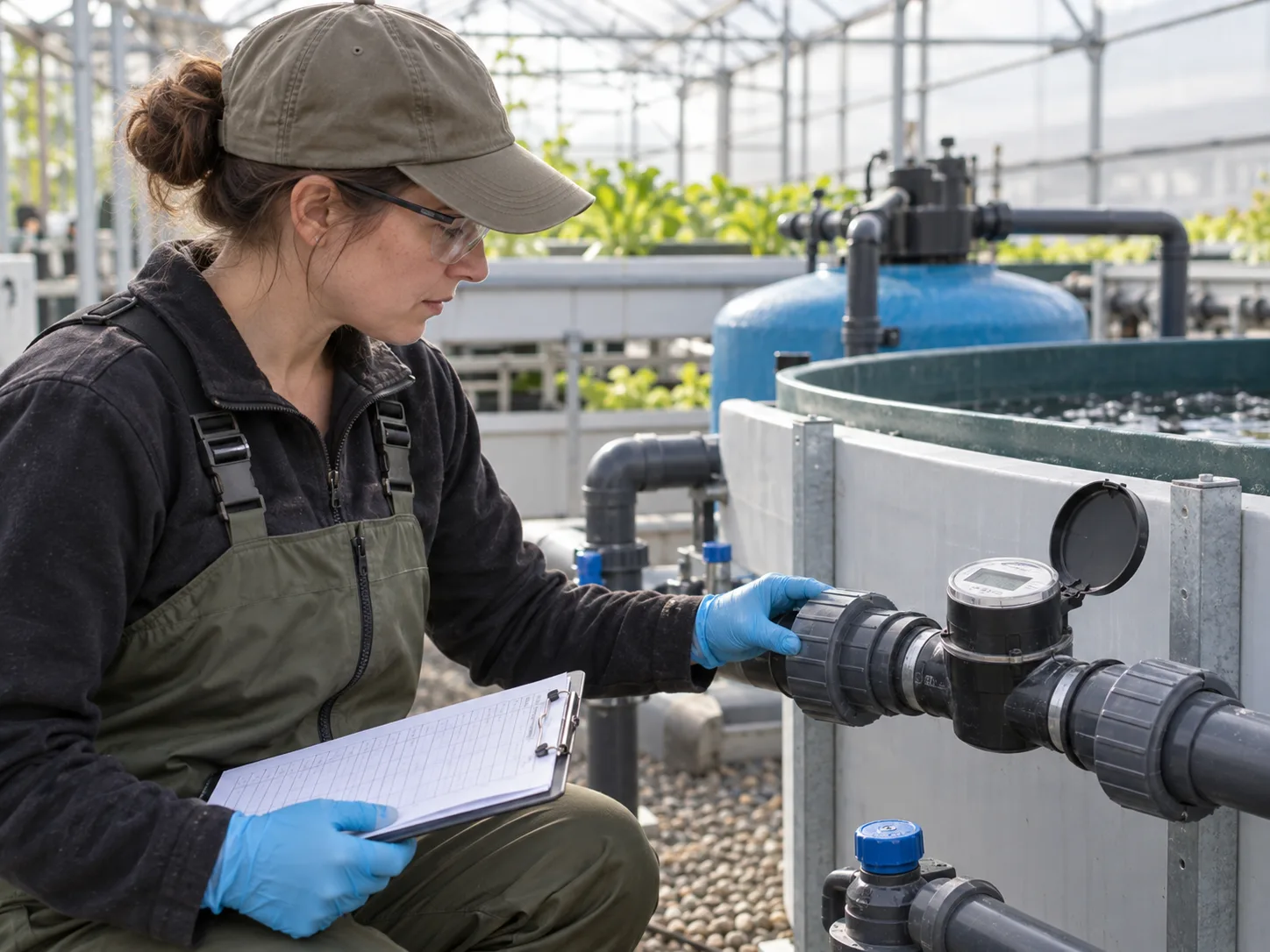
The goal is not to eliminate all water use. It is to separate expected consumption from a preventable fault while changes are still easy to correct.
Mid-article CTA
Planning a water-conscious project? Send your site climate, water source, target crop area, fish-production plan and preferred grow method. Send Your Requirements for a readable water-path, solids-handling and make-up-water checklist.
A supplier comparison checklist
Ask every supplier to answer the same questions:
1. Where is the normal water-level control point and what is its usable range?
2. How will make-up water be metered, isolated and treated when required?
3. What is the solids-removal method, cleaning frequency and typical cleaning-water route?
4. Which components have overflow, and where does each overflow discharge safely?
5. Which valves and drains are accessible without moving beds or tanks?
6. What leak test, level test and flow test are included in commissioning?
7. Which water meters, level sensors, gaskets and spare fittings are included or excluded?
8. What daily, weekly and seasonal water-use records should the operator keep?
Compare the answers against a drawing, not an assumption. One supplier may include a meter and drain path while another expects the site contractor to provide them. Either may be workable, but the responsibility and cost should be visible before approval.
FAQ
Does aquaponics use no water after it is filled?
No. A recirculating system still needs make-up water for crop transpiration, evaporation, solids removal, maintenance and occasional losses. The aim is to manage and measure these demands responsibly.
Does a larger filter always save water?
Not necessarily. Filter choice must match solids load, cleaning method, flow and labour. A poorly configured automatic rinse system can waste water; an undersized filter can create water-quality and cleaning problems.
Can automatic top-up be used?
It can be helpful when correctly designed, but it should be metered, isolated and reviewed. Automatic top-up must not hide a leak or bypass local water-conditioning requirements.
What is the first water record to keep?
Record the source, meter reading, deliberate water removal, reason for any cleaning or top-up, weather or climate note and unusual observations. Consistent records are more useful than an unsupported saving claim.
Conclusion
A water-conserving aquaponics system is a designed and measured operating loop. The strongest proposal makes water additions, solids discharge, cleaning, overflow and maintenance visible; it gives the operator access to act before loss becomes damage. Choose serviceable components, a simple water-balance record and commissioning tests that prove the real installation—not just a promise of recirculation.
Final CTA
Request a Water-Conservation Design Checklist. Contact Us with your site water source, climate, crop plan and expected scale. We will help define a practical scope for containment, filtration, make-up water, inspection and commissioning.

