
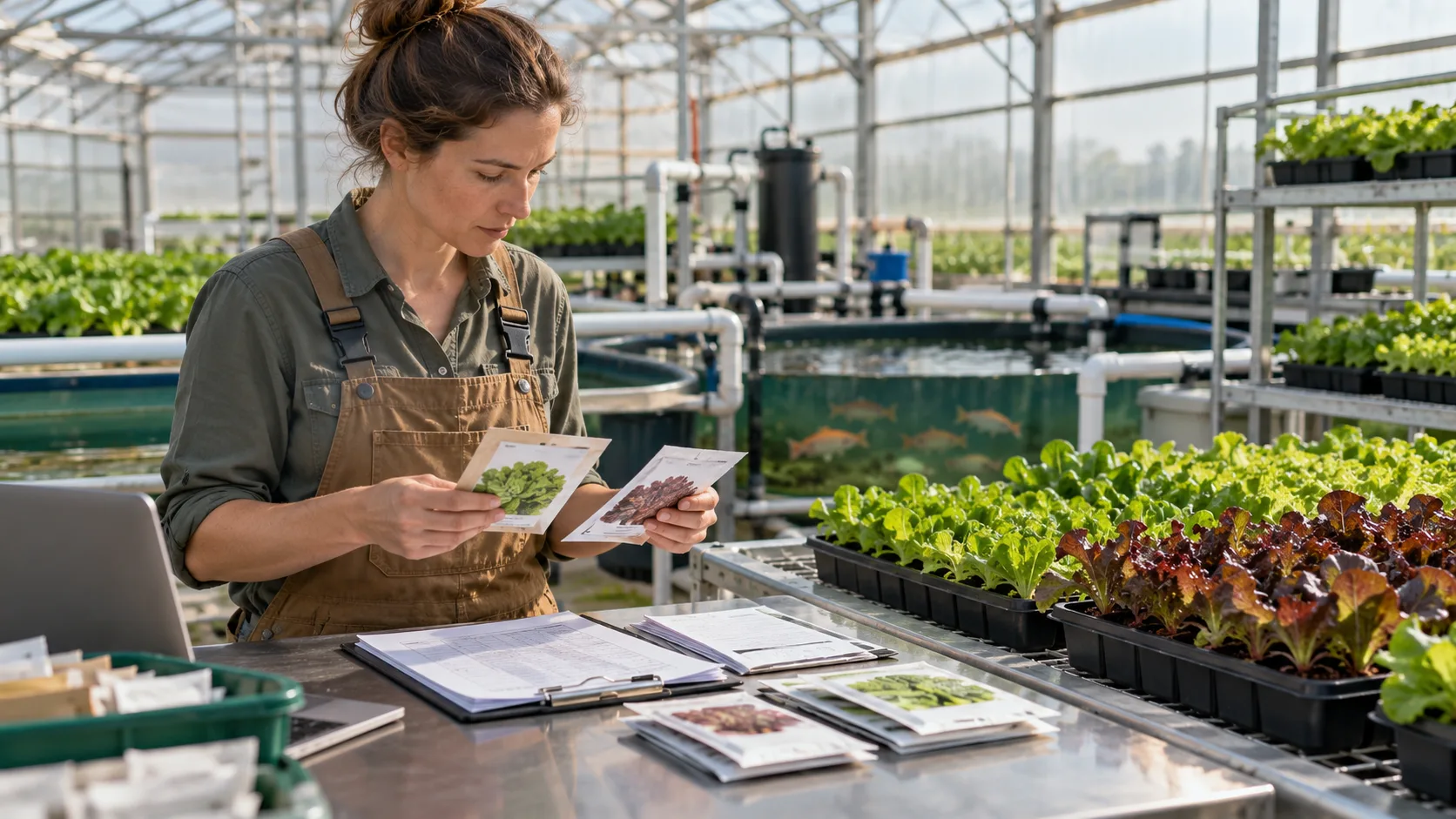
Reputable organic seed sourcing for aquaponics is a verification process, not a list of fashionable brands. Select a supplier that can identify the exact variety, lot, seed treatment status, organic documentation, germination information, package size, lead time and delivery conditions. Then select varieties around the aquaponics system’s crop method, climate, harvest specification and operating rhythm. “Organic,” “non-GMO,” “heirloom” and “suitable for hydroponics” are not interchangeable claims.
For a U.S. certified-organic operation, seed selection and recordkeeping have regulatory meaning. USDA guidance says certified operations must use organic seed and planting stock in accordance with its requirements, while documenting sourcing efforts and exceptions where an equivalent organic variety is not commercially available. USDA’s seed and planting-stock guidance is the appropriate starting point for a certified operation; growers outside the U.S. should check their own market and certifier requirements.
Define the crop requirement before contacting suppliers
Start with a crop plan, not a seed catalogue. State the crop and target variety type; growing method (raft, NFT, media bed or vertical); intended harvest stage; cycle length; greenhouse temperature and light conditions; expected weekly harvest; local market specification; and whether the project needs certified-organic documentation. For example, a restaurant may need a particular leaf shape and consistent harvest weight, while a school programme may value a fast, visible crop with broad learning value.
Aquaponics suitability is usually about fit, not a special seed category. A variety can be outstanding in soil yet poorly suited to a warm raft bed, a tight indoor spacing, a high-humidity greenhouse or a particular harvest schedule. Ask the supplier for variety information and trial it in the actual system before committing the full production plan. Our indoor leafy-green system guide can help match crop workflow to system format.
Verify the supplier and the specific lot
“Organic seed supplier” should be supported by documents, not only website language. Request the supplier’s current organic certificate or a verifiable reference to the certifying body, then confirm that the relevant scope covers the product/handling activity. Ask whether the offered lot is certified organic, whether the certificate applies to the named variety and whether a replacement lot could differ in treatment or origin.
At minimum, retain the quotation, order confirmation, invoice, seed packet or label, lot number, organic documentation, treatment statement, receiving date and storage location. This is useful for both certification records and practical troubleshooting. If germination is poor, the record identifies the seed lot, rather than blaming the water system without evidence.
The USDA Seeds and Planting Stock Practice Standard explains that organic status, prohibited seed treatments and genetic-engineering restrictions are distinct considerations. Do not replace documentation with a verbal assurance or use “non-GMO” as proof that a seed is certified organic.
Ask about treatment before you buy
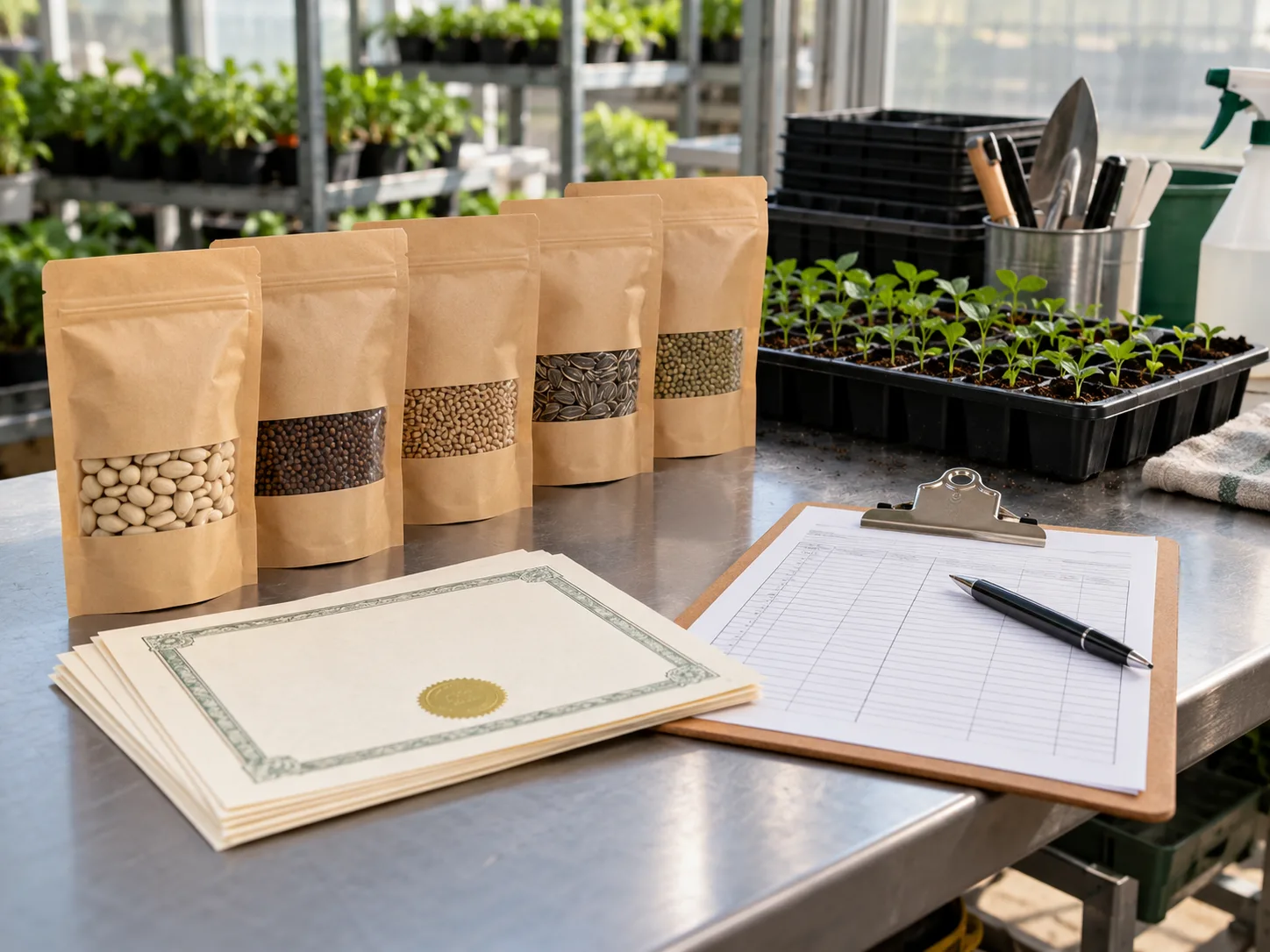
Seed treatments can be important for crop establishment, but the suitability of a treatment depends on the production claim, crop, local rules and system risk. Request a written answer: untreated, treated, treatment name/active ingredients where relevant, and documentation supporting the intended production standard. Keep treated seed, planting tools and records clearly separated from organic stock if that matters for the project.
In an aquaponics nursery, avoid casually washing residues into the fish loop. Germination, seedling work and sanitation should have a defined water route and waste-handling routine. A plant-start failure may come from seed age, storage, temperature, light, moisture, disease pressure or handling—not solely from the seed treatment status.
Evaluate variety fit through small, recorded trials
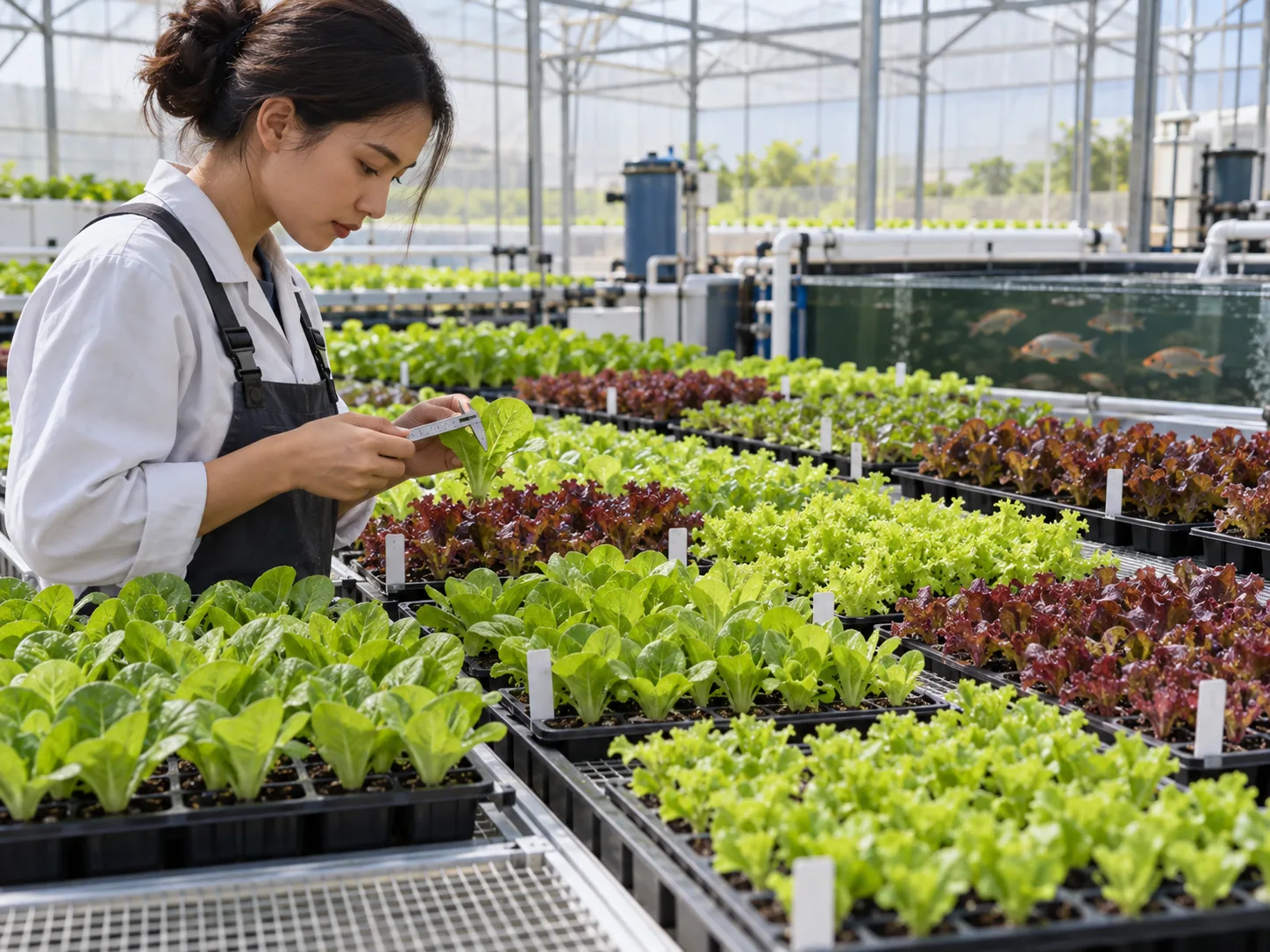
Run a controlled initial trial before a large purchase. Use a clearly recorded tray or zone, note sowing date, lot, germination rate, transplant date, spacing, light/temperature conditions, root appearance, harvest date and quality observations. Compare varieties at the same harvest stage rather than comparing a young trial with an established crop.
For leafy crops, practical evaluation may include uniformity, colour, bolting tendency, root health, harvest weight, shelf-life and fit with the buyer’s preferred package. For fruiting crops, support, pruning, pollination, climate and nutrient balance can matter as much as seed origin. Avoid implying a seed supplier can guarantee yield in an aquaponics system without controlling those operational variables.
> Need a crop-ready system scope for your chosen varieties? Ask for a Product Catalog and share crop mix, growing method, site climate and target harvest schedule.
Manage seed storage and receiving as part of quality control
Seed quality can be lost after delivery. On receipt, compare the variety, lot and quantity with the order; inspect packaging for damage or moisture; log the date; and store according to supplier instructions in a clean, stable environment. Avoid unlabelled decanting. When a packet is opened, retain the lot identification with the remaining seed.
For larger projects, create a simple seed inventory: supplier, crop/variety, lot, organic-document reference, treatment statement, package size, received date, storage location, test sowing result and reorder point. This helps the production team preserve traceability when staff changes or when a supplier substitutes a variety.
Distinguish seed procurement from organic crop claims
Buying certified-organic seed is an important procurement action, but it does not by itself make harvested aquaponics produce certified organic. Whole-operation certification, allowed inputs, records, handling, labelling and the relevant national or market standard all matter. Avoid using seed documentation as marketing proof for an end product without checking the full claim with the operation’s certifier.
This distinction is especially important in aquaponics because fish feed, water treatment, pest-management decisions, sanitation, packaging and production records can all become part of the wider compliance conversation. Keep the seed file clear and accurate: it should substantiate the seed purchase, not overstate what it proves.
Plan availability and substitutions before a crop gap occurs
Popular organic varieties can have seasonal availability limits, minimum order quantities or a different delivery schedule from general garden seed. Build a primary and secondary variety plan that preserves the buyer’s required crop type and harvest use. If a supplier proposes a substitution, obtain the new variety name, lot information, treatment status and organic documentation before accepting it; do not simply replace the packet in the nursery.
For year-round production, place trial and production orders on a rolling schedule. Keep enough seed for the next planned sowing window, but do not stock far beyond the supplier’s recommended storage period. A small germination test from each important new lot is usually less disruptive than discovering a weak lot after a full nursery bench has been scheduled.
Coordinate seed choice with harvest and post-harvest workflow
Seed selection should connect to what happens after the crop leaves the grow zone. Discuss leaf size, head formation, texture, colour, harvest method, wash/pack process and shelf-life with the customer or internal sales team. A variety that grows quickly but bruises during packaging may be less valuable than a slightly slower variety with stable presentation. Record these commercial observations alongside biological ones so the next order improves the whole workflow, not only germination.
Use germination and vigour data intelligently
Ask the supplier how germination information is stated and when it was tested. A stated germination rate is useful context, but it does not guarantee performance after transport, storage or in a particular nursery. Keep a small incoming test protocol for important lots: sow a known number under the normal nursery conditions, record emergence and uniformity, and compare the result to the supplier information without changing several other variables at the same time.
Vigour matters as well as germination. Two lots may both emerge, yet one may produce uneven seedlings that disrupt transplant and harvest scheduling. Record the percentage that becomes usable transplant material, not only the number that breaks the surface. This is especially helpful for commercial aquaponics, where a missed seedling week can leave production channels underused later.
If a lot performs poorly, preserve the packet, lot number, photographs and nursery conditions before making a claim. Contact the supplier promptly using factual evidence. Do not discard the label or assume water chemistry is responsible before the seed, environment and handling record has been reviewed.
Build supplier continuity into crop planning
Reputable suppliers are valuable because they communicate when availability changes. Establish a contact route and ask how the supplier handles seasonal shortages, crop failures, lot substitutions and discontinued varieties. Where a crop is commercially important, qualify an alternative supplier and trial an alternative variety before an emergency makes the choice unavoidable.
For a project that imports seed, allow time for documentation, customs review and any permit process. For a project buying domestically, check delivery lead times around peak planting seasons. A production calendar should include an order date, expected receipt, test-sow date, transplant date and harvest window. This allows the grower to spot supply risk early instead of filling a crop gap with an unverified packet.
Align nursery cleanliness with the fish loop
Seed and seedling work should have a documented hygiene routine. Keep seed packages dry; clean propagation tools between batches; identify runoff routes; and avoid allowing nursery waste, media particles or sanitation products to enter fish water unintentionally. If a nursery shares a greenhouse with the system, define where inputs are stored and how staff move from plant work to fish work.
This is not a claim that seed is the cause of every crop problem. It is basic process separation that protects the fish loop, makes traceability easier and reduces the chance that an unrecorded nursery input undermines a crop or organic-compliance investigation.
Make procurement roles and approvals clear
In a larger project, the person ordering seed may not be the person raising seedlings or managing organic records. Define who approves a new supplier, who verifies documents, who receives deliveries, who enters lots into the inventory and who can accept a substitution. A simple approval step prevents a well-intentioned emergency purchase from breaking traceability or introducing a treatment status the operation did not intend to use.
Keep supplier communication in the project record. Save the quote, certificate link or copy, treatment confirmation and substitution correspondence with the purchase order. If the organisation later changes manager, expands the system or is asked to support an organic claim, the new team can understand the decision rather than reconstruct it from scattered emails.
Review the seed plan after each production cycle
At the end of a cycle, review germination, usable-transplant percentage, crop uniformity, harvest outcome, customer feedback, seed use and remaining inventory. Decide whether to continue, change variety, adjust storage, increase order lead time or replace a supplier. This turns seed procurement into a measured part of the crop system rather than a recurring last-minute purchase.
The review also helps keep internal links between crop planning and equipment planning honest. If a variety needs more nursery space, different spacing or a different harvest rhythm, update the operating plan before assuming the existing aquaponics layout will absorb the change.
Consider import and cross-border procurement early
An online supplier may ship only domestically, and seeds crossing borders may require specific documentation or permits. In the U.S., USDA APHIS explains that plant and seed imports can be subject to entry conditions and that a permit may specify what can enter and under which conditions. APHIS guidance for buying plants and seeds online should be reviewed before an international order. Do not assume that a retailer’s checkout page confirms import eligibility.
For export-oriented growers, also check destination food-production and organic-claim requirements with the applicable certifier or authority. A purchase receipt alone does not establish an organic claim for the crop; whole-operation practices, records and certification status matter.
A supplier-comparison checklist
Compare suppliers against the same questions:
- Can they identify variety, lot, origin and current availability?
- Can they supply a current organic certificate or equivalent verification for the offered product?
- Is seed treatment clearly stated in writing?
- Do they provide germination/quality information and storage guidance?
- Can they supply the required package size and delivery date without substitution?
- What is their process for lot substitution, claim handling and replacement?
- Can the buyer retain invoices, labels and supporting documents?
For a commercial system, align seed orders with planting capacity, not projected fish volume. Crop succession depends on nursery space, labour, harvest schedule and market demand. The aquaponics agriculture guide explains why crop and fish plans must be managed as linked operational schedules.
FAQ
Are organic seeds automatically best for aquaponics?
No. Organic status addresses how seed is produced and handled under the relevant standard. Aquaponics suitability depends on the variety’s fit with the actual crop method, climate, spacing, operating skill and market requirement.
Is non-GMO the same as certified organic seed?
No. These are different claims. If certified-organic status is needed, request the supplier’s current documentation and retain lot-level purchasing records.
Should I buy many varieties for the first aquaponics crop?
Start with a manageable, documented trial. Too many variables make it difficult to identify whether an outcome relates to variety, seed lot, climate, water conditions, spacing or operator practice.
Conclusion
The most reputable organic seed supplier is one that supports verification: clear lot identity, organic documentation, treatment information, receiving records and consistent communication. The best variety is the one that proves fit in the actual aquaponics environment and meets the buyer’s harvest need. Combine procurement evidence with small trials, disciplined storage and realistic crop planning for a more reliable production start.
Selecting seeds for a new greenhouse, school or commercial project? Contact Us to discuss grow-zone layout, crop workflow and installation preparation.

