
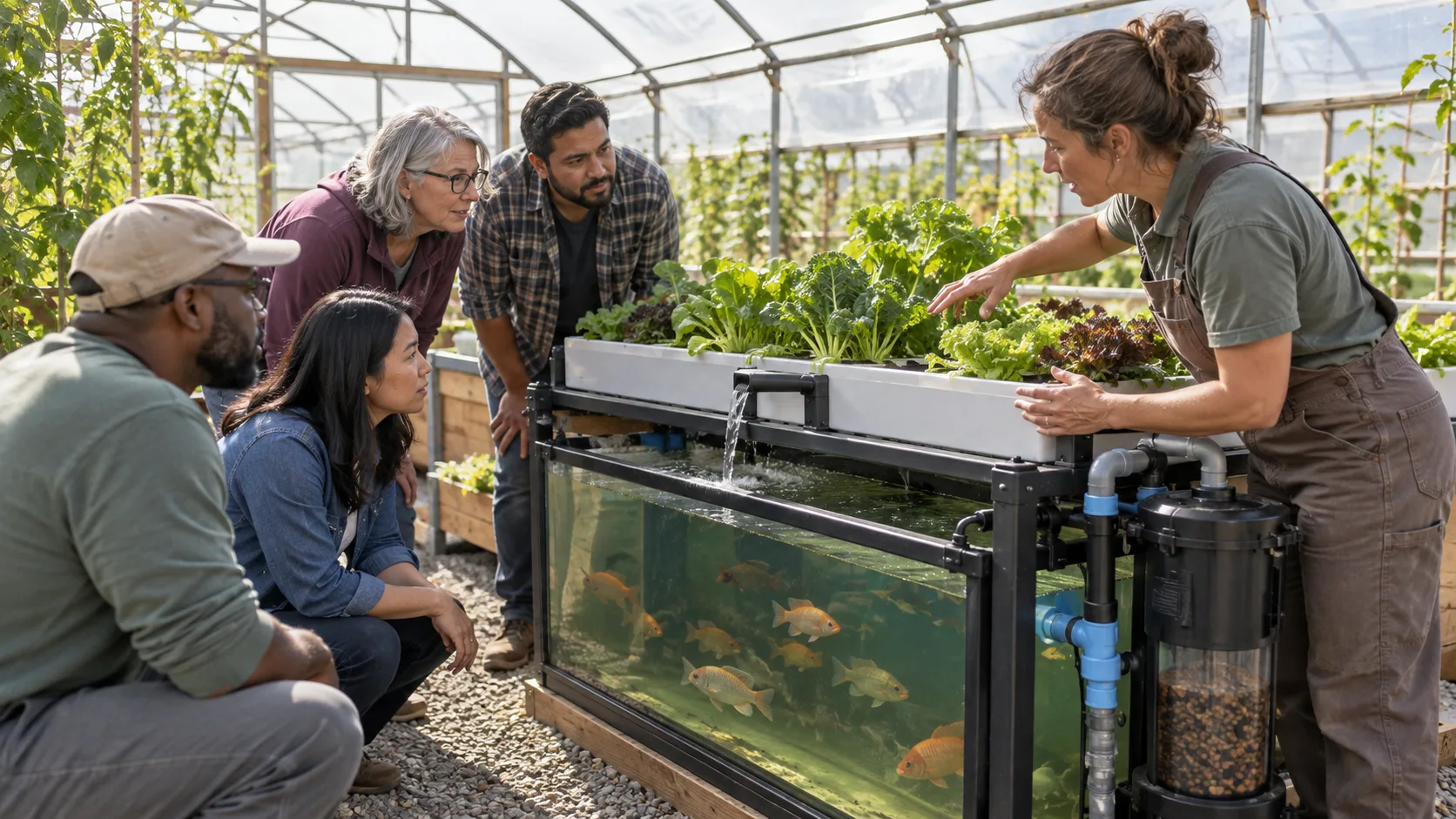
An affordable aquaponics system for a community garden is one that the group can safely operate, maintain and explain after the initial excitement has passed. The lowest purchase price is not always the lowest project cost. A missing drain, unsuitable electrical supply, inaccessible filter, unplanned winter protection, absent training or lack of a named operator can turn a low-cost kit into an expensive dormant display.
For community, school, nonprofit and municipal projects, affordability begins with a defined purpose. Is the system a small learning installation, a volunteer-led demonstration garden, a youth programme, a farm-stand asset or a production unit with a documented harvest plan? The answer determines scale, siting, safety, fish-care commitments, equipment specification and the support the group should purchase.
The University of Maine 4-H Aquaponics Project shows how aquaponics can be framed as project-based learning across formal and informal community settings. The University of Maryland’s low-cost small-scale system guide is a useful starting point for understanding small-system components and trade-offs. These sources support planning; they do not replace local site, food-safety, animal-care or construction requirements.
Start with a written community outcome
Avoid buying equipment before the group agrees on what success looks like. A short project brief should identify the beneficiary group, expected educational or harvest outcome, available operators, site, operating season, intended fish species (subject to local rules), budget ceiling and who owns ongoing decisions. For example, a youth science programme may prioritise visible components, safe access and observation logs. A garden cooperative may prioritise reliable leafy-green production, service access and a clear duty roster.
The project brief should also state what the system is *not* expected to do. A compact demonstration unit should not be advertised as a self-sufficient food source or treated as a commercial farm. Clear boundaries prevent overselling to funders and reduce pressure to overstock fish or skip the biological start-up period.
Build a budget around ownership, not just the initial package
Create two budget columns: capital costs and first-year operating/contingency costs.
Capital scope
List fish tank(s), grow modules, solids handling, biofilter, pump, air system, plumbing, valves, fittings, test equipment, covers, control/safety items, foundations or floor protection, drainage work, electrical work, delivery, unloading and installation tools. Ask each supplier whether fish, feed, plants, media, lights, heater/cooling equipment and water-treatment supplies are included or excluded.
First-year operating scope
Allow for water-quality consumables, fish feed, seedlings or seed, replacement pump or air-pump parts, test-meter maintenance, electricity, cleaning supplies, training, volunteer coordination, pest-management materials, insurance or permits where applicable and a reserve for a fault. A community project should not depend on a volunteer paying these recurring costs personally.
The cost of absence
Some costs are invisible in a catalogue quotation: a drain installed late, an electrical circuit added after delivery, a locked site with no after-hours response, or a filter that cannot be cleaned without two people. Include these in a site survey. “Affordable” should mean the group can continue to operate the system without concealing these responsibilities.
Select a system format the group can service
Compact learning or demonstration unit
A small integrated tank-and-grow-bed system can make the fish–bacteria–plant relationship visible. It has a lower entry cost and modest footprint, but small water volume may change rapidly after heat, overfeeding or a power interruption. Choose it when trained adults can inspect it frequently and the learning value outweighs harvest volume.
Modular small greenhouse or sheltered-outdoor system
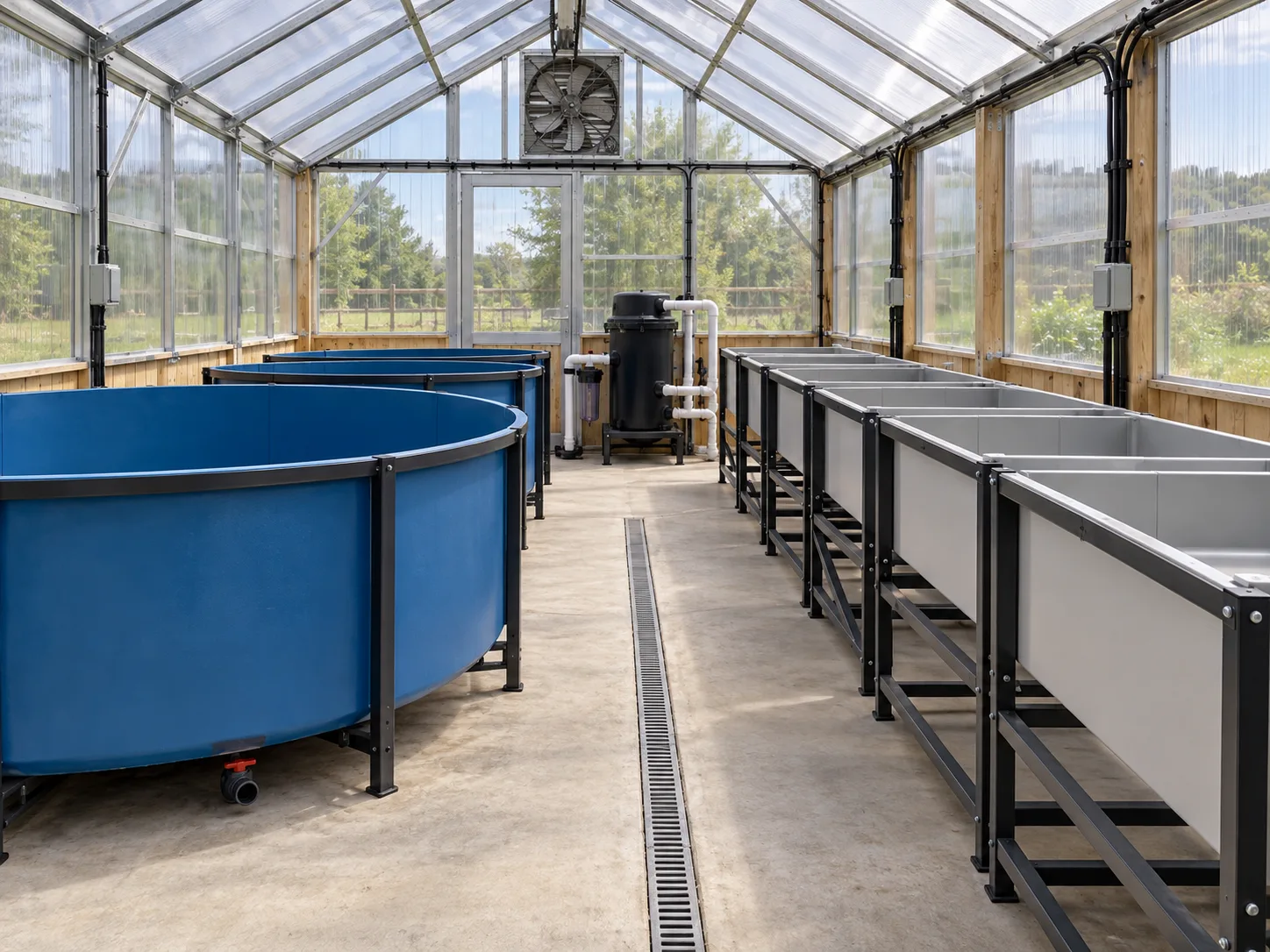
Separate tank, filtration and grow modules can be easier to inspect and expand. They also require more planning for floor loading, drainage, weather protection, wiring, access and winter operation. For many community gardens, this is a sensible middle path if a named team owns weekly maintenance.
Larger project system
A larger installation can support more growing area, but it increases the consequences of mechanical failure and volunteer turnover. Do not scale because a funding opportunity is large. Scale when the site, duty roster, operator skill and maintenance budget are demonstrably ready. Our guide to choosing the right aquaponics system size for home use offers useful thinking on access and daily care; a community site must add public safety, governance and scheduled ownership.
Choose a site that works on an ordinary rainy weekday
Visit the proposed location with the people who will operate the system. Check sunlight or indoor lighting, water source, drainage, level surface, safe electric supply, hose route, emergency access, security, ventilation, noise, delivery path and the distance to a place for testing and record keeping. Consider how a volunteer reaches a valve or test point in bad weather, not only how a visitor sees the system on launch day.
Where children or the public have access, design barriers, stable walkways, cable protection, clear signs and supervision procedures early. Keep chemicals, test reagents, tools and electrical controls secure. Do not rely on decorative fencing added after the system is installed; it may block filter access or emergency response.
Make governance part of the equipment specification
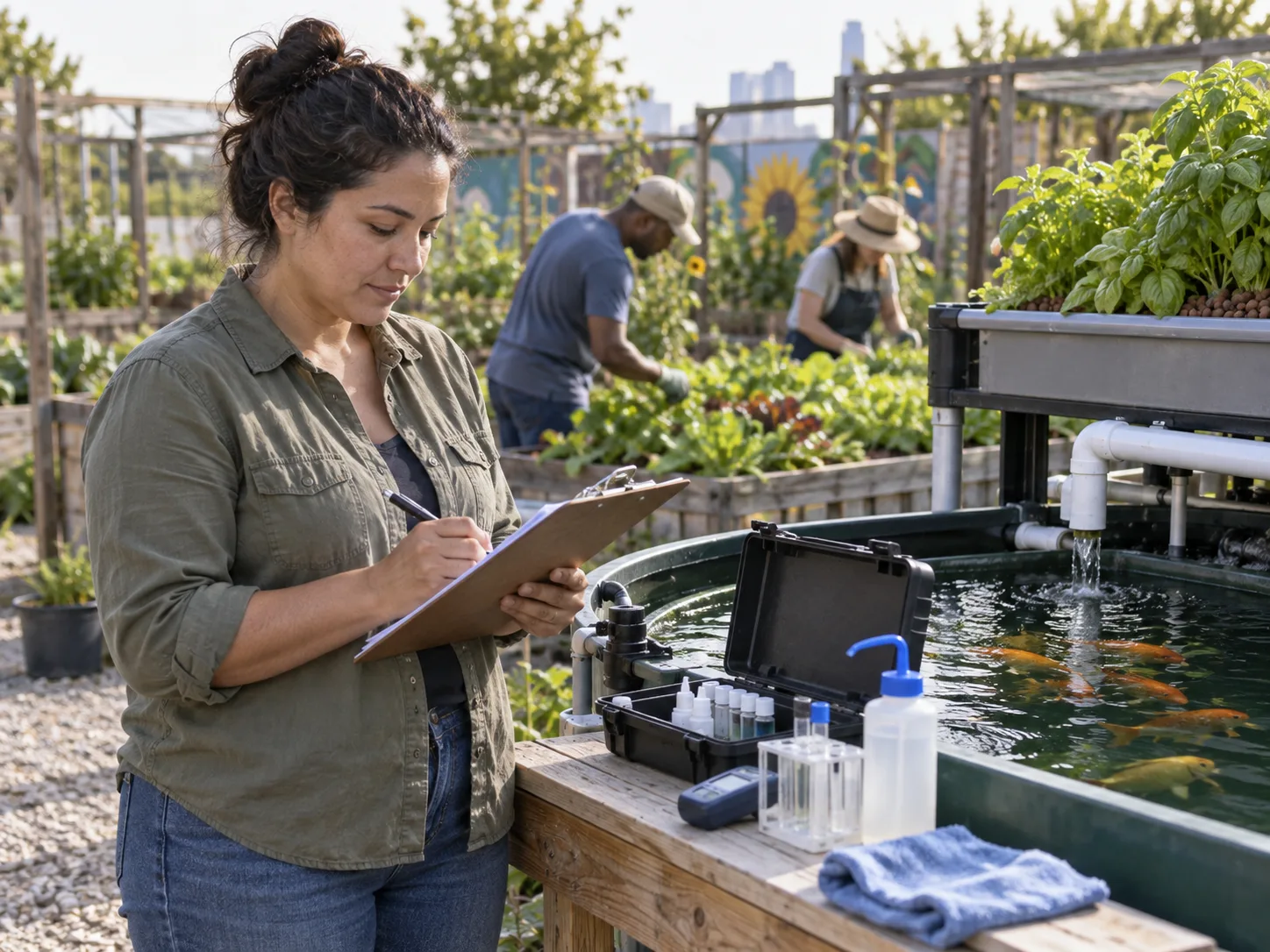
Community systems need an operating model. Assign at least a primary and secondary operator, a person authorised to approve purchases, a contact for after-hours alarms and a named liaison to the supplier. Put a short daily/weekly/monthly schedule at the system and in a shared online record. Tasks should be realistic: feed observation, water-level check, temperature/air/pump observation, test schedule, solids-device cleaning, plant work and response to alarms.
Use a handover process for new volunteers. A person should not adjust valves, add additives, increase feed or introduce fish without knowing the written procedure. Our guide on ordering aquaponics nutrient supplements and additives can help groups avoid treating a product purchase as a substitute for diagnosis.
> Building a community, school or nonprofit project? Send Your Requirements with the site plan, participant age group, intended season, available utilities and operating team so the system scope can be matched to the programme.
Buy in phases when the organisation is still learning
A phased plan can be more responsible than one large purchase. Phase 1 may establish site utilities, safe tank and filter layout, basic test routines and staff training. Phase 2 can add grow capacity once the group has completed a stable operating period. Phase 3 can add monitoring, educational signage or additional modules after evidence shows the team can sustain them.
Phasing is not an excuse to buy incompatible equipment. Request a system drawing that shows intended future connections, shut-off points, pump/air capacity assumptions, structural space, power allowance and how an added module will be commissioned. Preserve manuals, photos, factory-testing records and shipment inspection records in a shared project folder so the next coordinator understands what was delivered.
Keep the procurement process transparent
Community projects often involve a committee, grant requirements or public funds. Compare quotations with one shared checklist rather than comparing only total price. Record capacity assumptions, listed components, exclusions, expected utility work, warranty contact, spare-parts lead time, training hours, delivery responsibility and support after handover. Ask the same clarification questions of each supplier so the comparison is fair.
Avoid inserting a vague “complete system” line into a proposal. A complete project might require equipment only, or it might include freight, unloading, installation support, local contractor work, testing, cycling guidance, operator training and ongoing service. If the budget covers only equipment, say so plainly and assign the remaining responsibilities before purchase approval.
When inspecting an export shipment, product modules should be dry, protected and identified against the packing list; empty tanks and grow components should not be presented as operating fish-and-plant systems. Check for physical damage, count cartons and fittings, save photographs and report discrepancies promptly. The group can then arrange a controlled installation instead of rushing to fill an unverified system for an opening event.
Design for volunteer turnover and seasonal pauses
The most resilient community project assumes that key people will change. Keep a plain-language operating folder on site and a digital copy owned by the organisation, not a private account. Include supplier contacts, equipment list, normal photographs, test schedule, food and fish records, spares location and an escalation chart. Use a simple sign-off when a new coordinator takes responsibility.
Seasonal programmes need a deliberate plan for periods when attendance falls. Identify who checks the fish over weekends, holidays and school closures; whether the system will remain stocked; how weather protection changes; and whether any crop or fish transfer is permitted and planned. “We will find a volunteer” is not a continuity plan. A smaller system that remains cared for is more valuable than a larger installation paused without responsible oversight.
Measure value in more than harvested produce
A community garden may evaluate value through attendance, science lessons, volunteer skills, improved confidence with food production, shared harvest, local partnerships and consistent records as well as kilograms of vegetables. Set these measures at the outset. This helps funders and participants see the result of careful operating work even when seasonal weather, a start-up delay or a safety-first reduced fish load limits early harvest.
Request a transparent supplier scope
Ask for a quotation with a component-by-component list, drawings, responsibility matrix, lead time, packaging format, delivery terms, warranty route, spare-parts availability and installation/training options. Ask specifically what is factory tested, what must be tested after site installation, and which local trades are not included.
At shipment inspection, check modules and fittings against the packing list before the delivery crew leaves where practical. Photograph any damage or missing item, retain packaging when needed for a claim and avoid installing compromised components. During installation preparation, stage equipment so there is still access to filters, drain points, air distribution and electrical isolation.
The system should arrive as equipment, not as an unsupported promise. A supplier can provide useful product application advice, but local requirements and safe site work remain a shared project responsibility.
Design the learning experience without compromising animal care
Community aquaponics can teach biology, chemistry, engineering, record keeping, collaboration and food systems. The educational plan should respect the operating system. Schedule observation and lesson time around the normal care routine. Teach participants why water tests, feed records and quiet observation matter. Do not create frequent handling, feeding or water changes merely to make a demonstration more exciting.
Cornell’s garden-based learning material on soilless growing offers a useful educational framing: learners can plan, assemble, maintain and observe systems while considering plant and fish needs. Adapt activities to participant age, supervision and local rules.
A practical first-year resilience plan
Before stocking fish, agree on:
- who checks the system on weekends, holidays and school breaks;
- a primary and backup contact list;
- a response plan for power loss, low water, leak, blocked return and air-system fault;
- where the emergency air equipment and instructions are kept;
- who can authorise a repair or purchase; and
- a safe plan if the group can no longer care for the fish.
Testing an emergency route is more valuable than merely owning one. During commissioning, check the pump and air system, confirm safe drainage and practice the first communication steps. Record what was learned and revise the checklist. The aquaponics system maintenance guide provides a useful base for daily, weekly and monthly responsibilities.
FAQ
What is the most affordable system for a community garden?
The most affordable option is usually the smallest format that meets a defined educational or production objective while the group can still provide daily care, safe utilities, maintenance access and a backup operator. It is not automatically the cheapest kit.
Can volunteers run an aquaponics system?
Yes, when the tasks, training, records and responsibility schedule are clear. Volunteers need a named coordinator, written limits on changes, handover procedures and a reliable escalation route. Systems with fish cannot be left unmanaged during holidays or staffing changes.
Should a community project begin with a large system?
Not usually. Larger systems can be appropriate when the organisation has site readiness, trained operators, budget and continuity. A phased modular plan allows the group to demonstrate operating discipline before adding risk and complexity.
Are grants enough to make a project sustainable?
Grants can fund equipment, but sustainability depends on recurring utilities, consumables, time, maintenance and leadership. Include first-year operating costs and a responsible continuity plan in the project budget.
Conclusion
Affordable community-garden aquaponics is a planning achievement, not a discount label. Define the public purpose, choose a serviceable format, budget for the first year, prepare a safe site, assign real ownership and phase expansion around demonstrated capacity. The resulting project is more likely to remain a valuable learning and growing resource long after installation day.
Ready to turn a community project brief into a practical equipment scope? Contact Us with the proposed location, programme goals and operating arrangements.

