
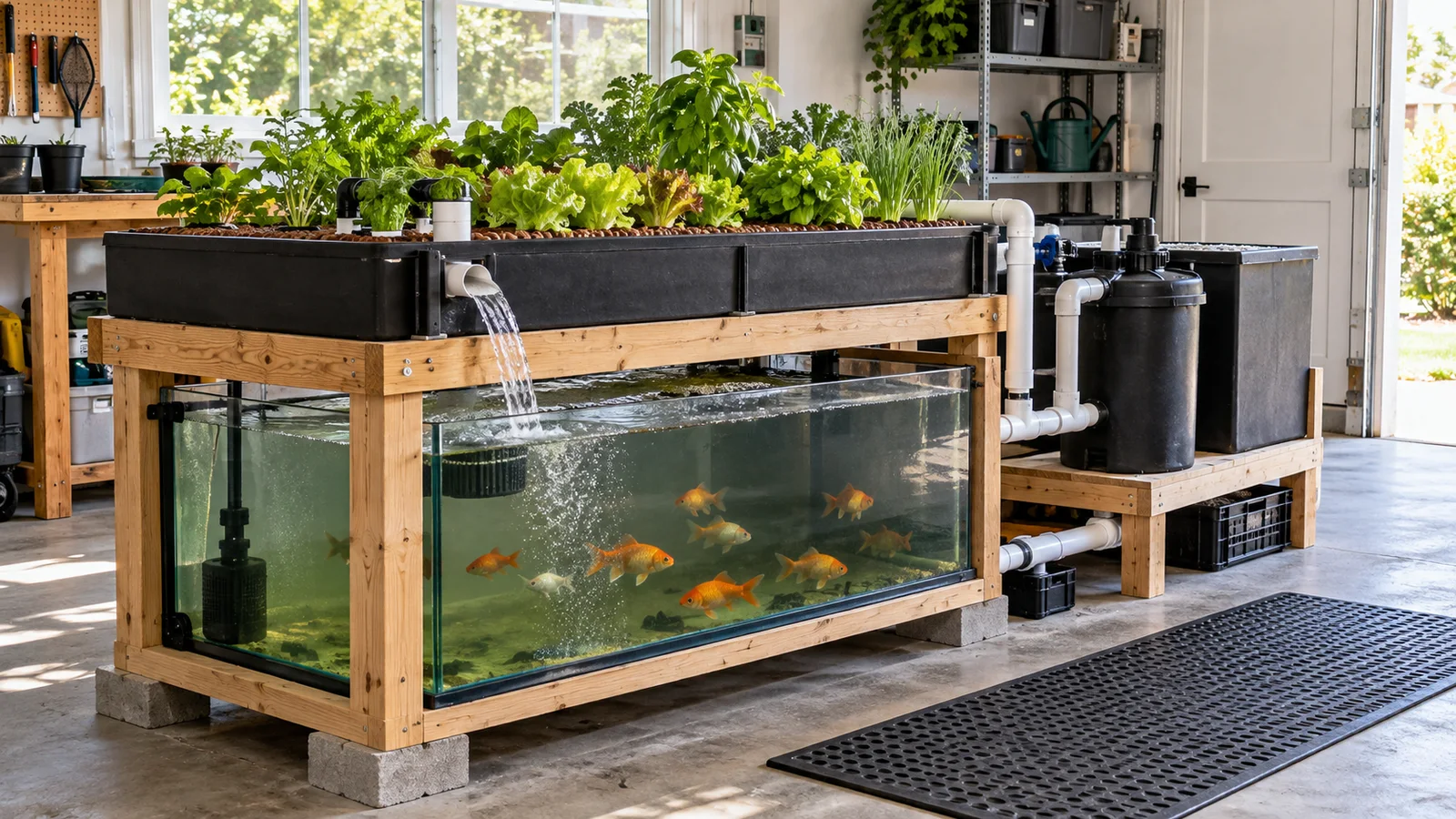
Introduction
The right home aquaponics system size is not determined by the biggest tank that fits in a garage or the highest number of planting holes in a product listing. It is the size that fits the household’s crop goal, fish-care experience, available floor and service space, water weight, local climate, utilities and willingness to inspect the system every day.
Small systems can be excellent teaching and herb-growing tools, but they have less water buffer when temperature, feeding or water quality changes. Larger systems may be more stable in some respects, yet they add weight, plumbing, cleaning, electrical demand and fish-welfare responsibility. A practical decision starts with the use case and works backward through water volume, plant area, filtration and site constraints.
This guide is for people selecting a new home system. If you already operate a stable system and want to add capacity, read our separate guide to scaling up a home aquaponics system.
The short answer
Choose the smallest system that can safely support your intended learning or growing goal while leaving realistic access for testing, feeding, cleaning and emergency response. Start with crops, available space and daily care capacity; then match fish tank volume, grow area, filtration, circulation and aeration to that purpose. Avoid selecting by tank volume or plant-site count alone.
The University of Maryland Extension’s small-scale build guide illustrates why tank, biofilter, water path and grow bed must be considered as one operating system. See the University of Maryland guide. Treat any design ratio as a planning tool rather than a universal guarantee, because fish, crops, feed, climate and management differ.
Start with the purpose, not the tank
Write down what success means for the household:
- a visible biology lesson with a few herbs;
- regular harvests of leafy greens for a family;
- a protected backyard project with seasonal crops;
- a school, community or demonstration installation;
- an indoor display where appearance and spill control matter as much as harvest.
A countertop aquarium-top garden and a backyard fish-and-plant system may both be called home aquaponics, but they are not interchangeable. The first may suit observation and small herbs. The second may offer more water stability and crop area, while requiring more filtration, floor protection and maintenance access. Be honest about the goal before comparing listings.
Measure the site as an operating space
Measure more than the footprint. Include access to fill and drain water, walkways, lid opening, filter removal, harvesting, hose use, electrical isolation and cleaning. A neat unit pushed tightly against a wall can become difficult to maintain when a pump needs to be removed or a slow leak appears behind the tank.
Check the delivery route too: gate width, door openings, stairs, turns, lift access and where a pallet can be placed. A large rigid tank may be suitable only if it can reach the final location safely. Modular parts can simplify access but add assembly work and more connections to inspect.
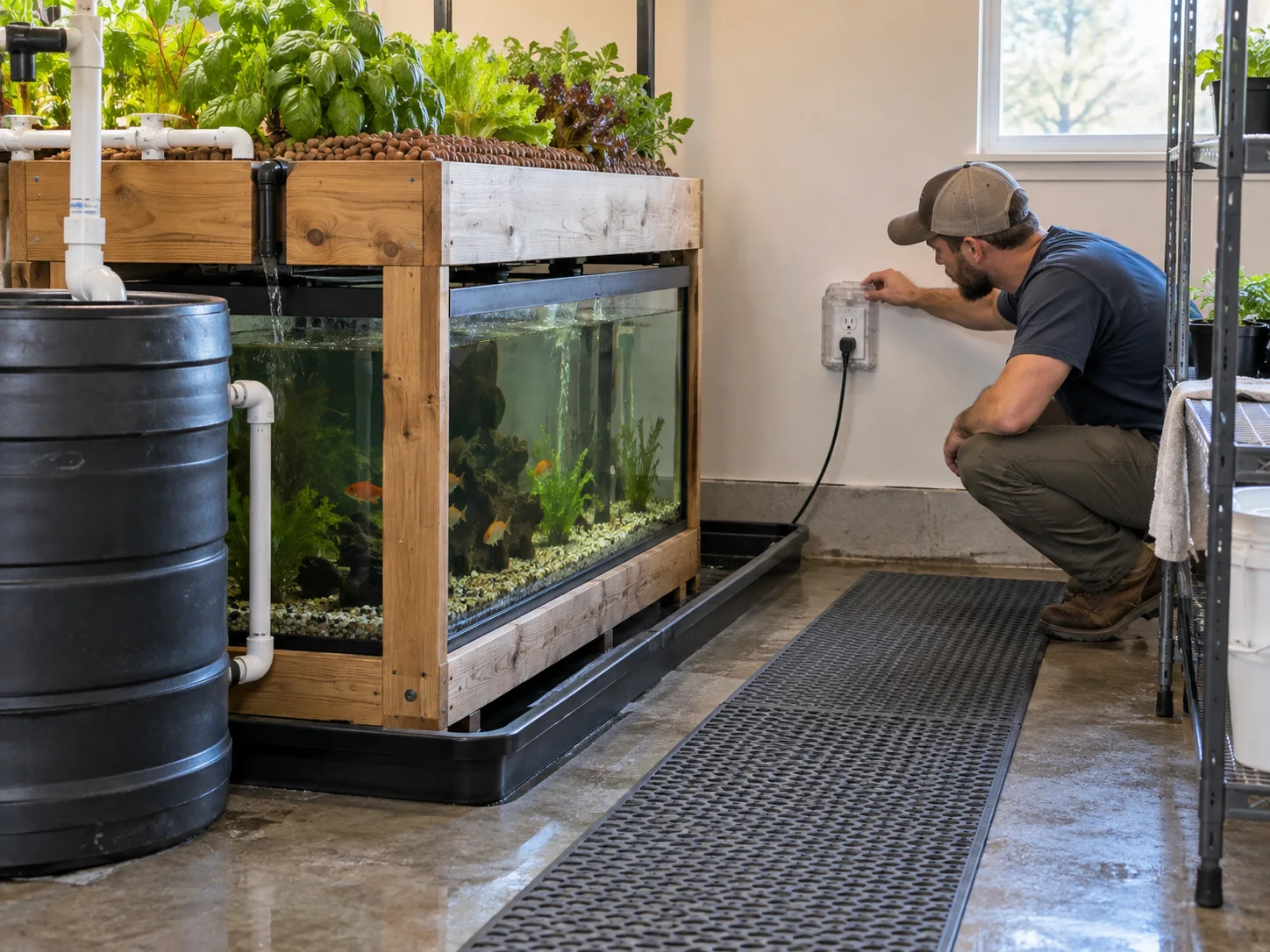
Water and wet media are heavy. Consult qualified local professionals where floor or deck loading is uncertain. For indoor installations, plan a water-resistant area, a practical drain or spill response, ventilation, safe cable routing and enough light for the intended crop. Do not place a system where a leak can reach power strips, finished flooring or inaccessible cavities.
Match water volume to management capacity
More water does not remove the need for testing, but it can provide more time to notice a small change. A very small fish tank can change temperature and water chemistry quickly after overfeeding, power loss or evaporation. A larger tank may buffer those changes better, yet it increases the consequences of a leak and the time required for cleaning and water management.
Instead of seeking a universal minimum volume, ask: Who will test water? Who will feed fish when the main operator is away? Where will make-up water come from? Is there room for a backup air arrangement suitable for the system? Can the household safely manage a water-only leak test and cycling period before fish are added?
Choose a tank with a safe lid or cover strategy, accessible drains and a clear overflow route. The most useful size is a system you can observe and service, not a maximum volume placed in a marginal location.
Size plant area from crop use and nutrient input
Plant holes are a marketing-friendly number, but they do not define harvest or biological balance. Crop choice changes usable area: leafy greens and herbs can be compact; fruiting crops require more root volume, height, support, light and nutrient demand. Crop spacing also changes through the season.
Plan a modest first planting. Write down intended crop varieties, seedling schedule, expected harvest rhythm and how the plants will be supported. Then ensure the fish side, feed input and filtration design can serve that plan. A row of empty sites does not justify adding fish rapidly; fish loading must remain within the capacity of water, oxygenation, solids handling and biofiltration.
The FAO small-scale aquaponics manual explains why component sizing and feed-related nutrient input must be treated as a connected system. Read the FAO production guide. Its examples are useful for understanding principles, not a replacement for site-specific design or local animal-welfare requirements.
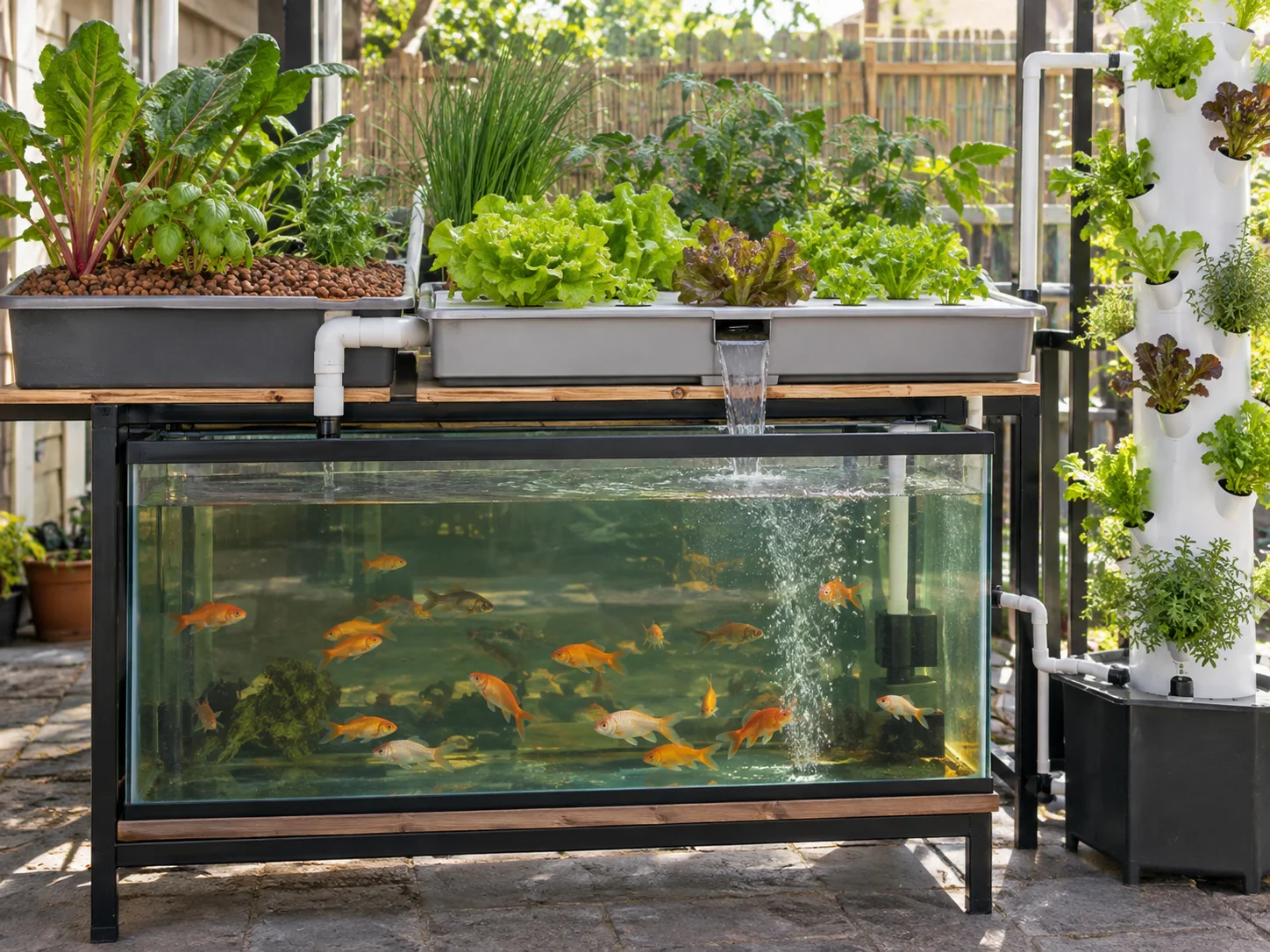
Choose the format that fits the planned size
Compact media-bed systems
Media beds can be practical for a home system because the media supports roots and provides biological surface area. They are heavy when wet, so bed support, floor loading, drain design and access to remove accumulated solids need attention. Flood-and-drain operation also needs reliable plumbing and an observable overflow path.
Raft or deep-water culture systems
Raft beds can use a clear planting layout for leafy crops, but often need effective solids removal upstream to protect roots and keep water manageable. Consider bed access, raft lifting, aeration, water level and how harvested rafts or seedlings are handled in the available space.
NFT and tower systems
NFT channels and towers can use vertical or linear space efficiently, yet their roots and narrow water paths generally need clean, well-filtered water. They are not an automatic shortcut to a large home harvest. Ask how solids are removed, how flow is balanced and how each channel or tower is cleaned.
For a fuller method comparison, see what are the different types of aquaponics systems. Choose the crop format before calculating a final footprint.
Confirm utilities, climate and routine tasks
A home system needs continuous or scheduled circulation and aeration consistent with its design, plus safe power near water. Confirm local voltage, protected outlets, cable management and a safe power-isolation point. If the system is indoors, grow lights, ventilation, dehumidification and water-temperature control may influence both room suitability and operating cost. If it is outdoors, consider sun, wind, rain, cold periods, pests and water temperature swings.
Build a basic routine before purchase: daily fish observation and flow check; weekly water tests and filter inspection; periodic pump, air stone, drain and root-zone review. If the operator cannot reach a component without moving furniture or lifting a heavy bed, the chosen size is probably not practical.
During installation preparation, mark the equipment footprint, maintenance aisle and water route on the floor. Review the proposed arrangement with the supplier before shipment. At factory testing, request evidence of the supplied tank, grow modules, drains, pump, aeration and fittings. At shipment inspection, verify those components against the packing list before installation begins.
Use a size range, not a false universal formula
Home buyers often ask for one ideal tank capacity or one plant-to-fish rule. These figures can be useful starting points, but they cannot replace a system-specific review. A tank of the same volume can behave very differently with a lightly stocked ornamental application and a food-fish plan; a media bed offers biological surface differently from a raft bed or NFT channel; an indoor room has different heating, lighting and spill risks from a mild-climate backyard.
Use a range-based decision instead. A compact learning system is appropriate when the crop goal is herbs or observation, water weight and floor area are limited, and the operator is prepared for close monitoring. A mid-size backyard or garage system may suit regular leafy-green production when the site has secure utilities, drainage and routine maintenance time. A larger household system should be chosen only when the structure, access, filtration, fish-care knowledge and contingency plan all grow with the footprint.
Before accepting a supplier recommendation, ask them to state the assumptions behind it: fish species and anticipated size, crop type, grow method, water temperature range, feed input, filter arrangement, flow rate, aeration, local climate and the operator’s target. If these assumptions are missing, the proposed size is a catalogue category rather than a functioning plan.
Avoid trying to make a small system behave like a larger one by overstocking fish, using excess feed or filling every plant position from the first week. Conversely, do not buy an oversized package just because it seems more stable if it cannot be safely delivered, cleaned or supported by the home site. Good sizing is a match between the system and the people who will operate it.
A simple home-size decision checklist
Choose a system only after you can answer these questions:
1. What crops and harvest frequency are realistic for the household?
2. What floor or ground area remains after a maintenance aisle is included?
3. Can the structure safely support water, wet media and people servicing the unit?
4. Who performs daily checks, water tests and feeding?
5. How are power, drainage, spill containment and ventilation handled?
6. What filtration and aeration are supplied, and how are they cleaned?
7. Can the selected system be delivered through the actual access route?
8. Which items are included, optional or supplied locally?
Mid-article CTA
Not sure which footprint fits your home? Send your available length, width, ceiling height or outdoor area, intended crops and installation location. Send Your Space Details before ordering a kit or modular system.
FAQ
Is a larger home aquaponics system always easier to manage?
No. More water can buffer some changes, but a larger system brings more weight, equipment, solids, power requirements and cleaning. Choose the size the household can inspect and maintain consistently.
Should I choose tank size or grow-bed size first?
Start with the purpose and crop area, then match the fish tank, feed input, filtration, circulation and aeration to the intended design. Neither side should be selected in isolation.
Can I place a home system upstairs or on a deck?
Only after the structure and water-management risks have been assessed appropriately. Water, media and equipment impose loads that should not be guessed. Seek qualified local advice where capacity is uncertain.
Should a beginner buy the smallest available kit?
Not automatically. A tiny unit can be a useful teaching system but may have less water buffer. Select an observable, serviceable package that matches available space, attention and crop expectations. Our beginner kit guide explains the related purchase checks.
Conclusion
The best home aquaponics system size is the one that supports a defined crop goal without exceeding the household’s space, weight, utility and maintenance capacity. Measure the site as a working environment, match water and plant area to biological and operational reality, and insist on accessible filtration, aeration, drains and electrical safety. A modest system that can be inspected every day is more valuable than a larger one that is difficult to operate.
Final CTA
Ask for a Home System Size Checklist. Contact Us with your intended location, available dimensions, crops and application to receive a pre-purchase information checklist.

