
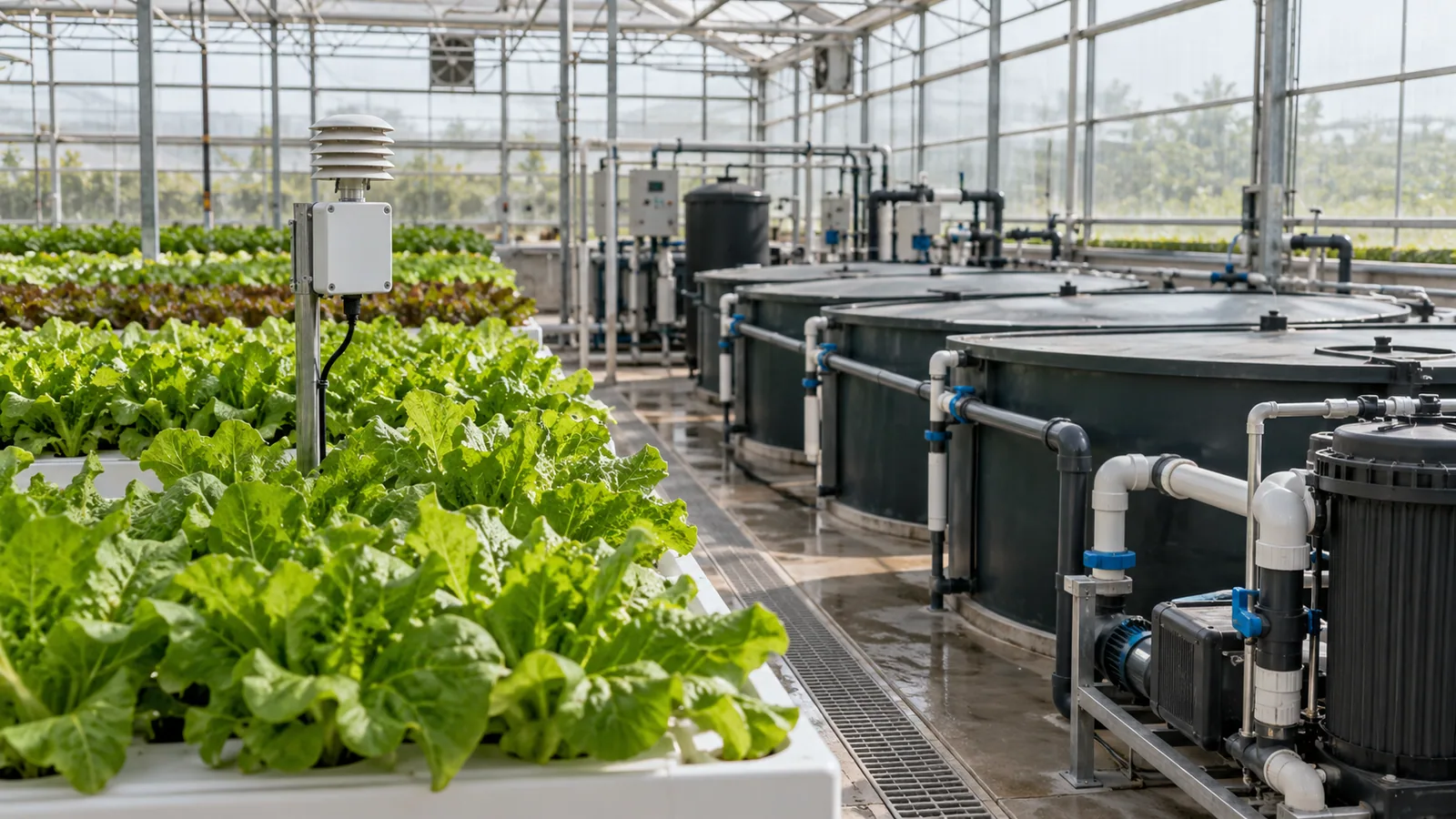
Most aquaponic systems do not need carbon dioxide injected into the water. Fish, bacteria and other organisms already produce dissolved CO2 through respiration, and excessive dissolved CO2 can interfere with fish respiration, depress pH and indicate inadequate gas exchange. Plants still require CO2 for photosynthesis, but they normally obtain it from the air around their leaves—not from CO2 deliberately added to the fish tank.
Supplemental CO2 can be considered for the air inside a tightly controlled greenhouse or indoor growing room when light, temperature, ventilation, crop density and economics justify it. That is a controlled-environment crop decision, not a routine aquaponics requirement. The enrichment system should remain separate from the fish-water loop and should include appropriate monitoring, ventilation and worker-safety controls.
This distinction matters because the question “Does aquaponics need CO2?” combines two different engineering problems: providing carbon to plant leaves and removing excess respiratory CO2 from recirculating fish water. A reliable project treats those problems separately.
The short answer for common aquaponic applications
For an outdoor, naturally ventilated greenhouse, backyard or small commercial aquaponics system, ambient air generally supplies plant leaves with CO2. The operator’s more urgent gas-management duties are maintaining dissolved oxygen, moving water through treatment stages and preventing dissolved CO2 from accumulating in heavily stocked or poorly ventilated water.
For a sealed or semi-sealed indoor farm with strong grow lighting, a dense canopy and controlled ventilation, leaf-level CO2 may fall during the light period. Enrichment may improve photosynthesis under suitable conditions, but only after other limits have been measured. Adding CO2 cannot compensate for inadequate light, unsuitable temperature, nutrient imbalance, root disease, poor airflow or weak crop management.
For the fish side, injected CO2 is generally the wrong response. Recirculating aquaculture guidance explains that CO2 is produced by fish and bacterial respiration and can accumulate unless aeration or degassing removes it. The SRAC management guide hosted by Texas A&M AgriLife Extension explains that excess CO2 is normally removed with packed-column aerators or other aeration devices.
Understand the three carbon pathways in aquaponics
CO2 in the air around plant leaves
During the light period, plants use carbon dioxide in photosynthesis to build carbohydrates. The relevant concentration is in the plant canopy, where airflow, ventilation, crop density and photosynthetic activity can make conditions different from a sensor mounted elsewhere in the room. An outdoor crop has continuous exchange with the atmosphere; a sealed room has a limited internal air volume unless fresh air or CO2 is supplied.
Dissolved CO2 in fish water
Fish release CO2 across their gills. Bacteria and other organisms also respire. The gas dissolves in water, and its concentration depends on biological loading, water flow, aeration, degassing, temperature, alkalinity and the difference between water and air concentrations. Water returning from a biofilter or other oxygen-consuming process may carry more CO2 and less dissolved oxygen than water entering it.
Inorganic carbon and alkalinity
Carbon in water also exists as bicarbonate and carbonate, with the balance affected by pH. These forms contribute to water chemistry and buffering, but they are not interchangeable with blindly bubbling CO2 into a tank. Nitrification consumes alkalinity and tends to lower pH over time. Operators should measure pH and alkalinity and correct them according to a planned water-quality procedure rather than assuming every falling pH value means plants need more CO2.
Why injecting CO2 into the fish tank is usually a mistake
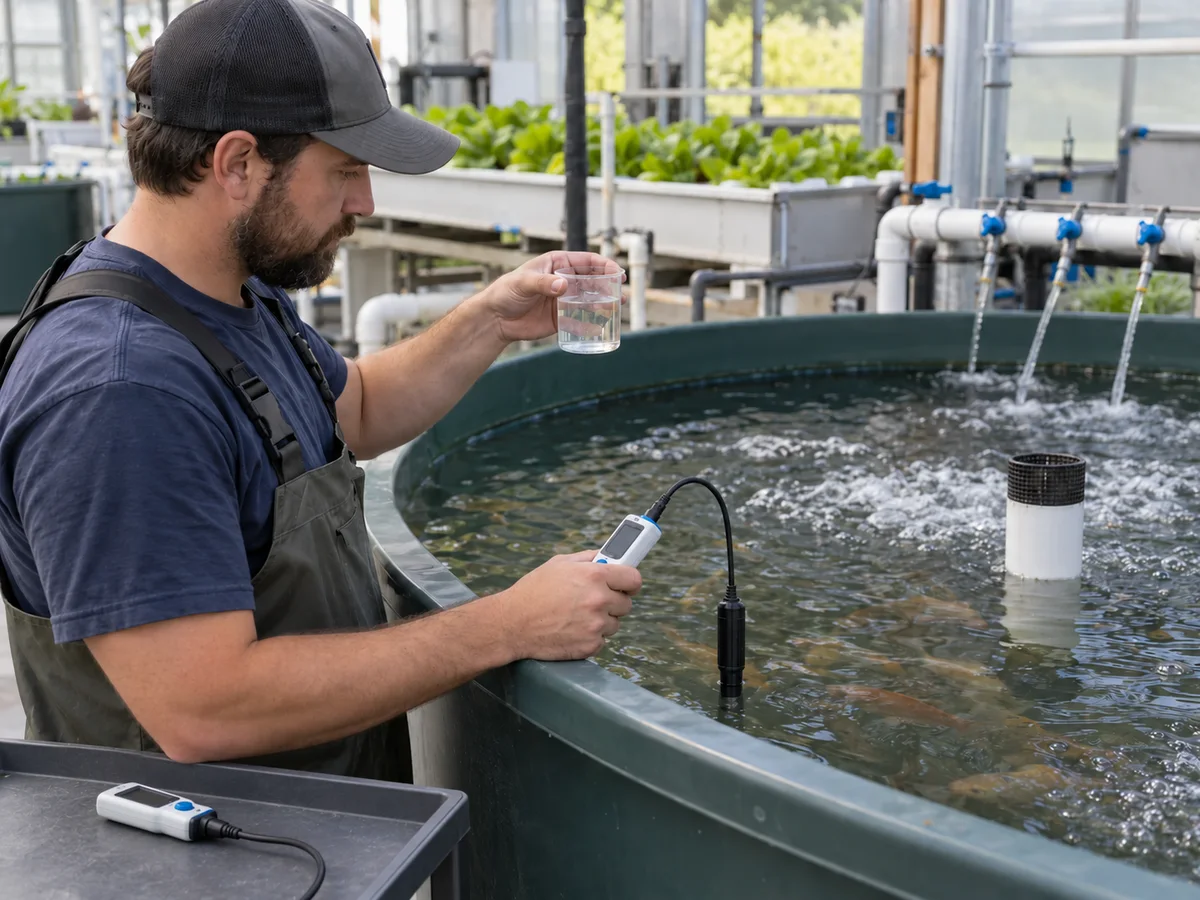
Fish must move oxygen from water into their blood and release CO2 in the opposite direction. When dissolved CO2 becomes excessive, that gas-exchange gradient becomes less favorable. Fish may show reduced appetite, unusual surface behavior, crowding near aeration or rapid gill movement, but those signs are not specific: low dissolved oxygen, ammonia, temperature stress and disease can look similar. Test before diagnosing.
Additional CO2 can also form carbonic acid and push pH downward. A temporary pH change created by gas injection is not the same as a stable alkalinity strategy. Once the water degasses, pH may rebound. Repeatedly adjusting one measurement without understanding dissolved gases and buffering can create unstable conditions for fish, plants and nitrifying bacteria.
The practical priority is therefore to verify aeration, water movement, solids control and degassing. Our guide to effective aeration systems for aquaponics fish tanks explains why oxygen delivery and CO2 removal should be evaluated as connected but separate performance duties.
When greenhouse or indoor CO2 enrichment may be considered
Supplemental CO2 belongs on the evaluation list only when the growing space is controlled enough to retain and regulate it. A naturally ventilated greenhouse may release added gas through roof vents and sidewalls faster than the crop can use it. An indoor room may retain it, but then worker exposure, distribution, monitoring and emergency ventilation become design responsibilities.
The crop also needs sufficient light. At low light, carbon assimilation is limited regardless of how much CO2 is available. Temperature, humidity, leaf health, nutrient supply, cultivar and growth stage further influence response. The University of Florida greenhouse nutrition guide explains that plants obtain carbon largely from atmospheric CO2 and that greenhouse enrichment is most effective during daylight when ventilation is off and canopy concentration is monitored. Its example concentrations are not a universal prescription for an aquaponics greenhouse; the current crop, facility and safety rules require their own professional assessment.
Conditions that support a serious evaluation
- The crop area is enclosed and its air-exchange pattern is known.
- Light level or daily light integral is measured and suitable for the crop.
- Crop temperature, humidity and airflow are controlled.
- Ambient and canopy-level CO2 can be monitored with maintained instruments.
- The operator can calculate the likely crop benefit and the cost of lost gas.
- Worker-occupancy, alarm and ventilation requirements have been reviewed locally.
- The CO2 source and distribution system cannot contaminate the crop or fish environment.
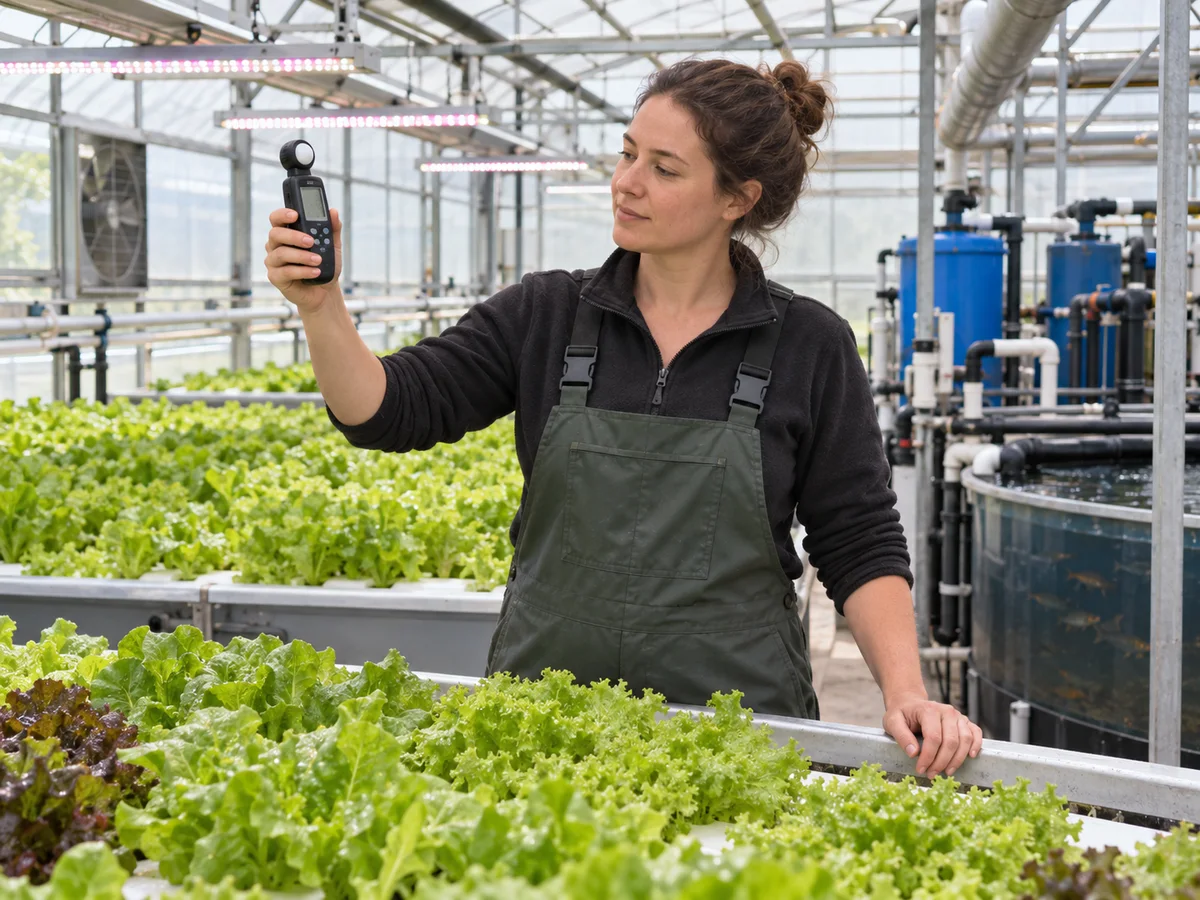
If these conditions are absent, improve the basic growing environment first. Our guide to indoor aquaponics systems with integrated LED grow lights explains why light intensity, photoperiod, heat and crop area should be defined together before another controlled-environment input is added.
> Planning a controlled-environment aquaponics project? Send Your Requirements with the crop area, lighting schedule, fish biomass, ventilation approach and local utility conditions.
Keep the plant-air and fish-water systems logically separated
A greenhouse enrichment system should release and distribute gas in the crop air according to a controlled-environment design. It should not use the fish tank as a CO2 reservoir or distribution device. Likewise, an aquaculture degassing system should release respiratory CO2 safely; it should not be expected to maintain an exact crop-canopy concentration.
Some projects try to capture respiratory CO2 from fish water for plants. The concept is attractive, but practical recovery requires controlled mass transfer, clean air handling, measurement and a favorable energy balance. A normal aerator releases a dilute gas stream mixed with a large volume of air. Capturing, concentrating and redistributing that stream may cost more and introduce more control risk than supplying fresh air or a conventional greenhouse source. Treat carbon recovery as an engineered project, not as a free by-product claim.
CO2 from combustion requires additional caution. Incomplete combustion or unsuitable fuel can introduce plant-damaging or hazardous contaminants. Any combustion-based enrichment system should be purpose-designed, installed and maintained to applicable local requirements. Do not place an improvised burner, generator exhaust or heating exhaust inside an occupied crop space.
Diagnose high dissolved CO2 before changing equipment
Review biological load and feeding
CO2 production rises with fish respiration and microbial activity. Compare current biomass, daily feed and temperature with the original design assumptions. A system can operate well at start-up and later lose gas-transfer margin as fish grow and feed input increases. Do not respond only by adding more air; confirm whether tank mixing, diffuser condition and the water-treatment path still match the load.
Inspect aeration and degassing
Look for blocked diffusers, damaged air lines, closed manifold valves, dirty blower intakes and changed water depths. Inspect waterfall, spray, packed-column or airlift equipment for fouling and bypass. Measure airflow or water flow where the design allows it. Visible bubbles confirm that air is present, but do not prove adequate oxygen transfer or CO2 stripping.
Check water circulation
Poor tank mixing can create local zones that a single sample misses. Confirm inlet direction, return flow, surface movement and solids accumulation. Sample at repeatable locations and times, including periods of high feeding or late in the dark cycle when plants and microbes continue to respire but photosynthesis is absent.
Interpret pH with alkalinity
If pH is declining, measure alkalinity and review nitrification, make-up water and buffering practice. Excess dissolved CO2 can contribute to lower pH, but so can normal biological acid production. The safe pH-lowering guide explains why gradual, measured correction is preferable to chasing a single reading; the same discipline applies when pH is already low.
A practical decision table
| Situation | Is supplemental CO2 normally needed? | Priority action |
|---|---|---|
| Outdoor aquaponics | Usually no | Maintain airflow, water movement and aeration |
| Naturally ventilated greenhouse | Usually no | Measure canopy conditions before considering enrichment |
| Sealed indoor farm with strong lighting | Possibly | Conduct crop, ventilation, safety and economic assessment |
| Fish tank with falling pH and stressed fish | No | Test DO, CO2 where possible, ammonia, temperature and alkalinity |
| High-biomass recirculating fish loop | Do not inject it | Size aeration and degassing for the actual feed and biomass |
| Low-light crop room | CO2 is unlikely to fix the main limit | Correct lighting and crop environment first |
Specify CO2-related requirements during procurement
For a complete aquaponics package, ask the supplier to distinguish water aeration, water circulation, degassing, greenhouse ventilation and optional crop-air enrichment. A statement such as “includes CO2 system” is not enough. Request equipment models, design duty, sensor range, alarm logic, ventilation interlock and responsibility for local installation.
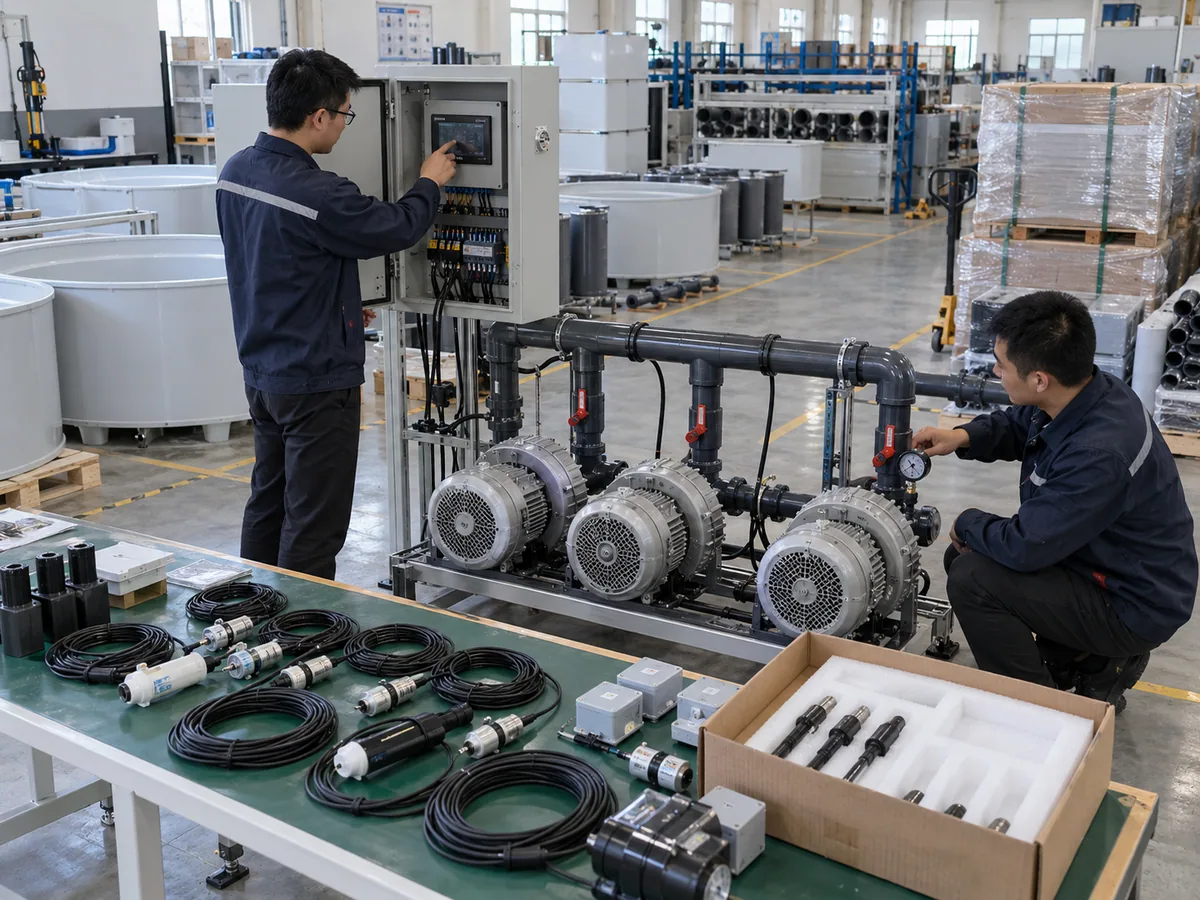
Factory testing can confirm blower rotation, airflow distribution, pump operation, sensor outputs and controller logic. It cannot prove the final greenhouse air distribution or fish-tank gas balance because those depend on site ducting, crop canopy, water depth, biomass, feed and elevation. Site acceptance should therefore include measured commissioning under realistic loads.
During shipment inspection, confirm that gas regulators, tubing, diffusers, sensors and electrical items match the approved list and local voltage. Pressurized cylinders normally come from an authorized local supplier rather than inside an international equipment shipment. Installation preparation should identify cylinder restraint, ventilation, access, warning signage and qualified trades before equipment arrives.
Commissioning and operating checks
Begin with calibrated or verified instruments and record baseline outdoor, room-air and water conditions. Operate pumps, blowers, ventilation and lighting through their normal schedule before stocking to the final biomass. Confirm that a power failure or controller fault produces the intended alarm and safe response.
If greenhouse CO2 enrichment is installed, commission it as its own controlled subsystem. Verify distribution at crop level, shutoff response, ventilation interlock and occupied-space procedures. Establish who checks the sensor, how often it is verified and what happens when readings disagree. Do not allow a crop-yield target to override fish welfare or worker safety.
For the water side, trend dissolved oxygen, pH, alkalinity, temperature, feed and observable fish behavior. Where dissolved CO2 measurement is justified, use a suitable method and a species-appropriate action plan developed with qualified aquaculture advice. A single generic limit should not replace the tolerance, temperature and loading conditions of the selected fish.
Buyer checklist
- Is the question about plant-canopy air or dissolved gas in fish water?
- Is the crop area open, ventilated, semi-sealed or sealed?
- Are light, temperature, humidity and canopy airflow measured?
- What fish biomass and daily feed define the respiration load?
- How are dissolved oxygen and excess CO2 managed during normal operation?
- Are pH and alkalinity interpreted together?
- Does enrichment have ventilation, alarm and worker-safety controls?
- Are the fish-water and crop-air systems physically and logically separated?
- What is tested at the factory, at shipment inspection and during site commissioning?
- What is the expected crop benefit after gas loss, equipment and operating cost?
FAQ
Do fish produce enough CO2 for aquaponic plants?
Fish and bacteria produce CO2, but most plants obtain carbon through their leaves from the surrounding air. The presence of fish respiration does not guarantee an optimal greenhouse canopy concentration, and it does not justify allowing dissolved CO2 to accumulate in the water.
Should I bubble CO2 into an aquaponics fish tank?
Normally no. Fish water usually needs adequate oxygenation and removal of excess respiratory CO2. Injecting CO2 can increase fish stress risk and lower pH. Investigate the actual water-quality problem before adding any gas or chemical.
Can supplemental CO2 increase aquaponic crop yield?
It may improve some crops in a well-controlled, adequately lit environment, but the result depends on crop, light, temperature, ventilation, humidity, nutrition and management. Enrichment should follow a measured agronomic and economic assessment.
Does an indoor aquaponics room automatically need CO2?
No. Many indoor systems exchange enough fresh air to maintain workable conditions. Measure crop-level CO2 during the light period before deciding. If concentration is low, compare controlled enrichment with increased ventilation and the associated heating or cooling cost.
Can low pH prove that dissolved CO2 is too high?
No. Dissolved CO2 can lower pH, but nitrification, source-water alkalinity and other inputs also affect it. Review pH, alkalinity, aeration, loading and sampling conditions together.
Is CO2 the same as oxygenation?
No. Plants use CO2 for photosynthesis, while fish and aerobic bacteria require oxygen for respiration. Dissolved CO2 is a respiratory waste gas on the fish side. Aeration can add oxygen and help remove CO2, but the required performance should be verified for the actual load.
Conclusion
Aquaponic systems normally need reliable air exchange, aeration and degassing—not CO2 injected into fish water. Ambient air is adequate for many crop applications. Supplemental crop-air CO2 becomes a legitimate option only in controlled, well-lit spaces where plant response, gas loss, safety and cost can be measured. Keep the plant-air decision separate from fish-water gas management, correct basic environmental limits first, and commission every gas-control function under realistic operating conditions.
Need help defining aeration, ventilation or controlled-environment options for a complete system? Contact Us with the project location, crop area, fish load, lighting and ventilation plan.

