
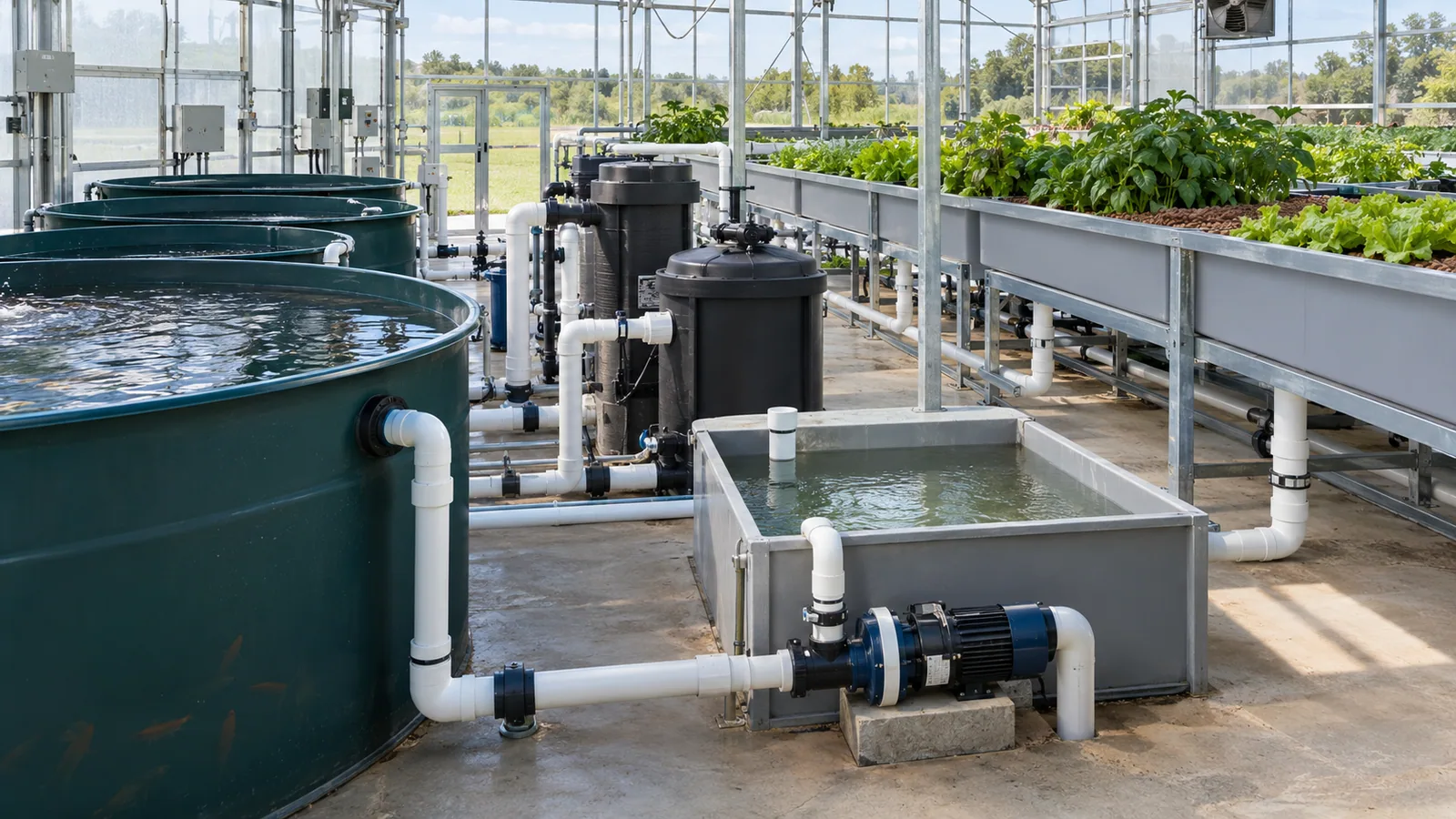
Most recirculating aquaponics systems need a device that moves water. In a conventional layout, that device is an electric water pump. Gravity can carry water downhill from a fish tank through filters and grow areas, but it cannot return that water to a higher elevation without another source of energy. An airlift can replace a conventional water pump in some low-head designs, yet the airlift still depends on an air blower or compressor. It is therefore more accurate to ask which water-moving method fits the hydraulic design than whether the system can operate without any pumping energy.
A pump keeps fish water moving through solids removal, biofiltration and plant production before it returns to the tank. If flow stops, oxygen distribution, waste transport and treatment performance may decline. The biological risk depends on fish biomass, feed, temperature, water volume, independent aeration and how long the outage lasts. Pump selection should consequently include flow, total dynamic head, continuous-duty suitability, energy use, solids tolerance, maintenance access and an outage response—not just the maximum liters or gallons per hour printed on the box.
What the pump actually does
Carries waste to treatment
Fish release dissolved waste and produce solids. Water movement transports those materials from the rearing tank to the mechanical filter and biofilter. Tank inlet and outlet placement also influence whether solids reach the drain or settle in corners. A large pump cannot correct poor tank geometry, but inadequate flow may leave waste in the culture area.
Supplies the biofilter
Nitrifying bacteria require a continuing supply of ammonia or ammonium, oxygen and suitable water conditions. The pump delivers fish water to the biological treatment stage. Some filters also need a particular hydraulic loading or mixing pattern. Flow that is too low can create bypass or low-oxygen zones; excessive flow can shorten retention, disturb media or waste energy depending on the filter design.
Delivers nutrients to plant roots
Grow beds, raft channels, nutrient film technique channels and tower planters have different flow and distribution requirements. The pump or airlift must serve the chosen grow method without starving the farthest branch or overflowing the nearest one. Valves can balance branches, but throttling an oversized pump is not always the most efficient solution.
Supports temperature and oxygen distribution
Water circulation distributes heat, dissolved oxygen and treatment effects through the loop. It does not automatically provide enough aeration. A return waterfall or spray may transfer oxygen, but a stocked fish tank often needs an independently evaluated air system. A water pump and an air pump perform different primary duties even when their effects overlap.
Our guide to how an aquaponics system works maps the water, nutrient and biological cycle that the circulation equipment must support.
Why gravity alone is not a complete recirculation method
Gravity moves water from a higher hydraulic level to a lower one. A well-designed aquaponics system uses that free energy wherever practical: water may leave an elevated fish tank, pass through filters and flow through plant channels before collecting in a low sump. The pump then lifts the treated water back to the high point.
This “pump once, gravity through the rest” arrangement can reduce the number of pumps and simplify control. It still needs careful elevation planning. Water levels, pipe inverts, filter losses, overflow capacity and maintenance access must be resolved before tanks are installed. A few centimeters of unplanned elevation loss can prevent a gravity drain from serving the next component.
A true pump-free closed loop would need another energy source capable of returning water uphill. A spring, elevated supply or continuous flow-through water source may move water without an electric water pump, but then the system is not operating as a normal closed recirculating loop and may create water-use, discharge, temperature and biosecurity responsibilities. A siphon can move water downhill after it starts; it cannot lift the system’s total flow back above the source level.
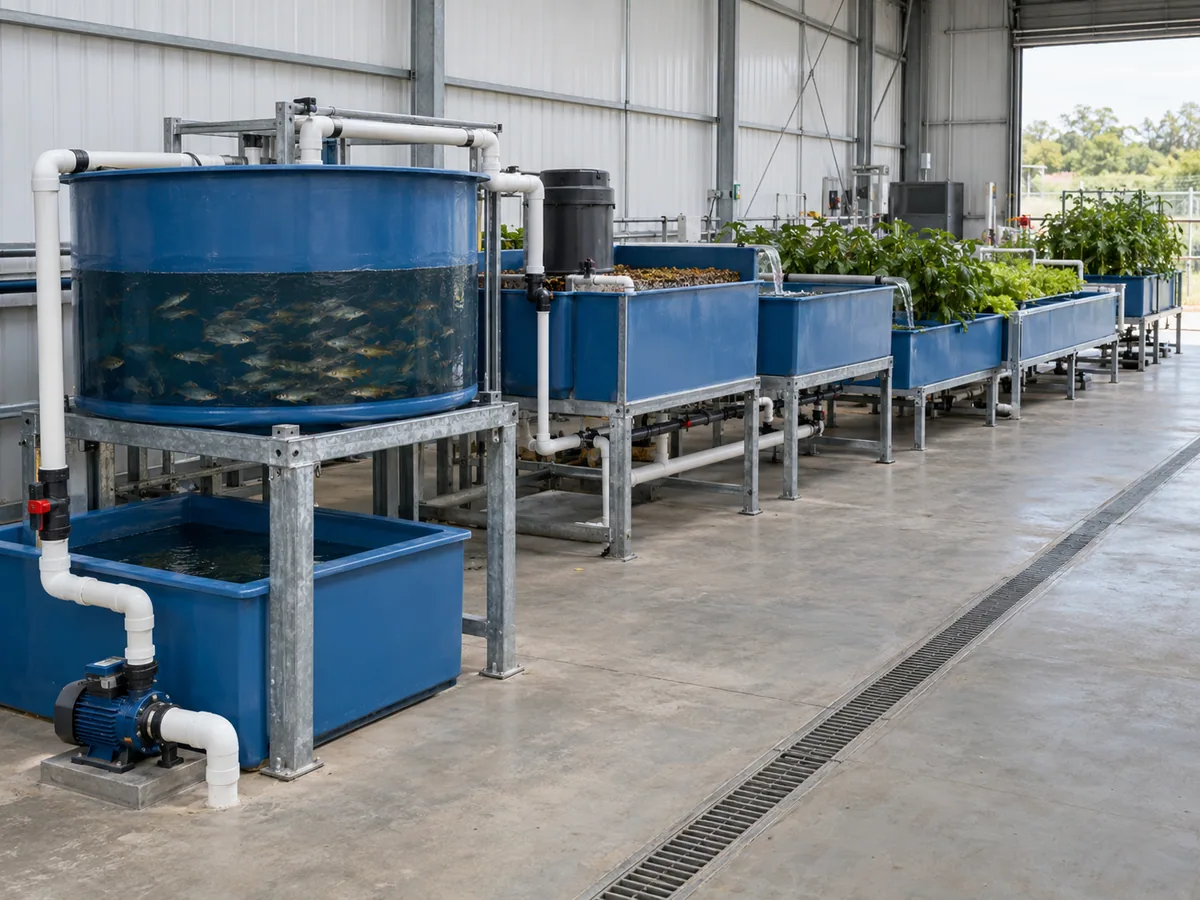
Conventional water-pump options
Submersible pumps
A submersible pump sits in the sump. It is compact and normally avoids priming, but it must be rated for continuous operation and the intended water and solids. Its heat enters the water, which can matter in a small indoor loop. Provide safe lifting access, unions and isolation so it can be serviced without cutting pipe.
External centrifugal pumps
An external centrifugal pump can be easier to inspect and may offer efficient high-flow options. Suction design becomes critical: flooded suction is usually more reliable than asking a non-self-priming unit to lift air-filled water. Avoid restrictive intakes and air leaks. Install the motor in a dry, ventilated service area with appropriate splash, weather and electrical protection.
Direct-current and solar-compatible pumps
DC pumps can integrate with batteries or solar power, but a “solar” label does not prove continuous life-support capacity. Calculate the duty point, controller losses, battery autonomy and seasonal solar availability, then define a response for low-sun periods and equipment failure.
Can an airlift replace the water pump?
An airlift injects compressed air near the bottom of a submerged riser pipe. The air–water mixture in the pipe becomes less dense than the surrounding water and rises, creating water movement. With few or no moving parts in the water, airlifts can be attractive for systems that already require a blower.
The limitation is lift. Airlifts perform best when the required elevation rise is small and the riser has substantial submergence. Water flow changes with pipe diameter, submergence, lift height and air input. The LSU feasibility study of airlift pumps in recirculating aquaculture found that airlift performance and gas transfer depend strongly on configuration; its tested values are research results, not catalogue ratings for every aquaponics system.
An airlift may combine water movement, aeration and some CO2 stripping in a low-head design. It does not eliminate equipment: the project still needs a correctly sized blower, manifold, air lines and backup plan. If towers, overhead NFT channels or elevated filters require significant head, a conventional water pump may be more practical. Compare the complete system duty rather than comparing one airlift tube with one pump label.
> Selecting pumps or airlifts for a new project? Send Your Requirements with the tank volume, elevation drawing, pipe sizes, grow method, local voltage and planned fish biomass.
Size the pump from the installed duty point
Define the required flow
Required flow is set by several processes: fish-tank waste transport, filtration, biofilter loading, plant distribution, temperature control and any equipment minimums. Turnover rules of thumb can support an early estimate, but they are not a final design. Two systems with the same water volume may need different flow because their fish biomass, feed, tank geometry, filter type and elevation differ.
Write a flow balance for the main loop and every branch. Identify normal flow, minimum acceptable flow and any short-term cleaning or backwash duty. If one pump serves several grow zones, specify how branch flow will be measured or balanced.
Calculate total dynamic head
Static head is the vertical difference between the source water surface and the discharge point. Total dynamic head adds friction and component losses from pipe length, diameter, fittings, valves, filters, heat exchangers and other equipment. Dirty filters or partially closed valves can raise the operating head beyond the clean-system calculation.
The Oklahoma State University guide to pump-system testing explains how a system curve represents the relationship between flow and required head, while a pump curve shows what a particular pump can deliver. The operating point is where those curves meet. Although written for irrigation, the hydraulic principle also applies to aquaponics.
Read the pump curve
The “maximum flow” is often measured at little or no head. The “maximum head” occurs near zero useful flow. Neither value is the intended continuous operating point. Use the manufacturer’s performance curve at the calculated head and select a model that operates in an appropriate efficiency region with reasonable margin.
Avoid excessive margin. An oversized pump may waste energy, add heat, create noise and require throttling. An undersized pump may never deliver the design flow after filters foul. Where speed control is appropriate, verify motor and controller compatibility and establish a minimum safe flow.
Include solids and screen conditions
Decide whether the pump receives filtered water or solids-laden water. A clean-water impeller may clog or wear when used before mechanical filtration. A solids-handling pump may have different efficiency and head characteristics. Intake screens should protect the pump without becoming an unmonitored failure point. Make them accessible and large enough that partial fouling does not immediately starve the pump.
One pump, multiple pumps or redundant pumps?
A single low-point pump can simplify a compact gravity-assisted system, but it is also one failure point. Larger projects may use duty/standby pumps or separate process loops. Redundancy works only when the standby can deliver the required flow and does not share the same blocked suction, undersized pipe, breaker or faulty controller. Test alternation, alarms and check valves, and document what happens when each pump stops.
Do you need both a water pump and an air pump?
Most conventional aquaponics systems use both a water pump and an air pump or blower, but two separate devices are not an absolute rule. What the system must provide is reliable water circulation and enough oxygen transfer for the fish, nitrifying bacteria and—where applicable—submerged plant roots. A water pump primarily moves water through the fish tank, filters and grow units. An air pump primarily supplies air to diffusers. Those functions overlap in some designs, but they are not automatically interchangeable.
A dedicated air pump is normally the safer choice for stocked fish tanks and is especially important in deep-water culture, where roots remain submerged. A carefully engineered falling return, spray bar, venturi or other device may add substantial oxygen, while an airlift can use blower air to aerate and move water in a low-head layout. In those cases, a separate conventional water pump or separate air pump may be unnecessary—but only if measured flow and dissolved oxygen remain adequate at maximum fish biomass, feed rate and water temperature.
Do not decide from bubbles, splashing or equipment labels alone. Verify dissolved oxygen in the fish tank, at the biofilter outlet and in the most remote grow zone under the warmest expected operating condition. Also test the failure modes. Separate aeration can continue protecting fish if the circulation pump stops, provided it has independent or backup power; a single combined airlift has fewer devices but can remove both circulation and aeration when its blower fails. The correct answer is therefore usually both devices in a standard system, or one validated system that reliably performs both functions.
Continuous versus intermittent pumping
Many aquaponics systems circulate continuously because fish and bacteria generate waste and consume oxygen around the clock. Media beds can be irrigated by continuous flood, bell siphon flood-and-drain or timed cycles, but the irrigation pattern does not automatically determine whether the main fish-treatment loop can stop.
Intermittent operation may reduce energy in a deliberately designed low-load system, yet off periods change oxygen, temperature, solids transport and biofilter conditions. Do not place a generic timer on a continuous-duty circulation pump to save electricity. Evaluate the longest off time under maximum biomass and temperature, and maintain the life-support functions that cannot pause.
Our energy-efficient aquaponics design guide explains why reducing static lift, friction and unnecessary throttling is usually safer than reducing essential circulation time.
Reliability, alarms and backup power
List credible failures such as grid outage, dry running, blocked intake, air lock, worn impeller, closed valve and controller fault. Define detection and response for each. Flow, pressure, tank-level or current monitoring can help, but every sensor also needs testing.
Backup energy should support critical loads for a defined duration. Emergency aeration is often the first priority, although circulation may also be essential. Size batteries and inverters from measured watts and starting loads, then exercise the backup and record the result.
An overflow and dry-run strategy is equally important. A stuck float or blocked drain can empty a sump, damage a pump or overflow a tank. Set operating levels, low-level cutoffs and overflow paths so one fault does not create a larger biological or building hazard.
Maintenance and replacement planning
Record the pump model, voltage, curve, impeller, seals, connection size and controller settings. Measure flow after commissioning; a decline may reveal fouling or wear. Provide unions and isolation valves, and keep a compatible spare whose voltage, connector and fittings actually match. Our replacement-parts guide for modular aquaponics provides an inventory method. Clean screens on a recorded schedule and follow safe electrical isolation procedures.
Procurement, factory testing and shipment inspection
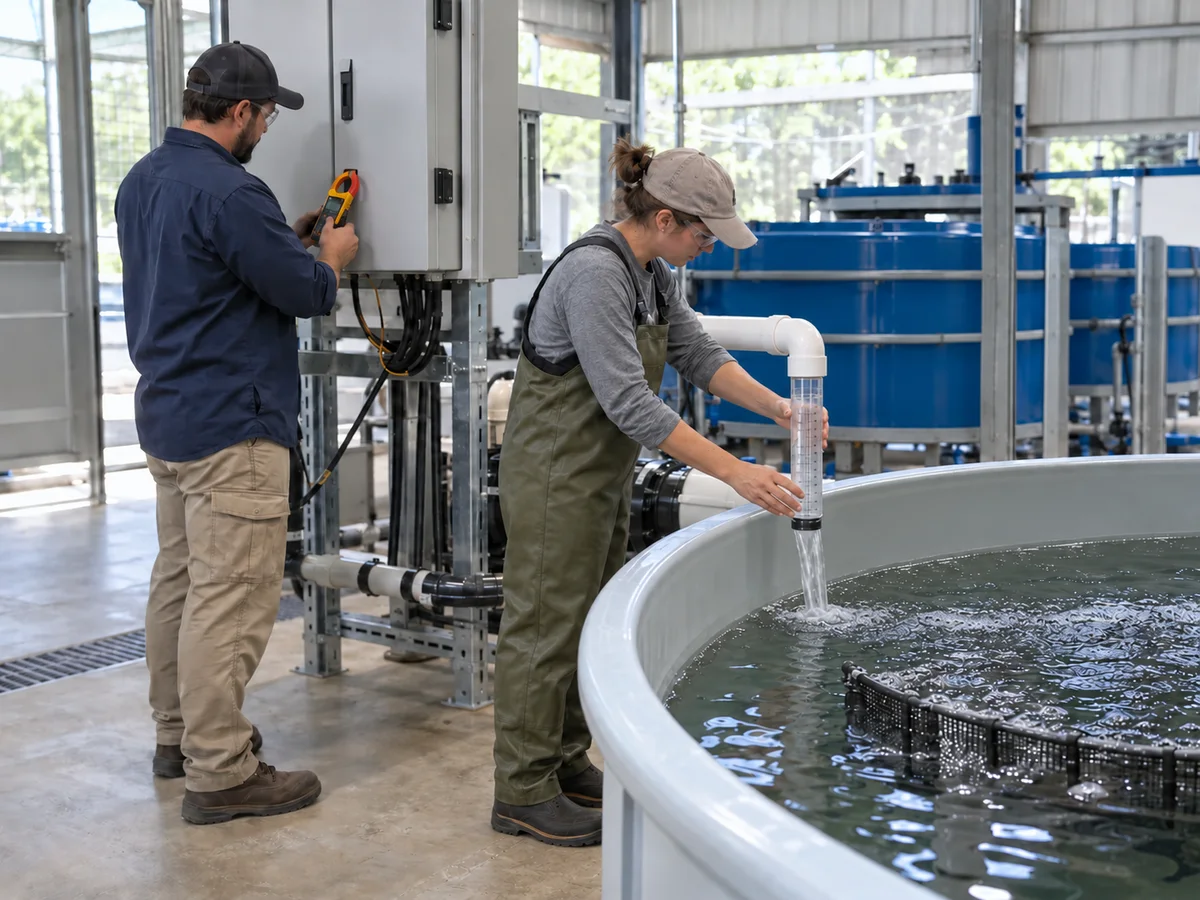
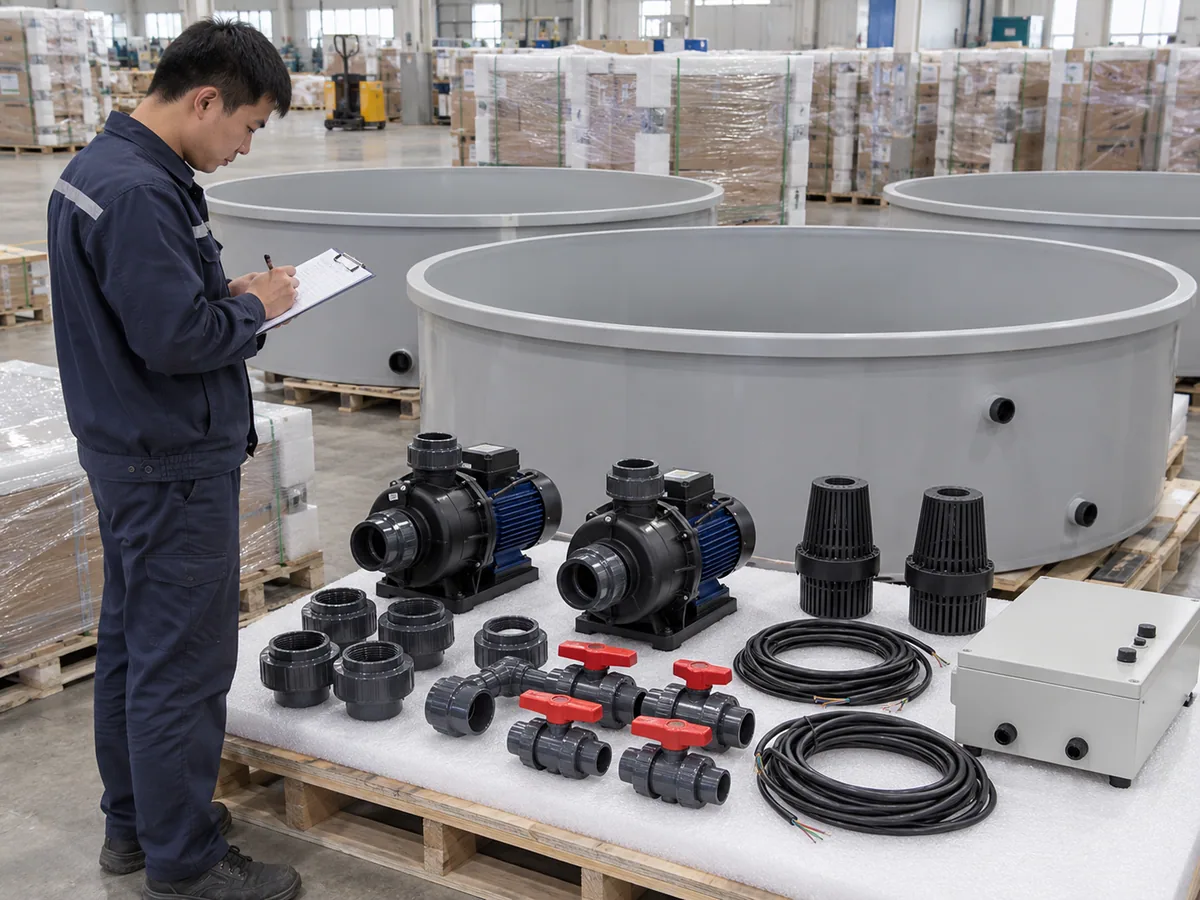
Provide suppliers with an elevation drawing, pipe sizes, filter types, branch flows, fish load, voltage, environment and backup expectation—not only tank volume. Factory testing should verify models, controls, leakage, representative flow and alarms while distinguishing test-loop results from projected site performance. Shipment inspection should check pumps, spares, unions, valves, screens, cables and manuals. Export tanks remain dry and empty, without fish, water or plants. At installation, verify suction, pipe support, valves, electrical protection, measured flow, alarms and backup power before adding the planned fish load.
Pump-selection checklist
- Main-loop and branch flow requirements
- Static lift and calculated friction losses
- Clean and dirty filter conditions
- Pump curve at the intended duty point
- Continuous-duty rating and water compatibility
- Solids size and intake-screen design
- Local voltage, frequency and electrical protection
- Normal power, heat and noise
- Safe access, unions and isolation valves
- Independent aeration requirement
- Alarm, backup and outage response
- Compatible spare pump and critical parts
- Factory-test scope and site acceptance criteria
FAQ
Can gravity run an aquaponics system without a pump?
Gravity can move water downhill through part of a system, but a closed recirculating loop needs energy to return water to the higher point. Most designs use one pump at the lowest point and gravity through the remaining stages.
Can an air pump replace a water pump?
An air blower can drive an airlift that moves water in a low-head design. Performance depends on submergence, lift, pipe geometry and air input. A normal airstone in a tank should not be assumed to provide the required circulation through filters and grow units.
How many hours per day should an aquaponics pump run?
Many systems run the main circulation continuously. Timed operation is only appropriate when the biological load, oxygen, filtration and grow method have been designed and tested for the off periods. Do not apply a generic schedule.
How large should the pump be?
Select it from required process flow and total dynamic head, then check the pump curve. Include pipe friction, fittings, filters, elevation and fouling margin. Tank volume alone is not enough.
Does a bigger pump improve aquaponics performance?
Not automatically. Excessive flow can waste electricity, add heat, disturb filters and require throttling. Better performance comes from matching the pump to the installed duty and minimizing unnecessary head loss.
What happens if the pump stops?
Waste transport and treatment flow stop, while oxygen and temperature distribution may deteriorate. The safe response time depends on biomass, temperature, independent aeration and system volume. Use alarms, emergency aeration, backup power and a written response plan.
Conclusion
Nearly every recirculating aquaponics system needs powered water movement. A conventional water pump is the usual choice; gravity should carry water downhill wherever possible, and an airlift may replace the pump when the layout has very low head and suitable submergence. Design the hydraulic path first, calculate flow and total dynamic head, select from a real pump curve, and build in access, alarms and backup. The best pump is not the largest one—it is the model that reliably delivers the required installed duty with manageable energy and maintenance.
Need a pump schedule and hydraulic layout for a complete aquaponics system? Contact Us with the tank volumes, elevations, grow method, pipe route, voltage and expected production load.

