
Introduction
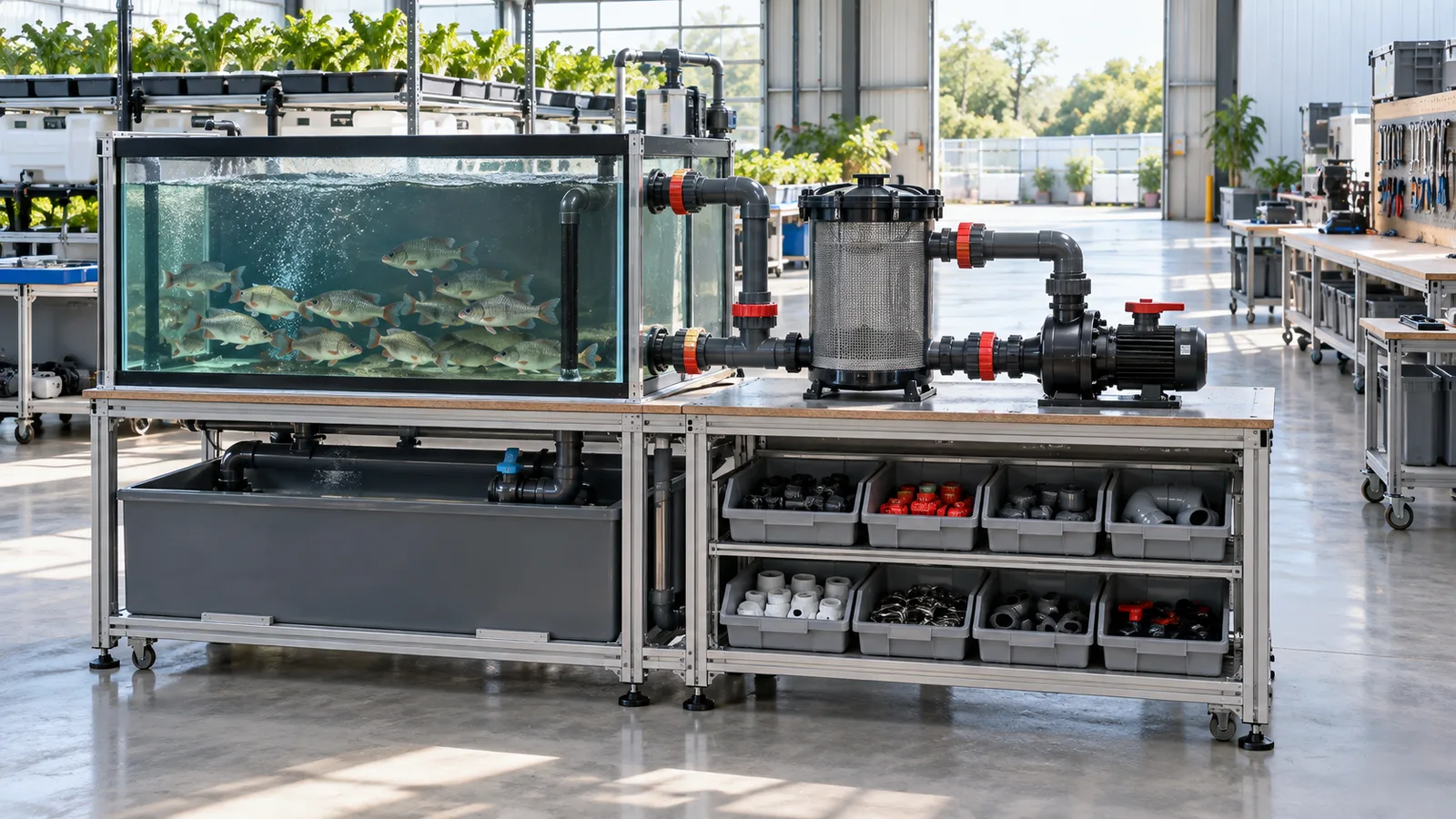
A modular aquaponics system is easier to expand and service than a fixed installation only when its replacement-parts route is planned before a failure. A stopped pump, split union, blocked screen, leaking bulkhead or damaged raft does not merely pause plant watering: it can reduce aeration, alter water level and put fish and the biofilter at risk. The practical answer is to identify each component by function and specification, then obtain the correct part through the system supplier, the original equipment manufacturer (OEM), or a local industrial-water supplier when the specification is genuinely standard.
This guide is written for home, school and small commercial operators. It does not recommend unverified substitutes. Compatibility, food-contact suitability, electrical rating and installation method matter more than finding the cheapest listing.
The short answer
Start with the supplier that sold the modular system. Ask for the current parts list, exploded diagram, model number, revision and compatible substitute list. If the original supplier cannot provide a part, source by documented dimensions and duty: voltage and flow/head for a pump; pipe material, outside diameter and connection type for plumbing; mesh opening and cleaning arrangement for a screen; and exact tank-wall thickness plus gasket type for a bulkhead.
Keep the failed part until the replacement has been compared during shipment inspection. Photograph labels, connectors and the installed orientation before removal.
Build a parts record before you need it
Create one register for the entire water path: fish tank, solids-removal stage, biofilter, pump, distribution manifold, grow section, return line and aeration. For each item record manufacturer, model, serial number where present, purchased date, electrical requirements, pipe or thread standard, service interval and supplier contact. Store manuals and a photograph of the installed item together.
This record prevents a common mistake: ordering a part that looks identical but has a different thread, voltage, shaft length or pressure limit. It also makes a supplier enquiry specific. “I need a pump” is slow to answer; “I need the 24 V replacement pump for controller revision B, with the original connector” is actionable.
For a broader operating record, use our aquaponics maintenance guide. If the failed item is part of solids removal, first confirm its role with our screen-filter selection guide.
Where to source the part
1. The system supplier or authorized distributor
This is normally the safest first route for proprietary tank fittings, racks, grow-bed supports, controller boards, custom manifolds and warranty-covered equipment. Send photos, system order number, part label, dimensions and the nature of the failure. Ask whether the replacement changes flow, warranty or installation instructions.
Some suppliers publish a formal damage-and-replacement process. For example, The Aquaponic Source describes how shipment damage should be documented with photographs so the supplier can arrange replacement components and a freight claim; the same discipline is useful for parts received after commissioning. Read its published shipping guidance.
2. The original equipment manufacturer
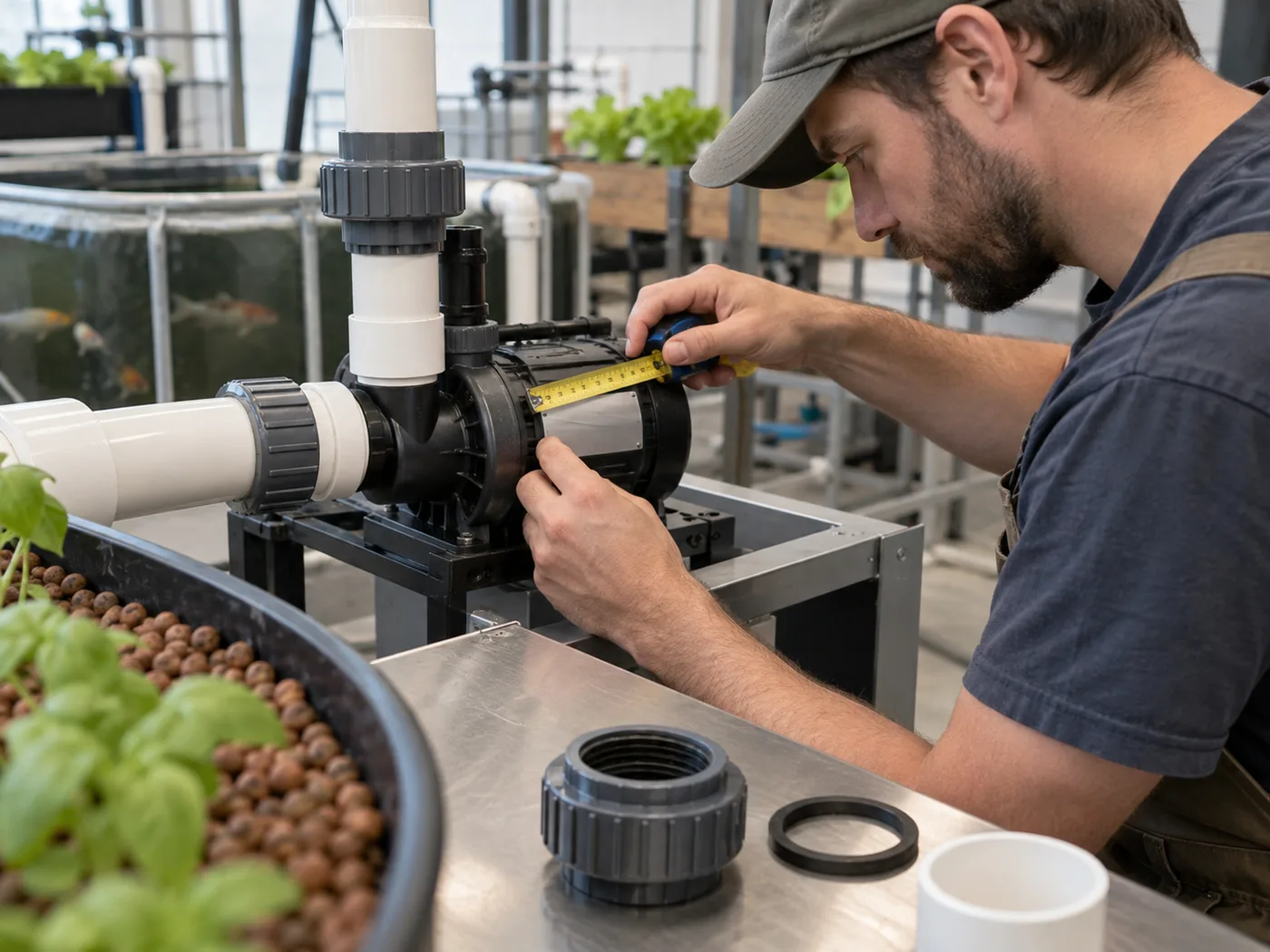
Pumps, blowers, timers, air stones, valves and sensors are often branded components within a larger kit. An OEM or listed distributor may be able to supply a genuine replacement more quickly. Check the exact model, voltage/frequency, connector, ingress rating, flow curve and maximum head. Do not select a larger pump simply because it is available: excess flow can overwhelm a filter, change dwell time or cause overflow.
3. A local plumbing, irrigation or controlled-environment supplier
Standard PVC/CPVC/PE pipe, unions, hose barbs, clamps, gaskets and some valves may be sourced locally if the material and connection standard match. Suppliers of pumps, tubing and connectors commonly stress that fittings must be selected for the installed hydraulic layout and maintained for leakage control, rather than treated as cosmetic accessories. See this component-category reference.
Use local substitutes only after confirming material compatibility, pressure rating, food-contact suitability where relevant, UV exposure, dimensions and ease of future service. Do not mix incompatible thread systems or rely on sealant to correct a poor mechanical fit.
Parts that should usually remain OEM-specific
Keep proprietary items within the supplier/OEM channel: molded tank penetrations, liner kits, electrical control boards, programmed sensors, bespoke rack components and documented safety devices. Replacing a protective controller or a tank fitting with an unapproved look-alike can create a leak or electrical hazard that costs more than the original part.
For standard consumables, a documented equivalent can be sensible: filter brushes, certain air stones, pipe clips or mechanical fasteners. The distinction is whether the system’s safe performance depends on a unique geometry, programming or material specification.
A safe replacement workflow
Confirm the actual failure
Check power supply, controller settings, blocked inlet screens, air locks, loose connections and isolation valves before declaring a component failed. Record water temperature, dissolved-oxygen observations, water level and fish behavior. A pump that has lost flow may be fouled rather than electrically failed.
Protect livestock and bacteria during downtime
Prepare temporary aeration and, where possible, maintain circulation or gentle bypass flow. Avoid sudden cleaning or chemical changes while diagnosing the issue. If fish behavior changes, treat fish welfare and oxygenation as the immediate priority. Our guide to cycling an aquaponics system explains why the biofilter must be protected from avoidable disruptions.
Verify the delivered part before installation
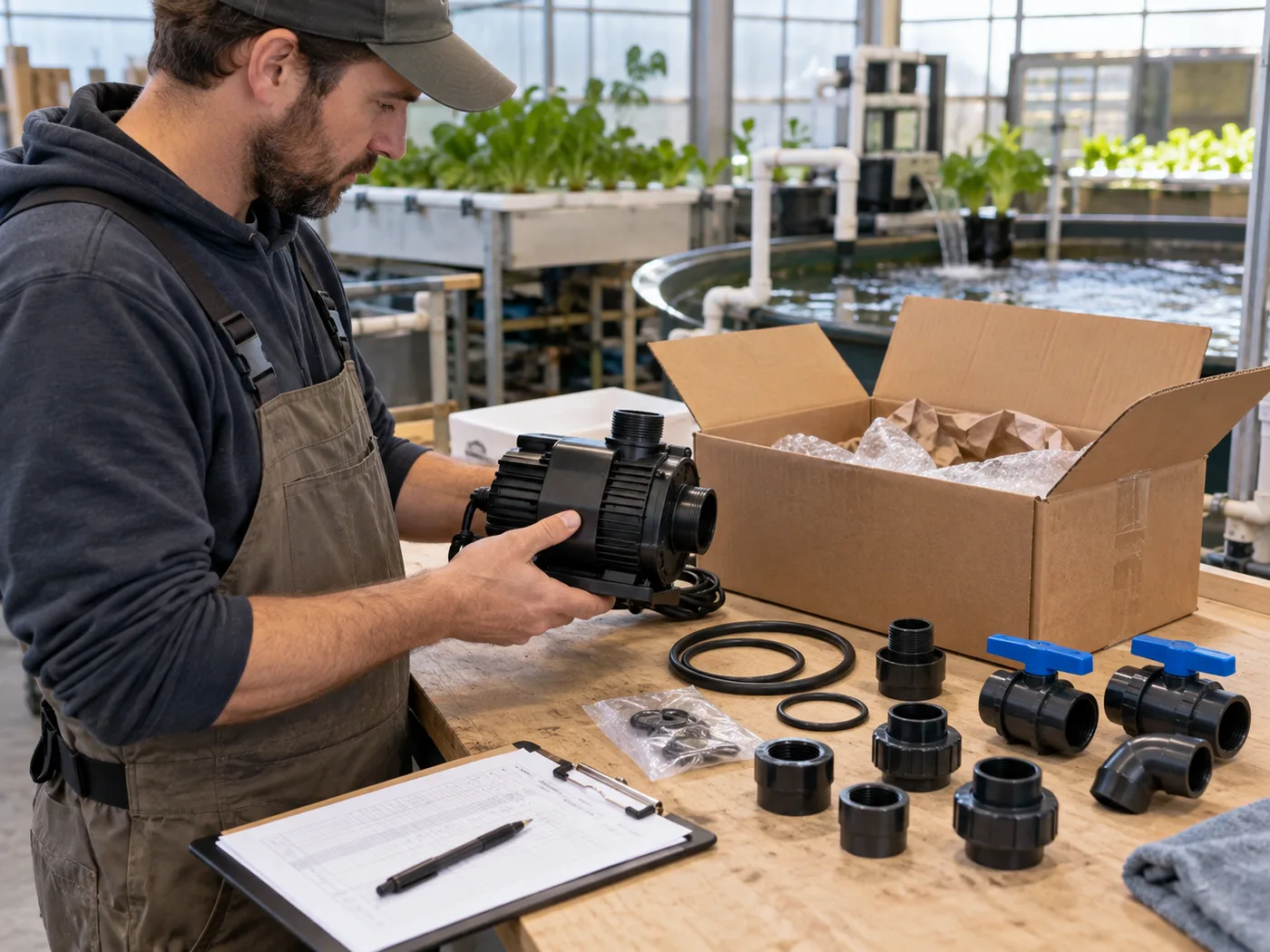
During shipment inspection, compare the label, connector, ports, dimensions, gaskets and accessories against the order confirmation. Photograph packaging damage before signing a carrier claim where applicable. Dry-fit plumbing components; never force threaded parts. For electrical equipment, confirm voltage, polarity, grounding and environmental rating against the manual.
Test in stages
Run a water-only leak and flow test where the design allows. Then observe start-up, return flow, water level, noise, heat and filter behavior. Log the date, part number and result so the replacement becomes part of the system’s maintenance history.
A practical on-site spares kit
The right spares kit is small and system-specific. Typical candidates are a correctly specified backup air pump, air stones, fuse, short lengths of matching tubing, clamps, O-rings, a union gasket, screen-cleaning tools and a manual water-test kit. A full duplicate pump may be justified when its failure would quickly threaten fish and lead time is long. Store dry spares out of sunlight and label them with the compatible system.
Do not stock chemicals or electrical parts without storage and expiry controls. A spare is useful only if its condition and specification are known.
Make compatibility a documented decision
The word “compatible” should be treated as a technical conclusion, not a seller’s adjective. A replacement can fit physically and still be unsuitable for the water loop. A pump, for example, may share the same inlet diameter but deliver a different flow at the installed head, draw more current, use a different connector, or create vibration that shortens the life of adjacent fittings. A valve may share a nominal pipe size but use a different thread standard. A screen may appear interchangeable but have a mesh opening, open area or cleaning geometry that changes solids handling.
Create a simple comparison sheet before approving a substitute. The first column is the failed item; the second is the candidate item; the third records a source such as the OEM datasheet, original manual or supplier confirmation. Compare the characteristic that matters for the component: voltage, frequency, wattage, flow curve and maximum head for a pump; material, pressure rating, seal material and joint type for plumbing; and dimensions, cutout size and tank-wall range for a bulkhead. Mark any unknown value as unknown rather than assuming it is acceptable.
For a B2B project, attach this sheet to the maintenance record. It becomes useful when an operator changes, when a system is expanded, or when customer requirements specify approved materials. It also gives a supplier enough context to advise responsibly rather than guessing from a photograph.
Pumps and air equipment
For water pumps, calculate the installed condition rather than choosing by the maximum flow printed on a box. Measure or estimate vertical lift, pipe length, bends, valves, filters and return height. Check whether the pump is designed for continuous duty and whether a failure alarm or backup is required. Match the original electrical arrangement: a 12 V DC device, a 24 V device and a mains-powered pump are not interchangeable simply because their flow labels look similar.
For aeration, confirm airline diameter, manifold fitting, diffuser type and expected back pressure. Replacing a single failed air stone with a very different diffuser can change the balance across the manifold. After replacement, observe bubble pattern and fish behavior; do not judge oxygenation from noise alone.
Water-contact and structural parts
Use materials appropriate to the intended water contact and operating environment. A fitting may be chemically acceptable but unsuitable for sunlight, heat, weight or repeated disassembly. Supports, racks and grow-bed frames deserve the same attention. If a modular frame is carrying a filled grow section, a replacement fastener should match the documented grade and assembly method; a visually similar hardware-store part can corrode or deform.
During installation preparation, clean mating surfaces, replace damaged O-rings rather than reusing them, align supports before tightening, and avoid overtightening plastic threads. Record the torque or manufacturer instruction where available. A slow leak is easier and safer to correct during a water-only test than after fish and plants are in the loop.
Procurement planning for international deliveries
International buyers should separate critical spare parts from routine consumables. Critical parts are those whose absence can create an urgent fish-welfare or containment problem: a specific pump impeller, controller, gasket, air component or tank fitting. Routine consumables may be purchased locally if their specifications have been confirmed. This distinction helps determine what should travel with the original shipment and what can be held as local stock.
Before final packing, ask the supplier for a spare-parts packing list, carton labels, individual part numbers and photographs of the included backups. At shipment inspection, confirm that parts are protected from moisture and that loose fittings have not been mixed between systems. If customs classification or lead time is relevant, plan the reorder route before commissioning rather than waiting for a failure.
An appropriate request is not “send extra parts.” It is “quote one approved spare pump assembly, two sets of O-rings, one screen-cleaning kit and the corresponding installation instructions for this system revision.” That wording reduces ambiguity for both parties.
When not to restart immediately
After a repair, resist the temptation to declare success once water moves again. Check for leaks at operating temperature, verify the return flow, inspect filter water level and listen for cavitation or vibration. Then recheck water-quality observations and animal behavior over the next operating cycle. A part replacement should not introduce sudden changes to feeding, pH correction or cleaning routines; isolate the cause of any problem so the record remains meaningful.
If a repair affects a biological filter, distribution manifold or major pump, update the site schematic. This small step ensures the documentation remains aligned with the installed system, which is especially valuable before future factory support, warranty discussions or expansion work.
Questions to ask before ordering
- Is the part original, superseded or an approved equivalent?
- Which system revision and installed component does it fit?
- What is included: gasket, cable, fitting, fastener or programming?
- Does the part affect flow, filtration capacity, electrical load or warranty?
- What are the lead time, packing method and damage-claim procedure?
- Is a new installation or factory-testing instruction required?
Create a parts escalation path
Not every component issue should be handled in the same way. Define three routes in the site manual. The first is an operator-check route for visible, low-risk issues such as a clogged inlet, loose clamp or worn air stone. The second is a supplier-support route for uncertain compatibility, controller faults, repeated leaks or changes that could affect warranty. The third is an urgent life-support route for loss of aeration, major containment failure or unsafe electrical conditions. List the responsible person, supplier contact, photographs required and safe temporary action for each route.
This structure prevents both extremes: an operator improvising a critical repair without evidence, or a minor service task becoming an avoidable shutdown. It also improves handover quality. When a system is delivered to a school, farm or distributor, the parts register and escalation path should be explained during operator training and reviewed after the first maintenance interval.
Keep specifications current after upgrades
Modular systems change over time. A replacement pump, revised manifold or new growing module may alter the installed specification. Update the equipment schedule, water-path diagram and spares list immediately after approved work. Future procurement will then refer to the system that actually exists, not the first version on the original quotation. This is a simple control that reduces repeat ordering errors and makes later expansion safer.
FAQ
Can I use a generic pump in a modular aquaponics system?
Only if its documented duty matches the original and the installation is safe. Compare flow at operating head, voltage, connector, ingress protection, heat, plumbing connections and control compatibility. A generic pump is not automatically an equivalent pump.
Which parts fail most often?
Wear depends on water quality and maintenance, but operators commonly monitor pump impellers, air stones, tubing, seals, mechanical screens, valves and timer/controller connections. A record identifies the parts that actually deserve a spare on your site.
Should I replace a leaking fitting with adhesive?
Not as the default. Identify whether the leak comes from a gasket, thread mismatch, cracked fitting, poor support or excessive pressure. A serviceable mechanical repair is usually safer for a modular system.
Conclusion
The best place to find a replacement part is the channel that can prove compatibility. Start with the system supplier, then the OEM, then a local supplier for truly standard components. Good documentation, measured specifications and a careful shipment inspection protect fish, plants and the project’s serviceability.
CTA — Need help identifying a modular-system component? Send Your Requirements with system photographs, part labels, dimensions and your delivery country. We can help you prepare a clear parts enquiry.

