
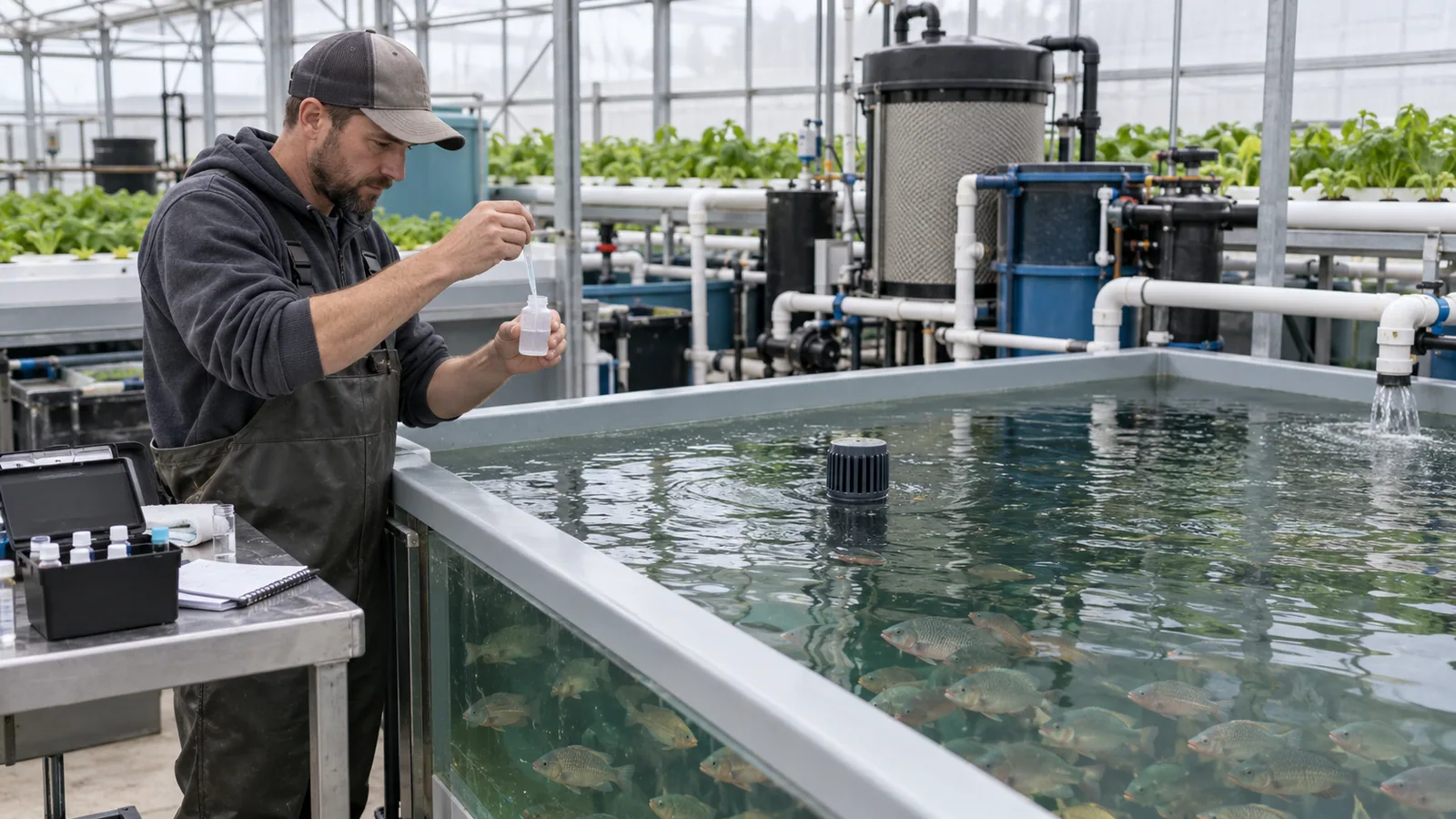
A healthy, mature aquaponics system should not have persistently high ammonia. Fish continually release ammonia and decomposing organic matter adds more, but a functioning biofilter converts it first to nitrite and then to nitrate. A small or temporarily measurable total ammonia nitrogen reading may occur after feeding, stocking changes or maintenance. A rising or sustained reading, especially when fish show stress, is a warning that ammonia production is exceeding the system's biological treatment capacity or that the water-quality measurement needs verification.
The result cannot be interpreted from one number alone. The proportion of more toxic un-ionized ammonia changes with pH and temperature; fish species, life stage, salinity, dissolved oxygen, test method and exposure duration also matter. Operators should verify the test, observe the fish, restore dependable aeration and circulation, reduce the immediate organic load where appropriate, and identify the cause. Abrupt chemical corrections made without this context can create a second problem.
First understand what the ammonia test reports
Fish excrete ammonia mainly across their gills. Uneaten feed, feces, dead organisms and decaying plant material can also release nitrogen as they break down. In water, ammonia is present in an equilibrium between un-ionized ammonia, NH3, and the ionized ammonium form, NH4+. Many commonly used kits report total ammonia nitrogen, or TAN, which represents the combined ammonia nitrogen in those forms rather than NH3 alone.
This distinction matters because un-ionized NH3 is generally the more toxic fraction. As pH and temperature increase, its proportion can increase. A TAN result that is less urgent in cool, lower-pH water may represent a greater risk in warmer, higher-pH water. That does not mean operators should force pH downward quickly: sudden pH change can stress fish and disrupt biological performance. It means TAN, pH and temperature should be measured and interpreted together.
The University of Florida IFAS technical guide Ammonia in Aquatic Systems explains ammonia speciation, TAN, test methods and the influence of pH and temperature. Use species-specific guidance and qualified aquatic-animal advice when deciding whether a measured concentration requires emergency action. Universal internet thresholds are a poor substitute for the fish, test method and conditions in the actual system.
Is some ammonia normal during system cycling?
Yes. In a new system, an ammonia source is needed to establish the microorganisms responsible for nitrification. During cycling, ammonia and then nitrite often become measurable before the biological community can process the intended daily load. This is a commissioning phase, not proof that a mature operating system should routinely run at elevated ammonia.
Fishless cycling allows the operator to develop and observe biofilter performance before valuable fish are exposed. Fish-in cycling requires much closer control and appropriate welfare precautions. In either method, the useful evidence is a trend: the system should demonstrate that it can process the planned input under stable flow, aeration, pH, alkalinity and temperature conditions.
Our guide to cycling an aquaponics system explains the commissioning sequence in more detail. Do not assume the system is ready merely because a calendar period has passed. Readiness depends on measured conversion performance, not a fixed number of days.
Why ammonia becomes high in an established system
The feeding rate increased faster than the biofilter capacity
Feed is one of the main controllable nitrogen inputs. A rapid increase in ration, a change to a richer feed, overfeeding or inaccurate biomass assumptions can raise ammonia production beyond the biofilter's current capacity. Fish growth also matters: the same number of fish can impose a much larger load several months after stocking.
Keep a feed log by day and, where practical, by tank. Compare the ammonia trend with feed changes, water temperature and fish biomass. A supplier evaluating customer requirements should ask for planned species, harvest size, feed rate and operating temperature rather than sizing filtration only from tank volume.
The fish biomass exceeds the design basis
A tank may look underfilled while the system is biologically overloaded. Biomass, oxygen demand, feeding rate, waste production and peak harvest weight are more useful design inputs than fish count alone. Mixed fish sizes can also hide the true load.
Stocking density should remain within a documented operating plan that includes aeration, mechanical solids removal, biofilter capacity and backup response. Increasing fish numbers without reviewing every connected subsystem can produce both ammonia and dissolved-oxygen problems.
The biofilter is new, undersized, damaged or partially bypassed
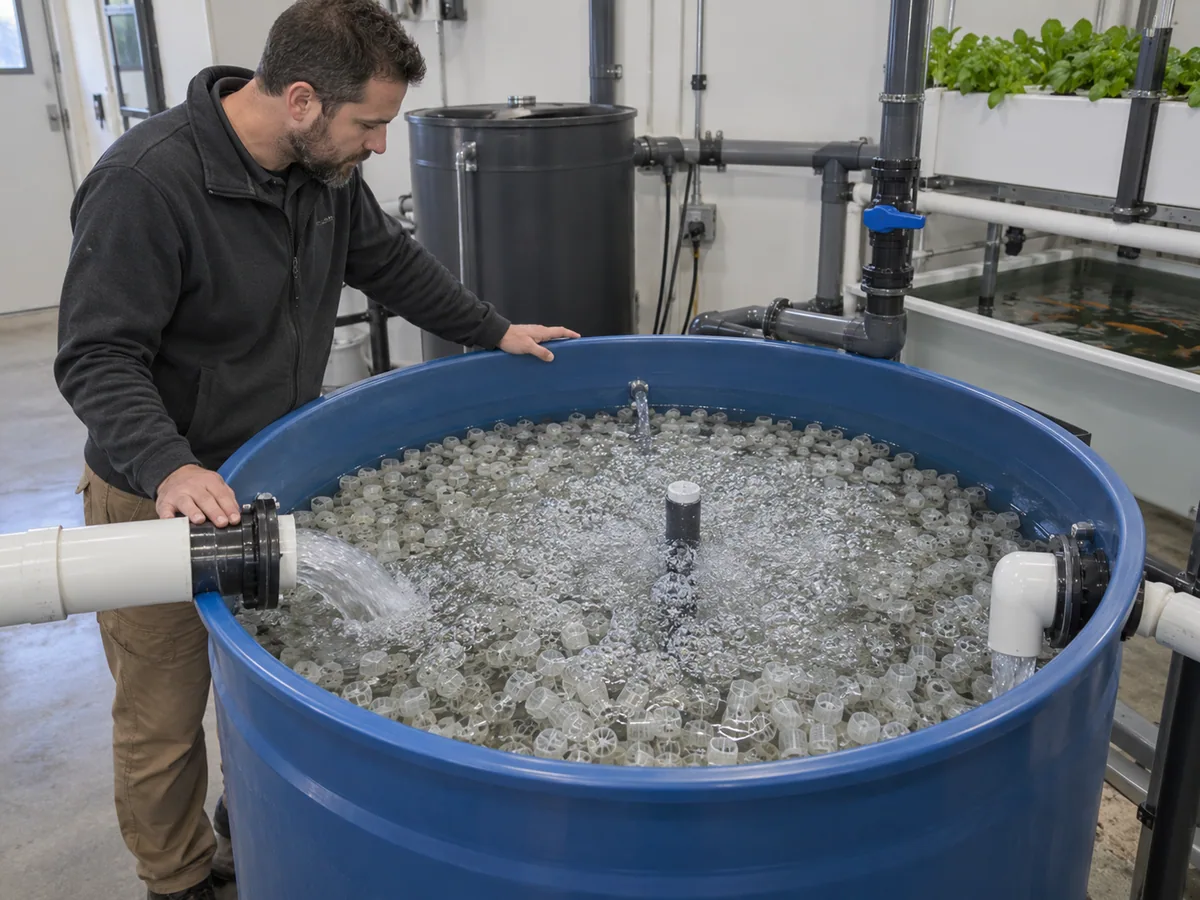
Nitrifying organisms need appropriate surface area, oxygen, water flow, alkalinity and a suitable operating environment. High ammonia may appear if the biofilter has not matured, its media volume is inadequate, channels allow water to bypass media, the pump no longer delivers design flow, or a valve has been left in the wrong position.
Biofilter performance may also decline after drying, overheating, freezing, long power loss, aggressive cleaning, exposure to chlorine or chloramine, or use of a treatment that inhibits microorganisms. Never clean biological media with an incompatible disinfectant or unconditioned chlorinated water. Follow the equipment and water-treatment guidance for the specific installation.
The University of Florida IFAS manual on fish-health management in recirculating aquaculture systems explains how fish load, feeding rate, solids, alkalinity and biofilter capacity interact in recirculating systems. Our article on the role of bacteria in aquaponics provides a complementary aquaponics design explanation.
Dissolved oxygen or circulation is inadequate
Fish and nitrifying organisms both depend on oxygen. Warm water holds less dissolved oxygen, while fish metabolism and microbial oxygen demand may rise. A blocked diffuser, worn blower, closed valve, dirty pump, low sump or obstructed pipe can reduce effective circulation even when some bubbles remain visible.
Measure rather than judge aeration by appearance. Check conditions at the fish tank, biofilter inlet and outlet, remote grow modules and sump. Compare actual pump flow and air delivery with the commissioning record. A backup air source should cover the biological load, not merely produce a few bubbles during an outage.
pH or alkalinity no longer supports stable nitrification
Nitrification consumes alkalinity and tends to lower pH over time. If alkalinity becomes depleted, pH can become unstable and biological conversion may slow. At the other extreme, high pH increases the fraction of ammonia present as NH3 and may make a TAN result more hazardous.
Adjustments require measured quantities, suitable compounds and gradual application. Do not add household chemicals on the basis of a generic online dose. Water volume estimates are often wrong, products differ in strength, and a correction suitable for an empty hydroponic reservoir may be unsafe around fish and biofilters.
Solids or dead organic material are decomposing
Settled waste in tank corners, pipes, sumps, clarifiers, media beds or filter bases can continue releasing nitrogen and consuming oxygen. A dead fish hidden behind a screen or pipe can cause a sudden load. Root decay and accumulated plant debris can add to the problem.
Inspect the complete water path. Mechanical filtration must capture solids and allow them to be removed without routinely stripping or damaging biological media. Pipe low points, inaccessible dead legs and poorly supported runs can retain material or obstruct inspection; our aquaponics plumbing-material guide explains how material compatibility and serviceable geometry support long-term operation.
Source water, test interference or operator error is confusing the result
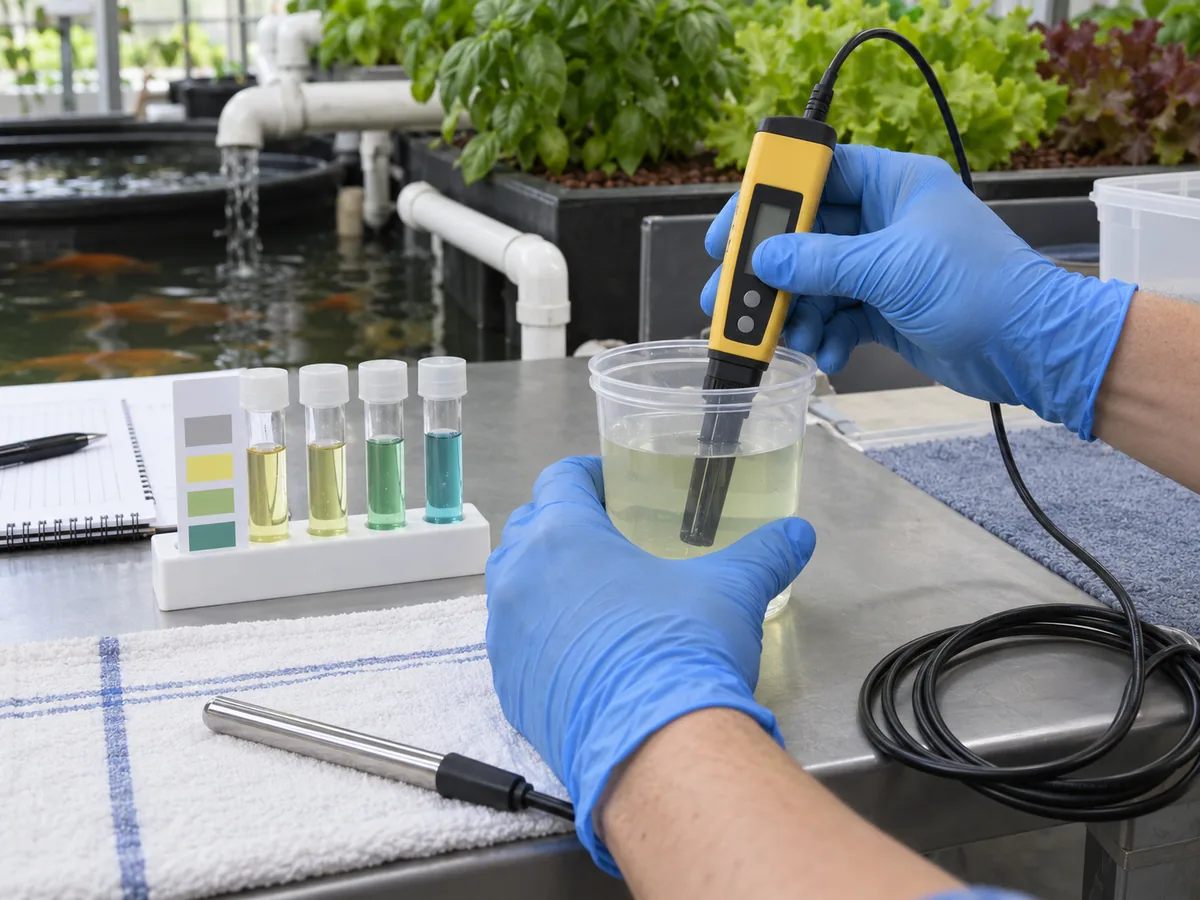
Test the make-up water as well as the system water. Some supplies can contain ammonia or compounds that affect treatment decisions. Check the kit's expiration date, storage conditions, reagent sequence, sample volume, reaction time, color-reading method, salinity limitations and reporting units. TAN reported as nitrogen is not numerically identical to a result reported as ammonia compound.
If a result is unexpected, repeat the test with a clean sample container and, for important decisions, compare it with a second method or competent laboratory. A false high can provoke unnecessary intervention, while a false low can delay a genuine response.
A practical response sequence for a high reading
1. Observe fish and verify life-support equipment
Look for rapid gill movement, gasping, reduced feeding, unusual swimming, crowding near water returns, color change or loss of balance. These signs are not specific to ammonia; they can also indicate low oxygen, nitrite, temperature stress or disease. Confirm pumps, aeration, water level and flow immediately. If fish are in distress, follow an established emergency plan and seek qualified aquatic-animal or local extension guidance.
2. Confirm TAN, pH and temperature
Repeat the ammonia test correctly and measure pH and temperature at the same time. Check nitrite and dissolved oxygen because multiple failures can occur together. Record the sample location and time relative to feeding. Trends from consistent sampling are more useful than isolated numbers taken under different conditions.
3. Stop adding unnecessary load
Do not add fish, increase feed or introduce decomposable material while the cause is unknown. Depending on fish condition, species, water temperature and professional guidance, a temporary feed reduction or pause may reduce new ammonia production. It should not become a substitute for repairing a failed biofilter, pump or aeration system.
4. Find the physical or operational cause
Inspect the fish tank, feed record, mortalities, mechanical filters, biofilter flow, media condition, valves, pumps, air delivery, sumps, pipes and grow modules. Compare current conditions with the system's normal operating record. Ask what changed during the previous several days: stocking, feed, cleaning, chemical use, power loss, heat event or component replacement.
5. Use water exchange carefully when it is part of the approved response
Partial water exchange may reduce a contaminant concentration, but incoming water must be compatible in temperature, pH, disinfectant residual, salinity and other chemistry. Large abrupt exchanges can shock fish or destabilize plant nutrition. Prepare and condition replacement water according to local water characteristics and the project protocol. Do not discharge nutrient-rich water where it can harm drains, waterways or neighboring property.
6. Re-test and document recovery
After corrective action, use a defined monitoring interval and consistent method. Record TAN, pH, temperature, nitrite, dissolved oxygen where available, flow observations, feed, fish behavior and the action taken. The desired result is not merely one improved reading; it is a stable trend and a corrected root cause.
> Need help reviewing recurring TAN increases? Send Your Requirements with the fish species, peak biomass, daily feed, tank volume, water temperature and pH range so the filtration and aeration design basis can be discussed.
Diagnostic pattern: what the combination of readings may suggest
Ammonia high while nitrite remains low in a newly commissioned system may mean the first nitrifying stage is not established. Ammonia improving while nitrite rises can be part of the cycling progression, but nitrite itself requires careful control. A mature system with a sudden ammonia increase after a power event may have lost circulation, oxygen or biofilter activity. A gradual rise as fish grow may indicate that feed and biomass have overtaken treatment capacity.
If ammonia and dissolved oxygen deteriorate together, look for aeration failure, high temperature or excessive organic loading. If pH is unexpectedly unstable, review alkalinity and the accuracy of the measurement. These patterns guide inspection; they are not a remote diagnosis. Fish behavior, equipment condition, historical records and competent advice remain necessary.
Design and procurement practices that reduce ammonia risk
Ammonia control begins before installation. A system proposal should document the design biomass, daily feed input, operating temperature range, biofilter type and media, expected hydraulic flow, aeration duty, solids-removal method, power demand and backup strategy. It should also state which assumptions require customer confirmation.
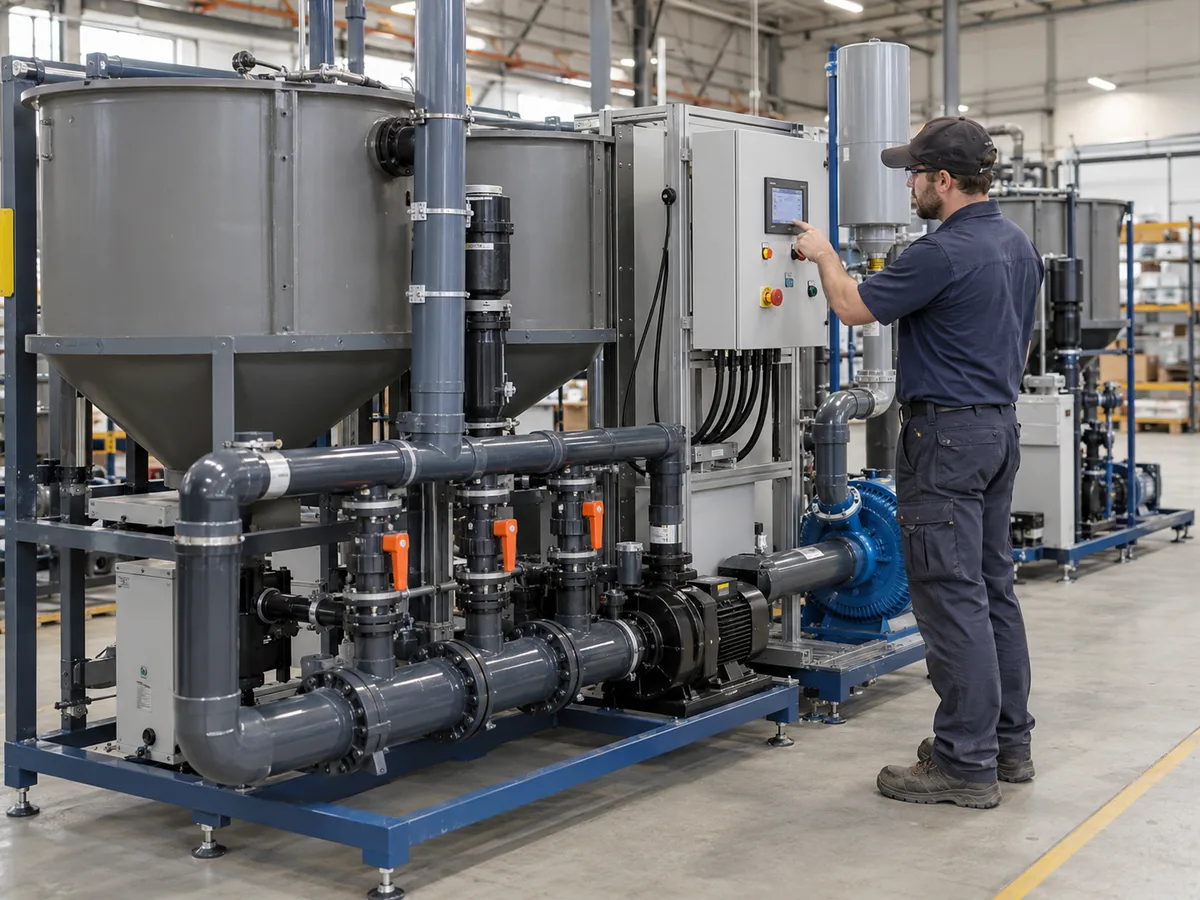
Factory testing can verify pump operation, control-panel logic, alarms, sensor communication, valve orientation and leak integrity where the assembled scope permits. It cannot biologically mature a biofilter that will be shipped dry, and it cannot guarantee performance under an undisclosed feed load. Shipment inspection should confirm that media, diffusers, pumps, fittings, test equipment and labeled connections match the packing list and have not been damaged.
During installation preparation, confirm conditioned water availability, electrical protection, drainage, ventilation, backup aeration, test-kit storage and a safe method for cleaning filters. Commission the system in stages. Verify actual water volumes and flow rates, establish baseline readings and train the responsible operators before increasing biomass.
For commercial projects, specify alarm ownership: who receives a high-ammonia, low-oxygen, pump-failure or power-loss alert, how quickly they must respond, and which actions they are authorized to take. Remote monitoring is useful only when sensors are maintained and an on-site response is possible.
Build an operating record that prevents recurrence
A concise daily record can include fish behavior, mortalities, feed quantity, water temperature, pump and aeration status and any unusual odor or appearance. Schedule pH, TAN, nitrite, nitrate, dissolved oxygen and alkalinity checks at frequencies justified by the system stage and risk. New, recently stocked or unstable systems normally require closer observation than a stable mature installation.
Calibrate or verify instruments according to their manuals, replace reagents before expiration, and train more than one person to obtain a representative sample. Keep maintenance records for air pumps, diffusers, water pumps and filters. Review trends rather than filing numbers without action limits.
After an ammonia event, write a short incident review: the earliest sign, confirmed cause, response, recovery evidence and preventive change. The improvement might be a feed-control procedure, larger or better-distributed aeration, a filter-cleaning schedule, additional biofilter capacity, a low-flow alarm or clearer valve labels. This turns a failure into a repeatable operating lesson.
FAQ
Do all aquaponics systems contain ammonia?
Ammonia is continually produced as part of fish metabolism and organic-matter breakdown. In a healthy mature system, biological filtration processes it fast enough that it should not accumulate to persistently high levels. Whether a test detects a small amount depends on the load, timing, method and system condition.
What ammonia level is safe for aquaponics fish?
There is no responsible single number for every system. Risk depends on TAN, pH, temperature, fish species and life stage, salinity, oxygen, exposure duration and the test's reporting basis. Use a species-appropriate reference or qualified aquatic professional and interpret TAN with simultaneous pH and temperature measurements.
Does a high nitrate reading mean ammonia is high?
No. Nitrate is a later product of nitrification and can accumulate even when ammonia remains low. Test each parameter rather than inferring one from another. Plant uptake, water exchange, denitrification and feed load affect nitrate differently.
Should I clean the biofilter when ammonia is high?
Not automatically. Aggressive cleaning can remove or damage the microorganisms needed to process ammonia. Inspect for blockage, bypass, solids accumulation and poor flow, then follow the specific filter's service procedure. Clean mechanical waste-removal components separately where the design allows.
Conclusion
Aquaponics systems produce ammonia, but well-designed and mature systems should not allow it to remain high. When TAN rises, interpret it with pH, temperature, oxygen, nitrite, fish behavior and the system's recent history. Verify the result, protect circulation and aeration, stop adding unnecessary load, inspect feed, solids and biofilter performance, and make measured corrections supported by species-appropriate guidance.
The most reliable prevention is a transparent design basis and disciplined operation: size treatment for peak biomass and feed, commission the biofilter before full stocking, protect power and aeration, maintain accessible solids removal, and keep useful trend records. Those practices make an ammonia reading an actionable signal rather than a surprise.
> Planning a more measurable aquaponics system? Contact Us to request a technical configuration and product catalog covering accessible solids removal, biological filtration, aeration and monitoring options.

