
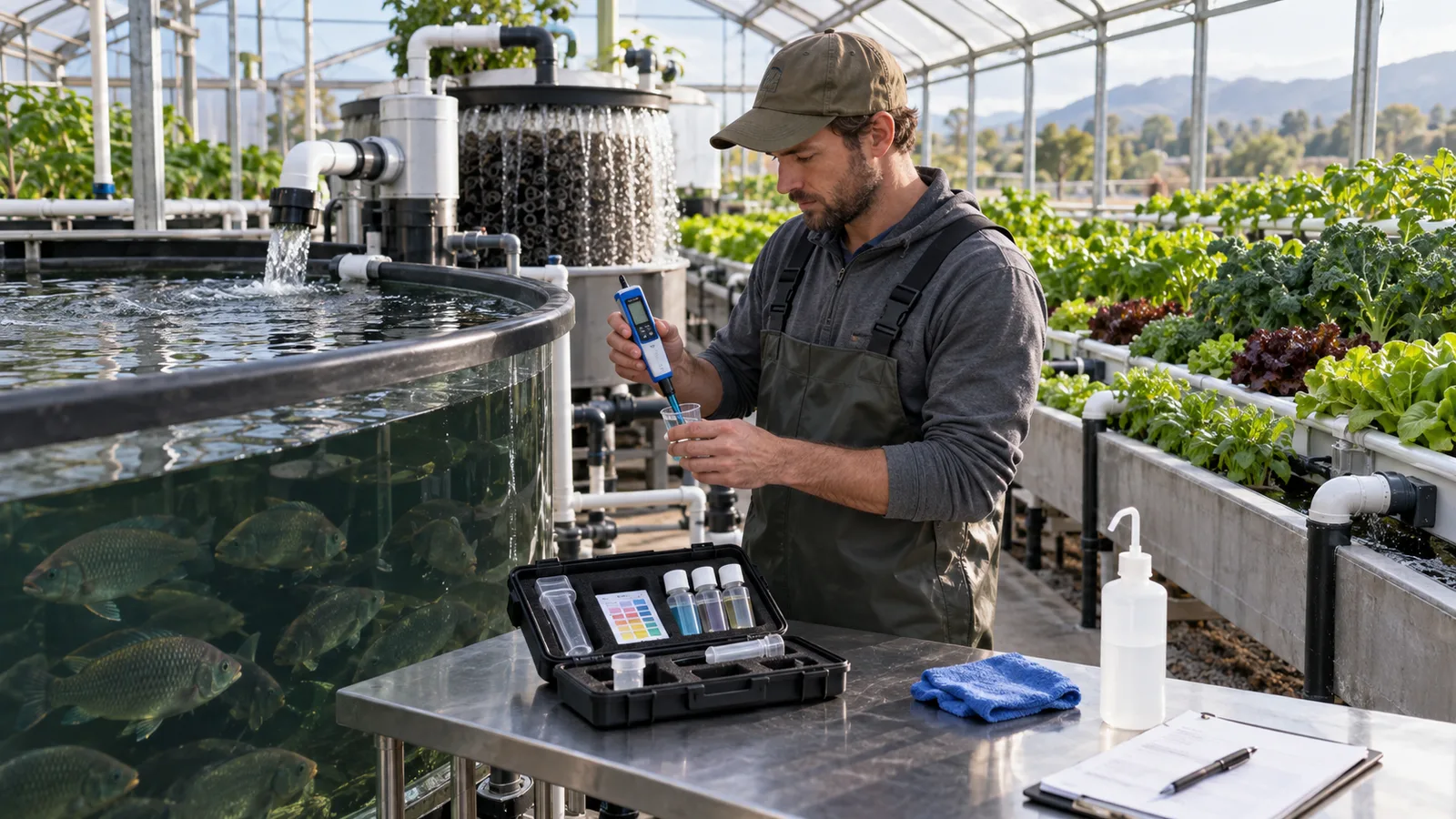
Raise pH in aquaponics gradually, after confirming the reading and understanding the system’s alkalinity. A low pH may slow nitrification, change nutrient availability and signal that the system has little buffering capacity. The unsafe response is to add a strong base quickly or pour an unfamiliar “pH up” product into the fish tank. A rapid shift can stress fish and change the proportion of toxic un-ionized ammonia.
The practical objective is not to hit a universal number in one day. It is to verify the measurement, understand why pH fell, correct it in small measured steps, then preserve enough alkalinity that the system does not crash again. This guide addresses persistently low pH; it deliberately does not repeat the high-pH diagnosis or lowering methods in How to Lower pH in an Aquaponics System.
New Mexico State University explains that nitrification normally consumes alkalinity and can lower pH, and advises gradual base additions when low pH affects system function. Read its aquaponics water-quality guide. FarmHub’s alkalinity guidance provides useful context on alkalinity and the role of bases in raising pH.
The short answer
If a confirmed reading is below the operating range selected for your fish, plants and biofilter, first test pH consistently and, where possible, measure alkalinity. Then choose a documented calcium- or potassium-based adjustment method suitable for the system and destination-market requirements. Pre-dilute and add a small amount in a high-flow zone or make-up-water vessel according to the operating plan, allow mixing, retest, observe fish and repeat only when needed.
Do not correct pH by guessing from leaf color alone. Do not add concentrated base directly onto fish, roots, biofilter media or a small stagnant tank section. If fish show distress, ammonia or nitrite is elevated, or the cause is not clear, pause changes and seek qualified local aquaculture advice.
pH and alkalinity are related but not identical
pH is the current acidity or basicity reading
pH shows the current concentration of hydrogen ions. It can move quickly after a treatment, top-up, temperature change or biological event. One reading does not reveal how resistant the water is to change.
Alkalinity is the buffering reserve
Alkalinity largely reflects bicarbonate and carbonate reserve in the water. It helps resist pH swings and is used by nitrifying microorganisms. A system can show an acceptable pH today but be close to a sudden decline if alkalinity is depleted. Conversely, a high alkalinity source water may make pH difficult to lower. Test both where practical, especially if pH drifts repeatedly.
Nitrification commonly pushes pH down over time
As biofilter organisms convert ammonia through the nitrogen cycle, acidity is produced and alkalinity is consumed. This is normal in an operating system. The correct response is a planned buffering and monitoring routine, not repeated emergency dosing. For the underlying biology, see What Role Do Bacteria Play in an Aquaponics System?.
Confirm the problem before adding anything
Check the instrument and sampling method
Calibrate a pH meter using appropriate buffers, check expiry dates on test reagents and take samples at the same time of day. If pH is unexpectedly low, compare a second method or meter before treatment. Record temperature, source-water pH, alkalinity if tested, ammonia, nitrite, nitrate, feed offered and recent additions.
Inspect for an operational trigger
Review recent feed increases, fish biomass changes, water top-ups, filter cleaning, solids accumulation, power interruptions and water-treatment products. A mature system with increasing feed input may consume alkalinity faster. A dirty mechanical filter or anaerobic area can introduce a different water-quality problem that should not be hidden by a pH correction.
Distinguish a new system from a mature system
New systems can show changing readings while biological capacity develops. Do not use large pH changes to force cycling. Maintain circulation and aeration, keep loading conservative and follow How to Cycle an Aquaponics System before increasing fish or feed.
A safe step-by-step process for raising pH
1. Set an operating band, not a single obsession point
Fish, plants and nitrifying bacteria do not have identical pH preferences. Set a practical range based on the selected species, crop and technical guidance, then avoid abrupt changes within it. A stable, documented compromise is usually safer than constant correction to a perfect-looking number.
2. Select the corrective input deliberately
Calcium hydroxide and potassium hydroxide are widely used bases in aquaponics management because they raise pH while contributing calcium or potassium—nutrients that can be relevant in crop production. Potassium bicarbonate or carefully managed carbonate materials can also raise alkalinity and provide buffering. The correct choice and amount depend on source water, current alkalinity, fish species, crops, local rules and the product specification.
Never treat these examples as a universal dose. Strong bases are hazardous to handle and can make water unsafe when overdosed. Use appropriate personal protective equipment, read the product safety documentation and involve a qualified adviser for commercial or high-value systems.
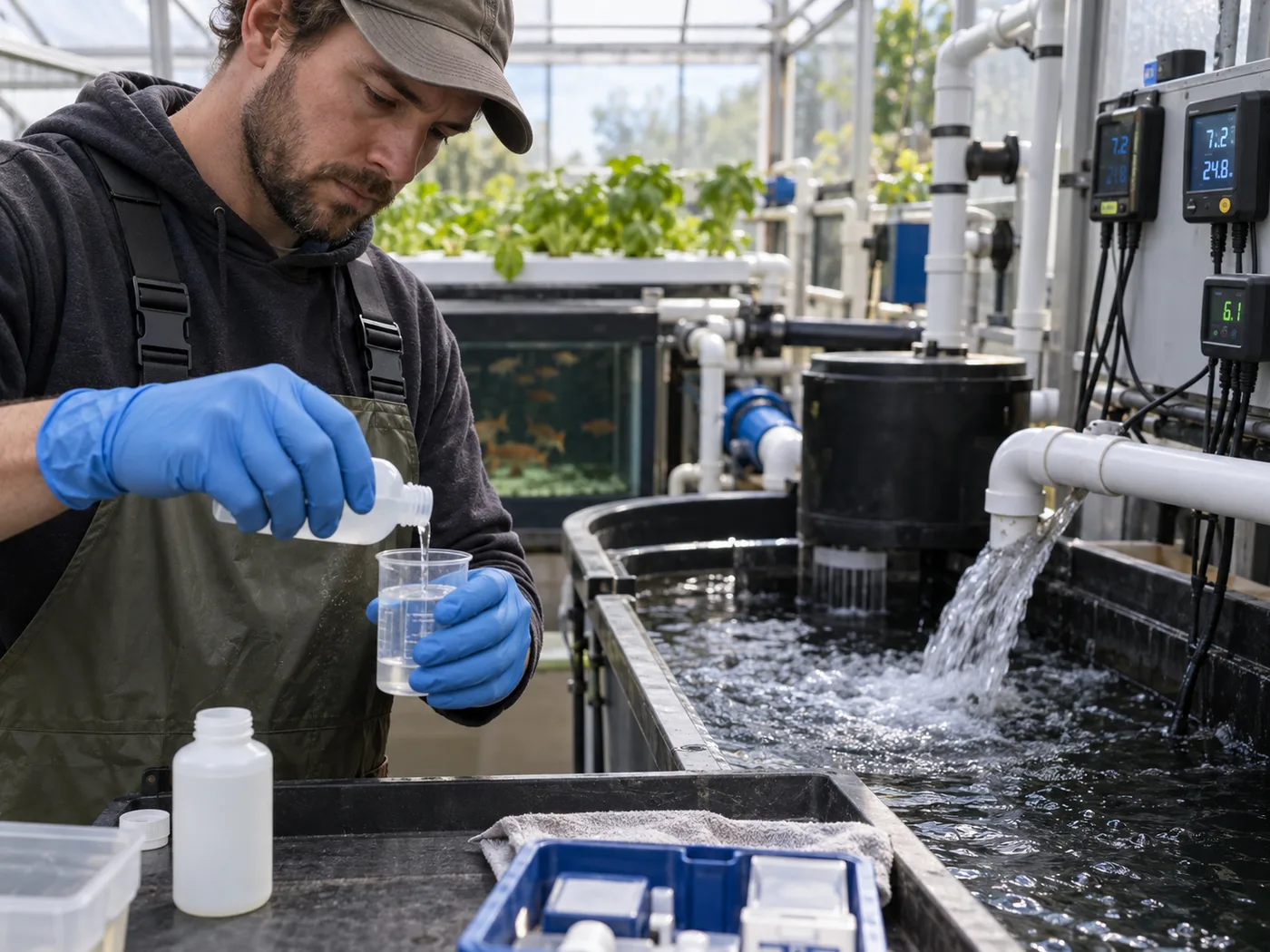
3. Pre-dilute and add in small increments
Prepare the material in a separate clean container with system or treated water, following the documented method. Add the diluted solution gradually to a high-flow sump or conditioning vessel—not directly over fish. Allow full circulation, then retest before another addition. Record the exact material, mass or volume, time, initial reading and response.
4. Watch the entire system after each adjustment
Observe fish respiration, swimming and feeding. Check aeration, pump flow and filter condition. Re-test pH and the water-quality parameters that matter to the project’s fish-health plan. A pH correction is not complete until the system is stable over time.
5. Build a prevention routine
If pH falls regularly, add alkalinity monitoring to the normal maintenance schedule and decide when a small planned correction is made. Alternate approved calcium- and potassium-based inputs only when that approach suits the system and is documented. Review feed growth, source-water changes and solids management before increasing corrective inputs.
> CTA — Need a system designed for observable water management? Share your fish species, crop plan, source-water report and intended capacity. We can help define test points, filtration access and commissioning scope for an easier-to-manage project. Get a Quote.
What not to do
Do not add a concentrated base directly to the fish tank
Local pH spikes can injure fish and damage biological surfaces before the water mixes. Pre-dilution and controlled addition provide a measurable response.
Do not make a large correction after one reading
Check calibration, sampling and trends first. The reason for a low reading may be exhausted alkalinity, source-water change, nitrification load or another operating issue. A large correction can replace one problem with a worse one.
Do not use random garden, pool or cleaning products
Products can contain additives unsuitable for fish, edible crops or food-production systems. Confirm the formulation and suitability before use.
Do not forget ammonia risk
As pH rises, the proportion of toxic un-ionized ammonia can increase at a given total-ammonia reading. Monitor the whole water-quality picture, not pH in isolation.
A practical decision table for low pH
pH is low, but fish are normal and alkalinity is known
Use the documented incremental correction method, retest after full mixing and record the response. If the same pattern repeats, add a planned alkalinity check and investigate whether feed loading has increased. Do not allow a routine correction to become an undocumented habit.
pH is low and ammonia or nitrite is detectable
Treat this first as a fish-health and biofilter-management situation. Increase observation, verify aeration and circulation, review feed and seek qualified local support where readings or fish behavior indicate risk. Raising pH too quickly in this condition can alter ammonia toxicity, so the correction plan must be especially conservative.
pH changes sharply after a water top-up
Test the make-up water separately for pH and alkalinity. Identify whether a new municipal supply, storage tank, treatment method or rain capture is changing the chemistry. Conditioning source water before it reaches fish is often easier to control than repeatedly correcting the whole system after addition.
pH seems low only on one test method
Do not dose. Clean and calibrate the meter, check reagents, repeat the sample and compare with a second method. A measurement error is cheaper and safer to resolve than an unnecessary chemical addition.
Records that make pH management auditable
A useful log contains more than a pH column. Record date and time, meter calibration status, system and source-water readings, alkalinity where measured, water added, feed offered, fish observations, filter cleaning, temperature, corrective material, quantity, dilution method and post-adjustment result. This gives an operator enough context to find trends and gives a project manager evidence that interventions are measured rather than improvised.
For multi-person sites, identify one person who reviews the log weekly and checks that high-risk events—power loss, fish mortality, unexpected water replacement or major cleaning—have an accompanying water-quality review. This is particularly helpful during installation handover, when responsibility moves from a supplier or installer to the daily operating team.
Procurement and commissioning questions
A supplier should identify water-test points, make-up-water route, drain and overflow path, chemical-storage assumptions, pump and aeration equipment, filter access and any conditioning vessel. At factory testing, confirm labelled valves, sample points, pumps, aeration and drain access. At shipment inspection, verify test kits, fittings, tanks and manuals that are included in scope. At installation, commission circulation and water testing before fish are loaded heavily.
FAQ
What is the fastest safe way to raise pH?
There is no responsible universal “fastest” method. A safe correction is gradual, measured and based on verified pH, alkalinity and fish condition. Avoid any method that creates a rapid, unobserved shift.
Can crushed shells raise pH?
Carbonate materials can contribute alkalinity and pH buffering, but release depends on water chemistry and contact conditions. They are better considered a controlled long-term buffering strategy than an emergency fix.
Why does my pH keep dropping?
Nitrification consumes alkalinity. Low source-water alkalinity, rising feed load and insufficient planned buffering can all contribute. Use records to identify the trend before changing the correction routine.
Conclusion
Raising pH safely is a measurement-and-buffering task, not a one-time chemical shortcut. Verify the reading, understand alkalinity, correct slowly in a controlled flow path and observe fish and water quality after every change. A stable routine protects the fish, plants and biofilter more effectively than chasing a number.
CTA — Want a practical water-management scope before installation? Contact Us with your fish plan, crops, source-water information and site layout.

