
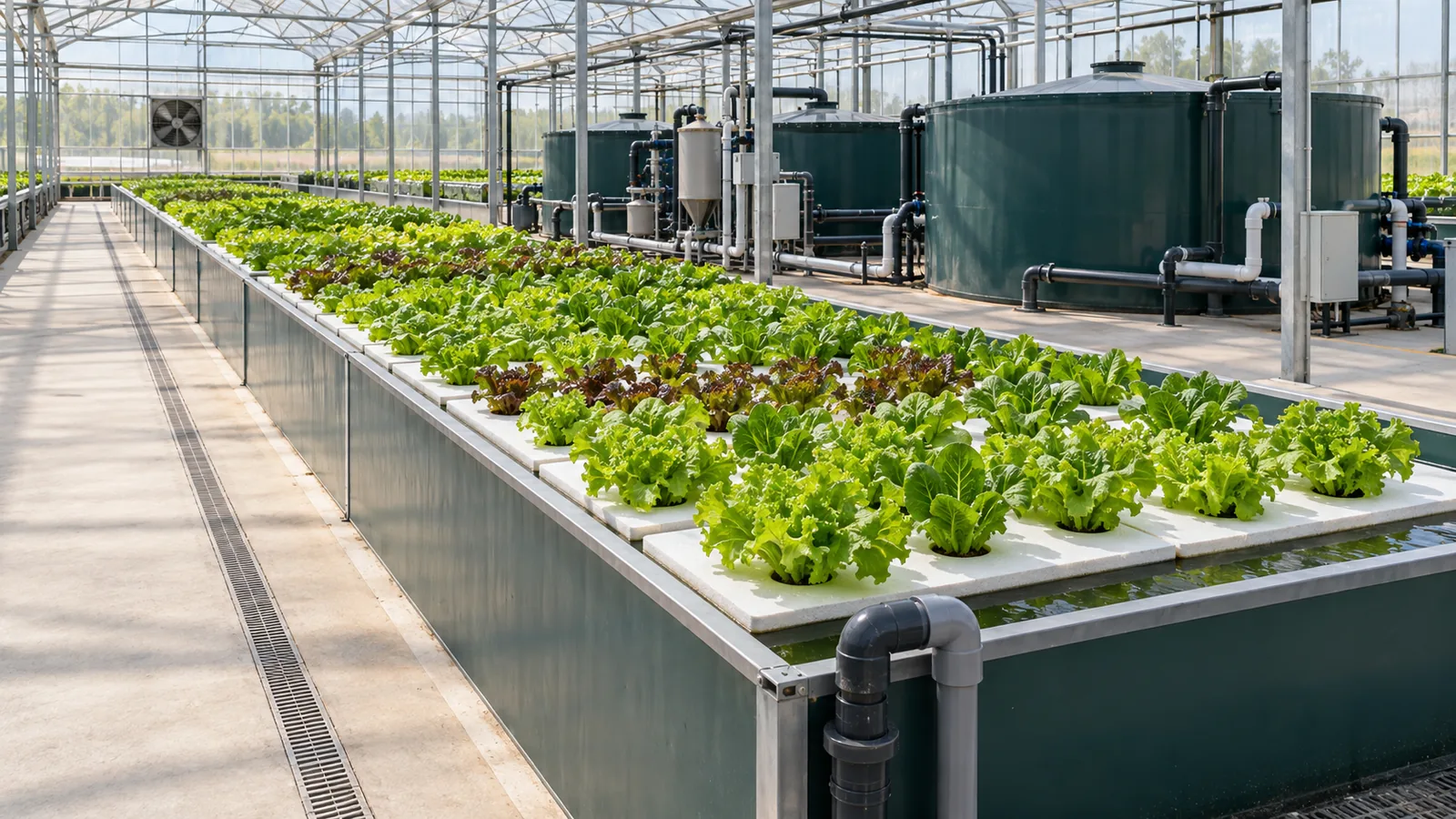
Introduction
A floating-raft aquaponics trough is commonly designed with roughly 6–12 inches (15–30 cm) of operating water depth, and many practical aquaponics references use about 10–12 inches (25–30 cm). That range is a starting point, not a universal standard. Crop roots, trough length, water-flow pattern, aeration, solids control, thermal conditions, structural loading and the role of the trough in total system volume all affect the correct depth.
“How deep” can refer to wall height, normal water depth, root clearance or raft thickness. These are separate dimensions. A 30 cm wall cannot safely operate with 30 cm of water if it needs freeboard, and a thick raft does not compensate for poor circulation.
This article helps home growers, greenhouse planners and international buyers define a useful floating-raft specification. It does not replace structural engineering, food-safety requirements or crop-specific trials at the final location.
The Short Answer
Start the design review around a 10–12 inch (25–30 cm) trough water depth when planning a conventional leafy-green DWC aquaponics zone, then adjust only for documented reasons. Shallower systems can work, but they usually have less thermal and chemical buffering, tighter construction tolerances and less space for long roots, diffusers and unobstructed flow. Deeper systems hold more water and add stability, yet increase structure, filling volume, pumping considerations and construction cost without automatically improving yield.
Whatever depth is selected, the system must provide:
- adequate space for the crop’s root mass;
- even treated-water movement across the trough;
- sufficient dissolved oxygen throughout the root zone;
- upstream solids removal and an accessible cleaning method;
- enough wall height above operating level for safe freeboard;
- structural support for water, rafts, crops and workers’ operating loads;
- a compatible sump, pump and total water-volume plan.
Define Which “Depth” You Mean
Structural trough depth
This is the height from trough floor to top edge. It includes operating water and freeboard. The frame, liner and supports must resist water pressure without sharp contact or unsupported tension.
Normal operating water depth
This is the water level maintained by the outlet, standpipe or overflow under normal flow. It is the main dimension discussed in most DWC depth guidance. Mark it physically after commissioning and do not assume it equals the drawing dimension once the floor, liner and fittings are installed.
Root-zone clearance
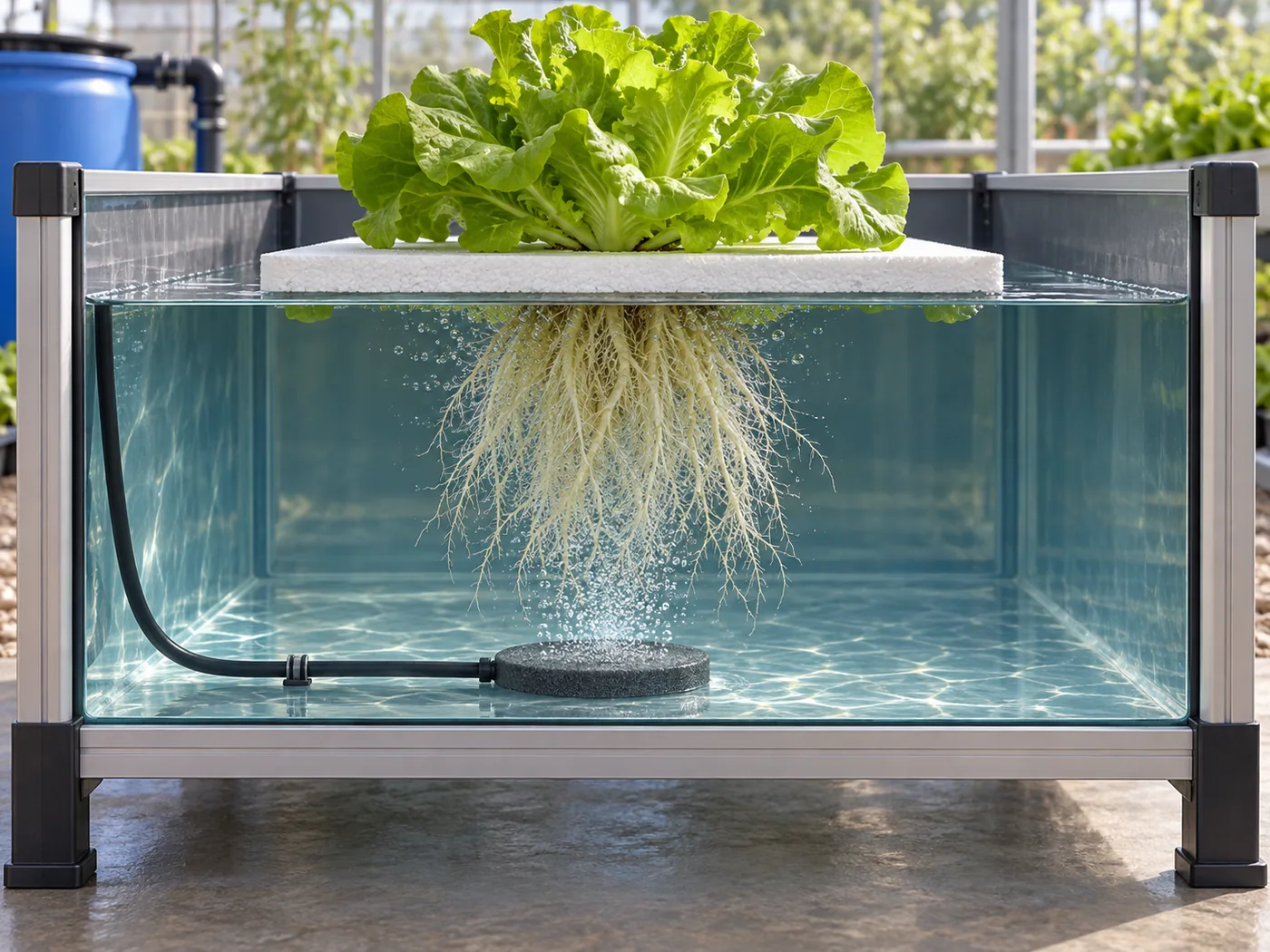
Root clearance is the distance below the raft to the trough floor. It is less than measured water depth because rafts and net pots project into the water; roots, air lines and diffusers share this space.
Raft thickness
Raft thickness is selected for buoyancy, stiffness, plant load, durability and handling. It does not determine trough water depth. Specify the exact material, density, food-production suitability, hole pattern, edge quality and cleaning procedure. Some systems use non-floating panels supported above the water, which creates a different relationship between net pots and operating level.
What Published Guidance Shows
Virginia Cooperative Extension’s DWC production guide describes production ponds ranging from approximately 4–12 inches in depth and notes the historical use of 6–8-inch raceways. It emphasizes that DWC installations vary and should be selected for the production scheme. That variation is why one number from a product listing should not be treated as a universal aquaponics requirement.
A New Zealand Ministry of Foreign Affairs and Trade aquaponics report documents floating-raft troughs in a shallower range in some applications. Such examples show that floating-raft cultivation can function at different depths; they do not prove that the shallowest example is best for a different crop, climate or commercial workflow.
For a buyer, the useful question is not “Which source is correct?” It is “What functions must this proposed depth deliver, and how will the supplier prove them at the operating conditions in our project?”
Why 10–12 Inches Is a Common Starting Point
Root volume and separation
Leafy-green roots need room to extend without compressing against the floor. Extra depth alone does not prevent roots tangling around air lines, outlets or neighboring plants.
The selected crop and harvest age matter. Baby-leaf production, full-size lettuce, basil and larger fruiting crops have different root and support needs. DWC is frequently used for organized leafy-green production, as discussed in our guide to the best aquaponics systems for indoor leafy greens. Fruiting crops may require trellising, longer cycles and nutrient management that depth alone does not solve.
Thermal and water-quality stability
More water per square metre changes temperature and chemistry more slowly, but it also takes more energy to heat or cool. Calculate seasonal heat gain and loss rather than treating depth as free climate control. Our guide on heating aquaponics water safely explains why insulation comes before heater selection.
Space for circulation and aeration
A practical depth provides clearance for circulation and removable diffusers. Deeper water increases diffuser back pressure, and visible bubbles do not prove uniform oxygen beneath mature rafts.
Construction practicality
A 10–12-inch water depth is compatible with many raised trough frames and typical standing crop workflows. The final top-of-raft working height must still suit planting, inspection and harvest. A structurally deep trough installed too high can create an ergonomic problem even if the water conditions are acceptable.
When a Shallower Trough May Work
A shallower DWC zone may suit a small educational installation, short-rooted crop, limited structural height or design in which water turnover and aeration are carefully controlled. It can reduce water volume and wall pressure. It can also warm and cool more quickly, lose usable depth after small level changes and leave less clearance beneath net pots.
Before approving a shallow design, ask:
- Will mature roots touch the floor or block water movement?
- Does the operating level remain stable after evaporation and filter cleaning?
- Can diffusers be removed without lifting an entire crop zone?
- Will the shallow volume overheat under lights or sun?
- Is there enough freeboard to prevent splash and overflow?
- Does the outlet maintain uniform depth across the full trough?
- What happens to roots during a pump or aeration outage?
A pilot trough should be operated through at least one representative crop cycle before duplicating a shallow geometry across a commercial greenhouse.
When a Deeper Trough May Be Justified
Additional depth can add volume and root clearance, but it needs a defined purpose. Compare any benefit with:
- greater water and structural load;
- higher liner and frame requirements;
- increased filling and conditioning time;
- greater diffuser back pressure;
- harder access to the floor and fittings;
- higher energy if the extra water must be heated or cooled;
- more water affected if a liner or fitting fails.
Deepening a trough does not replace a correctly sized fish tank, biofilter or sump, and extra water does not automatically increase nutrient supply.
Water Flow Matters as Much as Depth
Uniform depth can conceal poor movement. Water may short-circuit from inlet to outlet while corners and areas beneath mature roots receive little exchange. Long, wide troughs need an inlet and outlet arrangement that distributes treated water without damaging roots or creating inaccessible deposits.
Ask for design flow, inlet geometry, outlet-screen area and the method used to check flow after roots mature. Avoid one small outlet that a root mat can block, and provide overflow and isolation for cleaning.
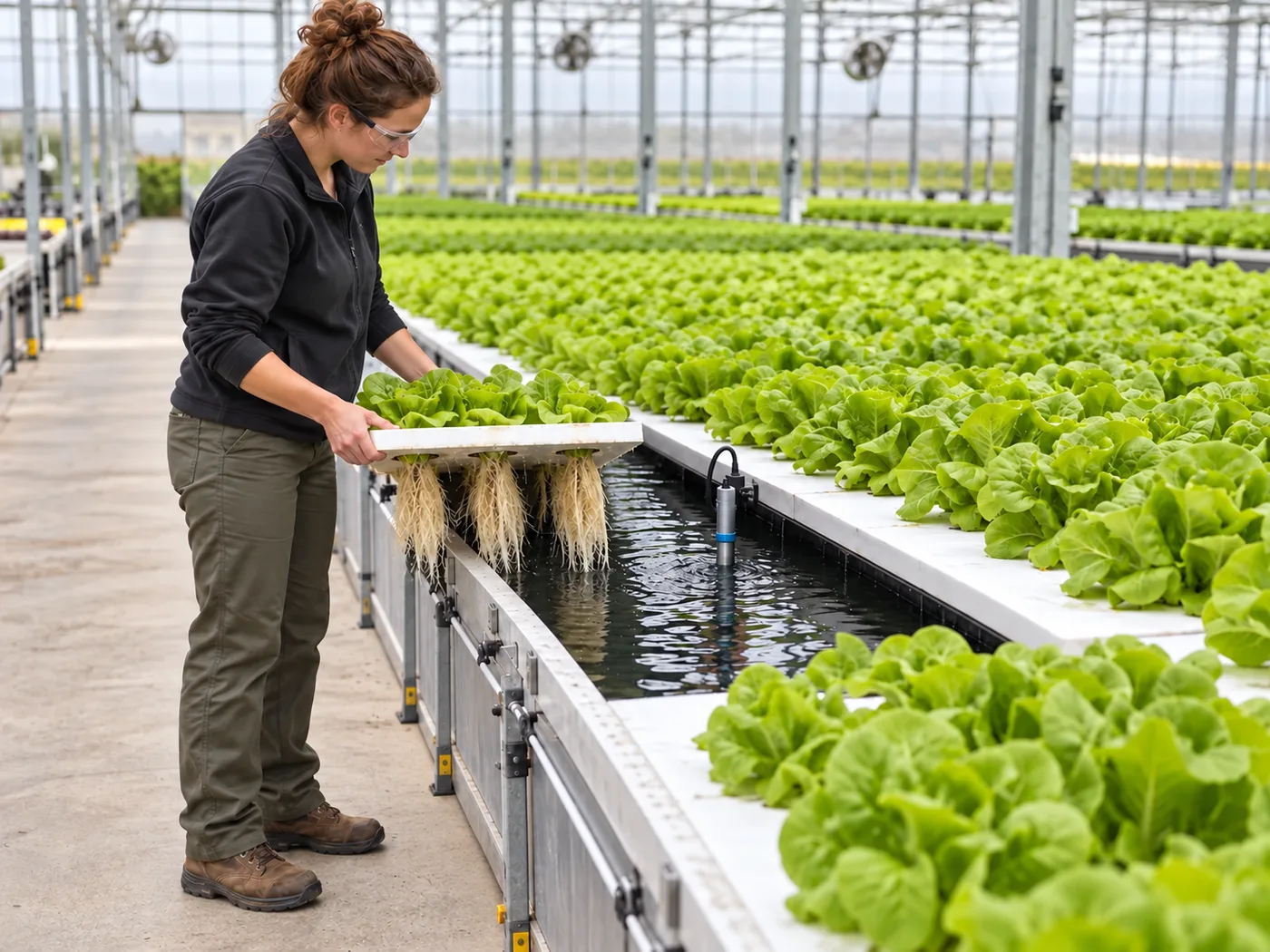
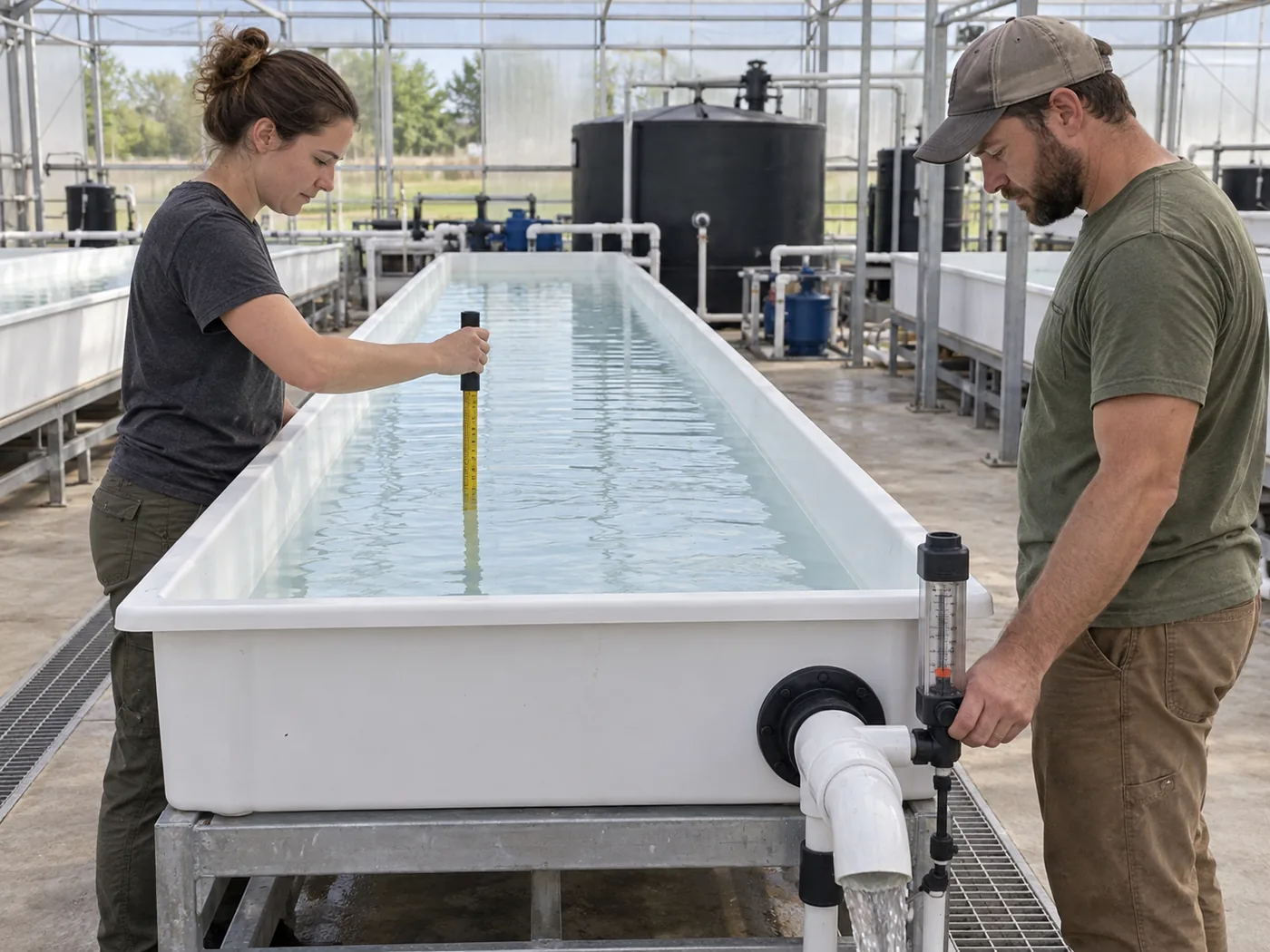
During commissioning, measure actual pump flow at the installed head and observe water level along the entire trough. A level floor is critical; a small construction slope can leave one end shallow and the other near overflow. Record depth at several points rather than checking only beside the outlet.
Solids Management Protects the Root Zone
DWC is not a settling basin. Fish waste and excess biofilm that reach the trough can coat roots, consume oxygen and collect on the floor. Upstream mechanical treatment should match feed input and desired root-zone cleanliness. A screen or fine-solids stage may help when properly selected and maintained; our guide to screen filters in aquaponics explains the trade-offs.
Depth does not remove the need for treatment. Provide a smooth accessible floor, suitable drain or cleaning route and enough raft modularity to inspect representative areas.
Do not drain nutrient-rich waste to a storm system or natural waterway. Include lawful capture or reuse in installation preparation. Where food crops are involved, cleaning tools and procedures should be documented and kept separate from general-purpose chemical equipment.
Aeration and Dissolved Oxygen
Plant roots and beneficial microorganisms consume oxygen. Warm water holds less dissolved oxygen, and mature roots can interfere with circulation around diffusers. The design should define target monitoring locations and action limits appropriate to the crop, fish and biological treatment—not merely the number of air stones per square metre.
Place diffusers for removal, protect air lines and balance manifold branches. Blower selection must account for depth, tube length and diffuser resistance.
Treat root-zone aeration and fish-tank life support as connected but distinct duties. A blower failure may affect both, so redundancy, alarms and response time need a whole-system review. The aquaponics aeration-system guide provides a broader equipment and backup framework.
Mid-article CTA — Ask for a DWC Specification Checklist
Planning a floating-raft zone? Send YAFAN your trough dimensions, crop plan, available space, climate and system flow diagram. We can help organize the information needed for a more useful equipment inquiry.
Structural Load and Material Selection
Water weighs approximately one kilogram per litre. A 30 cm-deep trough covering 20 m² contains about six tonnes of water at full rectangular volume, showing why floor and frame review cannot be postponed.
Use materials compatible with recirculating aquaculture and food production. Flexible liners need underlayment or a smooth protected surface, correct corner installation and fittings designed for the membrane. Rigid HDPE, fiberglass or other tanks need wall thickness and bracing appropriate to size and support.
Avoid unverified recycled plastic, treated wood in wetted contact and coatings with unclear immersion suitability. Request material identity; local professionals should confirm floor, frame and anchoring.
Working Height, Width and Raft Handling
Depth cannot be selected separately from access. Confirm finished working height, reach to the center and the route for moving planted rafts. Modules should be small enough to lift safely. Keep aisles dry and never require workers to stand in the trough or step on rafts. Manage gaps and unused holes with approved covers to limit light and algae.
Connect Trough Depth to Total System Volume
Every centimetre of depth adds water across the full footprint. Include that volume when selecting pumps, water treatment, heating or cooling and make-up-water preparation.
The sump should not be expected to hold the full DWC trough during routine shutdown. Set outlets and standpipes so the trough retains its intended level, then calculate only the credible drain-down from pipes, filters and the portion above overflow level. Provide containment for major leaks separately; a sump is not a substitute for floor drainage and emergency planning.
When comparing suppliers, ask each to state:
- structural trough depth and normal water depth;
- total trough volume at operating level;
- raft thickness, dimensions, material and plant-hole pattern;
- inlet, outlet, overflow and drain elevations;
- design flow and pump duty;
- solids-treatment sequence;
- aeration equipment and diffuser layout;
- cleaning and raft-handling method;
- liner or tank material specification;
- site work and structural items excluded from supply.
Factory Testing, Shipping and Site Commissioning
Factory testing can verify pumps, blowers, valves, sensor outputs and a representative assembled module where practical. It cannot prove a long site-built trough is level or that local joints and liners do not leak. Agree on what the supplier tests and what the installation contractor must verify.
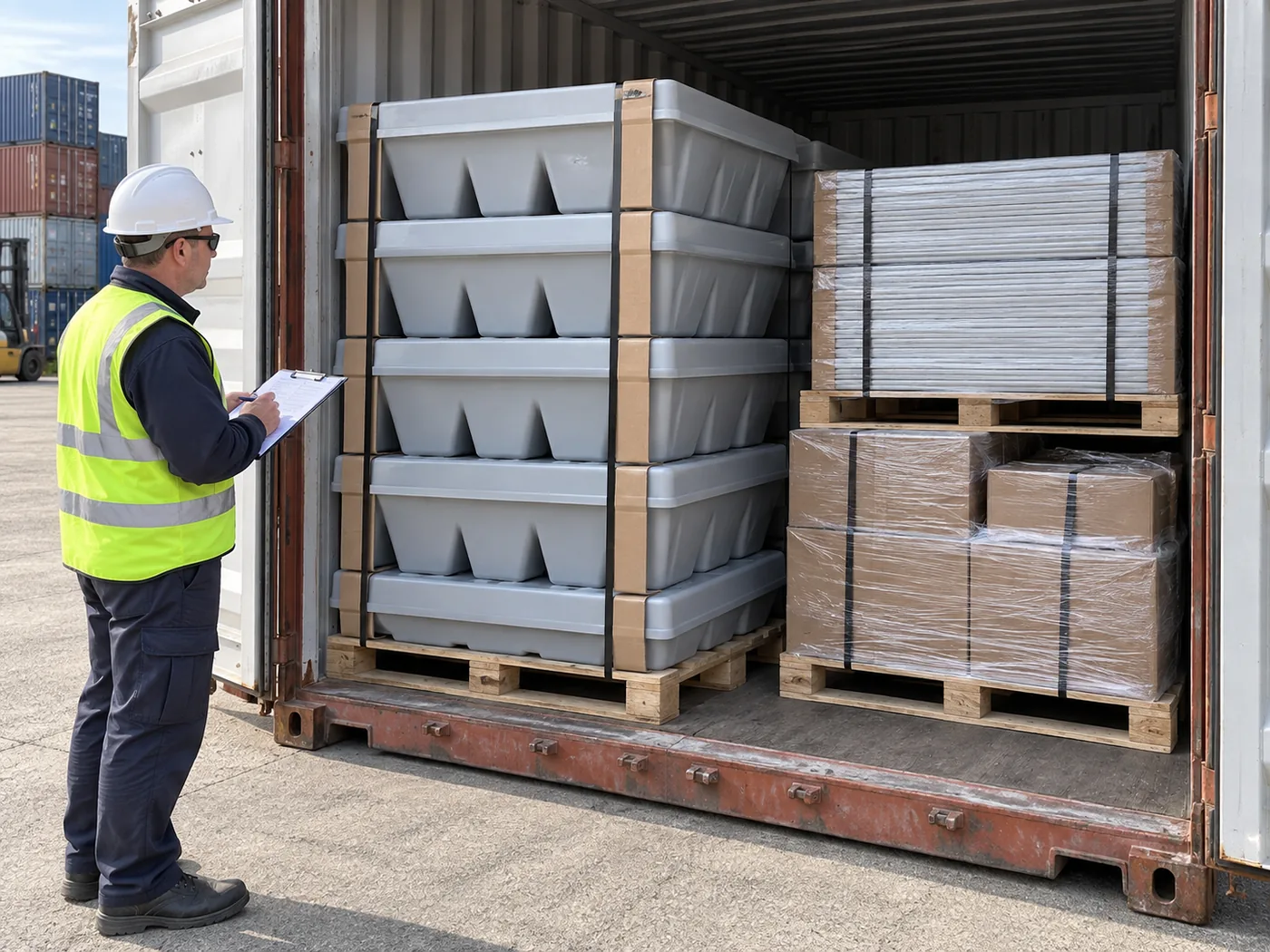
During shipment inspection, check rigid trough modules or rolled liner material for punctures, crushing, UV exposure and missing fittings. Verify raft quantity, hole pattern, edge condition and packaging. Aquaponics equipment shipped in a container should be dry and empty: no fish, water or living crops should appear inside tanks or grow modules during transport.
At site, commission in stages:
1. Confirm supports, dimensions and finished elevations.
2. Inspect and clean the trough without unapproved chemicals.
3. Fill partially and check corners, penetrations and floor settlement.
4. Fill to operating level and mark depth at several locations.
5. Test normal flow, pump-off behavior, drain and emergency overflow.
6. Balance diffuser zones and verify root-zone oxygen at representative points.
7. Run filtration and cycling before full biological load.
8. Introduce crops and fish gradually under the approved operating plan.
Retain drawings and test records, then repeat depth and flow checks after roots mature.
Common Design Mistakes
Confusing wall height with water depth
A 30 cm wall cannot safely provide 30 cm of operating water if freeboard and fitting tolerances are required.
Selecting the shallowest possible trough to save cost
Reduced wall material may create higher temperature fluctuation, tighter level control and inadequate root or diffuser clearance.
Ignoring mature roots
Commissioning with empty rafts cannot demonstrate flow through a mature root zone. Inspect and measure during production.
Allowing solids to settle beneath rafts
More depth does not neutralize fish waste. Use suitable upstream filtration and a cleaning route.
Copying a hydroponic design without fish-loop review
Aquaponics adds fish waste, biofiltration, animal-welfare and shared-water constraints. Hydroponic dimensions can inform a concept but do not establish complete compatibility.
FAQ
Is 12 inches deep enough for an aquaponics raft bed?
It is a common practical starting depth for leafy-green DWC systems, provided root space, flow, aeration, solids control, structure and freeboard are correctly designed. It is not an automatic specification for every crop or site.
Can a floating raft trough be only 6 inches deep?
Some shallow systems operate successfully, but the reduced water volume and root clearance create tighter limits. Validate temperature, oxygen, level stability, root growth and cleaning through a representative trial.
Does deeper water improve dissolved oxygen?
Not by itself. Deeper water adds volume but also increases diffuser pressure requirements. Oxygen depends on biological demand, temperature, airflow, diffuser performance, circulation and surface exchange.
How much freeboard should a DWC trough have?
Freeboard must cover normal level variation, flow imbalance, raft displacement, wave action and overflow protection. Determine it from the actual geometry and commissioning test rather than applying one universal number.
Should the floating raft touch the water?
A true floating raft is supported by the water surface. Seedling plug and net-pot position should keep young roots appropriately connected to moisture and oxygen. Some systems use fixed panels above water instead, which requires its own level specification.
Can fish live under the plant rafts?
Commercial aquaponics normally separates fish culture from the DWC plant trough so solids, feeding, capture and animal welfare can be managed properly. Combining them creates different risks and should not be assumed from a decorative demonstration system.
Conclusion
For many aquaponics floating-raft projects, approximately 10–12 inches of operating water is a sensible design-review starting point, while successful systems exist outside that range. Choose the final depth from crop roots, water stability, aeration, flow, solids control, structure, working height and total system volume.
The most credible proposal states both physical trough depth and normal operating depth, explains why they suit the project and shows how performance will be tested after installation. Depth is one part of a DWC production system; filtration, oxygen, access and operating discipline determine whether that water volume becomes a healthy root zone.
Final CTA — Send Your Floating-Raft Requirements
Contact YAFAN with your available area, proposed trough dimensions, target crop, climate, water source and fish plan. We can help structure an equipment inquiry and installation-preparation checklist for your project.

